
Shilpa Sailesh v. Varun Sreenivasan: Article 142 and the Recognition of Irretrievable Breakdown of Marriage
Author: SANIKA DEHURY
Student, National Law University, Odisha, city- Cuttack
—————————————————————————————–
💡 3 Quick Takeaways
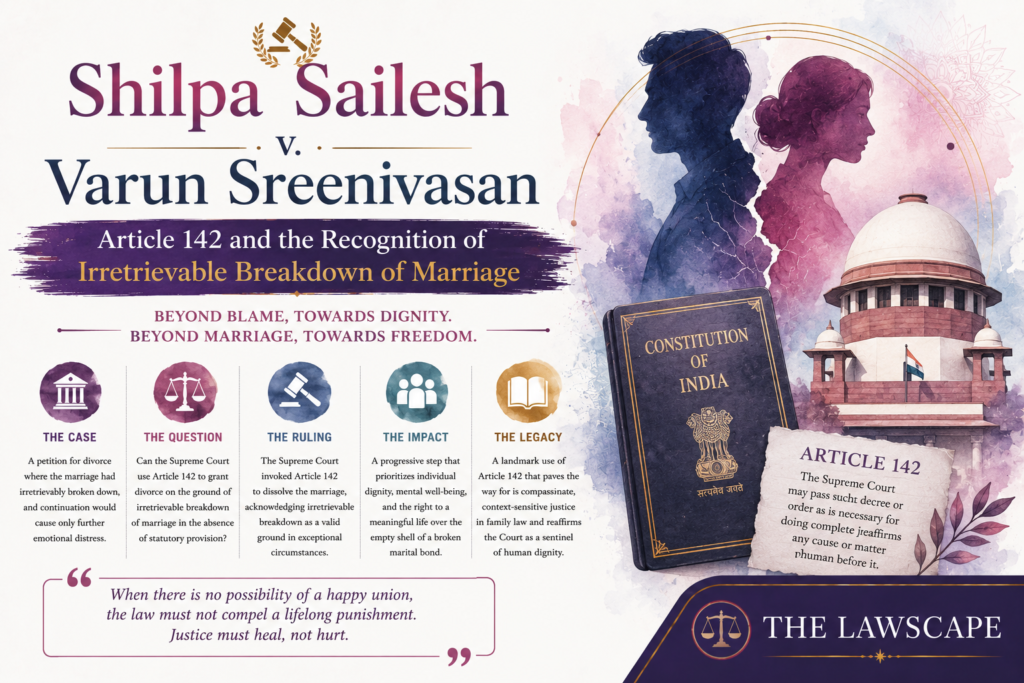
- Shilpa Sailesh v. Varun Sreenivasan clarifies that the Supreme Court may, in appropriate cases, use Article 142 to dissolve a marriage on the ground of irretrievable breakdown even though it is not a statutory ground under the Hindu Marriage Act, 1955.
- The judgment confirms that the six-month cooling-off period under Section 13B(2) of the Hindu Marriage Act may be waived where insisting on it would only prolong hardship and serve no meaningful purpose.
- While the decision advances substantive justice in matrimonial disputes, it also raises important concerns regarding judicial overreach, legislative silence, and the absence of clear standards for determining irretrievable breakdown of marriage.
Introduction
Marriage occupies a significant place in Indian society and is governed by a wide framework of personal and statutory laws. Yet, where a marriage has broken down beyond repair, strict adherence to procedural and statutory requirements may sometimes prolong the suffering of both parties rather than alleviate it. The Supreme Court’s decision in Shilpa Sailesh v. Varun Sreenivasan addresses this tension between statutory matrimonial law and the Court’s constitutional duty to do “complete justice.”
The case concerned the scope of Article 142 of the Constitution of India, which empowers the Supreme Court to pass such orders as may be necessary for doing complete justice in any cause or matter pending before it. The Court was called upon to determine whether it could waive the statutory six-month waiting period prescribed under Section 13B(2) of the Hindu Marriage Act, 1955, and whether it could dissolve a marriage on the basis of irretrievable breakdown even though that ground is not expressly recognised under the Act. The judgment is of considerable significance for matrimonial law in India because it sits at the intersection of judicial discretion, constitutional power, and legislative design.
Facts of the Case
Mr. Varun Sreenivasan and Ms. Shilpa Sailesh were married in accordance with Hindu customs and traditions on 17 February 2002 in Mumbai. After their marriage, they shifted to Thiruvananthapuram, Kerala. Owing to marital discord, they began living separately in 2007, and there appeared to be no realistic possibility of reconciliation thereafter.
In 2010, Mr. Varun filed a divorce petition before the Family Court at Thiruvananthapuram on the ground of cruelty. He alleged, among other things, that Ms. Shilpa had compelled him to sever ties with his family and had behaved disrespectfully towards them. At the same time, multiple legal proceedings were pending between the parties in different courts in Kerala. Ms. Shilpa initiated proceedings under Section 125 of the Code of Criminal Procedure seeking maintenance, and criminal proceedings under Section 498A of the Indian Penal Code were also instituted in connection with the matrimonial dispute.
During the course of these proceedings, the parties agreed to dissolve their marriage by mutual consent under Section 13B of the Hindu Marriage Act, 1955. In 2014, they entered into a settlement agreement under which Mr. Varun agreed to pay Ms. Shilpa a sum of ₹50 lakhs, and all claims between them were to stand resolved. The matter ultimately reached the Supreme Court, which considered broader questions regarding the scope of Article 142 and the extent to which the Court could waive the cooling-off period or grant divorce on the basis of irretrievable breakdown of marriage. On 1 May 2023, a Constitution Bench delivered its landmark judgment on these issues.
Issues Framed
The principal questions before the Court were as follows:
- Whether the Supreme Court can use its powers under Article 142 to grant relief beyond statutory provisions in order to do “complete justice.”
- Whether the six-month waiting period prescribed under Section 13B(2) of the Hindu Marriage Act can be waived.
- Whether the Supreme Court can, in exercise of its powers under Article 142, grant a divorce on the ground of irretrievable breakdown of marriage even in the absence of consent from one spouse.
Arguments
Petitioner’s Arguments
The petitioner contended that Article 142 confers wide powers upon the Supreme Court to dissolve a marriage in order to do complete justice between the parties. Reliance was placed on Amardeep Singh v. Harveen Kaur and Amit Kumar v. Suman Beniwal to argue that the Court could waive the six-month cooling-off period prescribed under Section 13B(2) of the Hindu Marriage Act.
It was further argued that the statutory waiting period serves no useful purpose where the marriage has already broken down irretrievably and there is no prospect of reconciliation. In such cases, insisting upon the waiting period merely increases mental agony and prolongs hardship for both parties.
The petitioner also submitted that the marriage had completely failed and there was no possibility of revival. Therefore, the Supreme Court, acting under Article 142, ought to be able to dissolve the marriage even though irretrievable breakdown is not expressly recognised as a ground for divorce under the Hindu Marriage Act. In support of this position, reliance was placed on Naveen Kohli v. Neelu Kohli and Ashok Hurra v. Rupa Bipin Zaveri.
Respondent’s Arguments
The respondent argued that irretrievable breakdown of marriage is not a ground for divorce under the Hindu Marriage Act, 1955, and that recognising it as such through judicial intervention would amount to judicial legislation, a function properly belonging to Parliament.
It was also contended that the six-month waiting period under Section 13B(2) is mandatory because it is designed to provide the parties with an opportunity to reconsider their decision and explore the possibility of reconciliation. Routinely waiving this requirement, it was argued, would defeat the legislative object underlying the provision.
Finally, the respondent submitted that although Article 142 empowers the Supreme Court to do complete justice, that power cannot be exercised in a manner that completely displaces substantive statutory law. The respondent relied on decisions such as I.C. Golak Nath v. State of Punjab and Union Carbide v. Union of India to argue that Article 142 must be exercised within constitutional limits and in harmony with statutory provisions.
Critical Analysis
The significance of Shilpa Sailesh v. Varun Sreenivasan lies in the Court’s expansive understanding of Article 142 and its willingness to use that provision to address practical deficiencies in matrimonial law. The Supreme Court recognised that in exceptional cases, where a marriage has irretrievably broken down and there is no possibility of reunion, it would be unjust to compel parties to remain tied to a legal relationship that has ceased to exist in substance. In that sense, the judgment reflects a humane and pragmatic approach to matrimonial disputes.
From a practical perspective, the reasoning is compelling. Where parties have been separated for years and are engaged in multiple rounds of litigation, insisting on the continuation of a failed marriage may only intensify emotional distress, financial hardship, and legal uncertainty. The waiver of the cooling-off period in such circumstances prevents the law from becoming an instrument of further suffering. The Court’s use of Article 142 may therefore be viewed as an attempt to ensure that constitutional justice remains responsive to the realities of matrimonial conflict.
At the same time, the judgment raises serious concerns regarding the limits of judicial power. Irretrievable breakdown of marriage is not one of the grounds for divorce enumerated under Section 13 of the Hindu Marriage Act. By granting divorce on that basis under Article 142, the Court has effectively supplied a ground that Parliament has not yet formally incorporated into the statute. This gives rise to the charge of judicial overreach, particularly because matrimonial law is an area in which legislative policy choices are often deliberate and closely contested.
Another concern is the absence of a clear and objective standard for determining when a marriage has irretrievably broken down. While the Court emphasised that Article 142 should be invoked only in rare and extraordinary cases, the judgment does not establish a rigid framework for identifying such cases. This leaves considerable room for subjectivity in future decisions. Without clear parameters, different benches may apply different thresholds in deciding whether a marriage is beyond repair, thereby risking inconsistency and unpredictability.
The ruling also exposes a larger disconnect between existing statutory law and social reality. Law reform bodies have, for many years, recommended that irretrievable breakdown of marriage be formally recognised as a statutory ground for divorce. The present judgment underscores the urgency of that reform. If the legislature were to incorporate irretrievable breakdown into the Hindu Marriage Act, along with carefully defined safeguards and objective criteria, it would provide a more stable and transparent framework than reliance on Article 142 alone.
Further, allowing dissolution of marriage even without the consent of one spouse may weaken the legislative design underlying Section 13B of the Hindu Marriage Act, which is structured around mutual consent. Although the Court attempted to balance equity and judicial restraint, the decision demonstrates the limitations of relying on constitutional discretion in the absence of statutory reform. It is one thing for the Court to do justice in an exceptional case; it is another to leave an entire area of matrimonial relief dependent on the uncertain boundaries of judicial power.
Conclusion
Shilpa Sailesh v. Varun Sreenivasan is a significant development in Indian matrimonial jurisprudence. It confirms that the Supreme Court may, in exceptional circumstances, invoke Article 142 to dissolve a marriage on the ground of irretrievable breakdown and waive the six-month cooling-off period under Section 13B(2) of the Hindu Marriage Act where doing so is necessary to achieve complete justice.
The decision is important because it recognises that rigid adherence to statutory procedure may, in some cases, defeat the very purpose of justice by forcing parties to remain in a dead marriage. At the same time, it highlights the continuing tension between judicial discretion and legislative authority. Since irretrievable breakdown of marriage is still not a statutory ground for divorce, reliance on Article 142 inevitably raises questions about judicial overreach, doctrinal uncertainty, and inconsistency in application.
Ultimately, the judgment serves both as a practical solution to an immediate legal problem and as a reminder of the need for legislative reform. If matrimonial law is to respond effectively to the realities of broken marriages, Parliament must consider formally incorporating irretrievable breakdown as a ground for divorce and provide a clear statutory framework for its application. Until then, Shilpa Sailesh will remain an important but contested example of the Supreme Court’s constitutional power to do complete justice in the face of legislative silence.
Disclaimer: The views expressed in this article are those of the author and do not necessarily reflect the views of The Lawscape.
The Lawscape — clear, practical legal insight for students and future lawyers.