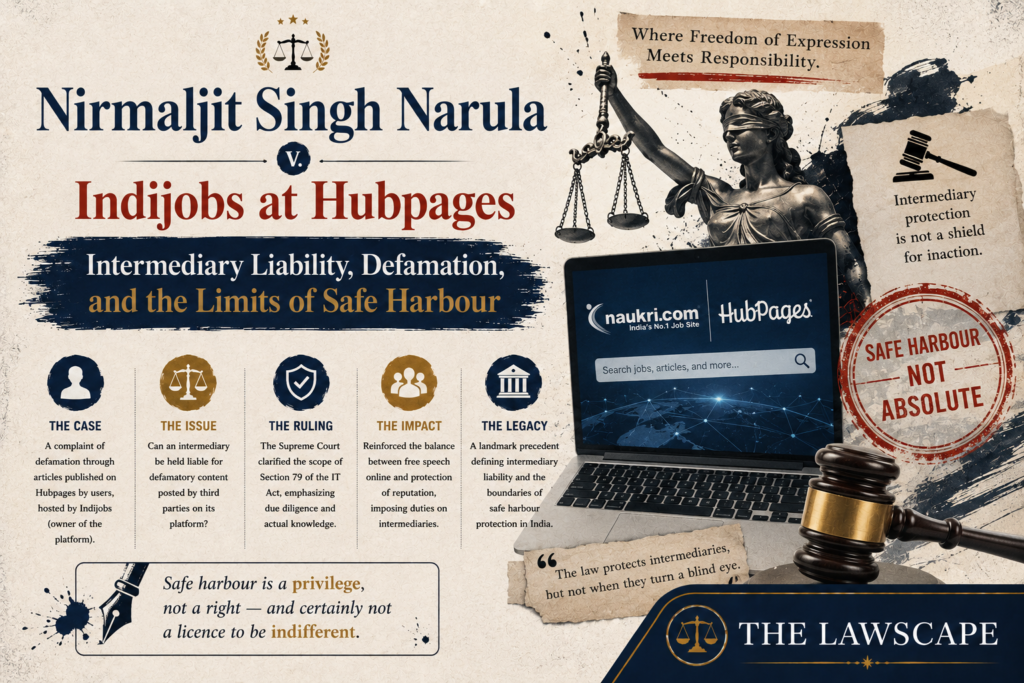
Nirmaljit Singh Narula v. Indijobs at Hubpages: Intermediary Liability, Defamation, and the Limits of Safe Harbour
Author: Vinayak S
Student, Prof. NR Madhava Menon Interdisciplinary Centre for Research Ethics and Protocols- CUSAT, Ernakulam
———————————————————————————
💡 3 Quick Takeaways
- The Delhi High Court treated an intermediary’s failure to remove allegedly defamatory content after notice as sufficient to deny safe harbour protection under Section 79 of the IT Act, 2000.
- The decision broadened the meaning of “actual knowledge” by treating private notice as a trigger for takedown obligations, a position later overturned in Shreya Singhal v. Union of India.
- The case remains an important early milestone in Indian intermediary liability jurisprudence, especially in the context of digital defamation and platform accountability.
Nirmaljit Singh Narula v. Indijobs at Hubpages
CS (OS) No. 871/2012
Court and Bench: High Court of Delhi, Ordinary Original Civil Suit, Single Judge Bench comprising Hon’ble Mr. Justice Manmohan Singh
Date of Judgment: 30 March 2012
Parties:
Petitioner: Nirmaljit Singh Narula alias Nirmal Baba, a renowned spiritual leader
Respondents: Indijobs, a registered hubber on Hubpages, and Hubpages, the intermediary platform
Facts
Indijobs was a registered hubber on the online platform Hubpages, where users posted articles under a commercial arrangement with the platform. Under this arrangement, revenue generated primarily through advertising was divided between the hubber and Hubpages, with 60% going to the hubber and 40% to the intermediary.
The dispute arose when Defendant No. 1, Indijobs, published an allegedly false and defamatory article on Hubpages concerning the plaintiff, Nirmaljit Singh Narula, popularly known as Nirmal Baba. The plaintiff was a highly revered spiritual guide known for his teachings and guidance offered through assemblies called Samgams, and he had a large following in India and abroad.
The impugned article, published under the title “Nirmal Baba a Fraud?”, alleged that the plaintiff was a fraud and used Vashikaran Mantra—described as black magic or psychological manipulation—to deceive gullible followers for monetary gain. According to the plaintiff, these allegations mocked his teachings, harmed his reputation, and caused serious damage to his standing among followers and the public.
After learning of the publication, the plaintiff sent a notice to Hubpages on 29 November 2011 requesting that the article be taken down and that the contact details of Defendant No. 1 be disclosed. By reply dated 1 December 2011, Hubpages declined the request on the ground that the publication reflected a mere difference of opinion and that it was not liable for content posted by Defendant No. 1. Even after a devotee separately emailed the intermediary stating that the article contained defamatory remarks and should be removed, the intermediary did not act on the request.
Issues
The court considered the following issues:
- Whether an intermediary is required to take down an article upon receiving notice that it contains defamatory content.
- Whether the intermediary can be held liable for allegedly defamatory material published on its platform.
Arguments
Petitioner’s Arguments
The petitioner submitted additional articles written by Defendant No. 1 and published on Hubpages, contending that they also contained derogatory and defamatory remarks. The plaintiff further relied upon Clause 4 of the intermediary’s terms and conditions, as well as the support materials and FAQ section of its website, to argue that Hubpages had a duty to remove malicious content and prevent the publication of defamatory statements against individuals. Clause 4 also reserved to the intermediary the right to delete a user’s account for any reason.
Counsel for the plaintiff argued that, in view of these contractual terms and the conduct of the intermediary, Hubpages was liable for breach of its obligations under Section 79(3)(b) of the Information Technology Act, 2000, because it failed to remove unlawful content despite receiving notice from the affected party. It was also contended that the intermediary had failed to observe due diligence and had knowingly continued to host unlawful information, contrary to Rule 3(2) read with Rule 3(3) of the relevant intermediary guidelines.
The plaintiff additionally argued that Hubpages conducted business in India and targeted an Indian audience. Therefore, Indian courts had jurisdiction over the matter and the intermediary was answerable under Indian law.
Judgment
The Delhi High Court held that the plaintiff had made out a prima facie case for the grant of interim relief and had demonstrated irreparable injury. Accordingly, the Court passed an ex parte ad interim injunction restraining Defendant No. 1, the intermediary, and their agents, employees, attorneys, and others acting on their behalf from writing, publishing, hosting, advertising, or otherwise disseminating any defamatory content concerning the plaintiff, whether existing or future, on Hubpages or on any associated websites or media platforms.
The Court further directed that such content be removed within 36 hours from the time the order was served. It also stated that, in the event of non-compliance, the intermediary could be banned from public access in India.
Ratio Decidendi
This case is significant for several reasons.
First, it marked an important stage in the development of the concept of “actual knowledge” under Indian intermediary liability law. The Court adopted a broad understanding of the term and suggested that even a notice from a private individual could trigger an intermediary’s obligation to examine the content carefully and remove unlawful material in order to retain the protection of safe harbour under Section 79 of the IT Act. In effect, the intermediary was expected to exercise due diligence upon receipt of a private complaint. However, this approach created serious concerns because it effectively placed private intermediaries in the position of adjudicating the legality of online speech. As a result, the protection of free expression risked becoming dependent on the discretionary judgment of a private platform rather than remaining a constitutional right. This position was later overturned by the Supreme Court in Shreya Singhal v. Union of India, which clarified that “actual knowledge” under Section 79 arises only when a court order or a notice from an authorised government agency is received.
Secondly, the Court appeared to find that the intermediary’s commercial arrangement with the content creator and its role in publishing the article prima facie undermined its claim to passivity. This aspect of the ruling suggested that the intermediary was not merely a passive host but had a degree of active participation sufficient to weaken its safe harbour protection. At the same time, this reasoning raises broader concerns for internet-based business models. The fact that a platform earns revenue through automated advertising linked to user traffic does not necessarily mean that it actively controls or endorses all content published on it. Intermediaries often function as facilitators rather than publishers in the traditional sense, even though they may impose content restrictions in accordance with law.
Thirdly, the Court’s warning that the intermediary could be banned in India in the event of non-compliance reflects a strong emphasis on protecting the rights and reputation of citizens over the commercial interests of private digital platforms. From one perspective, this demonstrates judicial willingness to ensure that intermediaries operating in India remain accountable to domestic legal standards. From another, it also reflects the aggressive and uncertain approach of early Indian cyber jurisprudence before clearer statutory and constitutional standards were laid down.
Conclusion
The Delhi High Court’s decision in Nirmaljit Singh Narula v. Indijobs and Ors. highlights the early challenges faced by Indian courts in dealing with intermediary liability and digital defamation. By granting an ex parte ad interim injunction and threatening to ban the intermediary in the event of non-compliance, the Court made it clear that a foreign intermediary could not profit at the expense of an Indian citizen’s reputation while claiming the protection of passivity.
At the same time, the judgment’s treatment of “actual knowledge” became one of its most controversial features. By treating private notice as a sufficient trigger for takedown obligations, the ruling risked converting free speech on online platforms into a matter of platform discretion rather than a legal right protected by constitutional standards. In that sense, while the case successfully protected the plaintiff’s reputation at the interim stage, it also exposed the dangers of placing censorship powers in the hands of private intermediaries without adequate judicial oversight.
Ultimately, the case serves as an important historical stepping stone in the evolution of Indian cyber law. The legal tension it generated was resolved three years later in Shreya Singhal v. Union of India (2015), where the Supreme Court clarified that takedown obligations arise only upon a court order or notification from a competent government authority. Today, the significance of the Nirmal Baba case lies less in its private-notice rule and more in the broader principle it advanced: digital platforms operating in India cannot remain indifferent to unlawful content and must balance their commercial models with a legally enforceable duty of care toward users.
Disclaimer: The views expressed in this article are those of the author and do not necessarily reflect the views of The Lawscape.
The Lawscape — clear, practical legal insight for students and future lawyers.