
National Legal Services Authority v. Union of India: Constitutional Recognition of Transgender Rights in India
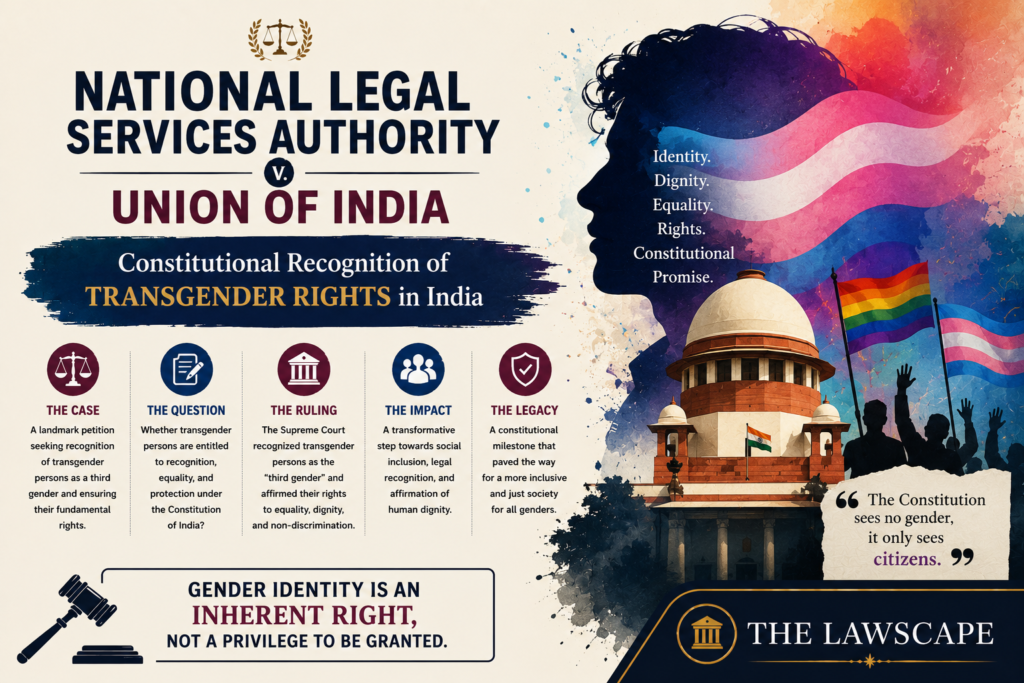
Author: Devika Krishna s
Student, REE NARAYANA GURU college of Legal studies
————————————————————————–
💡 3 Quick Takeaways
- The Supreme Court in National Legal Services Authority v. Union of India formally recognized transgender persons as a “third gender” under Indian law.
- The judgment held that gender identity is protected under Articles 14, 15, 16, 19, and 21 of the Constitution, thereby affirming dignity, equality, and personal autonomy for transgender persons.
- The Court directed the Central and State Governments to treat transgender persons as socially and educationally backward classes and to take affirmative measures for their welfare and inclusion.
Introduction
National Legal Services Authority v. Union of India is a landmark judgment in Indian constitutional law and human rights jurisprudence. The case marked a historic step in the recognition of the rights of transgender persons in India and affirmed that gender identity forms an integral part of dignity, liberty, and equality under the Constitution. The judgment is significant because it moved beyond the traditional male-female binary and recognized transgender persons as a distinct “third gender” entitled to full constitutional protection.
The Supreme Court, through this decision, addressed the long-standing discrimination, exclusion, and social marginalization faced by the transgender community. The judgment not only recognized their right to self-identify their gender but also directed the government to frame measures for their social, educational, and economic upliftment.
Court and Bench
Court: Supreme Court of India, Writ Jurisdiction
Bench: Justice K. S. Radhakrishnan and Justice A. K. Sikri
Date of Judgment: 15 April 2014
Parties
Petitioner: National Legal Services Authority (NALSA), a statutory body constituted under the National Legal Services Authority Act, 1985
Respondent: Union of India
Facts of the Case
The National Legal Services Authority, a statutory body established under the National Legal Services Authority Act, 1985, filed a public interest litigation before the Supreme Court to address the concerns of the transgender community in India. During the proceedings, Lakshmi Narayan Tripathi and Poojaya Mata Nasib Kaur Ji Women Welfare Society also joined the petition to support the cause of transgender rights.
The petition highlighted that members of transgender communities—including Hijras, eunuchs, Kothis, and other groups—were facing severe discrimination and social exclusion in various aspects of life. They were denied equal access to employment, healthcare, education, and official documentation. The petition also pointed to the harassment, abuse, and humiliation suffered by transgender persons in daily life. The central grievance was that transgender persons were neither adequately recognized in law nor provided meaningful protection under constitutional and statutory frameworks.
Issues Before the Court
The Supreme Court considered two principal issues:
- Whether a person born as a male with a predominantly female orientation, or vice versa, has the right to be recognized as female or male according to their choice, particularly after undergoing sex reassignment procedures.
- Whether transgender persons who do not identify strictly as male or female have the right to be recognized and categorized as a third gender.
Arguments of the Parties
Petitioner’s Arguments
The petitioner argued that transgender identity has historically been recognized in Indian society, mythology, and cultural traditions, and that the marginalization of transgender persons was a result of social and legal prejudice rather than any legitimate constitutional distinction. It was submitted that the non-recognition of gender identity violated the fundamental rights guaranteed under the Constitution. The petitioner emphasized that transgender persons have the right to determine their own gender identity and sexual orientation, and that denying them such recognition deprives them of the constitutional guarantees available to all citizens.
It was further argued that transgender persons, particularly members of the kinner community, are among the most deprived groups in society and should be declared socially and educationally backward classes entitled to affirmative action and welfare benefits. The petitioner relied on Articles 14, 15, 16, and 21 of the Constitution and contended that the State cannot discriminate on the basis of gender identity. It was also submitted that international developments, including recognition by United Nations bodies and the Yogyakarta Principles, support legal recognition of transgender identity and protection against discrimination.
Respondent’s Arguments
The Union of India submitted that expert committees had already been set up under the Ministry of Social Justice and Empowerment to identify the issues faced by transgender persons and to suggest reforms. It was argued that transgender persons had been given due representation in governmental consultations. At the same time, the Union raised practical concerns regarding the official recognition of transgender persons as a third gender, particularly with respect to documentation, proof of identity, and administrative adjustments in public records.
Judgment
The Supreme Court delivered a landmark ruling in favour of the transgender community. The Court held that, apart from the male-female binary, transgender persons must be recognized as a “third gender” for the purpose of safeguarding their rights under Part III of the Constitution. The Court further upheld the right of transgender persons to decide their self-identified gender, whether as male, female, or third gender.
The Court directed the Central and State Governments to treat transgender persons as socially and educationally backward classes and to extend reservations in educational institutions and public employment. It also directed governments to take measures to provide proper medical care, establish separate HIV surveillance centres, and address the stigma, shame, and discrimination faced by transgender persons. In addition, the Court called for public awareness measures to ensure that transgender persons are accepted as equal members of society.
Ratio Decidendi
The Court’s reasoning was primarily grounded in the constitutional guarantees of equality, non-discrimination, freedom of expression, dignity, and personal liberty.
Article 14: Equality Before Law
The Court held that the term “person” in Article 14 is gender-neutral and includes persons who do not fall within the conventional male-female binary. Therefore, transgender persons are entitled to equal protection of the laws in all spheres of state activity.
Articles 15 and 16: Prohibition of Discrimination
The Court interpreted the expression “sex” in Articles 15 and 16 broadly to include gender identity, and not merely biological sex. Accordingly, discrimination against transgender persons in employment, public life, or access to opportunities on the basis of gender identity was held to be unconstitutional. The Court also noted that transgender persons are entitled to the benefits of affirmative action as socially and educationally backward classes.
Article 19(1)(a): Freedom of Expression
The Court recognized that the freedom of speech and expression includes the right of an individual to express their self-identified gender through dress, words, action, or other forms of expression. This protection was linked to autonomy, privacy, and the right to self-definition.
Article 21: Right to Life and Personal Liberty
The Court held that Article 21 guarantees the right to live with dignity, as well as privacy and personal autonomy. Gender identity was treated as an essential component of personal autonomy, and the denial of legal recognition to transgender persons was seen as an affront to dignity and liberty. On this basis, the Court formally recognized Hijras, eunuchs, and other transgender communities as a third gender under the Constitution.
Significance of the Judgment
The judgment represents a major constitutional breakthrough for transgender rights in India. It shifted the discourse from charity and welfare to rights, dignity, and constitutional protection. By recognizing self-identified gender as a protected aspect of personhood, the Court affirmed that transgender persons are not outside the constitutional framework but are full rights-bearing citizens entitled to equality and dignity.
The decision is also notable for drawing from international principles and comparative legal developments while remaining firmly rooted in Indian constitutional values. It acknowledged that legal recognition is necessary to ensure access to education, employment, healthcare, and identity documents, all of which are essential for living with dignity. At the same time, the judgment recognized that legal reform alone is not sufficient unless accompanied by a change in social attitudes toward transgender persons.
Conclusion
National Legal Services Authority v. Union of India remains one of the most transformative decisions in Indian constitutional law. The judgment recognized transgender persons as a third gender, upheld the right to self-identify one’s gender, and interpreted the Constitution in a manner that protects dignity, autonomy, and equality for all persons irrespective of gender identity.
The case is significant not merely because it granted formal recognition to the transgender community, but because it affirmed that constitutional rights cannot be denied on the basis of social prejudice or traditional binaries. By directing affirmative measures for education, employment, healthcare, and public awareness, the Supreme Court attempted to move beyond symbolic recognition toward substantive equality.
At the same time, the case also reminds us that legal recognition is only the first step. Social acceptance, institutional sensitivity, and effective implementation remain essential if the promise of equality is to become a lived reality for transgender persons in India. The judgment paved the way for later legislative developments, including the Transgender Persons (Protection of Rights) Act, 2019, and continues to serve as a foundational authority in the struggle for gender justice and inclusion.
Disclaimer: The views expressed in this article are those of the author and do not necessarily reflect the views of The Lawscape.
The Lawscape — clear, practical legal insight for students and future lawyers.