
Navtej Singh Johar v. Union of India: Decriminalising Section 377 and Reclaiming Constitutional Morality
Author: KIRTI GAUTAM
Student, IPS Academy, Indore, M.P (Affiliated to DAVV, Indore)
—————————————————————————————-
💡 3 Quick Takeaways
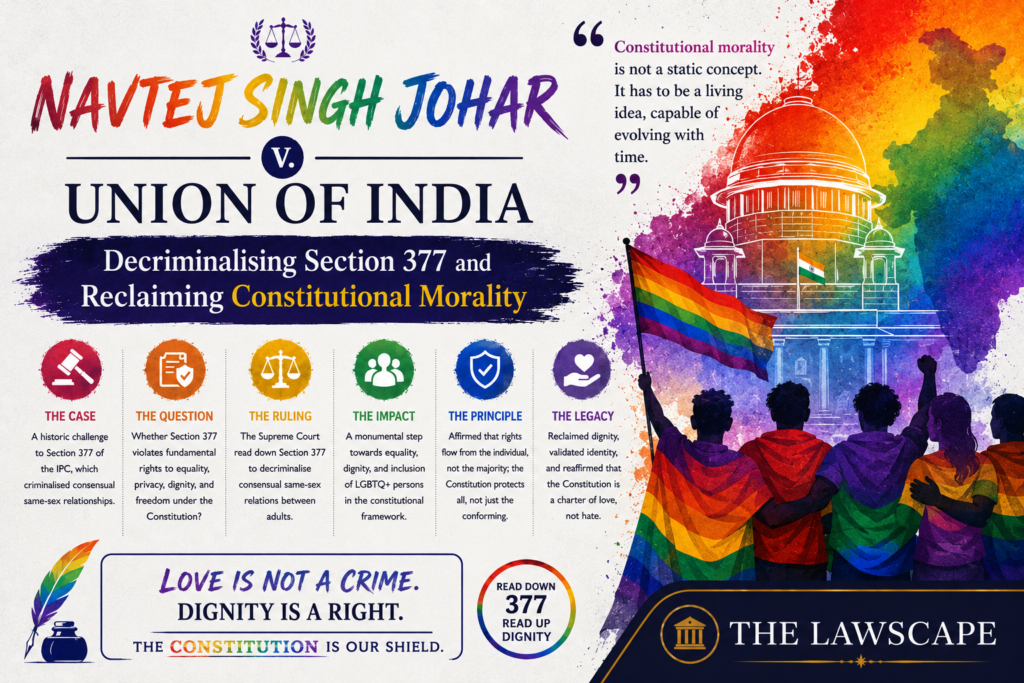
- The Supreme Court in Navtej Singh Johar v. Union of India decriminalised consensual same-sex relations between adults by reading down Section 377 of the Indian Penal Code.
- The Court held that sexual orientation is an intrinsic part of identity, dignity, privacy, and equality protected under Articles 14, 15, 19, and 21 of the Constitution.
- The judgment overruled Suresh Kumar Koushal and firmly established that constitutional morality must prevail over social prejudice and majoritarian disapproval.
Introduction
Navtej Singh Johar v. Union of India is one of the most transformative constitutional decisions in modern Indian jurisprudence. Decided by a Constitution Bench of the Supreme Court in 2018, the judgment struck down the criminal application of Section 377 of the Indian Penal Code, 1860, insofar as it penalised consensual sexual acts between adults in private. In doing so, the Court restored dignity, liberty, and equality to members of the LGBTQIA+ community who had long lived under the shadow of criminalisation.
The case represented the culmination of nearly two decades of litigation challenging the constitutionality of Section 377, a colonial-era provision that criminalised “carnal intercourse against the order of nature.” The judgment is significant not only because it decriminalised same-sex intimacy, but also because it advanced the principles of privacy, autonomy, non-discrimination, and constitutional morality in Indian constitutional law.
Court and Bench
Court: Supreme Court of India
Bench: Constitution Bench comprising Chief Justice Dipak Misra, Justice R.F. Nariman, Justice A.M. Khanwilkar, Justice D.Y. Chandrachud, and Justice Indu Malhotra
Date of Judgment: 6 September 2018
Parties
Petitioners: Navtej Singh Johar, Ritu Dalmia, Sunil Mehra, Aman Nath, Ayesha Kapur, along with mental health professionals, NGOs including the Naz Foundation, and members of the LGBTQIA+ community.
Respondents: Union of India, Suresh Kumar Koushal, and various religious and conservative intervenors.
Facts of the Case
The challenge to Section 377 had a long constitutional history. The movement began in 2001 when the Naz Foundation filed a writ petition before the Delhi High Court. In 2009, the Delhi High Court in Naz Foundation v. Government of NCT of Delhi decriminalised consensual sexual acts between adults in private, holding that Section 377 violated constitutional guarantees of equality, dignity, and liberty. However, in 2013, the Supreme Court in Suresh Kumar Koushal v. Naz Foundation reversed that decision and reinstated Section 377, observing that the LGBTQIA+ community constituted a “minuscule minority” and that any change to the law should come from Parliament.
In 2016, Navtej Singh Johar and five other members of the LGBTQIA+ community filed a fresh writ petition under Article 32 of the Constitution, challenging the validity of Section 377. They argued that the law violated their rights to equality, non-discrimination, dignity, privacy, and freedom of expression, and that the constant fear of criminal prosecution deeply affected their personal and professional lives.
The legal position had significantly changed after the Supreme Court’s decision in K.S. Puttaswamy v. Union of India (2017), which recognised the right to privacy as a fundamental right and expressly criticised the reasoning adopted in Koushal. In light of this changed constitutional landscape, the matter was referred to a Constitution Bench for final adjudication.
Issues Before the Court
The Court considered three principal issues:
- Whether Section 377 of the Indian Penal Code, insofar as it criminalised consensual sexual acts between adults in private, violated the rights to equality and non-discrimination under Articles 14 and 15 of the Constitution.
- Whether Section 377 violated the rights to life, personal liberty, privacy, dignity, and freedom of expression under Articles 19 and 21.
- Whether the judgment in Suresh Kumar Koushal v. Naz Foundation correctly stated the constitutional position regarding the rights of sexual minorities.
Arguments of the Parties
Petitioners’ Arguments
The petitioners argued that Section 377 was an archaic colonial provision that violated the basic constitutional guarantees of dignity, liberty, and equality. They contended that sexual orientation is an intrinsic and immutable aspect of a person’s identity and therefore falls within the constitutional protection of privacy and personal liberty under Article 21. They also argued that consensual intimacy between adults in private lies within the protected sphere of decisional autonomy and cannot be criminalised by the State.
It was further submitted that Section 377 created an arbitrary and irrational classification that lacked any legitimate state objective, thereby violating Article 14. The petitioners also challenged the reasoning in Koushal, arguing that constitutional rights cannot be denied merely because the affected group is numerically small. They emphasized the severe stigma, trauma, and institutional discrimination caused by the criminalisation of same-sex intimacy and sought a declaration reading down Section 377 to exclude consensual adult same-sex relations from its ambit.
Respondents’ Arguments
The Union of India adopted a largely neutral position and left the constitutional validity of Section 377 to the wisdom of the Court, provided the issue was confined to consensual acts between adults. It, however, requested that the proceedings should not extend to questions concerning civil rights such as same-sex marriage, adoption, or inheritance.
The religious and conservative intervenors opposed the petitions and defended Section 377 on the grounds of public morality, health, and societal values. They argued that homosexual conduct was contrary to the natural order of procreation and that the expression “sex” in Article 15 referred only to biological sex and not sexual orientation. They further urged the Court to exercise judicial restraint and leave any alteration to the penal law to the legislature.
Judgment
The Supreme Court unanimously held in favour of the petitioners and overruled Suresh Kumar Koushal. The Court declared that Section 377 of the Indian Penal Code is unconstitutional insofar as it criminalises consensual sexual acts between adults in private. The provision was read down to ensure that it would no longer apply to consensual same-sex relations between adults.
At the same time, the Court clarified that Section 377 would continue to apply to non-consensual sexual acts, sexual offences involving minors, and acts of bestiality. The judgment also expressly affirmed that members of the LGBTQIA+ community are entitled to the full protection of the Constitution, including equal citizenship, dignity, and freedom from discrimination.
Ratio Decidendi
Constitutional Morality Over Popular Morality
One of the most significant aspects of the judgment was its emphasis on constitutional morality. The Court held that constitutional adjudication cannot be guided by social disapproval or majoritarian morality. Instead, courts are bound to uphold the values of liberty, equality, and dignity embodied in the Constitution. The Court rejected the reasoning in Koushal that the rights of sexual minorities could be diluted because they formed a “minuscule minority,” and reaffirmed that constitutional rights protect every individual irrespective of numbers.
Articles 14 and 15: Equality and Non-Discrimination
The Court held that Section 377 was manifestly arbitrary and failed the test of Article 14 because it criminalised a natural and inherent identity without any rational nexus to a legitimate state purpose. It further held that the prohibition of discrimination on the ground of “sex” under Article 15 includes discrimination based on sexual orientation. By penalising consensual same-sex relations, Section 377 effectively targeted a class of persons on the basis of their identity and was therefore unconstitutional.
Articles 19 and 21: Privacy, Dignity, Autonomy, and Expression
Relying on Puttaswamy, the Court held that privacy includes the right to make intimate personal choices and to choose one’s partner. Sexual orientation was recognised as an inherent component of identity, dignity, and liberty. The Court observed that criminalising same-sex intimacy not only intruded into the private sphere but also denied LGBTQIA+ persons the freedom to express their identity and relationships openly. In this sense, Section 377 violated both the freedom of expression under Article 19(1)(a) and the right to life and personal liberty under Article 21.
Presumption of Constitutionality and Colonial Laws
The Court clarified that pre-constitutional laws do not enjoy unquestioned deference merely because they have existed for a long time. Since Section 377 was a colonial-era law enacted in 1860, it had to be tested against the touchstone of fundamental rights. Once it was found to violate the Constitution, the law could not be preserved merely on the basis of historical continuity.
Significance of the Judgment
The judgment in Navtej Singh Johar is monumental in Indian constitutional jurisprudence because it formally dismantled state-sponsored discrimination against LGBTQIA+ persons. By recognising sexual orientation as a natural and immutable aspect of identity, the Court restored dignity and equal citizenship to millions of people who had lived under the threat of criminal prosecution for their intimate relationships.
The decision also reinforced the doctrine of transformative constitutionalism. It presented the Constitution as a living document intended to guide society towards greater inclusion, pluralism, and social justice. The Court brought together the principles of privacy, dignity, autonomy, and equality into a unified constitutional framework and made it clear that the State cannot criminalise identity or love merely because it departs from social orthodoxy.
Justice Indu Malhotra’s observation that “history owes an apology” to the LGBTQIA+ community for centuries of stigma and exclusion captured the moral and constitutional significance of the judgment. The case is therefore not merely about decriminalisation, but about the recognition of LGBTQIA+ persons as equal constitutional citizens entitled to respect, protection, and dignity.
Conclusion
Navtej Singh Johar v. Union of India stands as one of the most important decisions in the history of Indian constitutional law. By reading down Section 377 and overruling Suresh Kumar Koushal, the Supreme Court reaffirmed that the Constitution protects the dignity, liberty, and equality of all persons, including sexual minorities.
The case transformed the legal position of LGBTQIA+ persons in India by removing the threat of criminalisation and recognising that sexual orientation is an intrinsic part of identity protected under the Constitution. More broadly, the judgment reaffirmed the role of the judiciary as a guardian of constitutional morality, especially where social prejudice and majoritarian values threaten the rights of vulnerable communities.
Its long-term significance extends beyond decriminalisation. It has become a foundational precedent for future debates on equality, family, identity, and queer rights in India. Above all, Navtej Singh Johar affirms a powerful constitutional truth: that love, dignity, and autonomy cannot be subordinated to prejudice, and that the Constitution belongs equally to every citizen.
Disclaimer: The views expressed in this article are those of the author and do not necessarily reflect the views of The Lawscape.
The Lawscape — clear, practical legal insight for students and future lawyers.