
Association for Democratic Reforms v. Union of India: Electoral Bonds, Corporate Funding, and the Constitutional Demand for Transparency
Author: Priyam Pratik
Student, Faculty of Law, University of Allahabad
—————————————————————————–
💡 3 Quick Takeaways
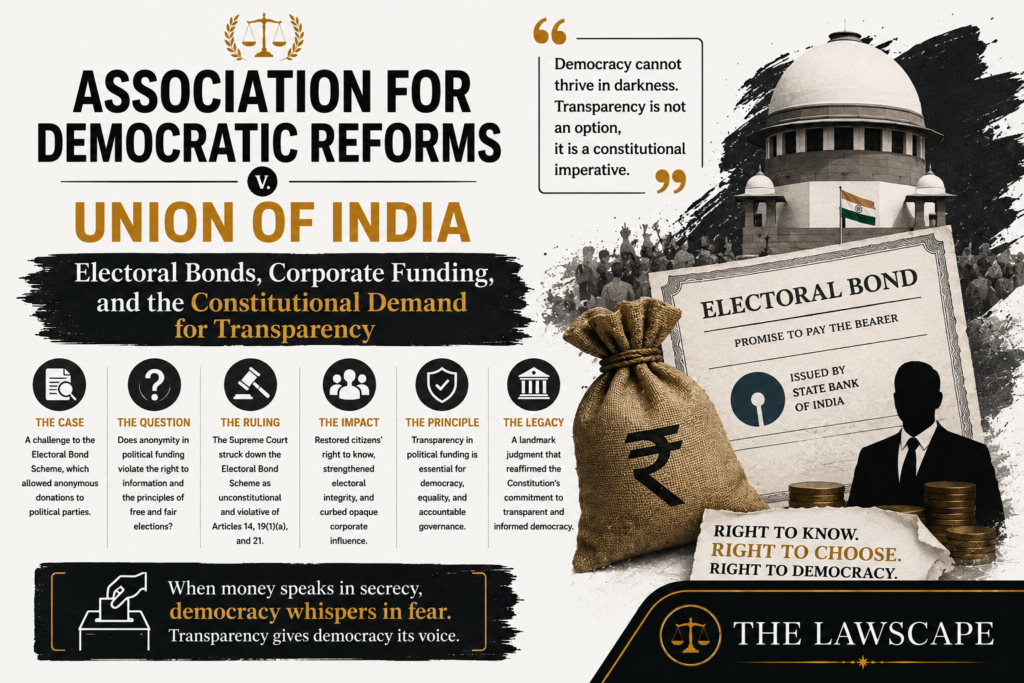
- In Association for Democratic Reforms v. Union of India, the Supreme Court struck down the Electoral Bonds Scheme for violating voters’ right to information under Article 19(1)(a).
- The judgment held that anonymous political funding and unlimited corporate donations create serious risks for democratic accountability, political equality, and free and fair elections.
- The decision is a major constitutional intervention in political finance law, reaffirming that transparency in electoral funding is a constitutional imperative rather than a policy choice.
Introduction
Few questions strike more directly at the integrity of a constitutional democracy than this: who finances its elections? The health of an electoral system depends not only on the promises made by political actors, but also on the ability of voters to understand the financial interests that sustain those actors. When that information is concealed, democratic accountability is weakened. It was this concern that lay at the heart of Association for Democratic Reforms v. Union of India, in which the Supreme Court of India delivered a unanimous verdict on 15 February 2024 striking down the Electoral Bonds Scheme in its entirety. The Constitution Bench, led by Chief Justice Dr. D.Y. Chandrachud and comprising Justices Sanjiv Khanna, B.R. Gavai, J.B. Pardiwala, and Manoj Misra, concluded that a scheme which masked the identities of political donors while allowing unlimited corporate contributions could not be reconciled with constitutional values.
The Electoral Bonds Scheme had been introduced in 2018 through a set of legislative amendments affecting the Finance Act, 2017, the Reserve Bank of India Act, 1934, the Representation of the People Act, 1951, and the Companies Act, 2013. The government defended the scheme as a reform designed to move political donations away from opaque cash transactions and into the formal banking system. Yet, in operation, the scheme did more than formalise donations. It dismantled prior disclosure requirements, removed the cap on corporate political contributions, and ensured that the identity of donors remained hidden from the public. Supporters viewed the scheme as a modernising reform; critics regarded it as a constitutional mechanism for institutionalised opacity. The Supreme Court ultimately sided with the critics.
Facts of the Case
The Electoral Bonds Scheme came into force in January 2018. Under the scheme, any individual or company incorporated in India could purchase electoral bonds from designated branches of the State Bank of India in fixed denominations ranging from ₹1,000 to ₹1 crore. These bonds could then be donated to any registered political party that had secured at least one percent of the vote in the most recent general or State election. The political party receiving the bond had fifteen days to encash it. Crucially, the identity of the donor was not disclosed to the public, and neither the donor’s accounts nor the recipient party’s records were required to reveal the details of the specific political contribution.
At the same time, the Finance Act, 2017 amended Section 182 of the Companies Act, 2013. Before this amendment, companies were prohibited from donating more than 7.5 percent of their average net profits over the previous three financial years to political parties, and they were required to disclose the names of the political parties to which they donated. The amendment removed both these safeguards. As a result, even a loss-making company with no meaningful operating history could donate unlimited amounts to a political party, without disclosing which party received the money.
A group of petitioners led by the Association for Democratic Reforms, along with the Communist Party of India (Marxist), challenged the constitutional validity of the scheme before the Supreme Court. Their principal contentions were threefold. First, they argued that the scheme violated the voter’s right to information under Article 19(1)(a) of the Constitution by concealing the identity of political donors. Secondly, they contended that the removal of the cap on corporate donations created a pathway for quid pro quo arrangements between business entities and political parties. Thirdly, they submitted that a system of free and fair elections, recognised as a basic feature of the Constitution, could not coexist with a funding regime that systematically concealed the financial interests shaping political competition.
Issues Raised
The Constitution Bench was required to consider a cluster of interrelated constitutional questions. The primary issue was whether the anonymity granted to political donors under the Electoral Bonds Scheme infringed the voter’s right to information, which earlier judgments had located within Article 19(1)(a) of the Constitution. This required the Court to determine whether the right to information extends not merely to the personal background of electoral candidates, but also to the financial structures that sustain political parties.
A second major issue concerned the constitutional validity of unlimited corporate donations. The removal of the statutory cap on corporate funding raised the question of whether unrestricted political contributions by commercial entities are compatible with political equality and democratic integrity. The Court also had to address the structural design of the scheme itself. Although the scheme ostensibly granted anonymity to all donors, the State Bank of India retained complete records of every bond transaction, which meant that the executive could potentially access information that remained unavailable to the public and to rival political parties. This raised the issue of whether the scheme created a constitutionally impermissible informational asymmetry. Finally, the Court had to determine the appropriate remedy if the scheme was found to be unconstitutional.
Analysis
(a) The Right to Information and Political Funding
The central constitutional contribution of the judgment lies in its recognition that the right to information under Article 19(1)(a) extends to political funding. The Court built upon earlier decisions such as Union of India v. Association for Democratic Reforms and People’s Union for Civil Liberties v. Union of India, which had already held that voters have a right to know the criminal antecedents, assets, and liabilities of electoral candidates. In the present case, the Court extended this logic to the financial networks sustaining political parties as continuing institutions. The reasoning was straightforward: if voters are to make an informed electoral choice, they must know not only who is contesting elections, but also who is financing those candidates and parties.
The Court applied the proportionality standard to examine whether the confidentiality provisions of the scheme could be justified as a reasonable restriction on the right to information. The government argued that donor anonymity was necessary to protect contributors from political harassment or retaliation by rival parties. The Court accepted that donor protection may be a legitimate objective, but concluded that the Electoral Bonds Scheme was a disproportionate means of achieving it. It noted that less restrictive alternatives were available, such as disclosure to an independent authority or delayed public disclosure after the completion of the electoral cycle. By contrast, the scheme provided for no public disclosure at any point, thereby permanently extinguishing the public’s access to information about political funding.
The judgment is particularly significant in the way it balances competing constitutional concerns. It did not dismiss the possibility of donor harassment, but it held that the complete and permanent concealment of donor identity imposed an excessive cost on democratic transparency. The Court therefore treated the right to know the financial underpinnings of political competition as an indispensable component of electoral freedom.
(b) Unlimited Corporate Donations and Democratic Integrity
The Court’s treatment of corporate political funding is one of the most structurally important aspects of the judgment. It recognised that political finance is a domain in which economic inequality can easily translate into political inequality. A legal framework that allows commercial entities with vast financial resources to donate unlimited sums to political parties, without disclosure and without ceiling, systematically privileges those capable of purchasing access and influence. The Court therefore treated unlimited corporate donations not as a mere regulatory issue, but as a structural threat to the integrity of elections.
The judgment drew a distinction between natural persons and corporations in the political sphere. A natural person who donates to a political party may be understood as participating in democratic life through civic engagement. A corporation, however, does not possess political agency in the same sense. It does not vote, nor does it possess political conscience. What it does possess is financial power, and its deployment of that power in politics is ordinarily directed toward securing favourable business outcomes. The Court recognised that, when combined with anonymity and the absence of any ceiling, such corporate funding creates fertile ground for quid pro quo corruption and distorts the democratic process.
The commentary also notes, by way of comparison, the contrasting position adopted by the United States Supreme Court in Citizens United v. Federal Election Commission, where corporations were treated as enjoying First Amendment protections comparable to those of natural persons in the context of political expenditure. Although the Indian Supreme Court did not engage directly with Citizens United, its reasoning moved in the opposite direction by treating political equality as a constitutional value capable of limiting the influence of corporate wealth in electoral politics.
(c) Structural Asymmetry and the Architecture of Opacity
Another major insight in the judgment lies in its analysis of the structural asymmetry embedded within the Electoral Bonds Scheme. Although the scheme was described as anonymous, the anonymity was never absolute. The State Bank of India, as the sole authorised issuer and encashment authority, maintained complete records of all bond purchases and encashments, including the identities of purchasers and the political parties to whom the bonds were donated. These records were unavailable to the public and to other political parties, but remained accessible in principle to the executive through its control over state banking institutions.
The Court rightly identified this as a constitutionally significant flaw. A funding mechanism that presents itself as anonymous while preserving a complete paper trail accessible to the government of the day is not a neutral transparency measure; it is an instrument of informational asymmetry. The ruling party could potentially know who donated to it and who donated to its rivals, while the public and rival parties remained in the dark. Such a structure creates an inherent advantage for the incumbent government and undermines the fairness of the electoral process. The Court’s direction requiring the State Bank of India to furnish full transaction records to the Election Commission of India for publication was therefore a proportionate and forceful response to this constitutional defect.
(d) Analytical Reservations
While the judgment is doctrinally significant and normatively persuasive, the commentary identifies certain analytical reservations. The first concerns the derivation of the voter’s right to information from Article 19(1)(a). The Court has previously linked electoral transparency to the freedom of speech and expression, and that approach finds support in existing jurisprudence. However, it remains arguable that a voter’s informational right could also be developed more directly within the framework of electoral law, particularly through Articles 324 to 329 of the Constitution and the Representation of the People Act, 1951. The reliance on Article 19(1)(a), though effective, may create doctrinal instability if the free speech framework and the electoral law framework diverge in future cases.
A second reservation concerns the absence of a positive constitutional blueprint for future political funding regulation. The Court invalidated the Electoral Bonds Scheme but did not articulate in detail what a constitutionally permissible replacement regime should look like. This restraint is understandable from the perspective of separation of powers, since it is not the judiciary’s role to design political funding policy. Nevertheless, a fuller articulation of the principles that any future framework must satisfy would have been useful for legislative guidance, particularly in balancing transparency, donor protection, prevention of black money, and fair electoral competition.
Conclusion
The decision in Association for Democratic Reforms v. Union of India is a landmark in Indian constitutional law and one of the most consequential judicial interventions in the field of political finance. At its core, the judgment affirms a simple but powerful proposition: the right of voters to participate meaningfully in a democratic process includes the right to know who finances the political actors seeking their support. Once that proposition is accepted, the foundations of the Electoral Bonds Scheme become difficult to defend.
By insisting that restrictions on voter information must satisfy proportionality, by recognising the dangers posed by unlimited corporate political funding, and by exposing the informational asymmetry built into the scheme’s architecture, the Court laid down an important constitutional framework for evaluating political finance laws in India. Any future legislative effort in this area will now have to engage seriously with these principles. A constitutionally sustainable framework would need to secure transparency, avoid structural advantages for incumbents, and account for the distinct dangers posed by corporate financial power in politics.
The judgment is not analytically flawless, but its importance is undiminished by those limitations. Its lasting contribution lies in making clear that transparency in political funding is not merely an administrative preference or a matter of policy design; it is a constitutional imperative essential to democratic accountability and electoral fairness. In that sense, Association for Democratic Reforms v. Union of India will remain a foundational precedent in the constitutional law of elections and political finance in India.
Disclaimer: The views expressed in this article are those of the author and do not necessarily reflect the views of The Lawscape.
The Lawscape — clear, practical legal insight for students and future lawyers.