
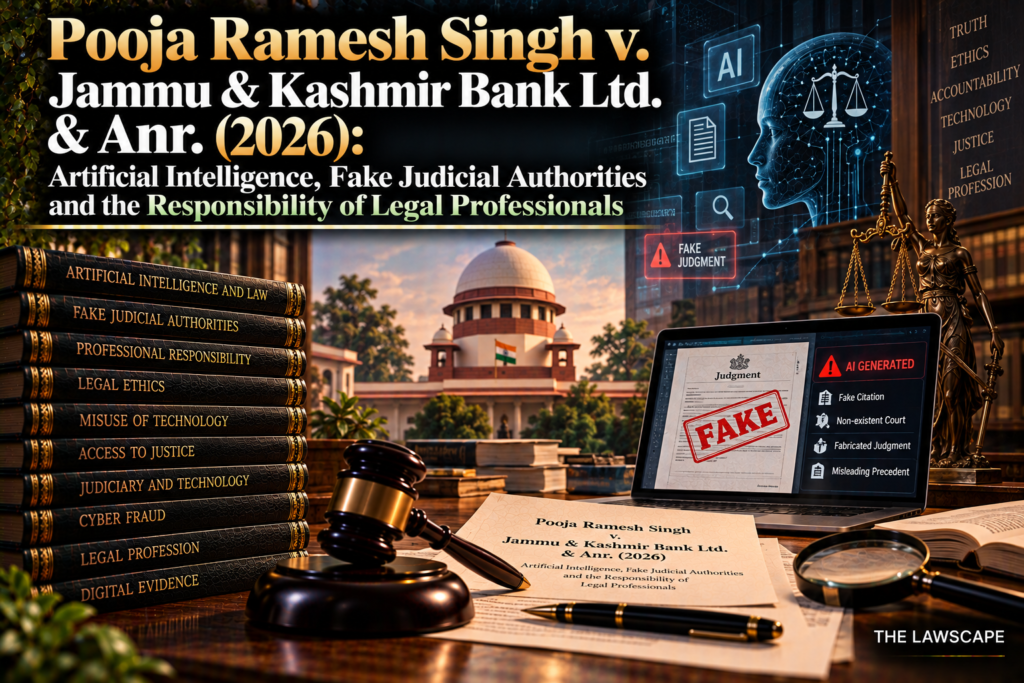
Pooja Ramesh Singh v. Jammu & Kashmir Bank Ltd. & Anr. (2026): Artificial Intelligence, Fake Judicial Authorities and the Responsibility of Legal Professionals
Author: Samarth Jalhotra
Student, Chaudhary charan singh university
———————————————————————————————–
💡 3 Quick Takeaways
- AI can assist with legal research, but AI-generated case citations and legal propositions must be independently verified before being relied upon in court.
- The Supreme Court emphasised that decisions based on fabricated or non-existent judicial authorities cannot be sustained, underscoring the importance of authenticity in judicial reasoning.
- The judgment highlights the responsibilities of both advocates and adjudicating authorities and calls for safeguards to ensure that technological assistance does not displace human judgment.
I. Introduction
“Actions have consequences; ignorance about the nature of those actions does not free a person from responsibility for the consequences.” — Stephan Dobyans
Artificial Intelligence (AI) is increasingly becoming part of everyday life, particularly in professional and academic settings. Lawyers, students, researchers and courts can use AI-based tools to search for information, summarise documents and assist with legal research. These tools can improve efficiency and help legal professionals process large volumes of information. However, their growing use also presents a significant challenge: AI systems may generate information that appears convincing but is false, inaccurate or unrelated to the issue under consideration.
In the legal field, this problem becomes particularly serious when a fabricated judgment, an incorrect citation or a non-existent legal proposition is presented as an authentic judicial precedent. Legal arguments and judicial decisions depend upon the accuracy of the authorities on which they rely. The use of fabricated material can therefore undermine the reasoning process and compromise confidence in the administration of justice.
The Supreme Court of India addressed this concern in Pooja Ramesh Singh v. Jammu & Kashmir Bank Ltd. & Anr., 2026 INSC 668, decided on 2 July 2026. The case is significant because the National Company Law Tribunal (NCLT) relied on several judicial authorities that were either non-existent or incorrectly attributed. Some of the authorities appeared to have originated from AI-generated material. The National Company Law Appellate Tribunal (NCLAT) subsequently affirmed the decision without identifying the problem. The Supreme Court ultimately set aside the orders of the lower tribunals.
The judgment does not reject AI as a technological tool. Instead, it draws an important distinction between using AI to assist legal work and treating AI-generated material as an unquestioned source of law. The Court emphasised the importance of keeping a “human in the loop” throughout AI-assisted legal research and adjudication.
The decision therefore represents an important development in the discussion surrounding the responsible use of AI in the Indian legal system.
II. Facts of the Case
Pooja Ramesh Singh, the appellant, was a suspended director of Essel Infraprojects Ltd. (EIL). EIL was the corporate debtor and corporate guarantor of Pan India Utilities Distribution Company Ltd. (PIUDCL), which had obtained loan facilities from Jammu & Kashmir Bank Ltd.
To secure the loan facilities, EIL had executed a corporate guarantee in favour of the bank. Subsequently, PIUDCL experienced financial difficulties and defaulted on its repayment obligations. Its loan accounts were consequently classified as non-performing assets.
The bank then filed an application under Section 7 of the Insolvency and Bankruptcy Code, 2016 (IBC), before the NCLT, Mumbai, seeking the initiation of the corporate insolvency resolution process against EIL.
On 28 August 2024, the NCLT admitted the application after finding that a debt and default existed. It also appointed an Interim Resolution Professional and declared a moratorium under Section 14 of the IBC.
Pooja Ramesh Singh challenged the order before the NCLAT. Among other arguments, she contended that internal restructuring involving demerger, merger and amalgamation had affected the liability of the corporate guarantor. She also argued that a renewed sanction letter did not contain the earlier guarantee and that the guarantee should therefore be treated as having been relinquished.
On 11 September 2025, the NCLAT dismissed the appeal, relying on several judicial authorities while considering the continuing liability of the corporate guarantor.
The matter subsequently reached the Supreme Court. Although the underlying dispute concerned insolvency proceedings and the liability of a corporate guarantor, the central concern that emerged before the Supreme Court was the reliance placed by the NCLT on questionable judicial authorities.
III. The Problem of Fake Judicial Authorities
One of the most significant aspects of the case was the manner in which judicial precedents had been relied upon by the NCLT.
During the proceedings before the Supreme Court, counsel for the appellant drew attention to certain authorities cited in the NCLT’s order that could not be verified. The Supreme Court independently examined the cited authorities and found that several were either non-existent or incorrectly represented. In some instances, the judgment itself existed, but the paragraph relied upon by the NCLT could not be found in the actual decision.
The Court identified six problematic authorities. This was particularly concerning because these were not merely incidental references. They had formed part of the reasoning used by the NCLT in deciding the matter.
The circumstances were further complicated by an affidavit filed by the respondent bank stating that its counsel had not cited these authorities during the proceedings. This raised questions about how the authorities had entered the NCLT’s reasoning and suggested that they may have been obtained independently during the preparation of the judicial order.
The incident demonstrates a serious risk associated with unverified legal research. An AI system may generate a case name, citation, paragraph or legal proposition that appears authentic but does not accurately correspond to an actual judicial decision. If such material is accepted without verification, it can enter legal submissions or judicial reasoning and influence the outcome of a case.
The problem is therefore not simply technological in nature. It concerns the reliability of legal sources, the responsibility of those who rely upon them and the integrity of the judicial process.
IV. Issues Before the Supreme Court
The principal issues considered in the case included:
- Whether a judicial decision based on fake, non-existent or AI-hallucinated legal material can be sustained in law.
- Whether relying on AI-generated authorities without verification undermines the rule of law and the integrity of judicial adjudication.
- What responsibilities should be imposed on lawyers and adjudicators when using AI-generated legal research.
- What safeguards and professional standards should be developed to ensure the responsible use of AI in the legal system.
These issues required the Court to consider not only the consequences of relying on fabricated authorities but also the appropriate boundaries between technological assistance and professional legal responsibility.
V. Judgment of the Supreme Court
The Supreme Court, speaking through Justice Pamidighantam Sri Narasimha, with Justice Alok Aradhe on the Bench, adopted a firm position against the use of unverified AI-generated authorities.
The Court held that a decision based on fake or hallucinated material cannot be sustained because judicial adjudication must rest on authentic law and reliable material. A judicial decision cannot be supported by authorities that do not exist or by legal propositions falsely attributed to genuine judgments.
The Court treated the issue as more serious than an ordinary research mistake. Fabricated judicial precedents can contaminate the judicial process by introducing false legal propositions into the reasoning through which courts determine disputes. Their use may distort the application of established legal principles and affect the legitimacy of the resulting decision.
At the same time, the Supreme Court did not reject AI as a technological tool. It recognised that AI can assist human beings in routine and intellectual tasks, including the processing and organisation of legal information. The Court’s concern was with uncontrolled or unverified reliance on AI-generated material.
The Court accordingly emphasised the need to maintain a “human in the loop” at every stage of AI-assisted adjudication. AI may assist a judge or lawyer in identifying potentially relevant material, but it cannot replace the professional responsibility to determine whether that material is authentic, relevant and legally accurate.
The Court also called for a zero-tolerance approach towards the production, citation or use of AI-generated precedents without proper verification.
Furthermore, the Supreme Court directed the Bar Council of India to constitute a committee to consider the problem of advocates submitting fake or hallucinated AI-generated material as genuine legal precedents. The committee was directed to develop appropriate guiding principles and consider disciplinary consequences for violations.
These directions reflect the Court’s concern that the increasing availability of AI tools must be accompanied by professional safeguards and clear standards of accountability.
VI. Analysis
The judgment in Pooja Ramesh Singh v. Jammu & Kashmir Bank Ltd. & Anr. is significant because it addresses the risks associated with the rapidly increasing use of AI in legal research. Rather than rejecting AI altogether, the Supreme Court distinguished between using AI as an assisting tool and relying on its output without proper verification.
1. The Importance of Human Oversight
The principle of keeping a “human in the loop” is one of the most important aspects of the judgment. AI can assist lawyers and judges in locating cases, summarising documents and processing large amounts of information. However, AI-generated content may appear convincing even when it is incorrect or fabricated.
The final responsibility for verifying the authenticity and relevance of legal material must therefore remain with a human legal professional. A citation generated by an AI tool should be treated as a reference requiring verification, not as proof that the cited authority exists or supports the proposition for which it is being used.
This distinction is particularly important in legal practice, where a single incorrect authority may undermine an argument or mislead a court.
2. Professional Responsibility of Advocates
The judgment also highlights the professional responsibility of advocates to assist courts by presenting genuine and accurate legal authorities.
The use of AI does not remove this responsibility. Before relying on an AI-generated citation, a lawyer must verify that the case actually exists, that the cited paragraph appears in the judgment and that the legal principle has been correctly understood and applied.
Legal research cannot be considered complete merely because a tool produces a plausible-looking answer. Verification against the actual judgment remains essential.
The responsibility is especially significant when legal authorities are submitted to a court, because the court may rely on them while determining the rights and obligations of the parties.
3. Responsibility of Adjudicating Authorities
The responsibility for ensuring the authenticity of judicial authorities does not rest exclusively with advocates. Adjudicating authorities must also exercise caution before relying on legal materials.
In the present case, the NCLT’s reliance on several incorrect or non-existent authorities illustrates the importance of independent verification at the judicial level. Even where a citation appears in a document or is generated during research, it must be checked against the original judgment before it forms part of judicial reasoning.
Human oversight must therefore operate throughout the legal process, from the preparation of submissions to the examination of authorities by the adjudicating body.
4. Zero Tolerance and the Need for Proportionate Guidelines
The Supreme Court’s zero-tolerance approach reflects the seriousness of introducing fabricated authorities into judicial proceedings. Such material can directly affect the reasoning and outcome of a case.
However, it is also important to distinguish between the deliberate submission of fabricated authorities and an inadvertent error resulting from reliance on an AI tool. Both situations require attention, but they may involve different degrees of responsibility.
Future professional guidelines should therefore clarify the standards of verification expected from advocates and explain how violations should be addressed. The author’s view is that such guidelines should also take account of the person’s intention, the degree of negligence involved and whether the error was corrected after it was identified.
The direction to the Bar Council of India to consider appropriate guidelines is consequently an important step towards establishing clearer professional standards for AI-assisted legal work.
5. Implications for the Future of Legal Practice
Completely avoiding AI may not be practical as its use in legal research and other professional tasks continues to increase. AI tools can provide valuable assistance, but their usefulness depends on how responsibly they are used.
The appropriate approach is to treat AI as a supporting technology rather than an independent source of law. Its output must be verified, its limitations must be recognised and the final legal assessment must remain under human control.
In my view, the judgment places accuracy, verification and human responsibility above technological convenience. AI may make legal work faster, but speed cannot come at the cost of judicial accuracy. The real challenge is not simply whether AI should be used, but how it can be used responsibly without compromising the integrity of legal research and adjudication.
VII. Conclusion
The judgment in Pooja Ramesh Singh v. Jammu & Kashmir Bank Ltd. & Anr. marks an important development in addressing the challenges created by the increasing use of Artificial Intelligence in the legal field.
The case demonstrates that AI can be useful in legal research, but its output cannot be accepted without proper verification. The reliance on fake and non-existent judicial authorities illustrates how fabricated or inaccurate information can enter the judicial process and affect judicial reasoning.
The Supreme Court emphasised the importance of human supervision and verification through the principle of keeping a “human in the loop”. AI may assist lawyers and judges, but it cannot replace their responsibility to ensure that the legal material relied upon is genuine and accurate.
The directions concerning the Bar Council of India may also contribute to the development of clearer professional standards for the responsible use of AI by advocates. Such standards should promote verification while appropriately distinguishing intentional misuse from inadvertent errors.
Ultimately, the judgment does not discourage technological development in the legal system. Instead, it establishes an important boundary between technological assistance and professional responsibility. As AI becomes more common in legal practice, accuracy, verification and human judgment must remain central to the administration of justice.
The challenge is therefore to ensure that technological progress strengthens legal research and judicial decision-making without compromising the authenticity of the law on which those decisions depend.
Disclaimer: The views expressed in this article are those of the author and do not necessarily reflect the views of The Lawscape.
The Lawscape — clear, practical legal insight for students and future lawyers.