
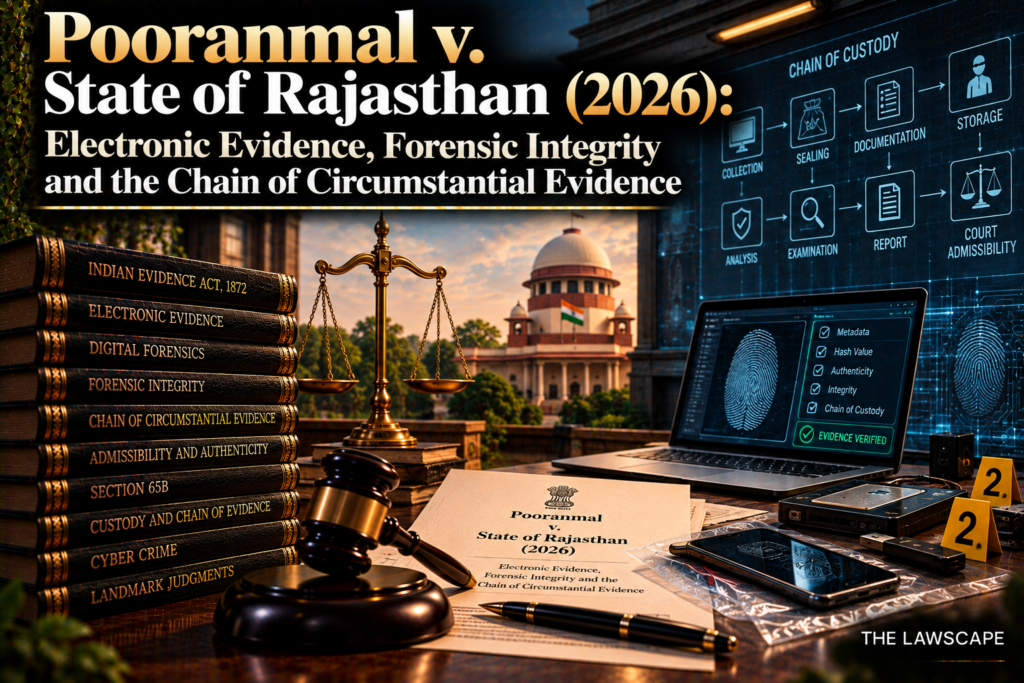
Pooranmal v. State of Rajasthan (2026): Electronic Evidence, Forensic Integrity and the Chain of Circumstantial Evidence
Author: Saloni Monga
Student, Meerut College, Meerut Affiliated To Chaudhary Charan Singh University, Meerut
———————————————————————————————————————————————————
💡 3 Quick Takeaways
- Electronic evidence must satisfy statutory requirements: Call-detail records cannot be relied upon when the mandatory certification requirements under Section 65-B of the Indian Evidence Act, 1872, have not been fulfilled.
- Forensic evidence requires an intact chain of custody: A laboratory report cannot establish guilt reliably if the prosecution fails to demonstrate that the material examined was properly preserved and protected from tampering.
- Suspicion cannot replace proof: A conviction based on circumstantial evidence requires a complete and reliable chain of circumstances establishing guilt beyond reasonable doubt.
Introduction
The increasing use of technology in criminal investigations has transformed the manner in which courts assess criminal liability. Evidence such as call-detail records (CDRs), CCTV footage, mobile-phone data, forensic reports and other digital records is frequently relied upon to establish a connection between an accused person and an alleged offence.
However, the evidentiary value of such material depends not merely on its existence but also on its authenticity, admissibility and proper preservation. The Supreme Court of India’s decision in Pooranmal v. State of Rajasthan & Anr., 2026 INSC 217, illustrates the importance of these principles.
The judgment, delivered on 10 March 2026, concerned Pooranmal’s conviction for the murder of Aruna, the wife of his co-accused, Ladu Lal. The prosecution’s case against Pooranmal rested entirely on circumstantial evidence, including call-detail records, the recovery of a blood-stained shirt and the recovery of ₹46,000. The Supreme Court concluded that these circumstances could not safely sustain his conviction.
The Court held that the call-detail records were inadmissible because the mandatory certificate required under Section 65-B of the Indian Evidence Act, 1872, had not been proved. It also identified serious deficiencies in the chain of custody of the blood-stained shirt and found that the recovery of currency was insufficiently connected with the crime.¹
The decision is significant in the present legal environment because Section 65-B of the Indian Evidence Act has a corresponding provision in Section 63 of the Bharatiya Sakshya Adhiniyam, 2023 (BSA). The judgment therefore provides useful guidance on the continuing importance of authentication and procedural safeguards in the use of electronic evidence in criminal trials.
Facts of the Case
The prosecution alleged that Pooranmal and Ladu Lal had participated in the murder of Aruna during the night of 2–3 March 2010 at Ladu Lal’s residence in Bhilwara, Rajasthan. Ladu Lal informed the police that unidentified persons had entered his house, murdered his wife and taken approximately ₹4 lakh from an almirah. An FIR was subsequently registered, and an investigation commenced.²
During the investigation, suspicion turned towards Ladu Lal. Following his interrogation and disclosure statement, Pooranmal was also apprehended. The prosecution claimed that a blood-stained shirt and ₹46,000 were recovered from Pooranmal’s residence pursuant to his disclosure statement. It also collected call-detail records relating to the mobile numbers of Pooranmal and Ladu Lal. According to the prosecution, these records showed communication between the two around the time of the incident.³
The trial court convicted both accused under Sections 302 read with 34 and Section 201 of the Indian Penal Code, 1860, imposing concurrent sentences of life imprisonment and seven years’ rigorous imprisonment, respectively. The Rajasthan High Court affirmed the convictions in 2018.⁴
Pooranmal subsequently approached the Supreme Court through legal aid. Although there was a delay of approximately 2,749 days in filing the appeal, the Court condoned the delay after considering his poverty and lack of access to legal assistance.⁵ The Court also distinguished Pooranmal’s case from that of his co-accused, Ladu Lal, because the prosecution’s case against Pooranmal rested principally on the recoveries and the call-detail records.
The Supreme Court identified three principal circumstances relied upon by the prosecution against Pooranmal: the call-detail records showing communication with Ladu Lal, the recovery of the blood-stained shirt, and the recovery of ₹46,000 allegedly paid to Pooranmal for committing the murder.⁶
Issues Raised
The principal legal questions before the Supreme Court were:
- Whether the prosecution had established a complete and unbroken chain of circumstantial evidence sufficient to prove Pooranmal’s involvement in the murder.
- Whether the recovery of ₹46,000 from the appellant could be treated as an incriminating circumstance in the absence of reliable evidence connecting the money with the commission of the offence.
- Whether the recovery and forensic examination of the blood-stained shirt could be relied upon when the prosecution had failed to establish a proper chain of custody.
- Whether the call-detail records were admissible in the absence of the mandatory certificate under Section 65-B of the Indian Evidence Act, 1872, which has a corresponding provision in Section 63 of the BSA.
- Whether the gaps and inconsistencies in the prosecution’s evidence, particularly concerning electronic and forensic material, raised reasonable doubt about the appellant’s involvement in the offence.
Analysis
A. Circumstantial Evidence and the Need for Clear Proof
The Supreme Court reiterated the principles governing cases based on circumstantial evidence. Relying on Sharad Birdhichand Sarda v. State of Maharashtra, the Court emphasised that the circumstances must be fully established, consistent only with the guilt of the accused, conclusive in nature and collectively sufficient to form a complete chain that excludes every reasonable hypothesis consistent with innocence.⁷
This principle is particularly important in cases involving electronic and forensic evidence. Digital records may establish that two individuals communicated, but communication alone does not necessarily establish participation in a crime. Similarly, possession of money or an item bearing traces of blood may appear suspicious, but suspicion cannot replace proof of the necessary connection between the accused and the offence.
In Pooranmal, the Court declined to treat several individually weak circumstances as automatically becoming conclusive when considered together. A chain of evidence is persuasive only when its individual links are reliable and, collectively, point towards guilt. If important links are legally inadmissible or factually unreliable, the chain remains incomplete.
B. Recovery of Currency Was Not Sufficient
The prosecution relied on the recovery of ₹46,000 from Pooranmal’s residence and alleged that the amount represented payment for the murder. However, the Court identified a discrepancy: although the relevant material exhibit was recorded as containing ₹46,000, the amount counted in court was ₹46,145. The additional ₹145 had not been reflected on the relevant packet.⁸
The Court therefore treated the recovery with serious doubt. It further held that, even if the recovery were assumed to be reliable, the mere possession of currency could not establish guilt without cogent evidence connecting the money with the crime.
This aspect of the judgment highlights the distinction between suspicious circumstances and incriminating circumstances. The prosecution cannot shift the burden of proof onto an accused merely because an item has been recovered from their possession. It must establish a reliable connection between the recovered article and the alleged offence.
C. Forensic Evidence Requires a Reliable Chain of Custody
The blood-stained shirt presented another evidentiary difficulty. The forensic science laboratory report indicated that the blood stains on the shirt belonged to blood group O, which was also the blood group of the deceased. However, the Supreme Court declined to treat this finding as conclusive.
The Court examined how the material exhibits had been stored and transported. The evidence revealed discrepancies concerning when the exhibits were removed from the malkhana, when they were forwarded to the laboratory and when they were returned. The malkhana records also conflicted with the testimony of the relevant police witnesses.⁹
The Court consequently held that the prosecution had failed to establish the necessary chain of custody. Without demonstrating that the material examined by the laboratory was the same material seized from the accused, and that it had remained properly sealed and protected against tampering, the forensic report could not safely be relied upon.¹⁰
This reasoning has wider implications for modern criminal investigations. Forensic evidence is often presented as objective or scientific evidence. However, the scientific accuracy of a laboratory test cannot cure deficiencies in the collection, preservation or transmission of a sample. Even a scientifically accurate result may have limited evidentiary value if the integrity of the material examined cannot be established.
The judgment therefore reinforces an important principle: the reliability of forensic evidence depends not only on the scientific methods used in the laboratory but also on the integrity of the evidentiary chain preceding the examination.
D. Electronic Evidence and the Mandatory Certificate
One of the most significant aspects of Pooranmal for cyber law and technology-related litigation is the Supreme Court’s treatment of call-detail records.
The prosecution argued that the CDRs had been proved through employees of the relevant telecommunications service providers and that the absence of a certificate under Section 65-B should not, therefore, be fatal to its case. The Supreme Court rejected this argument.¹¹
The Court relied on Anvar P.V. v. P.K. Basheer, in which the Supreme Court held that electronic records produced as computer output must satisfy the statutory conditions governing their admissibility.¹² It also relied on Arjun Panditrao Khotkar v. Kailash Kushanrao Gorantyal, which reaffirmed that the certificate required under Section 65-B(4) is a condition precedent to the admissibility of electronic evidence in circumstances covered by that provision.¹³
The Court observed that the required certificate had not been proved in the present case. Consequently, the CDRs were inadmissible and could not be relied upon to support the prosecution’s case.¹⁴
This part of the judgment is particularly relevant under India’s newer evidentiary framework. The incident in Pooranmal occurred in 2010, and the proceedings were therefore governed by the Indian Evidence Act. Nevertheless, the Supreme Court referred to Section 63 of the BSA as the corresponding provision. The decision thus illustrates the continuing importance of statutory compliance when electronic records are tendered as evidence.
The reasoning also demonstrates why procedural safeguards surrounding electronic evidence matter. Digital records can be copied, modified or altered without leaving obvious physical traces. Certification requirements serve an important evidentiary function by addressing the source and authenticity of electronic material before a court relies upon it.
At the same time, the practical operation of Section 63 of the BSA may require further judicial clarification as criminal investigations increasingly depend on cloud data, platform-generated records, mobile applications, encrypted communications and records held by foreign technology companies. Courts may need to address how statutory requirements apply to complex and distributed digital systems.
E. The Judgment and the Presumption of Innocence
The decision is also significant from the perspective of the presumption of innocence. A few suspicious circumstances cannot, by themselves, establish guilt. The prosecution must connect those circumstances through reliable evidence and prove its case beyond reasonable doubt.
In Pooranmal, the Supreme Court found several gaps in the evidence against the appellant. The recovery of money did not clearly connect him with the murder, the blood-stained shirt could not safely be relied upon because of deficiencies in its chain of custody, and the call-detail records could not be considered because they had not been proved in accordance with the applicable legal requirements. Taken together, these deficiencies meant that the prosecution had failed to establish a complete chain of evidence. The Court accordingly set aside the conviction and acquitted Pooranmal.¹⁵
The importance of the judgment lies in its approach to evidentiary reliability. Evidence should not be accepted merely because it appears suspicious or seems to point towards an accused. A proper connection between the evidence and the offence must be established. This is particularly important when the prosecution relies on electronic or forensic material, whose evidentiary value depends on its source, authenticity, handling and admissibility.
The judgment also highlights a practical challenge in criminal investigations. Police investigations increasingly rely on mobile records, digital data, forensic reports and other forms of electronic evidence. If investigating officers are not adequately trained to collect, store and preserve such material, potentially relevant evidence may become difficult to rely upon during trial.
Rather than treating these requirements as unnecessary technicalities, the focus should be on improving investigative procedures. Proper training for investigating officers, better digital-forensic facilities and careful maintenance of records can help prevent evidentiary failures. These measures can strengthen the prosecution’s case while ensuring that an accused person is not convicted on the basis of evidence whose reliability remains doubtful.
Conclusion
Pooranmal v. State of Rajasthan is a significant Supreme Court decision that brings together three central concerns of contemporary criminal justice: circumstantial evidence, forensic integrity and electronic evidence.
The judgment demonstrates that a criminal conviction cannot safely rest on a collection of circumstances that are individually doubtful or legally inadmissible. The recovery of money did not establish a sufficient connection with the murder; the blood-stained shirt could not safely be relied upon because the chain of custody had not been established; and the call-detail records were inadmissible because the mandatory certification requirement had not been satisfied.
The judgment is also relevant under India’s evolving evidentiary framework. Although the proceedings were governed by the Indian Evidence Act, the Court referred to Section 63 of the BSA as the corresponding provision concerning electronic records. The decision therefore has continuing significance for criminal trials involving mobile records, CDRs, CCTV footage, emails, social-media records and other digital material.
Ultimately, Pooranmal reinforces a fundamental proposition of criminal law: technology may strengthen an investigation, but it cannot replace proof. Electronic and forensic evidence must satisfy the principles of authenticity, reliability, admissibility and fair procedure that govern other forms of evidence. As criminal investigations become increasingly digital, the judgment serves as a reminder that technological evidence requires greater procedural discipline, not less.
Endnotes
- Pooranmal v. State of Rajasthan, 2026 INSC 217, ¶¶ 3–5 (India).
- Pooranmal v. State of Rajasthan, 2026 INSC 217, ¶ 3 (India).
- Pooranmal v. State of Rajasthan, 2026 INSC 217, ¶ 3 (India).
- Pooranmal v. State of Rajasthan, 2026 INSC 217, ¶ 4 (India).
- Pooranmal v. State of Rajasthan, 2026 INSC 217, ¶ 5 (India).
- Pooranmal v. State of Rajasthan, 2026 INSC 217, ¶ 6 (India).
- Pooranmal v. State of Rajasthan, 2026 INSC 217, ¶ 7 (India); Sharad Birdhichand Sarda v. State of Maharashtra, (1984) 4 SCC 116.
- Pooranmal v. State of Rajasthan, 2026 INSC 217, ¶ 8 (India).
- Pooranmal v. State of Rajasthan, 2026 INSC 217, ¶ 9 (India).
- Pooranmal v. State of Rajasthan, 2026 INSC 217, ¶ 10 (India).
- Pooranmal v. State of Rajasthan, 2026 INSC 217, ¶ 11 (India).
- Anvar P.V. v. P.K. Basheer, (2014) 10 SCC 473, 483–84.
- Arjun Panditrao Khotkar v. Kailash Kushanrao Gorantyal, (2020) 7 SCC 1, 24–27.
- Pooranmal v. State of Rajasthan, 2026 INSC 217, ¶¶ 50–52.
- Pooranmal v. State of Rajasthan, 2026 INSC 217, ¶ 15.
Disclaimer: The views expressed in this article are those of the author and do not necessarily reflect the views of The Lawscape.
The Lawscape — clear, practical legal insight for students and future lawyers.