
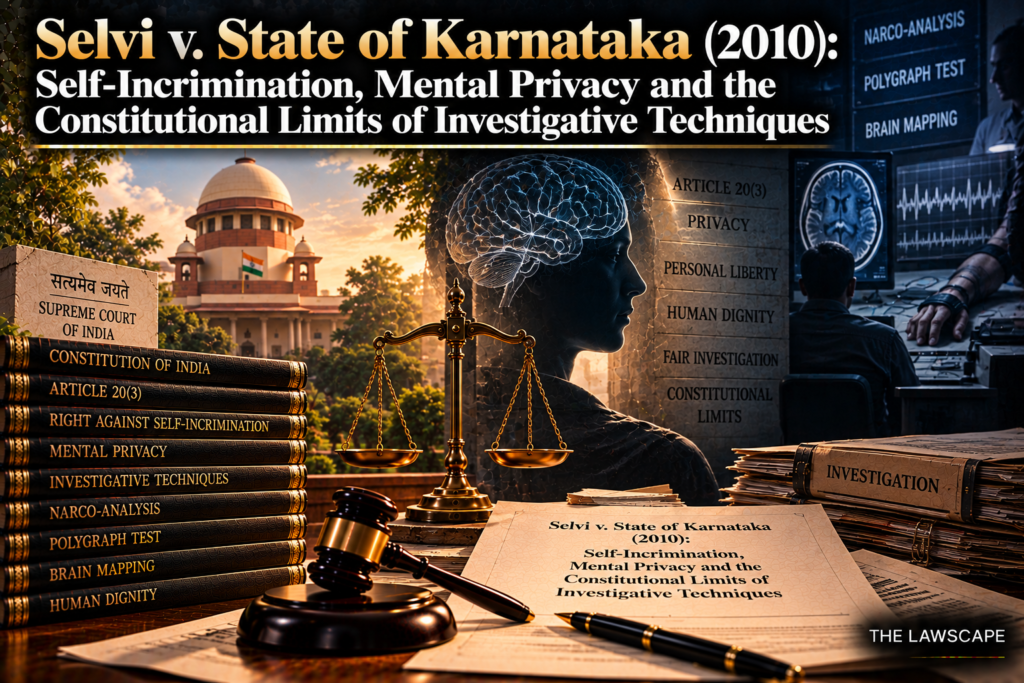
Selvi v. State of Karnataka (2010): Self-Incrimination, Mental Privacy and the Constitutional Limits of Investigative Techniques
Author: Srushti Prakash Gadhave
Student, National Forensic Sciences University
————————————————————————————————————-
Case Citation: Selvi & Ors. v. State of Karnataka, (2010) 7 SCC 263
Court: Supreme Court of India
Bench: Three-Judge Bench comprising Chief Justice K.G. Balakrishnan, Justice R.V. Raveendran and Justice J.M. Panchal
Date of Judgment: 5 May 2010
💡 3 Quick Takeaways
- Protection against self-incrimination: The involuntary administration of narcoanalysis, polygraph examinations and Brain Electrical Activation Profile (BEAP) tests violates Article 20(3) of the Constitution because these techniques involve the extraction of testimonial responses.
- Mental privacy and personal liberty: Compelling a person to undergo these procedures also violates Article 21, which protects personal liberty and the individual’s mental and psychological integrity.
- Consent and evidentiary limitations: These techniques may be administered only with genuine and voluntary consent and in accordance with the applicable safeguards. The resulting material does not automatically become admissible evidence or establish guilt.
1. Introduction
The relationship between investigative necessity and individual liberty has long been a central concern of criminal jurisprudence. Although the State has a legitimate interest in investigating offences and identifying those responsible, its investigative powers remain subject to constitutional limitations. The use of scientific and neuropsychological techniques in criminal investigations raises particularly difficult questions because these methods seek to obtain information through a person’s physiological responses or mental processes.
In Selvi & Ors. v. State of Karnataka, the Supreme Court of India considered the constitutional validity of three investigative techniques: narcoanalysis, polygraph examinations and Brain Electrical Activation Profile (BEAP) testing. The central question was whether a person could be compelled to undergo these procedures during a criminal investigation.
The Court examined the issue primarily through Articles 20(3) and 21 of the Constitution. Article 20(3) protects an accused person against compelled self-incrimination, while Article 21 safeguards life and personal liberty. The judgment clarified that the constitutional protection against compelled testimony extends beyond conventional verbal confessions and encompasses techniques that seek to obtain testimonial responses by bypassing an individual’s conscious control.
The decision is significant because it established constitutional limits on the use of investigative methods that intrude into a person’s mental processes. It also addressed the evidentiary implications of information obtained through such procedures.
2. Facts of the Case
The case arose from a batch of criminal appeals and connected proceedings concerning the use of neuro-scientific techniques during criminal investigations.
The three techniques considered by the Court were:
- Narcoanalysis: This procedure involves administering drugs intended to lower a person’s inhibitions, based on the theory that the person may disclose information more freely while under their influence. However, the procedure does not guarantee that the information disclosed will be truthful or accurate.
- Polygraph examination: Commonly known as a lie-detector test, a polygraph records physiological responses such as heart rate, breathing and skin conductivity while a person answers questions. It operates on the assumption that deceptive answers may produce detectable physiological changes, although such responses can have other causes.
- Brain Electrical Activation Profile (BEAP) testing: Also associated with Brain Electrical Oscillation Signature Profiling (BEOS), this technique examines electrical activity in the brain in response to information associated with an alleged crime. It is based on the theory that recognition of particular information may produce identifiable patterns of brain activity.
The State defended these techniques as modern investigative tools that could assist in cases where conventional investigative methods had proved insufficient. In some of the underlying proceedings, magistrates had permitted the administration of these tests despite the subjects’ refusal to consent.
The issue became particularly contentious because the procedures were treated by some authorities as comparable to conventional physical examinations, such as the collection of fingerprints or blood samples. Different High Courts had reached differing conclusions regarding the permissibility of compelling individuals to undergo these techniques.
The appellants challenged the orders permitting their involuntary administration, arguing that such procedures violated their fundamental rights. The Supreme Court considered the connected matters to determine the constitutional limits governing their use in criminal investigations.
3. Issues Before the Court
The principal issues were:
- Whether the involuntary administration of narcoanalysis, polygraph examinations and BEAP/BEOS techniques violates Article 20(3) of the Constitution, which protects against compelled self-incrimination.
- Whether the involuntary administration of these techniques violates the right to personal liberty and privacy protected under Article 21.
- Whether the results obtained through these techniques can be admitted as evidence and, if so, what evidentiary value they possess.
- Whether voluntary consent can make the administration of these techniques constitutionally permissible and what safeguards must be followed when they are undertaken voluntarily.
4. Arguments of the Parties
4.1 Arguments of the Appellants
The appellants argued that the three techniques were fundamentally different from conventional physical examinations because they sought to obtain responses originating from an individual’s mind, memory and personal knowledge.
A fingerprint or blood sample can be collected without requiring a person to communicate information about an alleged offence. By contrast, narcoanalysis seeks verbal responses, while polygraph and BEAP examinations attempt to draw inferences from physiological or neurological responses associated with questioning or crime-related information.
The appellants contended that compelling a person to undergo these procedures would undermine Article 20(3), which protects against being compelled to provide testimonial evidence against oneself. They also argued that the protection should not be defeated merely because a person was being questioned as a suspect or witness rather than having already been formally charged. Information disclosed during an investigation could subsequently be used to incriminate that person.
With respect to Article 21, the appellants submitted that forcibly administering drugs or subjecting an individual to procedures designed to access involuntary mental responses interferes with bodily autonomy, mental integrity and personal liberty. They maintained that constitutional protection must extend to an individual’s ability to decide what information to disclose and what to withhold.
The appellants also questioned the scientific reliability of the techniques. Narcoanalysis does not necessarily prevent a person from lying or fabricating information. Polygraph results may be affected by anxiety, medical conditions and deliberate countermeasures. The scientific validity and reliability of BEAP/BEOS testing were also disputed.
Accordingly, the appellants argued that investigative convenience could not justify compelling individuals to undergo procedures that infringed their fundamental rights.
4.2 Arguments of the Respondents
The State of Karnataka defended the techniques as investigative tools that could assist law-enforcement agencies, particularly in cases where physical evidence was limited or conventional interrogation had failed to produce useful information.
The respondents argued that these procedures were not equivalent to physical torture and should be considered alongside other investigative methods, such as obtaining fingerprints, blood samples, handwriting specimens and medical examinations. According to the State, the procedures generated information useful for investigation rather than conventional statements extracted through threats or physical force.
The State also proposed that, even if statements obtained through the tests could not be used directly against an accused person at trial, facts discovered as a result of those statements should remain admissible to the extent permitted by law. It relied on the principle reflected in Section 27 of the Indian Evidence Act, 1872, concerning the admissibility of information relating distinctly to a fact discovered.
Finally, the State argued that prior judicial authorisation and a magistrate’s order could provide sufficient safeguards against misuse. It contended that prohibiting the compelled use of these techniques would unnecessarily restrict the ability of investigators to solve difficult cases.
5. Judgment and Final Decision
The Supreme Court rejected the State’s position that these techniques could be administered involuntarily as ordinary investigative procedures. It held that the involuntary administration of narcoanalysis, polygraph examinations and BEAP testing violates Articles 20(3) and 21 of the Constitution.
5.1 Article 20(3): Protection Against Self-Incrimination
The Court held that the three techniques involve testimonial responses because they seek to obtain information originating from the subject’s personal knowledge and mental processes.
Article 20(3) provides that no person accused of an offence shall be compelled to be a witness against themselves. The Court examined the distinction between physical evidence and testimonial evidence, drawing upon the principles established in State of Bombay v. Kathi Kalu Oghad.
Physical evidence, such as fingerprints, generally exists independently of a person’s willingness to communicate information. Testimonial evidence, by contrast, conveys information derived from the individual’s personal knowledge.
The Court concluded that the physiological or neurological mechanism through which information is obtained does not alter the testimonial character of the response. The involuntary administration of these techniques therefore falls within the constitutional prohibition against compelled self-incrimination.
The judgment also recognised the importance of protection against compelled answers that may furnish a link in a chain of evidence leading to criminal liability. The constitutional safeguard cannot be circumvented simply by administering a test before a person has been formally charged.
5.2 Article 21: Personal Liberty and Mental Privacy
The Court separately examined the implications of these procedures under Article 21.
The protection of personal liberty is not confined to freedom from physical restraint. It also concerns personal autonomy and the ability to exercise control over matters that fundamentally affect one’s body and mind.
The involuntary administration of narcoanalysis, polygraph examinations and BEAP testing interferes with an individual’s ability to decide whether to disclose information. Such procedures can intrude upon mental and psychological integrity, particularly when they are conducted against the person’s wishes.
The Court therefore held that compelling a person to undergo these techniques violates Article 21. This constitutional objection is distinct from the question of whether the resulting information is ultimately used as evidence in a criminal trial. The involuntary procedure itself raises concerns about personal liberty and autonomy.
5.3 Scientific Reliability
The Court also considered the scientific basis and limitations of the techniques.
Narcoanalysis does not guarantee truthful disclosures, as a person under the influence of drugs may still provide inaccurate or fabricated information. Polygraph examinations are affected by physiological responses that may result from anxiety, fear, medical conditions or other factors unrelated to deception.
The Court also examined concerns about the scientific acceptance and validation of BEAP/BEOS testing. The limitations of these methods were relevant to assessing the State’s argument that their compulsory use was justified by investigative necessity.
The decision demonstrates that the use of scientific terminology does not, by itself, establish the reliability of an investigative method or remove the constitutional restrictions governing its administration.
5.4 Evidentiary Value of the Results
The Court distinguished between the permissibility of administering a test and the evidentiary value of the information obtained through it.
Even where a person voluntarily undergoes a test, the resulting statements do not automatically constitute a confession or provide a sufficient basis for conviction. Their admissibility and evidentiary value must be assessed in accordance with the applicable law.
The Court also considered the argument concerning facts discovered as a result of information obtained during such procedures. Section 27 of the Indian Evidence Act, 1872, permitted the use of information relating distinctly to a fact discovered in the circumstances covered by that provision. It did not make the entire statement obtained during the procedure admissible.
The distinction is important: the possible admissibility of a subsequently discovered fact does not validate the involuntary procedure through which the information was obtained.
5.5 Consent and Safeguards
The Court did not impose an absolute prohibition on the voluntary administration of these techniques. It held that they may be undertaken only where the subject gives genuine and voluntary consent and the applicable safeguards are followed.
The Court referred to the National Human Rights Commission’s 2000 guidelines governing the administration of polygraph examinations. These safeguards address matters such as consent, the recording of the procedure and appropriate medical oversight, particularly in relation to narcoanalysis.
However, consent must be voluntary rather than the product of compulsion. A judicial order authorising a procedure cannot, by itself, replace the individual’s consent or make an involuntary test constitutionally permissible.
The judgment thus drew a distinction between a procedure undertaken voluntarily under the required safeguards and one imposed by investigative or judicial authorities against the subject’s wishes.
6. Ratio Decidendi
The central ratio decidendi of Selvi v. State of Karnataka is that the involuntary administration of narcoanalysis, polygraph examinations and BEAP/BEOS testing violates Articles 20(3) and 21 of the Constitution.
First, the Court held that these techniques involve testimonial responses because they seek to obtain information derived from a person’s mental processes and personal knowledge. Their involuntary administration therefore violates the protection against compelled self-incrimination.
Second, the Court recognised that Article 21 protects personal liberty in a manner that includes mental and psychological integrity. Compelling an individual to undergo procedures that interfere with their control over the disclosure of information constitutes an infringement of personal autonomy.
Third, the Court clarified that the evidentiary consequences of these procedures must be considered separately from their constitutional permissibility. The possibility that information obtained during a procedure may lead to the discovery of a fact does not justify compelling the procedure in the first place.
Finally, the Court recognised a limited scope for voluntary administration, subject to genuine consent and compliance with the applicable safeguards. Judicial authorisation alone cannot cure the absence of consent.
The judgment therefore established that investigative necessity must operate within constitutional limits. The State cannot compel an individual to undergo a procedure that infringes the constitutional protection against self-incrimination and personal liberty merely because the procedure may assist an investigation.
7. Conclusion and Observations
Selvi v. State of Karnataka is a significant judgment on the constitutional limits of criminal investigation. It clarified the distinction between obtaining physical evidence and compelling an individual to provide testimonial information through techniques designed to access mental processes.
By interpreting Articles 20(3) and 21 together, the Supreme Court affirmed that the protection against self-incrimination extends beyond conventional confessions. It also recognised that personal liberty includes an individual’s interest in maintaining control over the disclosure of information arising from their own mental processes.
The decision has important implications for the use of scientific and technological methods in criminal investigations. A technique cannot be treated as constitutionally permissible merely because it is presented as a modern or scientifically advanced investigative tool. Its use must comply with fundamental rights, and the reliability of the information it produces remains a separate evidentiary question.
The judgment also highlights the importance of genuine consent. Although voluntary administration may be permissible under the safeguards identified by the Court, consent must be assessed carefully in circumstances involving police custody or investigative pressure. The existence of a formal consent document does not, by itself, resolve every question concerning voluntariness.
Ultimately, Selvi affirms that the pursuit of criminal justice must remain consistent with constitutional guarantees. The State’s responsibility to investigate offences does not displace an individual’s right against compelled self-incrimination or the protection of personal liberty. The judgment remains an important reference point for evaluating investigative techniques that seek to obtain information by intruding into the human mind.
Disclaimer: The views expressed in this article are those of the author and do not necessarily reflect the views of The Lawscape.
The Lawscape — clear, practical legal insight for students and future lawyers.