
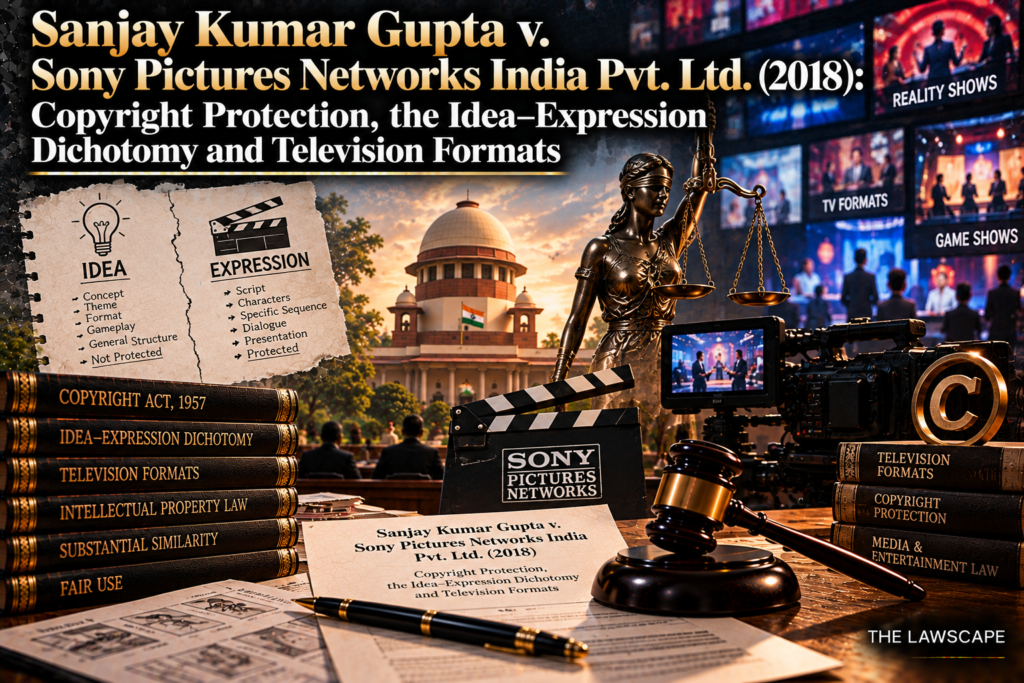
Sanjay Kumar Gupta v. Sony Pictures Networks India Pvt. Ltd. (2018): Copyright Protection, the Idea–Expression Dichotomy and Television Formats
Author: Santhoshini R.
Student, SASTRA Deemed University
——————————————————————
Case Citation: AIR 2018 Del 169; (2018) 251 DLT 688; (2018) 75 PTC 562 (Del)
Court: Delhi High Court
Judge: Justice Valmiki J. Mehta
Jurisdiction: Regular First Appeal under Section 96 of the Code of Civil Procedure, 1908
💡 3 Quick Takeaways
- Ideas are not protected by copyright: Copyright protects the expression of an idea in a legally recognised form, not the underlying idea, theme or concept itself.
- Originality and substantial similarity matter: A claimant must establish a protectable work and infringement of its protected expression. Similarity in generic features of a television format is not, by itself, sufficient.
- Confidentiality must be established: A breach-of-confidence claim may fail where the information is already publicly known or the claimant’s own documents undermine the alleged duty of confidence.
1. Introduction
In Sanjay Kumar Gupta & Anr. v. Sony Pictures Networks India Pvt. Ltd. & Ors., the Delhi High Court examined a longstanding question in Indian copyright law: whether an idea or concept, standing on its own, can attract copyright protection.
The appeal arose from a dispute between the creators of a television quiz format titled Jeeto Unlimited and the producers of Kaun Banega Crorepati (KBC), India’s well-known television game show. The dispute concerned a viewer-participation segment introduced on the KBC platform in collaboration with Reliance Jio.
Justice Valmiki J. Mehta, deciding the appeal under Section 96 of the Code of Civil Procedure, 1908, upheld the dismissal of the appellants’ suit. The judgment reaffirmed the principle laid down by the Supreme Court in R.G. Anand v. Delux Films: copyright subsists in the expression of an idea, not in the idea, theme or concept itself.
The decision is significant because it demonstrates how the idea–expression dichotomy applies to television programme formats. It also illustrates how an associated claim for breach of confidence may fail where the underlying information is not confidential or the claimant’s own documents undermine the alleged obligation of confidentiality.
2. Facts of the Case
The appellants, Sanjay Kumar Gupta and another, had conceived a play-along television format titled Jeeto Unlimited. According to the plaint, the format was registered as a copyrighted work on 4 January 2013 under Registration No. L-45361/2013.
The essential features of the proposed format included allowing home viewers to participate simultaneously with a studio contestant, answer the same questions posed to that contestant, participate through their phones and receive rewards based on the value of the questions answered correctly.
The appellants claimed that they had presented the concept to representatives of Sony Pictures Networks India Pvt. Ltd., the producer and broadcaster of KBC, during 2010–2011. They referred to meetings facilitated through Turner Broadcasting System in December 2011 and February 2012.
Before the relevant discussions, the appellants had signed a consent letter of the kind commonly used in the television industry. According to the case, the letter released the media house from liability if it subsequently broadcast content similar to the concept being pitched.
Sony later introduced a segment titled Jio KBC Play Along – Darshak Banenge Khilaadi in partnership with Reliance Jio. The segment enabled home viewers to answer questions posed to the studio contestant through a digital platform. The appellants alleged that this segment infringed their copyright in Jeeto Unlimited and breached the confidence in which they had disclosed their concept.
The trial court framed eight issues, including whether the concept constituted an original work protected under the Copyright Act, 1957, and whether the respondents had infringed the appellants’ rights. After recording evidence, including an admission by one of the appellants’ witnesses that home-viewer engagement was not a novel feature of quiz programmes, the trial court concluded that the two formats were fundamentally and substantially different and dismissed the suit.
The appellants challenged that decision before the Delhi High Court by way of a regular first appeal.
3. Issues Raised
The High Court considered three principal questions:
- Whether a mere idea or concept, as distinct from its expression in a literary, dramatic, musical or artistic work, can constitute a subject matter of copyright under the Copyright Act, 1957.
- Whether, assuming the concept of Jeeto Unlimited was protectable, the respondents’ Jio KBC Play Along segment reproduced its substantial and fundamental features so as to amount to copyright infringement.
- Whether the respondents were liable for breach of confidence by using a concept allegedly disclosed to them under circumstances of confidentiality.
4. Analysis of the Judgment
4.1 The Idea–Expression Dichotomy
The appellants relied principally on the Bombay High Court’s decision in Anil Gupta v. Kunal Dasgupta. They argued that a sufficiently developed concept note, containing defined components such as the mode of viewer participation and the structure of rewards, could itself qualify for copyright protection independently of a completed script or broadcast.
On this basis, the appellants contended that the similarities between the mechanics of Jeeto Unlimited and Jio KBC Play Along, as set out in a side-by-side comparison in the plaint, demonstrated copying.
The respondents disputed both originality and infringement. They relied on differences between the two formats, including the mechanism for selecting participating viewers, the relationship between the home-viewer game and the studio contestant’s performance, and the reward structures and elimination rules.
In particular, KBC used a “Fastest Finger First” mechanism to select participants, whereas Jeeto Unlimited relied on a lottery-style draw. The KBC home-viewer game also operated independently of, and continued beyond, the studio contestant’s game, while the appellants’ format linked the viewer’s outcome directly to the contestant’s performance.
The respondents further relied on the admission made by the appellants’ witness during cross-examination that home-audience participation had already appeared in earlier television programmes.
The Court approached the dispute through the statutory framework of the Copyright Act, 1957. Section 2(y) defines “work” by reference to the categories recognised under the Act, including literary, dramatic, musical and artistic works, cinematograph films and sound recordings. Sections 37 to 39A separately address certain broadcast-related rights.
The Court held that a concept does not become a protectable work merely because its components have been described in detail. The features identified by the appellants were, in substance, generic elements of a quiz format involving home-viewer participation. Without a qualifying expression of the idea, those elements could not independently establish copyright protection.
Section 16 of the Act reinforces the principle that copyright cannot be claimed except as provided by the statute. The central distinction is therefore between an idea, which remains available for others to develop, and its original expression in a form recognised by copyright law.
4.2 Originality and the Question of Copying
The Court also considered whether the appellants could establish infringement even if the concept were assumed, for the sake of argument, to be protectable.
The underlying idea of enabling a home audience to participate alongside a studio contestant was already known. The appellants’ own witness acknowledged that audience participation was not a novel feature of quiz programmes. The Court also considered the absence of a pleaded assertion that the appellants were the first to originate the format.
These circumstances weakened the claim that the appellants could establish originality in the underlying idea. The fact that two programmes share a general concept does not necessarily establish that one has copied the protectable expression of the other.
The comparison between the formats was therefore important. Their selection procedures, rules, relationship with the studio contestant and reward mechanisms differed in material respects. The dispute could not be resolved simply by identifying common features that formed part of the general idea of audience participation.
The judgment reaffirmed the principle in R.G. Anand v. Delux Films, in which the Supreme Court explained that copyright does not extend to ideas, themes or subject matter as such. Protection concerns the expression of those ideas in a qualifying work.
The High Court declined to follow Anil Gupta v. Kunal Dasgupta to the extent that it was relied upon to establish an independent copyright in a concept. The Supreme Court’s binding decision in R.G. Anand governed the question of whether an idea, without protectable expression, could sustain a copyright claim.
4.3 The Claim for Breach of Confidence
The appellants also argued that the respondents had used their concept after receiving it in circumstances that gave rise to an obligation of confidence.
The Court rejected this claim for two principal reasons. First, the appellants’ own witness had acknowledged that the underlying concept of home-viewer participation was already well known. This undermined the assertion that the information, in the form relied upon, was confidential.
Second, the appellants had pleaded that they signed consent letters releasing the media houses from liability for broadcasting similar content. The Court treated this aspect of their own case as an important obstacle to establishing the alleged duty of confidence.
The decision illustrates that a claim for breach of confidence requires more than showing that information was disclosed to another party and later used in a related context. The claimant must establish the relevant circumstances of confidentiality and a basis for imposing an obligation on the recipient.
The Court did not need to determine the broader question of whether a concept note disclosed under an industry consent letter might retain some independently protectable confidential element. On the facts before it, the appellants’ evidence and pleadings were sufficient to defeat the claim.
4.4 Doctrinal Significance
The judgment did not fundamentally alter the idea–expression dichotomy. Instead, it applied the established principle rigorously to television and game-show formats, where commercially valuable concepts may share common structural features.
Its significance lies in clarifying that a detailed concept note does not automatically create copyright over the underlying idea. Nor does a general resemblance between two formats necessarily establish infringement.
For creators, producers and broadcasters, the decision highlights the importance of distinguishing between generic programme mechanics and the original expression of a particular work. For litigants, it also demonstrates the significance of evidence, admissions made during cross-examination and documents executed during the pitching process.
5. Conclusion
Sanjay Kumar Gupta v. Sony Pictures Networks India Pvt. Ltd. reaffirms the foundational principle that copyright protects the expression of an idea rather than the idea itself. In the context of television formats, the decision makes clear that a concept cannot acquire independent copyright protection merely because it is commercially valuable or described in considerable detail.
By applying the principle established in R.G. Anand v. Delux Films, the Delhi High Court emphasised that the existence of common features between two programmes does not, by itself, establish infringement. A claimant must identify a legally protectable work and demonstrate infringement of its protected expression.
The judgment also illustrates the evidentiary difficulties that may arise in disputes involving programme formats. Here, an admission that home-audience participation was already a known feature and the existence of consent letters affected both the copyright and confidentiality claims.
For practitioners advising content creators, the case underscores the importance of identifying the precise work for which protection is claimed and carefully documenting the terms on which concepts are disclosed to prospective producers or broadcasters. Although copyright cannot create a monopoly over generic ideas, original expression may receive protection where the statutory requirements are satisfied.
More broadly, the ruling forms part of the established line of Indian authority, beginning with R.G. Anand, that distinguishes protectable expression from ideas and commonplace creative elements. This distinction preserves the ability of different creators to develop works around shared concepts while maintaining copyright protection for original expression.
Endnotes
- Sanjay Kumar Gupta v. Sony Pictures Networks India Pvt. Ltd., AIR 2018 Del 169; (2018) 251 DLT 688 (Del).
- R.G. Anand v. Delux Films, (1978) 4 SCC 118.
- Copyright Act, 1957, § 2(y).
- Copyright Act, 1957, § 13(1).
- Copyright Act, 1957, § 16.
- Copyright Act, 1957, §§ 37–39A.
- Anil Gupta v. Kunal Dasgupta, (2002) 97 DLT 257 (Del).
- Code of Civil Procedure, 1908, § 96.
- Zee Telefilms Ltd. v. Sundial Communications Pvt. Ltd., 2003 SCC OnLine Bom 344.
Disclaimer: The views expressed in this article are those of the author and do not necessarily reflect the views of The Lawscape.
The Lawscape — clear, practical legal insight for students and future lawyers.