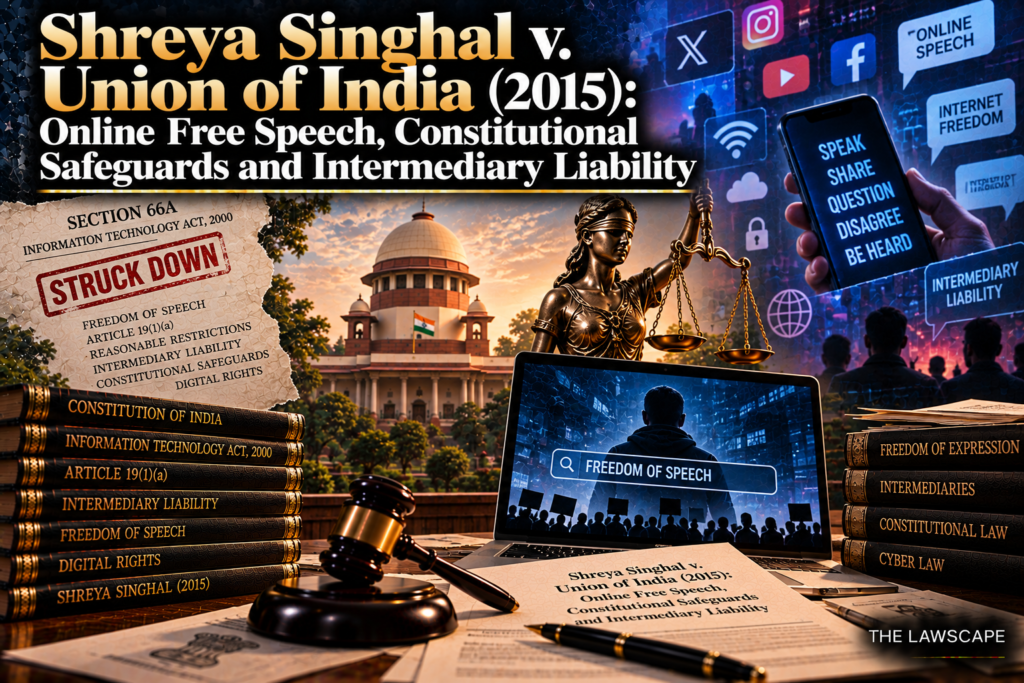
Shreya Singhal v. Union of India (2015): Online Free Speech, Constitutional Safeguards and Intermediary Liability
Author, Akshita Agarwal
Student, Iilm university , greater noida
——————————————————————————-
Case Citation: (2015) 5 SCC 1
Court: Supreme Court of India
Bench: Justice J. Chelameswar and Justice R.F. Nariman
Date of Judgment: 24 March 2015
💡 3 Quick Takeaways
- Freedom of speech online: The Supreme Court struck down Section 66A of the Information Technology Act, 2000, because its vague and overbroad language impermissibly restricted freedom of speech.
- Constitutional safeguards: The Court upheld Section 69A, recognising the statutory grounds and procedural safeguards governing the blocking of online content.
- Intermediary liability: The Court read down Section 79(3)(b) and Rule 3(4), limiting the meaning of “actual knowledge”. This protected intermediaries from being compelled to remove content merely on the basis of private complaints, but raised questions about access to remedies for individuals facing online harm.
Facts
Section 66A was inserted into the Information Technology Act, 2000, by the Information Technology (Amendment) Act, 2009. It criminalised the sending of information through a computer resource that was “grossly offensive”, had a “menacing character”, or was known to be false and sent with the intention of causing “annoyance, inconvenience, danger, obstruction, insult, injury, criminal intimidation, enmity, hatred or ill will”. A person convicted under the provision could face imprisonment for up to three years.
In November 2012, two young women in Palghar, Maharashtra, were arrested under Section 66A. One had posted a Facebook status questioning the shutdown of Mumbai following the death of a political leader, while the other had merely “liked” the post. Although the arrests were subsequently withdrawn, the incident drew public attention to the potential misuse of Section 66A against ordinary online expression.
The incident prompted Shreya Singhal, then a law student, to file a writ petition under Article 32 of the Constitution, challenging the constitutional validity of the provision. Several other petitions were subsequently tagged with hers. These challenged Section 66A, Section 69A, which concerns the blocking of online content, Section 79, which governs intermediary liability, and the rules framed under the Act.
The Supreme Court heard the matter through a two-judge Bench and delivered its judgment on 24 March 2015.
Introduction
The internet has become an important forum for public discourse, political participation and the exchange of ideas. Its development has required constitutional courts to consider how established principles of freedom of expression apply to digital communication. Shreya Singhal v. Union of India represents a significant intervention by the Supreme Court of India in this area.
In a judgment authored by Justice R.F. Nariman, the Court declared Section 66A of the Information Technology Act, 2000, unconstitutional in its entirety. It upheld Section 69A, which empowers the government to block access to online information subject to statutory requirements, and read down Section 79 in relation to intermediary liability.
The judgment is widely recognised for its protection of online speech. However, its treatment of intermediary liability under Section 79 also warrants closer examination. The Court’s reasoning on Section 66A addressed the problems of vagueness, overbreadth and the chilling effect on constitutionally protected expression. By contrast, although its interpretation of Section 79 sought to prevent private parties from exercising excessive control over online speech, the judgment did not fully address the practical difficulties faced by individuals seeking the removal of unlawful content.
This commentary examines the Court’s reasoning, its relationship with established constitutional principles, the adequacy of its treatment of intermediary liability, and the policy questions that followed from the decision.
Background
Section 66A was introduced through the 2009 amendment to the Information Technology Act, 2000. Its language criminalised certain online communications based on expressions such as “grossly offensive”, “menacing character”, “annoyance” and “inconvenience”. These terms did not provide sufficiently clear boundaries between lawful expression and punishable conduct.
The arrests in Maharashtra brought the provision’s potential consequences into focus. The controversy also raised broader questions about the constitutional limits of regulating online communication. The resulting petitions challenged not only Section 66A but also the statutory framework governing content blocking and the liability of intermediaries.
The Court situated its reasoning within the established constitutional protection of freedom of speech and expression under Article 19(1)(a). It considered earlier decisions, including Romesh Thappar v. State of Madras, Sakal Papers (P) Ltd. v. Union of India, Bennett Coleman & Co. v. Union of India and S. Khushboo v. Kanniamal, which addressed the importance of free expression and the circulation of ideas.
The Court also considered Secretary, Ministry of Information & Broadcasting v. Cricket Association of Bengal in examining the relationship between freedom of expression and media. In assessing the validity of Section 66A, the Court drew upon the constitutional framework governing permissible restrictions under Article 19(2), including the principles associated with Kedar Nath Singh v. State of Bihar.
This framework enabled the Court to assess Section 66A not merely as a measure regulating a new form of communication, but as a restriction on constitutionally protected expression that had to satisfy established constitutional requirements.
Analysis
1. Was the Court’s decision justified?
The Court’s decision to strike down Section 66A addressed a fundamental constitutional problem. The provision used expressions such as “grossly offensive”, “annoyance” and “inconvenience” without providing sufficiently objective standards for determining when online communication became criminal. As the Court observed, what one person considered offensive might not be regarded as offensive by another.
The absence of clear boundaries created uncertainty for individuals communicating online. A person could not reliably determine whether a post, comment or message would expose them to criminal proceedings. This uncertainty was particularly significant because the provision prescribed imprisonment.
The Court distinguished between discussion, advocacy and incitement. Discussion and advocacy, even when unpopular or critical of those in authority, ordinarily fall within the protection of Article 19(1)(a). Incitement, by contrast, may justify legal restriction when the applicable constitutional requirements are satisfied. Section 66A failed to maintain this distinction because its broad language could encompass expression that did not amount to incitement or fall within the grounds specified in Article 19(2).
The Court’s reasoning also addressed the chilling effect of criminal liability. Where individuals cannot reasonably predict whether their expression will attract punishment, they may avoid expressing lawful opinions altogether. The resulting restriction extends beyond the speech that the State may constitutionally regulate.
The judgment’s reasoning is consistent with the broader principle that restrictions on fundamental rights must have sufficiently clear boundaries. Comparative jurisprudence, including Grayned v. City of Rockford in the United States, has also examined the constitutional problems associated with vague legal provisions. Although the legal systems differ, the comparison illustrates the broader significance of legal certainty when criminal liability affects expression.
2. Did the decision follow or change existing law?
The judgment is best understood as an application of established constitutional principles rather than the creation of an entirely new standard of free speech.
Article 19(1)(a) protects freedom of speech and expression, while Article 19(2) permits restrictions only on specified grounds and subject to constitutional requirements. Earlier decisions had already established the importance of protecting expression and examining restrictions carefully.
In Romesh Thappar v. State of Madras, the Supreme Court addressed the constitutional protection of political expression. Other decisions, including Sakal Papers and Bennett Coleman, examined restrictions affecting the circulation of information and the freedom of the press. These authorities formed part of the constitutional background against which the Court considered Section 66A.
The judgment also distinguished the provision from the sedition law considered in Kedar Nath Singh. The issue was not simply whether Section 66A could be interpreted narrowly. Its broad and uncertain language extended to communications that did not necessarily bear the constitutionally required relationship to the grounds of restriction under Article 19(2).
The significance of Shreya Singhal therefore lies substantially in its application of existing constitutional principles to online communication. It demonstrated that the use of digital technology does not remove expression from constitutional protection and that restrictions on online speech must satisfy the same constitutional standards applicable to other forms of expression.
3. Did the Court adequately justify its reasoning, and were any issues left unresolved?
The Court’s analysis of Section 66A was detailed in its treatment of vagueness, overbreadth and the chilling effect. Its treatment of Section 69A also addressed the relationship between the power to block online content and the constitutional grounds for restricting expression.
The Court upheld Section 69A, taking account of its connection with the grounds specified in Article 19(2) and the procedural safeguards under the Information Technology (Procedure and Safeguards for Blocking for Access of Information by Public) Rules, 2009. These safeguards included requirements concerning the blocking process and the recording of reasons, subject to the applicable statutory framework.
The more difficult issue concerns Section 79(3)(b) and Rule 3(4) of the Information Technology (Intermediaries Guidelines) Rules, 2011. These provisions formed part of the framework governing an intermediary’s entitlement to safe-harbour protection. The interpretation of “actual knowledge” was central to the Court’s consideration of whether intermediaries could be expected to remove allegedly unlawful content following private complaints.
The Court was concerned that allowing private complaints alone to trigger removal obligations could encourage intermediaries to remove content excessively to avoid losing their statutory protection. Intermediaries might choose to remove disputed material rather than risk legal liability, even where the material was lawful. Such a system could reproduce the chilling effect that the Court had identified in Section 66A.
The Court consequently read down the relevant provisions, holding that “actual knowledge” in this context required a court order or notification by the appropriate government or its agency, in accordance with the judgment. This interpretation sought to prevent intermediaries from becoming private arbiters of the legality of online speech.
That reasoning follows the judgment’s broader concern with protecting expression from arbitrary restriction. However, it also raises a practical question: how can individuals obtain timely relief when online content allegedly infringes their rights?
Victims of defamation, harassment or the non-consensual circulation of intimate images may require prompt action to prevent continuing harm. Requiring judicial or governmental intervention can provide procedural safeguards, but it may also impose additional time and financial burdens on those seeking relief. The judgment did not establish a comprehensive, time-bound process through which such complaints would be considered.
Subsequent legal commentary has examined the relationship between intermediary liability and freedom of expression. Later litigation, including copyright disputes before the Delhi High Court, has also contributed to the development of the actual-knowledge standard. MySpace Inc. v. Super Cassettes Industries Ltd. provides an example of the continuing judicial consideration of intermediary liability in the context of online content.
The judgment’s treatment of Section 79 therefore left practical questions for subsequent courts, legislators and policymakers. Its concern about excessive removal of lawful content was constitutionally significant, but the judgment did not fully explain how that concern should be balanced against the need for accessible and timely remedies for individuals facing unlawful online content.
4. What were the policy implications, and were alternative approaches available?
The striking down of Section 66A removed a provision that had exposed online expression to criminal liability through vague and expansive language. The judgment also established an important constitutional precedent for assessing restrictions on digital speech.
Nevertheless, the continuing registration of complaints under Section 66A after it had been struck down illustrates that a judicial declaration of invalidity does not automatically ensure consistent compliance by law-enforcement authorities. Implementation may require effective communication of the judgment, appropriate police training and institutional mechanisms to identify and prevent reliance on unconstitutional provisions.
The Court’s treatment of intermediary liability raises a different policy question. Its interpretation of “actual knowledge” sought to prevent private complaints from becoming a mechanism for suppressing lawful expression. However, it also left questions about how individuals could secure prompt relief without first navigating potentially lengthy legal proceedings.
One possible alternative, as a matter of policy, would be a structured complaint mechanism that preserves safeguards against arbitrary takedowns while providing a clearer route for addressing unlawful content. Such a framework could include reasoned decisions, defined response periods and an opportunity for affected parties to contest a proposed removal. A counter-notice mechanism could also help address disputes over the legality of content.
These measures would require careful legal design. Any system that permits private complaints to trigger removal must guard against strategic or abusive demands to suppress lawful speech. Conversely, a system that makes effective relief excessively difficult to obtain may leave individuals without a practical remedy for serious online harm.
The central policy challenge is therefore to protect freedom of expression while ensuring that individuals have meaningful access to remedies where their rights are infringed. The judgment established important constitutional limits, but the development of a workable procedural framework remains a separate task for the relevant institutions.
Conclusion
Shreya Singhal v. Union of India remains a landmark decision in Indian free-speech jurisprudence. Its treatment of Section 66A applied established constitutional principles concerning vagueness, overbreadth and the chilling effect to a provision that imposed criminal liability on broadly defined forms of online communication.
The Court also recognised the importance of safeguards when the State exercises powers to block online content. Its interpretation of Section 79 sought to prevent intermediaries from removing material merely in response to private demands, thereby reducing the risk of excessive restrictions on lawful expression.
However, the judgment’s treatment of intermediary liability left unresolved questions about the practical availability of timely remedies for individuals facing unlawful online content. The requirement of judicial or governmental intervention can protect against arbitrary takedowns, but it also makes the accessibility and speed of those processes important considerations.
The enduring significance of the judgment lies in the constitutional principles it applied to digital communication. At the same time, it demonstrates that protecting individuals from State overreach and providing remedies for harm caused through online platforms can raise distinct concerns. Addressing both requires legal rules that protect freedom of expression while providing clear, accessible and procedurally fair mechanisms for resolving disputes over online content.
References
- The Information Technology Act, 2000, § 66A (inserted by the Information Technology (Amendment) Act, 2009).
- Shreya Singhal v. Union of India, (2015) 5 SCC 1, 15–16.
- Writ Petition (Criminal) No. 167 of 2012, Supreme Court of India.
- Romesh Thappar v. State of Madras, 1950 SCR 594.
- Sakal Papers (P) Ltd. v. Union of India, 1962 SCR (3) 842.
- Bennett Coleman & Co. v. Union of India, (1973) 2 SCR 757.
- S. Khushboo v. Kanniamal, (2010) 5 SCC 600.
- Secretary, Ministry of Information & Broadcasting v. Cricket Association of Bengal, (1995) 2 SCC 161.
- Kedar Nath Singh v. State of Bihar, AIR 1962 SC 955.
- Grayned v. City of Rockford, 408 U.S. 104 (1972).
- Shreya Singhal v. Union of India, (2015) 5 SCC 1, paras 13–23, 82–83.
- The Information Technology Act, 2000, § 69A; Information Technology (Procedure and Safeguards for Blocking for Access of Information by Public) Rules, 2009.
- The Information Technology Act, 2000, § 79(3)(b); Information Technology (Intermediaries Guidelines) Rules, 2011, Rule 3(4).
- Shreya Singhal v. Union of India, (2015) 5 SCC 1, paras 95–100, 117–122.
- Chinmayi Arun, “Gatekeeper Liability and Article 19(1)(a) of the Constitution of India”, 7 NUJS L. Rev. 73, 88–91 (2014).
- Apar Gupta, Commentary on Information Technology Act 245–49 (2nd ed. 2016).
- MySpace Inc. v. Super Cassettes Industries Ltd., 236 (2017) DLT 478.
- People’s Union for Civil Liberties v. State of Maharashtra, W.P. (Crl.) No. 12764 of 2019 (Bombay High Court).
Disclaimer: The views expressed in this article are those of the author and do not necessarily reflect the views of The Lawscape.
The Lawscape — clear, practical legal insight for students and future lawyers