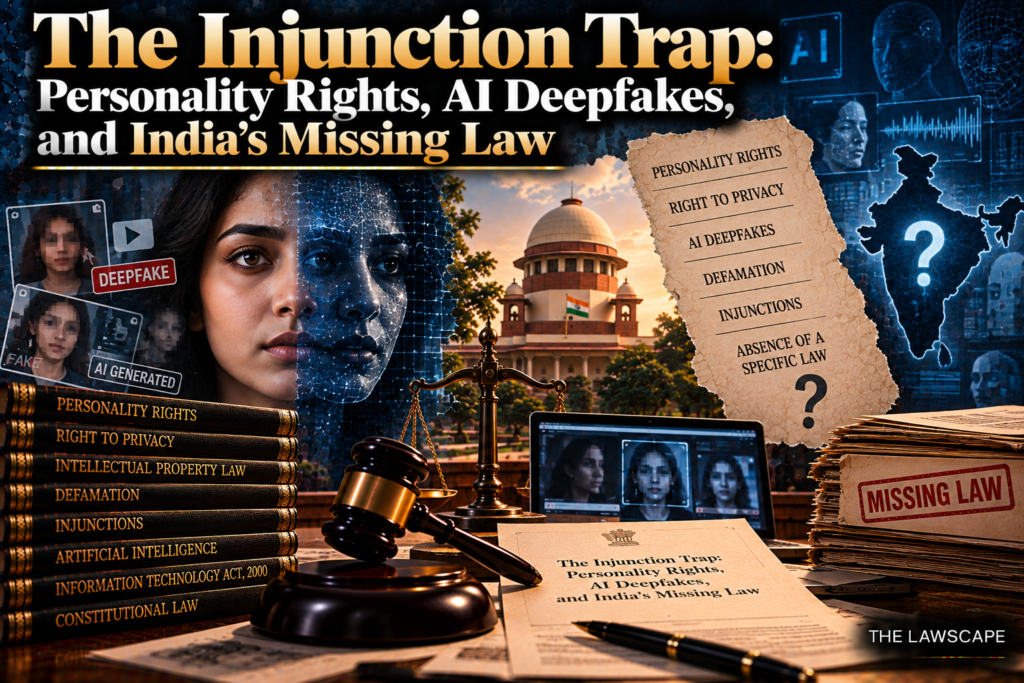
The Injunction Trap: Personality Rights, AI Deepfakes, and India’s Missing Law
Author: Akshita Agrawal
Student, Iilm university , greater noida
——————————————————————————–
Abstract
AI-generated deepfakes raise serious questions about personal identity, dignity, privacy and the adequacy of existing legal remedies. By reproducing a person’s face, voice or likeness without consent, these technologies can damage reputations, disrupt careers and facilitate harassment, fraud and the creation of non-consensual intimate imagery. Indian courts have responded through personality-rights decisions, including Anil Kapoor v. Simply Life India, Arijit Singh v. Codible Ventures LLP and Sadhguru Jagadish Vasudev v. Igor Isakov. However, judicial injunctions primarily provide case-specific relief and may be difficult for individuals without substantial financial resources to obtain.
This article argues that India needs a more comprehensive framework for protecting digital identity. It examines the development of personality rights in Indian jurisprudence, the limitations of existing legal remedies, and selected approaches adopted in the European Union, the United States and China. It proposes a dedicated personality-rights framework, proportionate criminal liability for harmful deepfakes, safeguards for AI developers, accessible remedies for victims, and stronger forensic capacity. The central argument is that protection against unauthorised digital impersonation should not depend on a person’s celebrity status or ability to approach a High Court.
Keywords: AI deepfakes, personality rights, digital identity, privacy, intermediary liability, criminal liability.
I. Introduction: The Problem Is Bigger Than We Think
India’s response to AI-generated deepfakes increasingly follows a familiar pattern. A public figure discovers that their face, voice or identity has been misappropriated, legal proceedings begin, and a court may issue an injunction against the unauthorised use of that person’s personality. Such orders can provide meaningful relief, but similar incidents continue to occur. The underlying difficulty is that individual judicial remedies do not necessarily establish an accessible system of protection for everyone affected.
Generative artificial intelligence enables users to create realistic images, videos and audio recordings of real people with relatively little technical expertise. A singer’s voice may be cloned to produce a fabricated song. A doctor’s identity may be used to promote a product without authorisation. A public figure’s likeness may be incorporated into misleading material for financial fraud. A woman’s face may be placed onto fabricated intimate imagery without her consent.
These examples illustrate how deepfakes can affect privacy, dignity, reputation, personal autonomy and financial security. The harm may be particularly severe when fabricated intimate content is circulated widely or when an individual’s identity is used to mislead others.
India’s legal framework addresses aspects of these harms through Article 21 of the Constitution, Article 19(1)(a), the Information Technology Act, 2000, other applicable legislation and judicial decisions recognising personality rights. These protections are significant, but their interaction does not automatically provide a comprehensive remedy for every form of AI-generated impersonation.
This article examines the limits of the current approach and argues for a framework that protects individuals irrespective of their public profile. It also considers how regulation can address not only the circulation of harmful content but, where appropriate, the conduct of those who create and distribute it.
II. Personality Rights: What They Are and Why They Matter More Than Ever
Personality rights concern an individual’s interest in controlling the commercial exploitation and unauthorised appropriation of aspects of their identity. Depending on the legal context, these aspects may include a person’s name, image, likeness, voice and other recognisable characteristics.
Such rights are not relevant only to celebrities. Although public figures may have a substantial commercial interest in their identities, ordinary individuals also have interests in privacy, dignity and control over how their personal attributes are used. Unauthorised digital replication can expose anyone to impersonation, reputational harm, harassment or fraud.
In India, constitutional privacy jurisprudence provides an important foundation for understanding these concerns. In Justice K.S. Puttaswamy (Retd.) v. Union of India, the Supreme Court recognised privacy as a fundamental right under the Constitution, including interests connected with personal autonomy and informational privacy. Article 21 also protects life and personal liberty, while Article 19(1)(a) protects freedom of speech and expression.
These constitutional interests may intersect in deepfake disputes. A person whose likeness is misappropriated may seek protection against privacy violations, reputational injury or unauthorised commercial exploitation. At the same time, regulation must account for legitimate expression, satire, commentary, artistic work and other uses that may be constitutionally protected.
The challenge is therefore not simply to prohibit all synthetic representations of real people. It is to distinguish harmful or unauthorised uses from legitimate expression while ensuring that individuals have meaningful remedies when their identity is exploited.
III. What the Courts Have Done: Progress and Its Limits
A. The development of judicial protection
Indian courts have increasingly addressed the unauthorised use of personality traits in the digital environment. In Amitabh Bachchan v. Rajat Nagi, the Delhi High Court considered the protection of a public figure’s personality against unauthorised exploitation.
In Anil Kapoor v. Simply Life India (2023), the Delhi High Court addressed the unauthorised use of the actor’s name, image, voice and other personality attributes, including misuse facilitated by artificial intelligence. The proceedings illustrated how existing personality-rights principles could be applied to emerging forms of digital impersonation.
In Arijit Singh v. Codible Ventures LLP (2024), the Bombay High Court considered the unauthorised exploitation of the singer’s identity, including concerns relating to voice cloning and artificial intelligence. The dispute demonstrated the importance of protecting an individual’s recognisable voice and identity against unauthorised commercial use.
Later proceedings, including Sadhguru Jagadish Vasudev v. Igor Isakov (2025), brought further attention to injunctions designed to address recurring or future instances of digital impersonation. The concept of a dynamic injunction may allow relief to respond to additional instances of allegedly infringing content without requiring an entirely new proceeding for every repetition, subject to the terms and legal limits of the order.
Courts have also considered personality-rights claims involving individuals outside the traditional entertainment industry. The proceedings concerning healthcare professional Dr Devi Prasad Shetty and public educator Ankur Warikoo illustrate the broader relevance of these disputes.
Taken together, these cases demonstrate that Indian courts can apply existing legal principles to emerging forms of identity misuse. They also raise an important question: whether case-by-case litigation can provide adequate protection for individuals who lack the resources to initiate proceedings.
B. Why injunctions are not enough
An injunction can restrain specified conduct and direct relevant parties to take action against unlawful content. In appropriate circumstances, it may also address recurring instances of misuse. However, judicial relief has practical limitations.
First, approaching a High Court may involve substantial legal costs, time and procedural complexity. A celebrity or well-resourced public figure may be able to pursue urgent relief, while a student, teacher, small-business owner or private individual may struggle to do so.
Second, an order obtained by one claimant does not automatically provide equivalent protection to every other person targeted by deepfakes. Each individual may face a separate problem involving different content, platforms, perpetrators and evidence.
Third, removal of content does not necessarily identify or hold accountable the person who created it. A fabricated video may be removed from one platform while copies continue to circulate elsewhere. The creator may remain unidentified, and the affected person may still face reputational or personal harm.
These limitations do not make injunctions ineffective. Rather, they demonstrate that injunctions are one component of a broader legal response. A system that relies predominantly on individual litigation may leave gaps in access to justice, enforcement and prevention.
The central concern is equality of protection. A person’s ability to seek relief against unauthorised digital impersonation should not depend entirely on their wealth, professional status or public recognition.
IV. What the Existing Legal Framework Provides—and Where It Falls Short
India has several laws that may apply to different aspects of deepfake-related conduct. Their relevance depends on the nature of the content, the method used to create it, the harm caused and the circumstances of its distribution.
The Information Technology Act, 2000, contains provisions addressing conduct such as identity theft and certain violations of privacy. Sections 66C, 66E and 67A may be relevant in particular circumstances involving fraudulent use of identity, certain private images or sexually explicit material in electronic form. However, these provisions have distinct elements and cannot be treated as a general prohibition on every deepfake.
The Copyright Act, 1957, may protect particular works and performers’ rights. Sections 38A and 57 may be relevant to performers’ rights and certain forms of distortion or modification. Nevertheless, copyright does not provide a universal right to control every unauthorised use of a person’s face or likeness. A deepfake made from publicly available material may raise issues that cannot be resolved solely through copyright law.
The Digital Personal Data Protection Act, 2023, establishes a framework for the processing of digital personal data, subject to its provisions, applicable exemptions and commencement arrangements. Its application to facial images, voice recordings and AI training depends on the circumstances and the statutory requirements. It should not be assumed that every use of a person’s likeness automatically creates criminal liability or that every breach results in imprisonment.
Intermediary rules may also impose obligations on online platforms concerning specified categories of unlawful or harmful content. However, platform obligations and the liability of the individual who creates a deepfake are separate questions. Rules governing the removal of content do not, by themselves, establish a comprehensive system of accountability for all creators, distributors or developers of AI tools.
The existing framework therefore offers several possible avenues of relief, but those avenues address different legal interests and operate under different conditions. Their combined existence does not necessarily resolve every problem involving consent, attribution, rapid removal, compensation and the identification of perpetrators.
V. Comparative Perspectives: Lessons from Other Jurisdictions
Comparative law can help identify different regulatory approaches, although each jurisdiction operates within its own constitutional and legal framework.
A. European Union
The European Union’s Artificial Intelligence Act, Regulation (EU) 2024/1689, establishes obligations for certain AI systems and general-purpose AI models. It also addresses transparency in relation to specified forms of AI-generated or manipulated content.
The broader regulatory lesson is that obligations can apply at different stages of the AI lifecycle. Rules may concern developers, providers, deployers and distributors rather than focusing exclusively on the final publication of harmful content.
For India, this raises the question of whether certain AI systems capable of producing realistic impersonations should be subject to appropriate transparency, risk-management and technical safeguards. Such obligations would need to be proportionate to the risks and designed to avoid unnecessarily restricting legitimate uses of generative technology.
B. United States
The United States has adopted the TAKE IT DOWN Act, 2025, addressing the non-consensual publication of intimate visual depictions, including specified digitally forged depictions. Its framework demonstrates how legislation can address particular forms of serious harm through criminal provisions and obligations concerning the removal of covered content.
The NO FAKES Act, by contrast, has been proposed as a means of addressing the unauthorised creation and distribution of digital replicas of individuals’ voices and likenesses. A proposal should not be confused with enacted federal law.
The distinction is important for India. Legislation could consider whether individuals should have a clearly defined legal claim against unauthorised digital replicas, including when the claimant is not a celebrity. Any such right would require carefully defined exceptions for protected expression, commentary, parody and other legitimate uses.
C. China
China’s Provisions on the Administration of Deep Synthesis Internet Information Services, effective from 10 January 2023, regulate certain deep-synthesis services. The framework includes requirements relating to the management and labelling of synthetic content and restrictions concerning the use of personal information in specified circumstances.
This approach highlights the possibility of imposing responsibilities on service providers before harmful content is widely distributed. However, the scope and operation of those obligations differ from the constitutional and statutory arrangements in India.
The comparative lesson is not that India should reproduce any one foreign system in full. Rather, India can examine how transparency, consent, platform responsibility and safeguards at the development stage might complement existing remedies.
VI. Practical Recommendations: What India Could Do Next
A. Enact a dedicated personality-rights framework
India could consider a dedicated statutory framework clarifying the protection available against unauthorised exploitation of personal identity, including through AI-generated replicas.
Such legislation should define the interests protected, the conduct covered and the circumstances in which consent is required. It should also clarify available remedies, including injunctions, compensation and procedures for addressing repeated misuse.
The framework should protect individuals regardless of celebrity status. At the same time, it should contain clear exceptions and safeguards for legitimate speech, reporting, criticism, parody, research and artistic expression. A broad prohibition on creating any synthetic depiction of a real person could unnecessarily restrict lawful communication.
B. Establish proportionate liability for harmful deepfakes
A dedicated framework could clarify when creating or distributing a deepfake gives rise to civil or criminal liability. The legal consequences should depend on clearly defined elements, including the nature of the content, the conduct and intent of the person responsible, and the harm or risk involved.
Particular attention may be warranted for non-consensual intimate imagery, fraud, impersonation for financial gain and fabricated material intended to cause serious harm. Any criminal provision should be sufficiently precise, proportionate and consistent with constitutional protections.
Liability should also distinguish between the person who deliberately creates harmful content, a person who knowingly distributes it, an intermediary responding to a valid notice, and a developer whose tool has legitimate uses but may be misused by others. These roles do not necessarily warrant identical treatment.
C. Regulate AI tool developers proportionately
Developers and providers of AI systems may be able to reduce certain risks through technical and organisational safeguards. Depending on the system and the risks involved, these may include synthetic-content labelling, provenance information, safeguards against unauthorised impersonation and accessible mechanisms for reporting misuse.
India could examine whether additional obligations are appropriate for systems specifically designed or marketed to create realistic replicas of identifiable individuals. Such obligations should take account of technical feasibility, the scale of risk and the legitimate uses of the technology.
Consent requirements for using a person’s face or voice in model development also require careful definition. The legal framework should distinguish between the collection of personal data, the use of copyrighted material, the creation of a replica and the subsequent publication of generated content.
D. Create an accessible and time-bound remedy mechanism
Individuals affected by deepfakes should have access to a clear complaint process without necessarily having to begin with High Court litigation.
A proposed mechanism could provide for accessible reporting, prompt assessment of complaints, reasoned decisions and an opportunity to challenge erroneous outcomes. Defined response periods could be considered for urgent cases, particularly those involving non-consensual intimate imagery, credible threats or ongoing fraud.
The framework should also address repeat uploads and content reproduced across multiple platforms. At the same time, safeguards should protect against false complaints and attempts to remove lawful expression. Affected speakers should have an appropriate opportunity to contest removal where circumstances permit.
A statutory mechanism could complement, rather than replace, judicial remedies. Its purpose would be to make initial relief more accessible while preserving the courts’ role in resolving contested legal questions.
E. Strengthen synthetic-media forensic capacity
Effective enforcement depends partly on the ability to assess digital evidence. Courts and investigating agencies may need specialist assistance when determining the provenance, authenticity and alteration of images, audio recordings and videos.
India could consider strengthening existing forensic institutions or establishing specialised capacity for synthetic-media analysis. Such institutions could assist with technical examination, develop consistent methods and support the presentation of reliable evidence in legal proceedings.
Forensic analysis must also recognise its limitations. Detection tools do not always provide definitive answers, and the absence of a detectable marker does not necessarily establish that content is authentic. Findings should be assessed alongside other evidence, with appropriate disclosure of methods and uncertainty.
VII. Conclusion: The Law Must Protect Everyone, Not Just the Famous
Indian courts have begun applying personality-rights principles to the misuse of names, voices, images and other identifying characteristics through digital technologies. Decisions such as Anil Kapoor v. Simply Life India, Arijit Singh v. Codible Ventures LLP and Sadhguru Jagadish Vasudev v. Igor Isakov demonstrate the role that judicial injunctions can play in addressing unauthorised digital impersonation.
However, case-specific relief cannot by itself guarantee accessible protection for every person affected by deepfakes. Existing laws address different aspects of identity misuse, privacy, data processing, copyright and intermediary obligations, but their application depends on the particular facts and statutory requirements.
India could strengthen its response through a clearly defined personality-rights framework, proportionate liability for harmful conduct, appropriate safeguards for AI developers, accessible complaint procedures and stronger forensic capacity. These measures should be designed to protect individuals without unnecessarily restricting legitimate expression or treating all synthetic media as unlawful.
The fundamental issue is not whether technology should be prohibited. It is how the law should respond when technology is used to appropriate another person’s identity without consent and cause harm. Digital identity protection should not be a privilege available only to those who can afford extensive litigation. A coherent and accessible legal framework would help ensure that ordinary individuals, as well as public figures, can seek meaningful protection against the misuse of their faces, voices and identities.
References
- Constitution of India, 1950, arts. 19(1)(a) and 21.
- Information Technology Act, 2000, §§ 66C, 66E, 67A, 69A and 79.
- Justice K.S. Puttaswamy (Retd.) v. Union of India, (2017) 10 SCC 1.
- Amitabh Bachchan v. Rajat Nagi, CS(COMM) 819/2022, Delhi High Court (2022).
- Anil Kapoor v. Simply Life India, CS(COMM) 652/2023, Delhi High Court, order dated 20 September 2023.
- Arijit Singh v. Codible Ventures LLP, COM IPR SUIT (L) No. 23443 of 2024, 2024 SCC OnLine Bom 2445, Bombay High Court, judgment dated 26 July 2024.
- Sadhguru Jagadish Vasudev v. Igor Isakov, CS(COMM) 578/2025, Delhi High Court (2025).
- Dr Devi Prasad Shetty v. Medicine Me, CS(COMM) 1053/2024, Delhi High Court (2024).
- Ankur Warikoo v. John Doe, CS(COMM) 514/2025, Delhi High Court (2025).
- Copyright Act, 1957, §§ 38A and 57.
- Digital Personal Data Protection Act, 2023.
- Regulation (EU) 2024/1689, Artificial Intelligence Act.
- TAKE IT DOWN Act, 2025, United States.
- NO FAKES Act, proposed legislation, 2023.
- Cyberspace Administration of China, Provisions on the Administration of Deep Synthesis Internet Information Services, effective 10 January 2023.
Disclaimer: The views expressed in this article are those of the author and do not necessarily reflect the views of The Lawscape.
The Lawscape — clear, practical legal insight for students and future lawyers.