
After Hours, Not Off Duty: The Quest for the Right to Disconnect in India
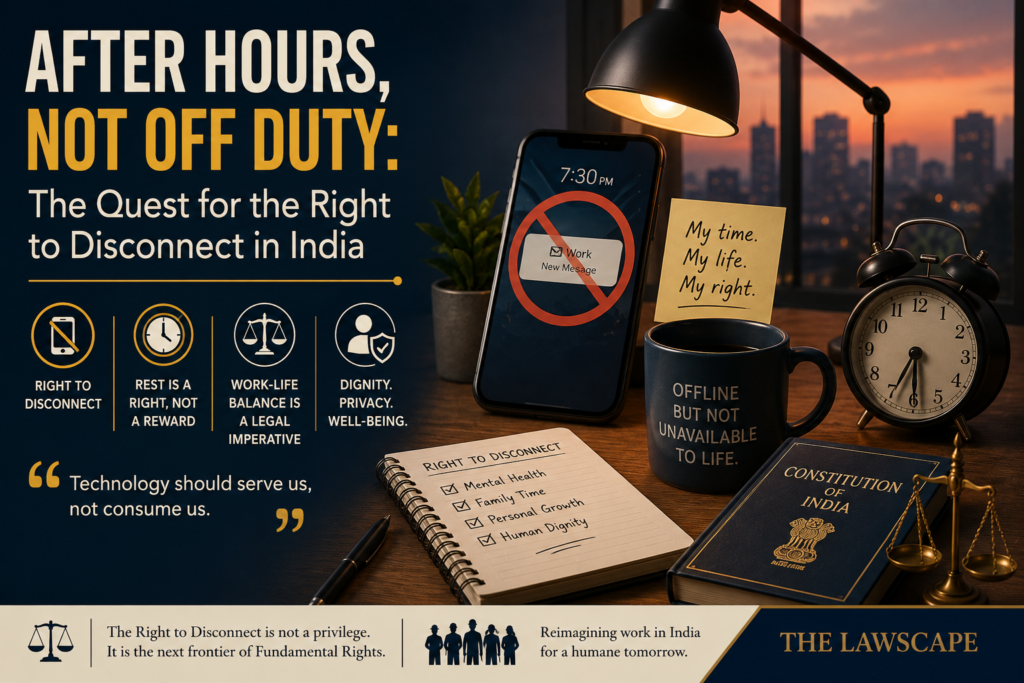
Author: Deepika Goriparthi
Student, Koneru Lakshmaiah University, Vijayawada
Co-Author: Syed.Arshil
Student, Koneru Lakshmaiah University
———————————————————————————-
💡 3 Quick Takeaways
- Constant digital connectivity has blurred the distinction between work and personal life, raising concerns about privacy, dignity, and autonomy.
- While several countries have recognised the Right to Disconnect through legislation, India continues to face a significant regulatory gap.
- Any future Indian framework must balance employee well-being with the practical realities of modern, flexible workplaces.
Introduction
“The price of anything is the amount of life you exchange for it.”
— Henry David Thoreau
A phone notification appears on a Sunday evening just before a planned family outing. It is a message from a supervisor assigning additional work. The employee is immediately confronted with a difficult choice: respond to work demands or spend valuable time with loved ones who have waited all week for that moment. This dilemma has become increasingly common in the digital age.
Rapid digitalisation has transformed workplaces and enhanced convenience. However, it has also created an expectation of constant responsiveness through emails, instant messaging applications, and collaborative digital platforms. As a result, the boundaries between professional responsibilities, family life, and personal time have become increasingly blurred.
This development raises an important question: does continuous digital availability amount to a form of invisible or unpaid labour? Employer access to employees now extends beyond office premises and prescribed working hours. Personal time is increasingly interrupted by work-related demands, affecting individual liberty, privacy, dignity, mental health, and work-life balance. The issue reflects not only changing workplace practices but also the limitations of existing labour law protections in addressing the realities of digital employment.
Time as a Legal Interest: Beyond Work-Life Balance
Time is perhaps the most fundamental element of human existence. Unlike financial resources, lost time can never be recovered. Every individual requires personal time for rest, family obligations, self-development, recreation, and emotional well-being.
The increasing pace of work and expectations of constant efficiency have placed unprecedented demands on employees. The pressure to remain continuously available often diminishes both personal well-being and the quality of professional output. A recent study illustrates this reality through a researcher’s response to the question, “When do you do research?” The answer was telling: “Sunday evenings.” This observation highlights the growing absence of structure and balance in contemporary professional life.
Advancements in communication technologies have enabled employees to work from virtually any location using smartphones and digital devices. While this flexibility offers significant advantages, it also creates a substantial risk of eroding the distinction between professional and personal life. The rise of remote work during and after the COVID-19 pandemic accelerated this trend as homes increasingly became workplaces.
In India, these effects have been particularly visible in sectors operating across international time zones or under demanding project deadlines. Many young professionals fear that disengaging from work may be perceived as a lack of commitment. Consequently, working hours often extend far beyond formal schedules, leaving little room for meaningful rest.
The legal system already recognises and protects several intangible interests. Reputation is safeguarded through defamation law, privacy through constitutional and statutory protections, and intellectual property through specialised legal frameworks. These examples demonstrate that the law protects interests that are central to human dignity and autonomy, even when they are not tangible in nature.
Personal time deserves similar recognition. Continuous digital availability creates a form of latent labour in which employees remain psychologically connected to work even when they are not actively performing tasks. An individual attending a family gathering may still feel compelled to monitor messages in anticipation of a supervisor’s request. This expectation of perpetual readiness effectively extends employer influence into evenings, weekends, holidays, and other periods traditionally reserved for personal life.
The concept of temporal autonomy provides an important framework for understanding this issue. Temporal autonomy refers to an individual’s ability to determine how their time is spent. It encompasses the freedom to rest, maintain personal relationships, pursue hobbies, and remain unavailable when desired.
This understanding finds support in the Supreme Court’s decision in Justice K.S. Puttaswamy (Retd.) v. Union of India, where privacy was recognised as encompassing autonomy, dignity, and control over personal space. Viewed through this constitutional lens, the right to disconnect is not merely a matter of workplace convenience. It is a legal mechanism intended to preserve individual authority over personal time.
Employment contracts compensate employees for their labour. They do not grant employers unrestricted access to an employee’s personal life. Outside agreed working hours, time should presumptively belong to the employee. Recognising this principle is essential to ensuring that technological advancement does not erode the boundaries necessary for liberty, dignity, and meaningful rest.
Global Recognition of the Right to Disconnect and India’s Regulatory Gap
The rapid expansion of digital workplaces and remote employment has intensified concerns regarding employee availability outside prescribed working hours. Increasing dependence on digital communication has contributed to employee burnout, workplace stress, and physical exhaustion.
In response, several jurisdictions have recognised the Right to Disconnect as an essential labour right in the digital age.
The conceptual foundations of this right can be traced to Article 24 of the Universal Declaration of Human Rights, which recognises the right to rest and leisure. Approximately fifteen countries have introduced legislative measures or policy reforms addressing various aspects of this right.
France emerged as the first country to formally recognise the Right to Disconnect through the El Khomri Law in 2017. Australia has subsequently amended its Fair Work Act to provide employees with the right to refuse work-related contact outside working hours unless such refusal would be unreasonable. Other countries, including Belgium, Spain, Italy, and Portugal, have adopted legal frameworks designed to regulate after-hours communication and protect work-life balance.
International labour standards have also increasingly acknowledged the importance of protecting workers in evolving digital economies. The International Labour Organization’s Convention No. 177 concerning home work reflects this growing recognition.
Despite these international developments, India currently lacks comprehensive employee-centric legislation addressing digital overreach and constant workplace accessibility.
The Right to Disconnect Bill was introduced as a Private Member’s Bill by Supriya Sule on 28 October 2019. However, the proposal has not been enacted and remains pending. This legislative stagnation reflects both policy uncertainty and a broader lack of engagement with emerging digital labour concerns.
Existing labour laws, including the Factories Act, various Shops and Establishments Acts, and the Occupational Safety, Health and Working Conditions Code, primarily regulate overtime, working conditions, and weekly holidays. However, they do not adequately address the realities of remote work, psychological availability, emotional responsiveness, or digital surveillance.
These shortcomings are particularly significant because a substantial portion of India’s workforce comprises freelancers, contractual workers, gig workers, and platform-based workers who often remain outside the protective scope of traditional labour legislation.
Constitutional Foundations and Practical Challenges
Contemporary discussions surrounding privacy frequently focus on informational privacy and data protection. However, privacy also encompasses freedom from unwarranted intrusion, control over personal space, and the ability to disengage from institutional demands.
Digital work culture has fundamentally blurred the distinction between workplace and personal space. Work accompanies employees into homes, vacations, weekends, restaurants, and recreational activities. Consequently, an important constitutional question arises: if work can continuously enter personal spaces, does privacy continue to exist in any meaningful sense?
In Justice K.S. Puttaswamy v. Union of India, the Supreme Court recognised privacy as including autonomy, decisional freedom, and private life. Constant workplace communication may intrude into this constitutionally protected sphere without adequate legal scrutiny.
Employees require personal space and uninterrupted time to meaningfully exercise autonomy and personal liberty. Employer access should not extend indefinitely beyond the office environment. Viewed from this perspective, unrestricted digital communication raises legitimate concerns regarding privacy rights.
Closely linked to privacy is the constitutional value of dignity. Human dignity encompasses not merely survival but the ability to lead a meaningful and flourishing life. The Supreme Court has consistently interpreted Article 21 broadly to include personal autonomy, mental well-being, and dignity.
A dignified existence requires opportunities for rest, recreation, family interaction, and temporary disengagement from professional obligations. When employees are expected to remain perpetually attentive to workplace demands, the distinction between personal and professional life gradually disappears. Over time, this may undermine individual control over personal decisions and daily life.
Article 42 of the Constitution, although non-justiciable, further reflects the constitutional commitment to humane working conditions and employee welfare.
At the same time, practical realities must be acknowledged. Contemporary workplaces often operate across jurisdictions, time zones, and digital platforms. Multinational corporations, emergency-response services, client-based industries, and global businesses frequently require limited communication beyond traditional working hours.
The increasing prevalence of remote and hybrid work models further complicates the issue. In many sectors, productivity is measured through outcomes rather than fixed schedules. Consequently, a complete prohibition on after-hours communication may not always be practical.
India’s employment landscape presents additional challenges. Extended working hours, informal employment arrangements, startup culture, and competitive corporate environments often normalise continuous accessibility. Employees themselves may voluntarily adopt flexible schedules to meet targets or pursue professional opportunities.
Therefore, any constitutional or legislative recognition of the Right to Disconnect cannot operate in an absolute manner. Instead, it must be guided by principles of proportionality, reasonableness, and practical flexibility.
Towards a Balanced Right to Disconnect Framework in India
The growing normalisation of after-hours digital engagement necessitates a comprehensive legal framework capable of protecting employees’ temporal autonomy while accommodating the realities of modern workplaces.
The expansion of digital communication has significantly blurred the distinction between professional and personal life, requiring employees to remain engaged with work beyond prescribed hours. India has also emerged as one of the world’s most overworked nations. Recent International Labour Organization data indicates that the average Indian worker spends approximately 46.7 hours per week working, placing India among countries with the longest working hours globally.
Against this backdrop, recognising the Right to Disconnect becomes increasingly important. Such recognition would restore work-life balance, protect employee control over personal time, and reinforce constitutional values of dignity, privacy, and personal liberty.
The proposed legislation highlights the necessity of formally recognising this right. In the absence of clear legal standards, employers may continue to classify communications as work-related and indirectly demand continuous availability.
While existing labour regulations concerning working hours provide some protection, a distinct and clearly defined Right to Disconnect would empower employees to disengage from work without fear of adverse consequences. Such protection would ensure that broader labour rights are not rendered ineffective in practice.
At the same time, any future framework must preserve flexibility for individuals who prefer unconventional working arrangements, including caregivers, students, remote workers, and employees operating across time zones.
Accordingly, future legislation should incorporate anti-retaliation provisions ensuring that employees are not subjected to direct or indirect discrimination for refusing work-related communication outside prescribed working hours.
Conclusion
Digitalisation has fundamentally transformed the relationship between work and personal life. Work is no longer confined to offices, designated schedules, or direct supervision. Instead, it persists through expectations of constant responsiveness, psychological availability, and uninterrupted communication.
As personal time increasingly becomes an extension of professional availability, concerns arise that extend far beyond workplace inconvenience. The erosion of temporal boundaries implicates constitutional values of autonomy, privacy, dignity, and meaningful human freedom.
The Right to Disconnect should therefore not be viewed merely as a demand for improved work-life balance. Rather, it raises a broader constitutional question concerning whether individuals retain meaningful control over their own time in an age where labour is mediated through technology.
As argued throughout this article, personal time deserves recognition as a legally protected interest closely connected to personal autonomy, humane working conditions, and constitutional guarantees under Article 21. The ability to disengage from professional responsibilities, remain unavailable outside agreed working hours, and preserve spaces free from institutional intrusion is essential to human dignity.
At the same time, recognition of this right must remain sensitive to the realities of modern employment. Global business operations, emergency communications, hybrid work arrangements, and flexible schedules make a complete prohibition on after-hours communication neither practical nor desirable.
Accordingly, any legal framework governing the Right to Disconnect must evolve through principles of proportionality, reasonableness, and contextual flexibility. Such an approach would balance legitimate organisational interests with the constitutional imperative of protecting individual autonomy and well-being.
Technological progress cannot justify the unrestricted extension of employer control into private life. Employment may legitimately require labour, dedication, and productivity, but it cannot claim unlimited access to an individual’s time, attention, or existence. Protecting the Right to Disconnect ultimately protects not only rest from work but also the broader conditions necessary for human freedom.
Disclaimer: The views expressed in this article are those of the author and do not necessarily reflect the views of The Lawscape.
The Lawscape — clear, practical legal insight for students and future lawyers.