
Artificial Intelligence and the Dangerous Side of Deepfakes
Author: Khushboo Gupta
Student, MKLM’s Adhia College of Law, Mumbai
————————————————————————————–
💡 3 Quick Takeaways
- Artificial Intelligence has transformed modern society, but its misuse—particularly through deepfake technology—poses serious risks to privacy, dignity, and reputation.
- Deepfakes enable highly realistic manipulation of images, videos, and voices, creating opportunities for misinformation, fraud, extortion, and cybercrime.
- Existing Indian laws provide partial remedies against deepfake misuse, but a comprehensive regulatory framework remains necessary to address emerging technological threats.
Abstract
India has witnessed remarkable technological growth in recent decades. Advancements in technology have become an integral part of daily life, influencing communication, employment, access to information, and decision-making. While technological development has improved efficiency and convenience, it has also increased dependence on digital systems and automated tools.
Among the most significant technological developments is Artificial Intelligence (AI), which has transformed numerous sectors by enabling machines to perform tasks traditionally associated with human intelligence. However, the rapid expansion of AI has also generated new risks, particularly through the misuse of deepfake technology.
This article examines the growing significance of Artificial Intelligence and explores the dangers associated with deepfake technology. It analyses the impact of deepfakes on privacy, dignity, reputation, and public trust while discussing the legal remedies currently available in India to address such misuse.
Keywords: Artificial Intelligence, Deepfake, Technology, Digitalisation, Privacy, Misuse
Artificial Intelligence and Its Expanding Role
The rapid advancement of technology has significantly contributed to the growth of Artificial Intelligence.
Artificial Intelligence refers to technological systems capable of performing tasks associated with human intelligence, including decision-making, data processing, learning, reasoning, and content generation. Modern AI systems increasingly replicate cognitive functions that were previously considered uniquely human.
As technological innovation has progressed, Artificial Intelligence has become integrated into everyday applications and devices, making it widely accessible to individuals and organisations alike. AI enables users to obtain information, analyse data, and perform complex tasks within seconds.
Traditionally, researching a topic required consulting multiple sources, reviewing extensive material, and synthesising information manually. AI systems can now generate responses almost instantly based on user prompts.
Despite these advantages, Artificial Intelligence cannot be relied upon uncritically. AI systems operate through algorithms and training data and may therefore produce inaccurate, incomplete, or biased information. Consequently, while AI represents a valuable technological tool, it must be utilised responsibly and with appropriate human oversight.
Excessive dependence on Artificial Intelligence raises concerns regarding misinformation, reduced human participation in critical decision-making, and the erosion of independent judgment.
AI has also significantly influenced employment patterns. Tasks involving data analysis, customer support, content generation, and administrative processing are increasingly being automated. Many organisations favour AI-driven systems because they can complete tasks more quickly and at lower operational costs.
As a result, concerns regarding job displacement and unemployment have become increasingly prominent.
A notable illustration of AI’s growing influence emerged when Ms. Tang Yu, an AI-powered virtual entity, was appointed to an executive position by a subsidiary of NetDragon Websoft Holdings Ltd. This development demonstrates that Artificial Intelligence is no longer confined to supporting human activity but is increasingly being entrusted with managerial and decision-making functions.
However, such developments also generate important legal questions. If an AI system causes financial loss, engages in unlawful conduct, or contributes to harmful outcomes, determining responsibility becomes challenging. Questions arise regarding whether liability should rest with developers, corporations, operators, or other stakeholders.
Since Artificial Intelligence does not possess legal personality, it cannot be held accountable in the same manner as a human being. This highlights the growing need for comprehensive legal frameworks governing AI deployment and accountability.
The Need for Artificial Intelligence Regulation
The growing influence of Artificial Intelligence has prompted several jurisdictions to develop dedicated regulatory frameworks.
The European Union has taken a leading role through the adoption of the Artificial Intelligence Act, which seeks to promote trustworthy and responsible AI development.
The Act adopts a risk-based approach by classifying AI systems according to their potential impact on safety, society, and fundamental rights.
Certain applications posing unacceptable risks—such as particular forms of mass surveillance—are prohibited altogether. High-risk systems operating in sectors such as education, employment, recruitment, and biometric identification are subject to strict compliance obligations involving transparency, accountability, and data governance.
Lower-risk AI systems are permitted to operate with comparatively limited regulation.
These developments illustrate the growing international recognition that technological innovation must be balanced with legal safeguards.
India similarly faces the challenge of developing an effective regulatory framework capable of promoting innovation while protecting individual rights and public interests.
Artificial Intelligence and Creative Manipulation
Artificial Intelligence has also expanded into creative and artistic fields.
AI-powered tools can now generate images, videos, artworks, and multimedia content that often appear indistinguishable from human-created material.
Tasks that once required specialised artistic skill can increasingly be performed through automated systems. While these technologies offer substantial creative opportunities, they also present significant risks.
Artificial Intelligence lacks the originality, ethical judgment, and contextual understanding that characterise human creativity. Consequently, AI-generated content can be manipulated in ways that threaten privacy, reputation, and dignity.
Individuals frequently upload photographs, videos, and personal information without fully understanding how such data may subsequently be used.
These concerns become particularly acute when personal images and recordings are exploited to create deepfake content.
Deepfake Technology
One of the most significant challenges arising from Artificial Intelligence is the rapid proliferation of deepfake technology.
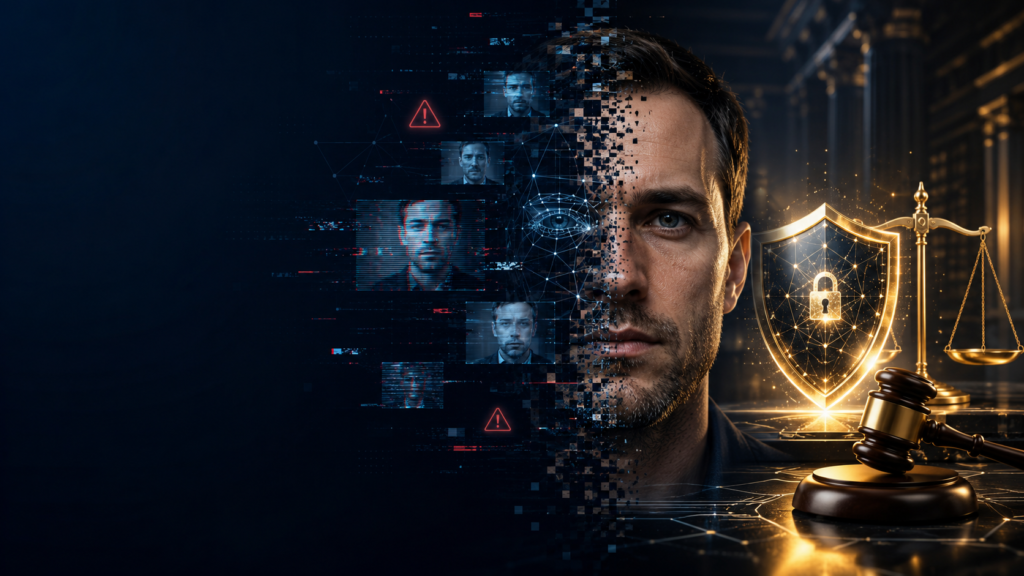
Deepfakes use AI systems to replicate an individual’s facial features, voice patterns, expressions, and movements before inserting them into fabricated images, videos, or audio recordings. The resulting content often appears highly realistic and can create the false impression that an individual said or did something that never actually occurred.
Through sophisticated AI tools, a person’s voice can be cloned and facial characteristics digitally reconstructed with remarkable accuracy.
As a consequence, deepfakes have become increasingly associated with fraud, misinformation, identity theft, harassment, and reputational harm.
Examples include scam voice calls in which fraudsters impersonate family members to obtain money, as well as fabricated videos depicting individuals in inappropriate or offensive situations.
The realism of modern deepfakes makes it difficult for ordinary viewers to distinguish genuine content from manipulated material.
This contributes to the spread of misinformation, false accusations, social manipulation, and public confusion. Individuals frequently share such content without verification, magnifying its impact.
Deepfakes therefore pose a direct threat to privacy, dignity, reputation, and public trust.
Psychological and Social Consequences
The consequences of deepfake misuse extend far beyond technological concerns.
Victims often experience emotional distress, anxiety, humiliation, and reputational damage. Manipulated content can affect personal relationships, professional opportunities, and social standing.
In many cases, victims become subject to public ridicule or suspicion despite having done nothing wrong.
Deepfake technology was originally developed for legitimate purposes including education, entertainment, advertising, and creative media production. However, its misuse has transformed it into a powerful tool for harassment, extortion, and cybercrime.
Individuals are increasingly threatened with the release of fabricated videos unless money or other benefits are provided. Such conduct transforms deepfakes into instruments of coercion and exploitation.
How Deepfakes Work
Deepfake technology primarily relies upon a machine learning framework known as a Generative Adversarial Network (GAN).
GANs consist of two competing AI systems:
- A generator, which creates synthetic images, videos, or audio recordings; and
- A discriminator, which evaluates the generated content and identifies flaws.
The generator continuously attempts to create more realistic content, while the discriminator analyses errors involving facial proportions, lighting, movements, and other visual characteristics.
Through repeated cycles of correction and refinement, the generated content becomes increasingly convincing.
The more extensive the training data and computational resources available, the more realistic the resulting deepfake becomes.
This process makes detection increasingly difficult and significantly increases the potential for deception and misuse.
Misuse of Deepfakes and Their Consequences
The misuse of deepfake technology has become increasingly visible in cases involving public figures.
Several incidents in India have demonstrated the risks posed by AI-generated misinformation.
Deepfake videos allegedly depicting actors Ranveer Singh and Aamir Khan endorsing political positions circulated widely online before being identified as fabricated content. Both actors reportedly initiated legal action in response.
Similarly, actress Rashmika Mandanna became the victim of a widely circulated deepfake video in which her face was digitally superimposed onto another individual’s body. The incident generated significant public concern regarding privacy, dignity, and online safety.
Deepfakes have also been used to spread political misinformation.
A manipulated video depicting the Union Home Minister, Amit Shah, allegedly making statements concerning reservation policies circulated on social media platforms. Such content possesses the potential to generate public unrest and distort democratic discourse.
While prominent individuals may possess resources to pursue legal remedies, ordinary citizens often face greater difficulties.
Economically vulnerable individuals frequently become targets of deepfake-based blackmail, extortion, and harassment. Fear of social stigma, lack of awareness, and limited access to legal assistance often prevent victims from reporting such incidents.
These realities demonstrate the urgent need for stronger legal safeguards and regulatory intervention.
Caution and Preventive Measures
Victims of deepfake-related misconduct should avoid panic and immediately report incidents to cybercrime authorities.
Prompt reporting can assist law enforcement agencies in identifying perpetrators, removing harmful content, and preventing further dissemination.
Victims should avoid complying with demands for money or other concessions, as doing so may encourage further criminal activity.
Members of the public should also exercise caution when encountering suspicious videos or recordings online.
Before sharing potentially misleading content, individuals should verify its authenticity through reliable sources and official statements. If content is confirmed to be fabricated, accurate information should be disseminated to prevent further misinformation.
Public awareness and responsible digital behaviour remain essential tools in combating the harmful effects of deepfake technology.
Legal Remedies in India Against Deepfakes
Although India does not currently possess legislation dedicated exclusively to deepfake technology, several existing legal provisions may be invoked against offenders.
Digital Personal Data Protection Act, 2023
Section 6 of the Digital Personal Data Protection Act, 2023 requires valid consent for the processing of personal data.
Because deepfakes frequently involve the unauthorised use of facial images, voice recordings, and biometric information, such conduct may constitute unlawful processing of personal data and attract substantial penalties.
Bharatiya Nyaya Sanhita, 2023
Several provisions of the Bharatiya Nyaya Sanhita may apply to deepfake-related offences:
- Section 111 (Organised Crime) may apply where deepfakes are used systematically for financial gain, extortion, or coordinated criminal activity.
- Section 319 (Cheating by Personation) may apply when individuals are impersonated through synthetic media.
- Section 353 (Statements Conducing to Public Mischief) may apply where deepfake content spreads misinformation capable of disturbing public order.
- Section 336 (Forgery) may apply because deepfakes constitute fabricated electronic records intended to deceive.
- Section 356 (Defamation) may apply where manipulated content harms an individual’s reputation.
Information Technology Act, 2000
Section 67 addresses the publication or transmission of obscene material in electronic form.
This provision is particularly relevant where deepfake content involves sexually explicit or obscene material used for harassment, exploitation, or blackmail.
Bharatiya Sakshya Adhiniyam, 2023
Section 63 relating to the admissibility and authentication of electronic evidence enables courts to evaluate digital records and technological evidence when investigating deepfake-related offences.
Such provisions assist law enforcement agencies and courts in identifying offenders and establishing evidentiary authenticity.
Conclusion
Deepfake technology has emerged as one of the most dangerous consequences of rapid advances in Artificial Intelligence.
The creation and circulation of fabricated images, videos, and audio recordings without consent constitute serious violations of privacy, dignity, and reputation. The increasingly realistic nature of deepfakes makes detection difficult and leaves victims vulnerable to humiliation, misinformation, extortion, and reputational harm.
The threat extends beyond individual victims. Deepfakes involving political leaders, public institutions, and social issues possess the potential to mislead citizens, disrupt public order, and undermine democratic processes.
Although deepfake technology was originally developed for legitimate and beneficial purposes, its misuse has transformed it into a significant cybercrime challenge.
Victims should respond through lawful channels by reporting incidents to cybercrime authorities rather than reacting out of fear or panic. Existing legal remedies provide some protection, but the evolving nature of deepfake technology highlights the need for more comprehensive regulation.
India must develop a robust legal framework capable of addressing the challenges posed by Artificial Intelligence and deepfake technology. Stronger safeguards, stricter penalties, greater public awareness, and improved enforcement mechanisms are necessary to ensure that technological innovation remains ethical, responsible, and consistent with the protection of individual rights.
Disclaimer: The views expressed in this article are those of the author and do not necessarily reflect the views of The Lawscape.
The Lawscape — clear, practical legal insight for students and future lawyers.