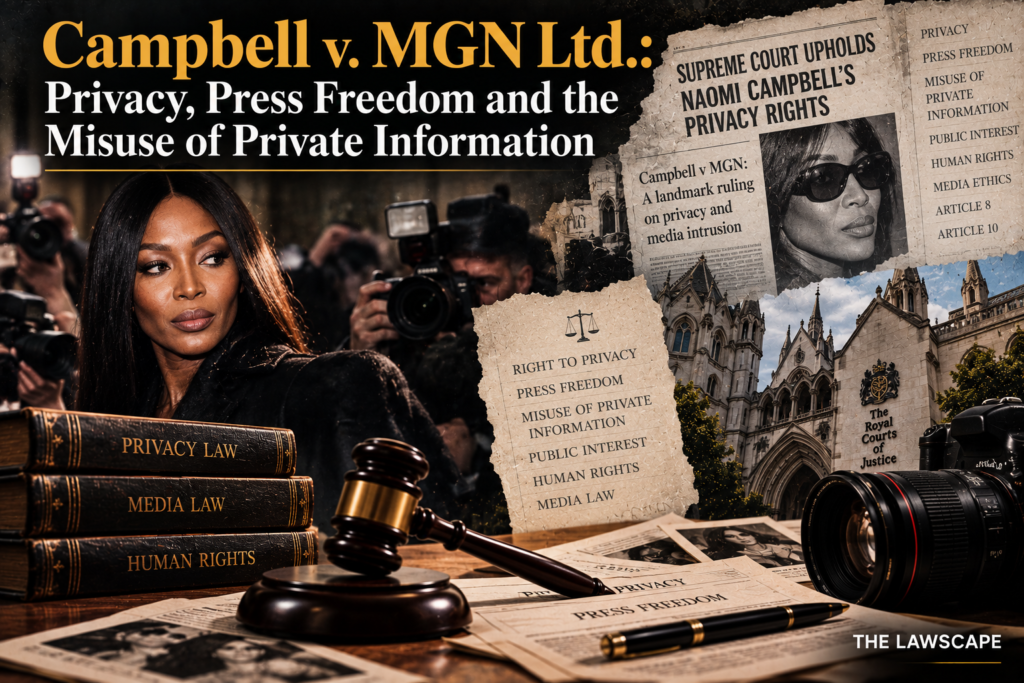
Campbell v. MGN Ltd.: Privacy, Press Freedom and the Misuse of Private Information
Author: Lawson Boladuro
Student, Lead City University
———————————————————————————
💡 3 Quick Takeaways
- Campbell v. MGN Ltd. helped establish the modern English law of misuse of private information, moving beyond the traditional requirement of a pre-existing confidential relationship.
- The House of Lords adopted a two-stage approach: determining whether the claimant had a reasonable expectation of privacy and then balancing that interest against freedom of expression under Articles 8 and 10 of the European Convention on Human Rights.
- A public figure’s decision to seek publicity or mislead the public does not remove all privacy rights, particularly concerning medical treatment, therapeutic support and photographs taken in vulnerable circumstances.
1. Introduction
For much of its history, English law did not recognise a free-standing right to privacy. Individuals seeking to prevent the publication of sensitive personal information generally relied on the equitable doctrine of breach of confidence, an action traditionally associated with a confidential relationship between the parties.[1]
The Human Rights Act 1998, which gave domestic effect to the European Convention on Human Rights (ECHR), brought the competing interests protected by Article 8—the right to respect for private life—and Article 10—freedom of expression—directly before the English courts.[2] This development required courts to reconsider whether the traditional law of confidence offered adequate protection against the publication of private information by the media.
In Campbell v. MGN Ltd., the House of Lords addressed this question directly. The judgment is widely regarded as a landmark in the development of the tort of misuse of private information from the older action for breach of confidence.[3] Decided by a three-to-two majority, the case is notable both for the Law Lords’ agreement on the governing legal principles and for their disagreement over how those principles should apply to the facts. This commentary examines the factual background, the principal legal issues, the reasoning of the majority and minority, and the judgment’s significance for the relationship between privacy and press freedom.
2. Facts of the Case
The appellant, Naomi Campbell, was an internationally recognised fashion model who had repeatedly denied publicly that she used illegal drugs. She had also contrasted herself with other models who had succumbed to drug use.
On 1 February 2001, the respondent, MGN Ltd., publisher of The Mirror, published a front-page story headed “Naomi: I am a drug addict”. The article disclosed that Campbell was attending Narcotics Anonymous (NA) meetings to address her addiction. It was accompanied by a photograph taken covertly by a photographer positioned in a parked car, showing Campbell leaving a meeting.
The publication went beyond the basic facts of her addiction and treatment. It included details about the duration and frequency of her attendance, information about the therapeutic process at NA, and photographs of her outside the meeting venue. Some of these details were subsequently shown to be inaccurate.
Campbell brought proceedings for damages for breach of confidence and under the Data Protection Act 1998. The newspaper subsequently published further, more hostile articles about her, which formed part of her claim for aggravated damages.
At trial, Morland J found in Campbell’s favour and awarded compensatory and aggravated damages.[4] The Court of Appeal allowed the newspaper’s appeal, holding that the additional details were not sufficiently significant to constitute a breach of confidence and that the balance favoured freedom of expression.[5]
Campbell appealed to the House of Lords. By a majority of three to two, the House restored the trial judge’s finding of liability. The majority concluded that the additional details and the covert photograph went beyond what was justified by the legitimate public interest in correcting Campbell’s earlier false denials.
3. Issues Raised
The appeal raised three principal questions:
- Whether English law could develop the equitable action for breach of confidence into a means of protecting private information without requiring a pre-existing confidential relationship between the parties.
- Whether the additional details about Campbell’s attendance at Narcotics Anonymous and the accompanying photographs remained protected private information, despite her concession that the newspaper could report the basic facts of her addiction and treatment.
- How the competing rights under Articles 8 and 10 of the ECHR should be balanced when both were engaged, and how much latitude should be afforded to editorial judgment in presenting a legitimate news story.
4. Analysis
A. The Development of Misuse of Private Information
A central contribution of Campbell was Lord Nicholls’ explanation that the traditional label “breach of confidence” had become misleading. The law no longer required a prior relationship of trust between the parties. Instead, the relevant question was whether the recipient of the information knew, or ought to have known, that the information was reasonably to be regarded as private.[6]
Lord Nicholls therefore suggested that the modern cause of action was more accurately described as misuse of private information. The approach drew on Convention jurisprudence rather than relying exclusively on traditional equitable principles.[7]
The judgment established a two-stage framework. First, the court determines whether the claimant had a reasonable expectation of privacy in relation to the information disclosed. Second, if such an expectation exists, the court balances the claimant’s privacy interest against the publisher’s right to freedom of expression through a proportionality assessment.
This framework provides a structured means of addressing conflicts between privacy and expression. Neither right automatically prevails merely because the claimant is a public figure or the publisher is reporting a matter of public interest.
B. The Dissenting Opinions: Editorial Judgment and Freedom of Expression
Although the Law Lords agreed on the governing principles, Lord Nicholls and Lord Hoffmann disagreed with the majority’s application of those principles.
The dissenting Law Lords regarded the additional details concerning Campbell’s treatment and the accompanying photograph as a relatively minor intrusion. They considered the material closely connected to information that the newspaper had legitimately been permitted to disclose because Campbell had publicly denied her drug use.
Lord Hoffmann also emphasised the practical realities of journalism. Editorial decisions are frequently made under time constraints and without the benefit of the detailed information available to a court reviewing a publication after the event. Photographs can also lend credibility to a story in a way that text alone cannot.[8]
From this perspective, once the publication of the central story was justified, the newspaper should have been afforded a reasonable degree of editorial discretion in deciding how to present it. The dissenters therefore considered the additional details insufficiently intrusive to justify liability in the circumstances.
C. The Majority’s Approach: Privacy and Therapeutic Treatment
The majority adopted a narrower view of editorial freedom. Lord Hope rejected the Court of Appeal’s distinction between clinical medical treatment and group therapy at Narcotics Anonymous. Anonymity and confidentiality were essential to such therapy, and disclosure of when, where and how frequently Campbell attended meetings could interfere with her recovery.[9]
The majority’s approach also focused on the claimant’s circumstances. The relevant question was not simply whether an ordinary reader would find the disclosure offensive, but whether a reasonable person in the claimant’s position, confronted with the publicity, would regard it as highly offensive.
Baroness Hale and Lord Carswell agreed that the details concerning Campbell’s treatment and the covert photograph were sufficient to shift the balance in favour of privacy. The newspaper’s legitimate interest in correcting Campbell’s public statements did not entitle it to publish every detail associated with her treatment.
The judgment therefore distinguished between the public interest in correcting a false statement and the publication of additional information that was not necessary to serve that interest.
D. Public Figures, Photographs and the Scope of Privacy
One important implication of Campbell is that public figures retain a protected sphere of privacy, even where they actively seek publicity or have misled the public on a particular subject. Information about medical or therapeutic treatment may remain private despite the legitimate public interest in reporting the underlying issue.
The judgment also demonstrates that photographs can have informational content of their own. A photograph may reveal a person’s location, activities or involvement in a sensitive situation, and may therefore contribute independently to an infringement of privacy. The circumstances in which an image was obtained and the vulnerability of the person depicted may be relevant to the assessment.[10]
These principles have influenced later privacy litigation, including cases concerning photographs of public figures in public places and the extent to which their reasonable expectations of privacy should be respected.[11]
E. Academic Debate and the Judgment’s Continuing Importance
The judgment has attracted both criticism and support. Some academic commentary has questioned whether the narrow three-to-two division provides sufficient certainty for publishers, particularly when the judges agreed on the legal framework but reached opposing conclusions about the same material.[12]
Others have welcomed the decision as an important development in the protection of informational privacy. It helped address the limitations of the traditional law of confidence and the absence of a general common-law tort of invasion of privacy, a limitation discussed in Wainwright v. Home Office.[13]
The continuing importance of Campbell lies in its structured approach to privacy claims. The reasonable-expectation-of-privacy inquiry and the subsequent balancing of competing rights provide a framework for courts to assess claims involving the media. The framework does not eliminate difficult judgments; rather, it identifies the legal questions that must be addressed.
5. Conclusion
Campbell v. MGN Ltd. remains a leading authority on the protection of personal privacy against the press in English law. By developing the traditional action for breach of confidence into the tort of misuse of private information, the House of Lords established a framework based on a reasonable expectation of privacy and a balance between Articles 8 and 10 of the ECHR.
The judgment demonstrates that public figures do not lose all privacy rights by seeking publicity or making misleading public statements. Although the press may have a legitimate interest in correcting falsehoods, that interest does not automatically justify publishing additional details about medical treatment or images obtained in vulnerable circumstances.
The case also illustrates the continuing difficulty of balancing privacy against freedom of expression. The majority and minority agreed on the governing principles but differed over the weight that should be given to editorial judgment and the extent of the intrusion.
Ultimately, Campbell remains significant because it recognises that the public interest in a story does not necessarily extend to every detail that could make the story more compelling. Privacy and freedom of expression must be assessed in context, with neither right treated as absolute.
Endnotes
- Coco v. A. N. Clark (Engineers) Ltd., [1969] R.P.C. 41 (Ch.).
- Human Rights Act 1998, c. 42, § 6 (U.K.).
- Campbell v. MGN Ltd., [2004] UKHL 22, [2004] 2 A.C. 457, paras. 14, 51 (per Lord Nicholls and Lord Hoffmann).
- Campbell v. MGN Ltd., [2002] EWHC 499 (Q.B.).
- Campbell v. MGN Ltd., [2002] EWCA Civ 1373, [2003] Q.B. 633.
- Campbell v. MGN Ltd., [2004] UKHL 22, paras. 13–14 (per Lord Nicholls), citing Attorney-General v. Guardian Newspapers Ltd. (No. 2), [1990] 1 A.C. 109, 281 (H.L.) (per Lord Goff of Chieveley).
- Campbell v. MGN Ltd., [2004] UKHL 22, paras. 20–21.
- Campbell v. MGN Ltd., [2004] UKHL 22, paras. 61–63 (per Lord Hoffmann).
- Campbell v. MGN Ltd., [2004] UKHL 22, paras. 95–98 (per Lord Hope of Craighead).
- Campbell v. MGN Ltd., [2004] UKHL 22, paras. 72–75 (per Lord Hoffmann, discussing the informational content of photographs generally).
- Von Hannover v. Germany, 2004-VI Eur. Ct. H.R. 41 (2004).
- Gavin Phillipson, “Transforming Breach of Confidence? Towards a Common Law Right of Privacy Under the Human Rights Act,” 66 Modern Law Review 726, 726–28 (2003).
- Wainwright v. Home Office, [2003] UKHL 53, [2004] 2 A.C. 406.
Disclaimer: The views expressed in this article are those of the author and do not necessarily reflect the views of The Lawscape.
The Lawscape — clear, practical legal insight for students and future lawyers.