
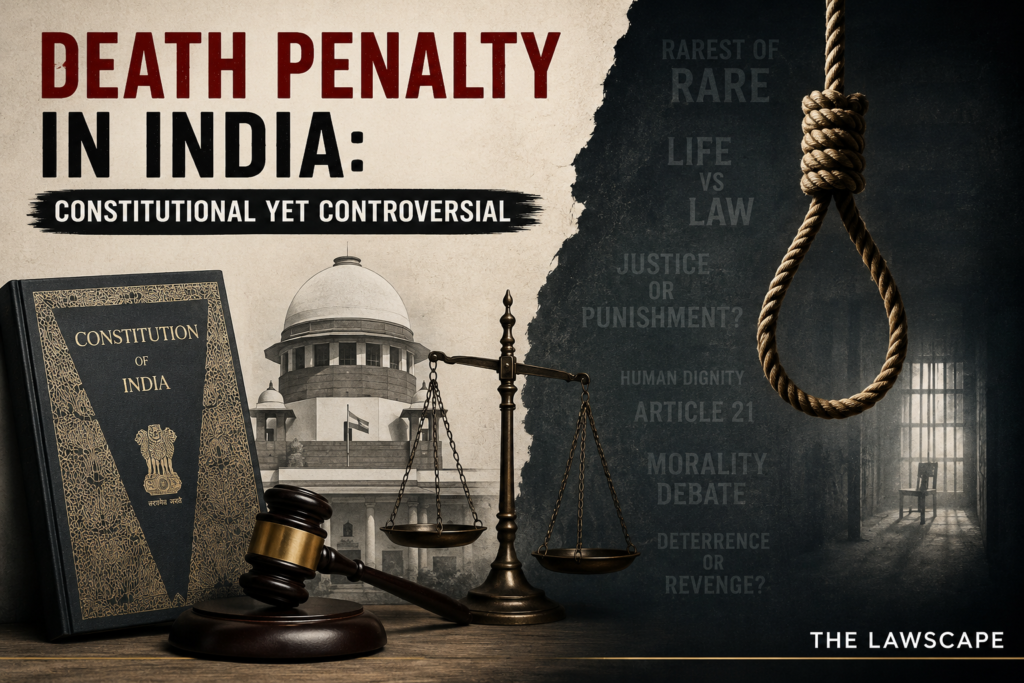
Death Penalty in India: Constitutional Yet Controversial
Author: Bhavya Suman
Student, Lloyd Law College
———————————————————–
💡 3 Quick Takeaways
1. The Supreme Court has upheld the constitutional validity of the death penalty while restricting its application to the “rarest of rare” cases.
2. The continuing debate centres on balancing societal interests with the constitutional guarantees of life, dignity, and fair procedure under Articles 14 and 21.
3. Concerns regarding arbitrariness, wrongful convictions, and inadequate legal representation continue to fuel demands for reform.
Abstract
The death penalty remains one of the most debated forms of punishment in India because it reflects the continuing conflict between protecting society and safeguarding human rights. This article examines the constitutional validity of capital punishment under Articles 14 and 21 of the Constitution and analyses landmark judicial decisions including Jagmohan Singh, Rajendra Prasad, Bachan Singh, and Machhi Singh. It further discusses the development of the “rarest of rare” doctrine, the principal arguments supporting and opposing capital punishment, judicial safeguards, and the recommendations of the Law Commission of India. The article also highlights concerns relating to arbitrariness, wrongful convictions, inadequate legal representation, and the reformative approach to punishment. Through constitutional and legal analysis, it seeks to evaluate whether the death penalty can continue to be justified in a democratic society governed by the rule of law and respect for human dignity.
Introduction
The death penalty, also known as capital punishment, is the most severe punishment recognised under Indian criminal law. It refers to the State-sanctioned execution of an individual convicted of certain exceptionally grave offences. In India, the sentence is presently carried out by hanging. As the most irreversible form of punishment, capital punishment has remained one of the most controversial aspects of India’s criminal justice system.
Supporters argue that the death penalty serves the objectives of deterrence, justice for victims, and protection of society. Opponents contend that punishment should not merely deter crime but should also provide offenders with an opportunity for reform and rehabilitation.
Historically, capital punishment has existed since ancient times and was traditionally imposed for offences against the State and society. However, modern constitutional democracies have increasingly questioned both its morality and its compatibility with fundamental human rights.
Although numerous countries have abolished capital punishment, India continues to retain it for the “rarest of rare” cases despite Article 21 guaranteeing the right to life and personal liberty.
This article examines the constitutional validity of the death penalty in India, the evolution of the “rarest of rare” doctrine, and the continuing constitutional debate between justice and human rights.
Constitutional Validity of the Death Penalty
The constitutional foundation of capital punishment primarily rests upon Articles 14 and 21 of the Constitution. Article 21 guarantees the right to life and personal liberty but permits deprivation of life through a procedure established by law, provided that such procedure is fair, just, and reasonable.
Statutorily, both the Indian Penal Code, 1860 and the Bharatiya Nyaya Sanhita, 2023 retain capital punishment for specified offences. Under the Bharatiya Nyaya Sanhita, the death penalty continues to be prescribed for offences including murder, aggravated rape resulting in death or a persistent vegetative state, waging war against the Government of India, and certain terrorism-related offences. The continued existence of these provisions reflects the legislative view that capital punishment remains necessary for exceptionally grave crimes.
The constitutional validity of capital punishment has also been examined under Article 14, which guarantees equality before the law and equal protection of the laws. Critics argue that the discretionary nature of sentencing may sometimes produce unequal outcomes, thereby raising concerns regarding arbitrariness.
The Supreme Court first considered the constitutional validity of the death penalty in Jagmohan Singh v. State of Uttar Pradesh (1973), where it upheld capital punishment and held that the death penalty did not violate Articles 14 or 21 because it was imposed through a legally established judicial procedure following a fair trial.
Subsequently, in Rajendra Prasad v. State of Uttar Pradesh (1979), the Supreme Court adopted a more reformative approach. Justice V.R. Krishna Iyer emphasised that capital punishment should be imposed only in exceptional circumstances where the offender poses a continuing threat to society and stressed the importance of recording “special reasons” while awarding the death sentence.
The constitutional position was conclusively settled in Bachan Singh v. State of Punjab (1980). The Constitution Bench upheld the constitutional validity of the death penalty while introducing the celebrated “rarest of rare” doctrine, holding that death should be awarded only where life imprisonment would be unquestionably inadequate. The Court attempted to balance society’s interests, victims’ rights, and the constitutional protection of life and liberty.
The “Rarest of Rare” Doctrine
The “rarest of rare” doctrine introduced in Bachan Singh fundamentally transformed India’s sentencing jurisprudence by making life imprisonment the ordinary rule and capital punishment the exception.
The Court recognised that sentencing should not depend solely upon the brutality of the offence but must also consider the possibility of reform and rehabilitation of the offender. The doctrine therefore reflects constitutional values of fairness, proportionality, and human dignity.
Its scope was further clarified in Machhi Singh v. State of Punjab (1983), where the Supreme Court identified various factors to determine whether a case falls within the “rarest of rare” category, including the manner of commission of the crime, its motive, magnitude, and the vulnerability of the victim.
Despite its significance, the doctrine has attracted sustained criticism. Opponents argue that its inherently subjective nature has resulted in inconsistent judicial outcomes. The absence of comprehensive sentencing guidelines, together with varying judicial approaches towards mitigating circumstances and reformative potential, continues to generate concerns regarding arbitrariness under Articles 14 and 21.
Arguments in Favour of the Death Penalty
Deterrence Theory
One of the principal justifications for retaining capital punishment is the theory of deterrence. Supporters contend that the fear of execution discourages individuals from committing particularly heinous offences such as terrorism, brutal murders, and aggravated sexual offences.
According to this view, the existence of capital punishment contributes to maintaining public order by discouraging potential offenders from engaging in serious criminal conduct.
Justice for Victims
Another commonly advanced argument is that capital punishment delivers justice to victims and their families. In cases involving exceptionally brutal offences, supporters believe that the gravity of the crime warrants the harshest possible punishment. Capital punishment, they argue, reinforces public confidence in the administration of criminal justice.
National Security
Supporters also maintain that the death penalty remains necessary for offences involving terrorism, waging war against the State, and crimes threatening national security. They argue that retaining capital punishment for such offences serves both as punishment and as a safeguard against future threats to the nation.
Public Confidence in the Judiciary
It is further argued that imposing the death penalty in exceptionally grave cases strengthens public confidence in the justice delivery system by demonstrating that the law responds firmly to the most serious crimes.
Arguments Against the Death Penalty
Violation of Human Rights
One of the strongest criticisms is that capital punishment violates the right to life and human dignity protected under Article 21.
Human rights advocates contend that no authority, including the State, should permanently extinguish human life. They further argue that the irreversible nature of execution makes the punishment fundamentally inconsistent with constitutional morality.
Reformative Theory of Punishment
Critics strongly support the reformative theory, which recognises that every individual possesses inherent dignity irrespective of the offence committed.
According to this approach, criminal justice should prioritise rehabilitation and reformation rather than elimination of the offender. Even individuals convicted of serious offences may reform through education, counselling, and rehabilitation. Consequently, permanent deprivation of life is viewed as incompatible with humanitarian principles.
Wrongful Convictions
Perhaps the most compelling criticism concerns the possibility of judicial error.
Because the death penalty is irreversible, any wrongful conviction results in irreversible injustice. Errors during investigation, inadequate legal representation, mistaken identification, or incorrect appreciation of evidence may lead to the execution of innocent persons, thereby undermining public confidence in the criminal justice system.
Arbitrariness in Sentencing
Critics also argue that application of the “rarest of rare” doctrine frequently depends upon individual judicial discretion rather than objective standards.
Consequently, similar cases may receive different punishments, raising concerns regarding unequal application of law and arbitrariness contrary to Article 14.
Lack of Conclusive Deterrent Effect
Opponents further contend that there is no conclusive empirical evidence establishing that capital punishment deters crime more effectively than life imprisonment.
Criminological theories, including the labelling theory of crime, suggest that criminal behaviour is influenced by complex social, economic, and psychological factors rather than merely by fear of punishment.
Law Commission of India’s 262nd Report
The Law Commission of India, in its 262nd Report (2015), recommended abolition of the death penalty for all offences except terrorism-related offences and offences involving waging war against the nation.
The Commission observed that no conclusive evidence established the deterrent value of capital punishment. It also expressed concern regarding arbitrariness, wrongful convictions, and the increasing importance of constitutional morality, human dignity, and reformative justice.
Nevertheless, considering national security concerns, the Commission recommended retaining capital punishment for terrorism-related offences and offences affecting the sovereignty and integrity of India.
Contemporary Debate and Recent Cases
The debate surrounding capital punishment remains highly relevant in contemporary India.
The Nirbhaya case (Mukesh v. State (NCT of Delhi)) reignited public support for capital punishment following the brutal gang rape and murder that shocked the nation. The execution of the convicts in 2020 was widely perceived as a symbol of justice for victims of crimes against women.
Similarly, decisions involving Mohammed Ajmal Kasab and Yakub Abdul Razak Memon strengthened arguments supporting retention of the death penalty for offences involving terrorism and national security.
At the same time, critics continue to question whether even the gravest offences justify irreversible punishment in a constitutional democracy committed to human dignity and reformative justice.
Judicial Safeguards in Death Penalty Cases
Recognising the irreversible nature of capital punishment, Indian law provides multiple judicial and constitutional safeguards before execution.
These include:
- Special Leave Petition before the Supreme Court under Article 136.
- Review Petition under Article 137 seeking reconsideration of the Supreme Court’s judgment.
- Curative Petition, recognised in Rupa Ashok Hurra v. Ashok Hurra, to prevent miscarriage of justice in exceptional circumstances.
- Mercy Petition before the President under Article 72 and the Governor under Article 161 seeking pardon, commutation, remission, or reprieve.
These safeguards demonstrate India’s constitutional commitment to fairness, due process, and protection against miscarriage of justice.
Critical Analysis
The constitutional debate surrounding capital punishment ultimately reflects the tension between two competing values.
Supporters maintain that the State must retain the ultimate punishment in the “rarest of rare” cases to protect society and uphold justice. Critics argue that capital punishment remains incompatible with the constitutional commitment to life, dignity, and reformative justice.
The issue becomes even more complex when viewed against systemic weaknesses within the criminal justice system. Custodial violence, fabricated evidence, procedural irregularities, inadequate legal representation, and socioeconomic inequality increase the possibility of wrongful convictions.
Particularly concerning is the disproportionate impact upon economically weaker and marginalised accused persons, who frequently depend upon inadequate legal aid and therefore face greater difficulty in securing effective legal representation. Since capital punishment is irreversible, even minor judicial errors may result in irreversible injustice.
These concerns continue to fuel scholarly criticism regarding the practical fairness of capital punishment within India’s criminal justice system.
Conclusion
The debate over the death penalty remains one of the most significant constitutional and criminal law debates in India.
Supporters continue to regard capital punishment as necessary for maintaining public order, protecting national security, and delivering justice to victims. Opponents question its compatibility with human dignity, reformative justice, and the constitutional guarantee of life under Article 21.
Judicial developments such as the “rarest of rare” doctrine and multiple procedural safeguards seek to minimise arbitrary sentencing. Nevertheless, concerns regarding wrongful convictions, inconsistent sentencing, and structural deficiencies within the criminal justice system continue to persist.
Accordingly, the constitutional validity and practical implementation of capital punishment require continuous judicial and legislative scrutiny to maintain an appropriate balance between the interests of society and the protection of fundamental human rights.
In a constitutional democracy governed by the rule of law, the central question is not merely whether an offender deserves death, but whether the justice system can impose such an irreversible punishment in a manner that is fair, just, and non-arbitrary.
Disclaimer: The views expressed in this article are those of the author and do not necessarily reflect the views of The Lawscape.
The Lawscape — clear, practical legal insight for students and future lawyers.