
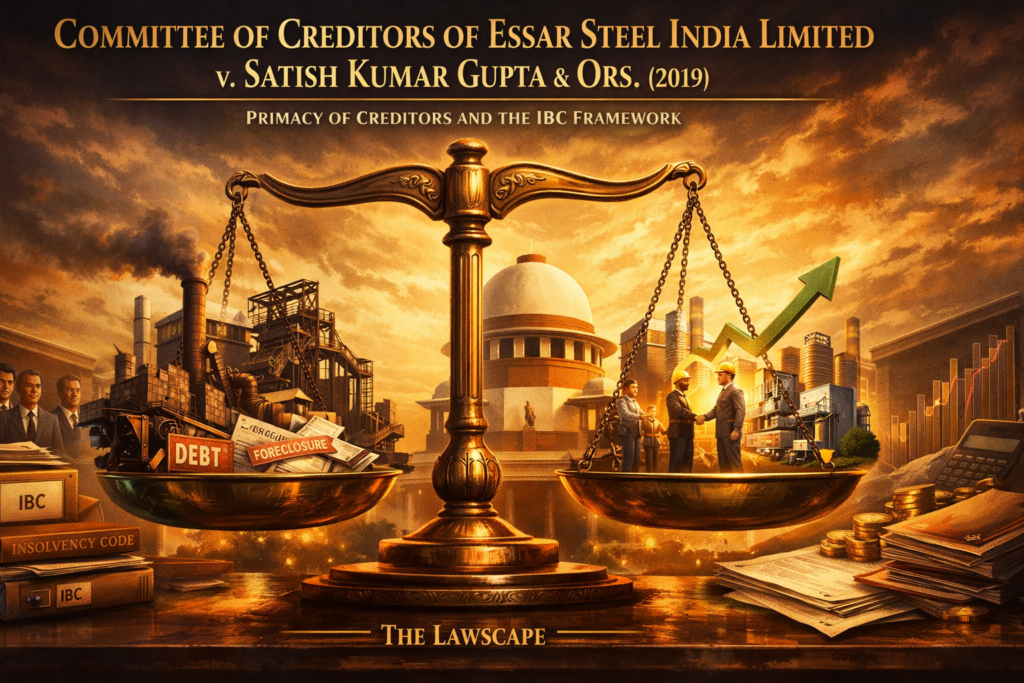
Committee of Creditors of Essar Steel India Limited v. Satish Kumar Gupta & Ors. (2019)
Author: Swapnil Prakash Chavan
Student, Nirmal Education Society’s Subhash Desai College of Law (Mumbai University)
———————————————————————————————————————————————————-
💡 3 Quick Takeaways
- The Supreme Court affirmed the primacy of the Committee of Creditors (CoC) in commercial decision-making under the Insolvency and Bankruptcy Code, 2016.
- Judicial review by the NCLT and NCLAT is limited and cannot extend to questioning the commercial wisdom of the CoC.
- The judgment strengthened the framework of timely resolution and clarified the role of stakeholders in insolvency proceedings.
ABSTRACT
The case of Committee of Creditors of Essar Steel India Limited v. Satish Kumar Gupta & Ors. is a landmark judgment under the Insolvency and Bankruptcy Code, 2016 (IBC). It clarified the scope of judicial intervention in insolvency proceedings and reinforced the importance of the Committee of Creditors (CoC). The Supreme Court emphasized that the commercial wisdom of the CoC is paramount and cannot be interfered with by adjudicating authorities, except within limited statutory boundaries. The case also addressed issues relating to the distribution of resolution proceeds and the rights of operational creditors, thereby shaping the future of insolvency jurisprudence in India.
INTRODUCTION
The Insolvency and Bankruptcy Code, 2016, was enacted to consolidate and amend laws relating to insolvency resolution in India. It aims to ensure time-bound resolution of stressed assets while maximizing the value of such assets.
The case of Committee of Creditors of Essar Steel India Limited v. Satish Kumar Gupta & Ors. is one of the most significant decisions under the IBC. It deals with the extent of judicial intervention in the decisions taken by the Committee of Creditors (CoC) and the treatment of different classes of creditors during the resolution process.
The dispute arose during the corporate insolvency resolution process (CIRP) of Essar Steel India Limited, one of the largest steel manufacturing companies in India. The case raised important questions regarding the distribution of resolution proceeds, the role of adjudicating authorities, and the limits of judicial review under the IBC.
FACTS OF THE CASE
Essar Steel India Limited faced financial distress and defaulted on its debt obligations. Consequently, insolvency proceedings were initiated under the Insolvency and Bankruptcy Code, 2016.
During the CIRP, resolution plans were submitted by various bidders. Eventually, ArcelorMittal’s resolution plan was approved by the Committee of Creditors (CoC) with the required majority. The plan proposed differential treatment between financial creditors and operational creditors.
Operational creditors challenged the distribution mechanism, arguing that they were being treated unfairly compared to financial creditors. The National Company Law Tribunal (NCLT) and later the National Company Law Appellate Tribunal (NCLAT) modified the resolution plan to ensure more equitable distribution among creditors.
Aggrieved by these modifications, the Committee of Creditors approached the Supreme Court, challenging the interference by the NCLT and NCLAT in its commercial decisions.
LITIGATION HISTORY
The matter was first adjudicated by the National Company Law Tribunal (NCLT), which examined the resolution plan. Subsequently, the National Company Law Appellate Tribunal (NCLAT) modified the plan, particularly with respect to the distribution of funds among creditors.
The NCLAT held that equitable treatment must be given to all creditors, including operational creditors. This decision effectively reduced the discretion of the CoC in determining distribution.
The Committee of Creditors challenged this decision before the Supreme Court of India, arguing that such interference violated the scheme of the Insolvency and Bankruptcy Code, 2016.
ISSUES IN THE CASE
- Whether the adjudicating authorities (NCLT and NCLAT) can interfere with the commercial decisions of the Committee of Creditors.
- Whether differential treatment between financial creditors and operational creditors is permissible under the IBC.
- Whether the distribution of resolution proceeds must follow strict equality among creditors.
- Whether the provisions of the Insolvency and Bankruptcy Code, 2016 allow limited judicial review.
ARGUMENTS OF THE PETITIONERS
The petitioners, primarily the Committee of Creditors, argued that the Insolvency and Bankruptcy Code, 2016 clearly grants decision-making power to the CoC. They relied on Section 30(4) of the IBC, which empowers the CoC to approve resolution plans based on its commercial wisdom.
They contended that the role of the NCLT under Section 31 of the IBC is limited to verifying whether the resolution plan meets the requirements specified in the Code. Similarly, under Section 61, the appellate jurisdiction of the NCLAT is also limited.
The petitioners argued that by modifying the resolution plan, the NCLT and NCLAT exceeded their jurisdiction and undermined the objectives of the IBC.
ARGUMENTS OF THE RESPONDENTS
The respondents, including operational creditors, argued that the resolution plan was discriminatory and violated the principle of fairness. They contended that similarly situated creditors should be treated equally.
They also argued that the adjudicating authorities have the power to ensure that the resolution plan is fair and equitable and does not violate the provisions of the IBC. According to them, judicial intervention was necessary to protect the interests of operational creditors.
JUDGMENT
The Supreme Court of India allowed the appeal and upheld the primacy of the Committee of Creditors in the insolvency resolution process. The Court held that the commercial wisdom of the CoC is paramount and cannot be questioned by the NCLT or NCLAT, except on limited grounds specified in the Code.
The Court clarified that Section 30(2) of the Insolvency and Bankruptcy Code, 2016 provides the parameters within which the adjudicating authority can examine a resolution plan. Beyond these parameters, the authority cannot interfere with the decisions of the CoC.
It further held that differential treatment between financial creditors and operational creditors is permissible, provided that the minimum requirements under the Code are satisfied. The Court emphasized that equitable treatment does not mean equal payment to all creditors.
The judgment also highlighted that the objective of the IBC is to maximize the value of assets and ensure timely resolution, and unnecessary judicial interference would defeat this purpose.
Full text of the judgment: https://indiankanoon.org/doc/145803703/
CONCLUSION
The judgment in Committee of Creditors of Essar Steel India Limited v. Satish Kumar Gupta & Ors. is a landmark ruling that strengthened the insolvency framework in India. It reaffirmed the central role of the Committee of Creditors and clarified the limited scope of judicial review under the Insolvency and Bankruptcy Code, 2016.
The decision ensured that insolvency proceedings remain efficient and commercially driven, while also providing clarity on the treatment of different classes of creditors. It continues to serve as a guiding precedent in insolvency law and practice.
Disclaimer: The views expressed in this article are those of the author and do not necessarily reflect the views of The Lawscape.
The Lawscape — clear, practical legal insight for students and future lawyers.
Congratulations Very good story and information. good luck next article.
God bless you. May your thoughts get appreciated all over. Congratulations that from now onwards your thoughts are on the paper and been published in social media also.