
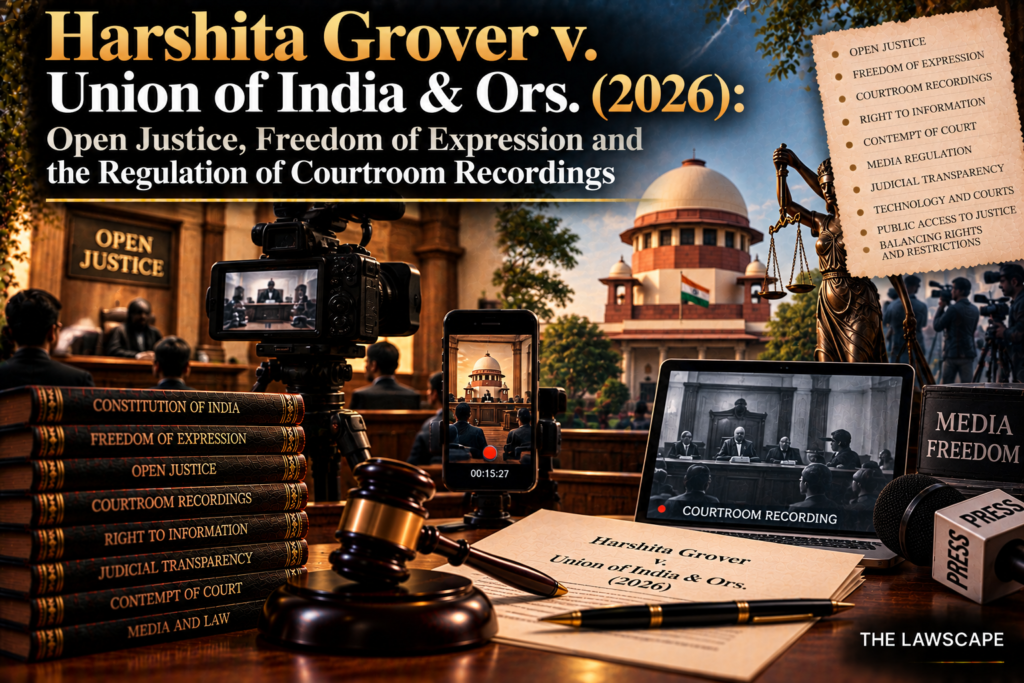
Harshita Grover v. Union of India & Ors. (2026): Open Justice, Freedom of Expression and the Regulation of Courtroom Recordings
Author: Mahewish Shaikh
Student, Savitribai Phule Pune Unviersity
——————————————————————————
💡 3 Quick Takeaways
- The case raises a constitutional question about the distinction between public access to judicial proceedings and the subsequent extraction, editing, dissemination, and commercial exploitation of courtroom recordings.
- The Supreme Court’s interim directions seek to regulate the reuse of audio-visual recordings while the matter remains pending, without imposing a blanket prohibition on journalistic reporting about court proceedings.
- The case highlights the need to balance open justice and freedom of expression under Article 19(1)(a) with concerns about dignity, privacy, security, and the circulation of decontextualised courtroom footage.
I. Introduction
Live-streaming of judicial proceedings has increasingly been recognised as an important component of open justice and public access to the administration of justice. By enabling members of the public to observe court proceedings, live-streaming can promote transparency, accountability, and public confidence in judicial institutions. In Swapnil Tripathi v. Supreme Court of India, (2018) 10 SCC 639, the Supreme Court recognised the constitutional significance of live-streaming proceedings, particularly in matters of public importance.
However, the availability of courtroom recordings raises questions beyond the initial broadcast. Once recordings enter the digital environment, portions of hearings may be extracted, edited, circulated, and monetised on social-media platforms. According to the petitioner in Harshita Grover v. Union of India & Ors., such practices may detach judicial observations and submissions from their factual and procedural context, potentially creating risks of misinformation, harassment, reputational harm, and interference with the dignity of judicial proceedings.
The petition therefore raises a distinct constitutional question: does public access to judicial proceedings necessarily include an unrestricted right to reproduce, modify, disseminate, and commercially exploit audio-visual recordings of those proceedings?
The case brings together several constitutional interests, including open justice, freedom of speech and expression, individual dignity, and the regulation of digital intermediaries. The Supreme Court’s interim directions attempt to address these concerns while the broader regulatory questions remain pending.
II. Case Details
- Case: Harshita Grover v. Union of India & Ors.
- Case number: W.P. (C) No. 751 of 2026
- Court: Supreme Court of India
- Bench: Chief Justice Surya Kant, Justice Joymalya Bagchi, and Justice V. Mohana
- Interim order: 24 July 2026
- Clarificatory order: 31 July 2026
- Constitutional provisions: Articles 19(1)(a), 21, and 32 of the Constitution of India
- Nature of proceeding: Public interest litigation under Article 32
The petition concerns the regulation of recording, extraction, dissemination, and monetisation of audio-visual recordings of judicial proceedings, particularly their subsequent circulation through social-media and other digital platforms.
III. Facts of the Case
Following the development of rules concerning the live-streaming and recording of judicial proceedings, several High Courts began broadcasting hearings to promote transparency and public confidence in the administration of justice.
The petitioner contended that the availability of these recordings had also facilitated the extraction and circulation of short clips containing isolated judicial observations and submissions made by counsel. Such excerpts could be accompanied by sensational captions, thumbnails, or headlines, potentially presenting statements without their wider factual and procedural context.
According to the petition, this form of circulation could expose judges, advocates, and litigants to harassment, vilification, and threats. It could also distort public understanding of judicial proceedings by presenting a limited portion of a hearing as though it represented the complete position of the court or the parties.
The petitioner consequently sought judicial intervention to regulate the unauthorised extraction, dissemination, and commercial exploitation of courtroom recordings.
The proceedings involved several technology and social-media intermediaries, including Meta, Google, YouTube, X, WhatsApp, and LinkedIn, alongside relevant constitutional and judicial authorities. The dispute thus extended beyond courtroom transparency to the responsibilities of digital platforms in handling recordings of judicial proceedings.
IV. Legal Issues
The principal issues raised in the proceedings include:
- Whether the unauthorised extraction, editing, dissemination, and monetisation of recordings of judicial proceedings are inconsistent with the dignity and integrity of those proceedings.
- Whether restrictions on the circulation of courtroom recordings are compatible with the freedom of speech and expression guaranteed under Article 19(1)(a) of the Constitution.
- How restrictions on the reuse of courtroom recordings should be balanced against the constitutional principle of open justice.
- Whether digital intermediaries may bear obligations concerning the circulation of unauthorised courtroom recordings.
- Whether recognised news organisations should receive different treatment from independent journalists, researchers, educators, and ordinary users.
- Whether a prior-permission requirement constitutes a proportionate interim restriction on constitutionally protected expression.
These questions require the Court to distinguish between access to judicial proceedings, reporting on those proceedings, and the independent reproduction or commercial exploitation of audio-visual recordings.
V. Arguments Presented
A. Petitioner’s Arguments
The petitioner argued that the absence of a sufficiently comprehensive regulatory framework had facilitated the sensationalised circulation of courtroom footage. According to the petitioner, isolated judicial observations and submissions could be detached from their factual and procedural context and transformed into viral digital content.
The petitioner further contended that such circulation could expose judges, advocates, and litigants to harassment, vilification, and threats. The resulting content could undermine the dignity of judicial proceedings and create misleading impressions about the positions taken by the court or the parties.
On this basis, the petitioner sought interim safeguards pending the formulation of a comprehensive regulatory framework governing the extraction and reuse of court recordings.
B. Respondents’ and Intervenors’ Arguments
The intervenors raised concerns about an overly broad permission-based regime. They argued that requiring prior authorisation for the reuse of courtroom recordings could interfere with open justice and the freedom of expression.
They proposed a more calibrated framework based on an official archive of judicial proceedings and clearly articulated rules governing the extraction and reuse of recordings.
The intervenors also questioned whether any exemption should be limited to recognised news organisations. Independent journalists, researchers, academics, educators, and citizen journalists may also perform legitimate public-interest functions. A framework that distinguishes between users solely on the basis of institutional recognition could therefore raise concerns about unequal treatment and unnecessary restrictions on expression.
VI. The Court’s Reasoning and Interim Directions
A. Balancing Open Justice and the Protection of Proceedings
The Supreme Court recognised the tension between open justice and transparency, on the one hand, and the protection of judicial proceedings from potentially harmful and decontextualised digital circulation, on the other.
The constitutional value of open justice does not necessarily establish an unrestricted entitlement for third parties to reproduce, edit, commercialise, or redistribute every audio-visual recording of judicial proceedings. Access to a hearing and the subsequent independent use of its recording raise related but distinct questions.
At the interim stage, the Court considered restrictions on unauthorised extraction and dissemination necessary to address the potential misuse of courtroom recordings while the broader regulatory question remained pending.
At the same time, the Court clarified that its directions were not intended to prevent legitimate journalistic reporting of judicial proceedings. The distinction between reporting on proceedings and reproducing audio-visual clips of those proceedings was therefore material to the interim framework.
B. Directions Issued on 24 July 2026
By its interim order dated 24 July 2026, the Supreme Court directed that audio-visual recordings of judicial proceedings could not be extracted, disseminated, monetised, posted, reposted, uploaded, transmitted, modified, stored, or hosted on social-media or digital platforms without prior permission from the Secretary General of the Supreme Court or the Registrar General of the concerned High Court.
The direction sought to regulate the subsequent use of courtroom recordings rather than eliminate the principle of public access to judicial proceedings.
The Court also sought information concerning the implementation of live-streaming rules and the practical feasibility of continuous and uninterrupted live-streaming of judicial proceedings.
C. Clarification Issued on 31 July 2026
The Court subsequently clarified that the interim restriction did not amount to a blanket prohibition on recognised news organisations reporting on court proceedings. However, such reporting could not itself rely upon audio-visual clips of the hearings.
This clarification is significant because it distinguishes the act of reporting on judicial proceedings from the reproduction and circulation of their recordings. Nevertheless, the restriction on the use of audio-visual clips continues to raise questions about the practical ability of journalists and other users to communicate information and commentary about judicial proceedings.
The directions must be understood within their procedural context. They are interim measures and should not be treated as a final determination of the constitutional validity of a permanent regulatory framework.
VII. Constitutional Analysis
A. Article 19(1)(a): Freedom of Speech and Expression
Article 19(1)(a) guarantees freedom of speech and expression. This protection is central to journalism, academic research, legal education, public commentary, and democratic scrutiny of judicial institutions.
However, the right is subject to constitutionally permissible restrictions under Article 19(2). Any restriction must therefore be assessed against the applicable constitutional requirements rather than justified solely by the possibility that courtroom recordings may be misused.
The prior-permission requirement raises questions about the breadth and practical operation of the restriction. It may affect journalists, researchers, educators, and independent commentators who wish to use courtroom recordings for legitimate public-interest purposes.
The constitutional inquiry consequently concerns whether the restriction is appropriately tailored to the identified risks and whether less restrictive measures could address those risks while preserving legitimate forms of expression.
B. Article 21: Dignity, Privacy, and Personal Security
Article 21 protects life and personal liberty. The proceedings also raise concerns relating to dignity, privacy, and personal security for individuals involved in judicial proceedings.
Courtroom footage may include sensitive submissions, personal information, or observations that acquire a different meaning when separated from the surrounding proceedings. The subsequent circulation of such material may create risks for litigants, witnesses, advocates, and judges.
These concerns form part of the broader constitutional context of the case. However, the existence of potential harm does not, by itself, resolve the question of how broadly restrictions on the reuse of recordings should operate.
The challenge is to address legitimate concerns about individual dignity and security without unnecessarily restricting public-interest reporting or commentary.
C. Open Justice and Public Accountability
Open justice promotes transparency and accountability in the administration of justice. By allowing the public to observe judicial proceedings, live-streaming can make the functioning of courts more accessible and strengthen public understanding of legal processes.
In Swapnil Tripathi v. Supreme Court of India, (2018) 10 SCC 639, the Supreme Court recognised the significance of live-streaming in furthering these objectives.
The present dispute concerns the extent to which these principles apply after a hearing has been recorded. Public access to proceedings, journalistic reporting, and unrestricted reproduction of audio-visual recordings are not necessarily identical rights.
The challenge is to establish a framework that preserves meaningful transparency while addressing the risks associated with misleading editing, unauthorised circulation, and commercial exploitation.
VIII. Critical Analysis
A. Significance of the Case
The case addresses an emerging regulatory problem arising from the interaction between open justice and digital-platform architecture.
Traditional reporting generally involves selecting, contextualising, and presenting developments from a judicial proceeding. Social-media circulation of short video excerpts operates differently. A few seconds of a hearing may be detached from the surrounding argument and distributed widely without the context needed to understand the exchange.
The case therefore raises an important question about whether access to judicial proceedings necessarily includes an unrestricted right to reproduce and commercially exploit recordings of those proceedings.
Its significance lies in the need to develop a framework that recognises the benefits of transparency while addressing the distinct risks created by the circulation of decontextualised recordings.
B. Freedom of Expression Concerns
The interim permission requirement raises legitimate concerns under Article 19(1)(a). Prior authorisation requirements may create practical obstacles for journalists, researchers, educators, and independent commentators seeking to use recordings for legitimate purposes.
A permanent framework should therefore distinguish, as far as practicable, between harmful commercial exploitation and legitimate journalism, research, education, commentary, and archival use.
The concerns raised by the intervenors also highlight the importance of avoiding unnecessary distinctions between recognised news organisations and independent users who may perform comparable public-interest functions.
The eventual regulatory approach will need to address these competing considerations with sufficient clarity to enable users to understand the applicable restrictions.
C. Responsibility of Digital Intermediaries
The involvement of major digital intermediaries raises questions about the extent to which platforms should be required to monitor, remove, or restrict courtroom recordings.
The Information Technology Act, 2000, particularly Sections 79 and 87, provides part of the statutory context for intermediary regulation and the framing of relevant rules.
Any permanent framework must account for applicable statutory safe-harbour protections, intermediary obligations, and constitutional free-expression principles.
A regulatory framework that imposes unclear or excessively broad obligations may create uncertainty about lawful content and encourage restrictions beyond what is necessary to address the identified risks. Conversely, a framework that does not adequately address harmful circulation may leave affected persons with limited practical protection.
The case thus raises questions about how responsibilities should be allocated between the courts, users, and digital platforms.
D. The Need for a Calibrated Regulatory Framework
The concerns raised in the proceedings suggest that regulation should distinguish between different forms of access and reuse. Public access to judicial proceedings, reporting on court proceedings, and the reproduction of audio-visual recordings are related activities, but they may create different risks.
An official archive, clearly stated conditions of use, and transparent permission procedures are among the approaches discussed in the proceedings. The intervenors’ submissions also highlight the importance of preserving legitimate public-interest uses.
Any permanent framework will need to address the scope of restrictions, the categories of permitted use, the position of independent journalists and researchers, and the responsibilities of digital intermediaries. These questions remain part of the broader regulatory issue and should not be treated as finally resolved by the interim directions.
IX. Ratio and Interim Significance
Because the matter remains pending at the interim stage, the directions should not be characterised as a final determination of the constitutional validity of a permanent regulatory framework.
The principal significance of the interim orders lies in the distinction they draw between:
- Public access to judicial proceedings.
- Journalistic reporting concerning those proceedings.
- The unauthorised extraction, reproduction, editing, dissemination, and monetisation of audio-visual recordings.
This distinction is central to understanding the constitutional balance attempted by the Court.
The interim directions regulate the reuse of courtroom recordings while the broader questions concerning open justice, freedom of expression, and digital intermediaries remain subject to further consideration. The final legal position must be understood in light of subsequent proceedings and any further orders of the Court.
X. Conclusion
Harshita Grover v. Union of India & Ors. raises an important constitutional question at the intersection of open justice, digital platforms, freedom of expression, judicial dignity, and intermediary regulation.
The case demonstrates that transparency through live-streaming creates a further regulatory challenge once courtroom footage enters the digital ecosystem. While public access promotes accountability and participation, the unrestricted reproduction and decontextualised circulation of recordings may create different risks for individuals involved in judicial proceedings and for public understanding of the judicial process.
The interim directions attempt to address these concerns by regulating the extraction and dissemination of courtroom recordings while preserving the distinction between such activities and reporting on judicial proceedings. At the same time, the permission requirement raises questions about its practical effects on journalism, research, education, and independent commentary.
The eventual final decision may have important consequences for the future governance of judicial recordings in India. A lasting framework will need to reconcile transparency with legitimate protections for dignity and security, while ensuring that restrictions on expression remain constitutionally justified and appropriately tailored.
Ultimately, the challenge is not simply to determine who may access courtroom recordings, but to establish how those recordings may be reused without undermining either the openness of the judicial process or the constitutional freedoms that sustain public scrutiny.
XI. Authorities and References
Cases
- Harshita Grover v. Union of India & Ors., W.P. (C) No. 751 of 2026 (Supreme Court of India, 24 July 2026) (interim order).
- Harshita Grover v. Union of India & Ors., W.P. (C) No. 751 of 2026 (Supreme Court of India, 31 July 2026) (clarificatory order).
- Swapnil Tripathi v. Supreme Court of India, (2018) 10 SCC 639.
Constitutional Provisions
- Constitution of India, Article 19(1)(a).
- Constitution of India, Article 19(2).
- Constitution of India, Article 21.
- Constitution of India, Article 32.
Legislation
- Information Technology Act, 2000, Sections 79 and 87.
Secondary Sources
- LiveLaw, “Supreme Court Bans Uploading & Sharing of Audio-Video Recordings of Court Hearings Without Prior Permission” (24 July 2026).
- SCC Online Blog, “Inside the Order: Why and How the Supreme Court Curbed Clipped, Out-of-Context Court Videos on Social Media” (29 July 2026).
- LawBeat, “Audio-Video Clips of Court Proceedings Cannot Be Used for Reporting: Supreme Court” (31 July 2026).
- LawStreet, “Live-Streaming Restrictions Don’t Bar News Reporting on Court Proceedings, Clarifies SC.”
- Counterview, “Supreme Court Allows Transparency Activists to Intervene in Live-Streaming Case” (August 2026).
Disclaimer: The views expressed in this article are those of the author and do not necessarily reflect the views of The Lawscape.
The Lawscape — clear, practical legal insight for students and future lawyers.