
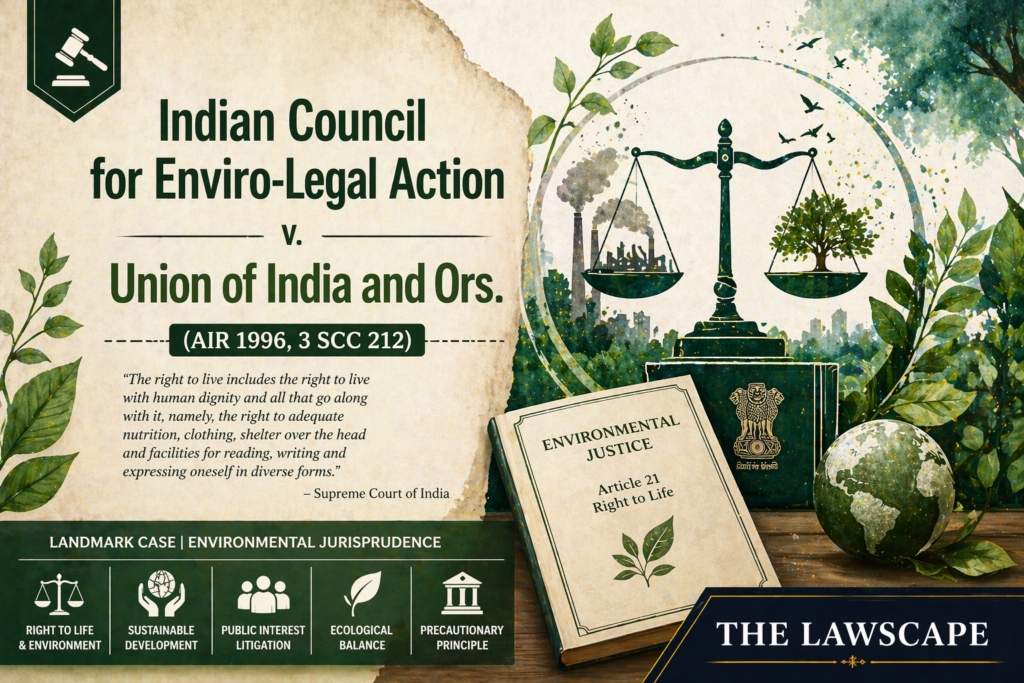
Indian Council for Enviro-Legal Action v. Union of India and Ors. (AIR 1996, 3 SCC 212)
Author: Khushboo Sanjay Gupta
Student, MKLM Adhia College of Law
———————————————————————————————————-
💡 3 Quick Takeaways
The Supreme Court in Indian Council for Enviro-Legal Action v. Union of India firmly applied the Polluter Pays Principle — holding that industries responsible for environmental damage bear full liability for compensation and restoration, regardless of whether precautions were taken.
The case arose from devastating chemical contamination in Bichhri village, Udaipur, where hazardous industrial discharge of H-Acid, oleum gas, and related substances caused widespread illness, death, and long-term ecological destruction.
The judgment stands as a landmark in Indian environmental jurisprudence, establishing that those who profit from hazardous industrial activity cannot escape the financial and legal consequences of the harm they cause to the environment and to the communities living within it.
Court and Bench
Supreme Court of India; Division Bench comprising Justice B.P. Jeevan Reddy and Justice B.N. Kirpal.
Date of Judgment: 13th February 1996
Parties: Petitioner — Indian Council for Enviro-Legal Action (an organisation engaged in environmental protection); Respondents — Union of India and Others.
Facts
The Indian Council for Enviro-Legal Action, an organisation dedicated to environmental protection, filed a writ petition before the Supreme Court concerning a severe environmental crisis that had developed in Bichhri village, a small settlement in the Udaipur district of Rajasthan. The village had become home to a large number of chemical industrial plants, creating serious potential for environmental pollution across the region.
The northern part of Bichhri village housed several industrial units, including Hindustan Zinc Limited and other chemical industries. Many of the industrialists operating these plants treated them primarily as sources of commercial profit — particularly through export revenues — and continued their operations without adequate concern for the surrounding environment or the health of the local population.
In 1987, Hindustan Agro Chemicals Ltd. established a plant in the village and commenced the manufacture of oleum gas — a form of fuming sulphuric acid capable of causing severe skin burns, eye irritation, and lung damage upon exposure. Around the same time, Tatasilver Chemicals began producing H-Acid, a chemical used in manufacturing acid dyes for cotton and cellulosic fibres. H-Acid is a harmful substance that causes skin and eye irritation and poses serious risks to both human health and the environment. Another industry, Jyoti Chemicals, also situated within the village, was engaged in producing H-Acid alongside other hazardous chemicals. Several additional industries in the same area were involved in the manufacture of fertilisers and other toxic substances.
The waste generated by these industries was discharged into water bodies, causing widespread water contamination. It was disposed of on land, rendering the soil infertile, and released into the atmosphere, making it difficult for residents and animals to breathe. Despite the severity of the environmental consequences, the industries continued to dispose of their waste in and around the village without implementing adequate preventive or remedial measures.
The health conditions of the village deteriorated rapidly. Illnesses among residents increased significantly, deaths were recorded in the village and surrounding areas, and animals in the region were affected on a large scale due to the contamination of water, soil, and air. The worsening situation eventually drew the attention of the authorities and Parliament, prompting protests against the environmental degradation. The District Magistrate ultimately invoked Section 144 of the Code of Criminal Procedure, and all industrial plants operating in the village were ordered to shut down.
Issues
The following issues arose for the Court’s determination:
Whether the industries involved in the manufacture of toxic chemicals had taken any adequate environmental protection measures; and
Whether the respondent industries were legally liable to bear the cost of the remedial and restorative actions necessitated by their activities.
Arguments of the Parties
Petitioner
The petitioner argued that the respondent industries were manufacturing H-Acid and other hazardous chemicals within the same industrial area in Bichhri village. The manufacturing process generated large quantities of harmful industrial discharge — including iron-based waste and gypsum — which further produced toxic sludge. It was contended that this sludge and other industrial waste were neither properly treated nor disposed of, resulting in the significant contamination of air, water, soil, and other environmental resources. The consequent pollution had posed grave risks to the health and safety of the village’s residents.
The petitioner further argued that these industries had been generating pollution without any regard for the surrounding environment, and urged the Court to order their immediate closure to prevent further damage. It was also submitted that production should remain suspended until adequate remedial measures were adopted and the environmental damage already caused was repaired. The petitioner additionally noted that the respondent industries had applied for a No Objection Certificate (NOC) from the relevant authorities to continue manufacturing these hazardous chemicals — an application that was refused. This refusal demonstrated that the authorities were well aware of the serious environmental consequences of such manufacturing activities, yet the industries had continued regardless.
Respondents
The respondent Hindustan Agro Chemicals Limited contended, by affidavit, that its plant had obtained an NOC from the Pollution Control Board for the manufacture of sulphuric acid and aluminium sulphate, granted subject to certain terms and conditions under the Water (Prevention and Control of Pollution) Act, 1974 and the Air (Prevention and Control of Pollution) Act, 1981. It was claimed that following the grant of the NOC, the plant had shifted to producing oleum and single super phosphate rather than sulphuric acid. The respondents further contended that complete treatment of the industrial waste was not feasible, as many of the hazardous substances generated during the manufacturing process were resistant in nature and difficult to neutralise.
Judgment
The Supreme Court held the respondent industries liable for the extensive environmental damage caused in Bichhri village and the surrounding areas. The Court found that the industries had caused severe pollution of air, water, and soil through the improper disposal of hazardous chemical waste, and directed them to pay compensation for the damage caused to the environment and to the residents of the affected villages.
By its order dated 11th April 1997, the Court directed the respondent industries to pay a penalty of Rs. 37,385,000 together with compound interest at the rate of 12 percent per annum until the entire amount was fully discharged. The Court observed that the industries had intentionally failed to comply with its earlier directions regarding environmental protection and maintenance. It further noted that the respondents had filed a series of interlocutory applications over the course of more than fifteen years with the evident intention of prolonging litigation and delaying compliance, rather than for any genuine legal purpose. These applications were rejected with costs.
In addition, the Court imposed further costs of Rs. 10 lakhs on the respondent industries for the unnecessary delay caused and for the misuse of judicial process.
In delivering its judgment, the Court applied the Polluter Pays Principle — the principle that any person or industry responsible for causing environmental harm must bear the cost of compensating those affected and of restoring the damaged environment. The Court held that where an activity is hazardous in nature and results in environmental damage, the polluting party is legally obligated to compensate the affected parties and to bear the full cost of environmental restoration, irrespective of whether precautions were taken at the time of the activity.
Ratio Decidendi
The ratio of the case lies in the Court’s recognition and application of the Polluter Pays Principle as a binding principle of Indian environmental jurisprudence. The Court held that this principle could be implemented through the powers conferred under Sections 3 and 5 of the Environment (Protection) Act, 1986, which authorise the government to take necessary measures to protect and improve the quality of the environment.
The principle was further grounded in Principle 16 of the Rio Declaration on Environment and Development (1992), which provides that the polluter should, in principle, bear the cost of pollution, having regard to the public interest and without distorting international trade and investment. The Court emphasised that the individual or industry responsible for pollution must bear the financial burden of compensating for the harm caused.
This reasoning was reinforced by the doctrine of Absolute Liability, earlier established by the Supreme Court in M.C. Mehta v. Union of India (Oleum Gas Leak Case). The Court reaffirmed that industries engaged in hazardous or inherently dangerous activities are strictly liable for all environmental harm caused by them, and that the compensation and penalties imposed must be directed towards restoring the damaged environment and compensating the affected residents.
Conclusion
Environmental pollution does not harm a single individual in isolation — it damages the entire ecosystem. It contaminates water resources, pollutes the atmosphere, degrades the quality of air available to living beings, and renders the soil infertile, potentially leading to drought and the loss of agricultural productivity. Environmental resources are of inestimable value, and once degraded, they cannot easily be restored to their original condition. The contamination of a primary water source, for instance, poses challenges that may persist for generations.
It is therefore the collective responsibility of society and industry alike to protect and preserve the natural environment. Industries engaged in hazardous activities ought to be located away from residential settlements to minimise the risk to human life and health, and away from water sources and agricultural areas, where the discharge of industrial waste can cause severe harm to both human populations and other living organisms.
The imposition of substantial financial penalties on polluters plays a vital role in deterring environmentally harmful activities. When industries are compelled to bear the full financial cost of the damage caused by their actions, it creates a meaningful incentive to adopt proper waste management systems and preventive measures.
The Polluter Pays Principle as affirmed in Indian Council for Enviro-Legal Action v. Union of India has assumed an important position in Indian environmental law. The judgment has set a significant precedent — one that holds those responsible for environmental pollution fully accountable and ensures that they compensate both the environment and the communities that bear the consequences of their actions.
Disclaimer: The views expressed in this article are those of the author and do not necessarily reflect the views of The Lawscape.
The Lawscape — clear, practical legal insight for students and future lawyers.