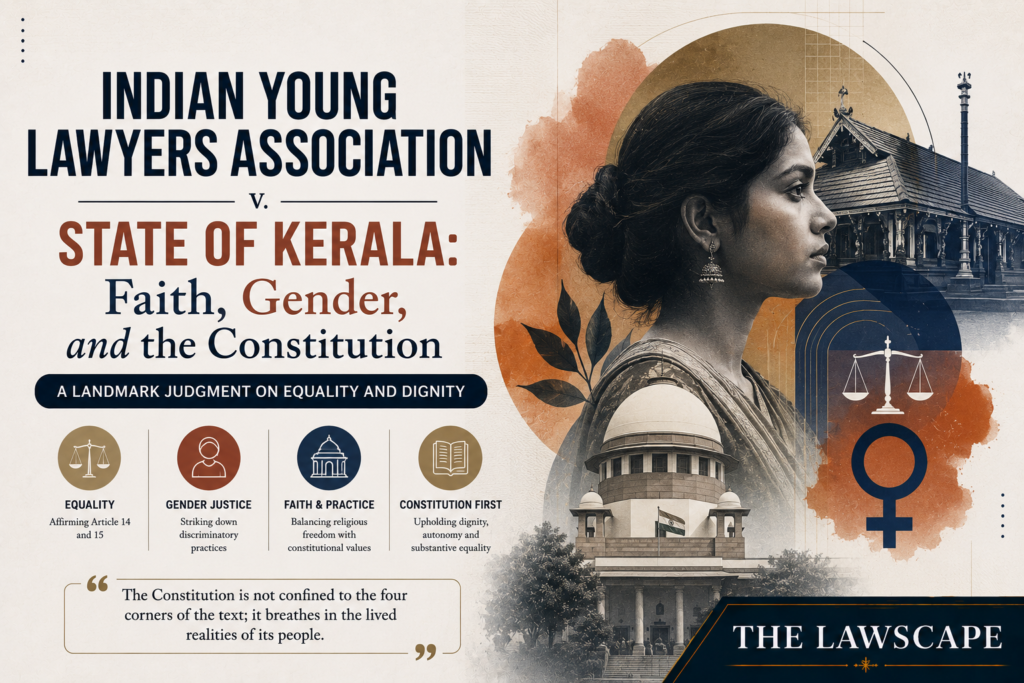
Indian Young Lawyers Association v. State of Kerala: Faith, Gender, and the Constitution
Author: Yadu Krishna K G
Student, Bharata Mata School of Legal Studies, Aluva, Kerala
————————————————————————————————-
Author: [Full Name]
Student, [Institution Name]
💡 3 Quick Takeaways
- The exclusion of women of menstruating age from the Sabarimala Temple was held to violate Articles 14, 15, 17, and 25(1) of the Constitution.
- The Supreme Court ruled that devotees of Lord Ayyappa do not constitute a separate religious denomination under Article 26.
- The judgment reignited the debate on the Essential Religious Practices doctrine, which is presently under reconsideration before a nine-judge bench of the Supreme Court.
Introduction
There is a hill in Kerala called Sabarimala. On it stands a temple dedicated to Lord Ayyappa. For centuries, women between the ages of ten and fifty were not permitted to enter. In September 2018, the Supreme Court of India held that they could. That ruling in Indian Young Lawyers Association v. State of Kerala remains one of the most debated constitutional judgments of the twenty-first century.
The case is not merely about temple entry. At its core lies a constitutional question that Indian jurisprudence has struggled to resolve conclusively: when religious practices and constitutional rights come into conflict, which should prevail? The majority held that constitutional guarantees must prevail. The lone dissenter maintained that courts should not assume the authority to make such determinations. Both positions present serious constitutional arguments, and the tension between them is what makes this case particularly significant.
The developments following the judgment further complicated the debate. Two women entered the temple on 2 January 2019, triggering widespread protests across Kerala. More than fifty review petitions were subsequently filed. Rather than deciding the review petitions, the review bench referred seven broader constitutional questions to a nine-judge bench of the Supreme Court. That bench heard arguments for sixteen days between April and May 2026 and has reserved its judgment. Consequently, while the 2018 decision remains binding law, the constitutional foundations upon which it rests are currently under examination by the largest bench that the Supreme Court can constitute.
This commentary focuses on the 2018 judgment, its reasoning, strengths, and unresolved constitutional questions. The 2026 reference proceedings are addressed only in the conclusion as contextual background to the issues that remain unsettled.
Facts of the Case
The Sabarimala Sree Dharma Sastha Temple, situated in the Pathanamthitta district of Kerala, is dedicated to Lord Ayyappa, who is worshipped as a Naishtika Brahmachari—an eternal celibate. On this basis, the Travancore Devaswom Board historically excluded women between the ages of ten and fifty from entering the temple.
This practice received statutory support through Rule 3(b) of the Kerala Hindu Places of Worship (Authorisation of Entry) Rules, 1965, which permitted Hindu denominations to exclude women from public places of worship on the basis of custom.
The Indian Young Lawyers Association filed a writ petition under Article 32 of the Constitution challenging the exclusion. The petition argued that Rule 3(b) violated Articles 14, 15, 17, 19, and 25 of the Constitution. The matter was referred to a five-judge Constitution Bench, and on 28 September 2018, the Court delivered its judgment by a 4:1 majority, striking down Rule 3(b) and holding the exclusion unconstitutional.
The majority consisted of Chief Justice Dipak Misra and Justice A.M. Khanwilkar (joint opinion), Justice R.F. Nariman (concurring), and Justice D.Y. Chandrachud (concurring). Justice Indu Malhotra delivered the sole dissenting opinion. Each judge authored a separate opinion, resulting in a judgment spanning hundreds of pages and reflecting the complexity of the constitutional questions involved.
Issues Raised
The Constitution Bench framed the following questions for determination:
- Whether the exclusion of women of menstruating age from the Sabarimala Temple violates Articles 14, 15, and 17 of the Constitution.
- Whether the devotees of Lord Ayyappa constitute a religious denomination within the meaning of Article 26 and, if so, whether the exclusion is protected as an aspect of denominational autonomy.
- Whether the exclusion of women constitutes an essential religious practice of the Ayyappa faith and is therefore protected under Article 25(1).
- Whether Rule 3(b) of the Kerala Hindu Places of Worship (Authorisation of Entry) Rules, 1965, is constitutionally valid.
- What is the scope of the term “morality” in Articles 25 and 26, and whether it refers to popular morality or constitutional morality.
Judgment and Ratio Decidendi
The majority first held that the exclusion violated Article 14. The classification of women on the basis of menstruation lacked any rational nexus with a legitimate constitutional objective. The biological fact of menstruation could not justify excluding a class of women from a place of public worship.
Second, the Court held that the exclusion constituted discrimination on the ground of sex under Article 15(1). Since the Travancore Devaswom Board is a statutory body, its rules carry the force of State action. A statutory rule that discriminates against women on the basis of a physiological characteristic falls squarely within the prohibition contained in Article 15.
Third, the majority held that devotees of Lord Ayyappa do not constitute a separate religious denomination under Article 26. To qualify as a religious denomination, a group must possess a distinct name, a common faith, and a common organisational structure. The Court concluded that devotees of Lord Ayyappa are simply Hindus who worship at a particular shrine and therefore do not satisfy the requirements necessary to claim denominational autonomy.
Fourth, applying the Essential Religious Practices (ERP) doctrine developed in The Commissioner, Hindu Religious Endowments, Madras v. Shri Lakshmindra Thirtha Swamiar of Shirur Mutt, the Court held that the exclusion of menstruating women was not an essential religious practice. No scriptural evidence demonstrated that the religion would lose its essential character if women of menstruating age were permitted entry. Consequently, the exclusion was not entitled to constitutional protection.
Justice Chandrachud’s concurring opinion went a step further by invoking Article 17. He held that treating women’s bodies as ritually impure on account of menstruation constitutes a form of untouchability within the meaning of Article 17, which abolishes untouchability in “any form.” According to this interpretation, the constitutional prohibition extends beyond caste-based exclusions to encompass practices that treat any class of persons as inherently polluting.
Justice Indu Malhotra dissented on every issue. Her principal concern related to institutional competence. She argued that courts are not equipped to determine what is essential to a faith and that the ERP doctrine requires judges to undertake theological inquiries beyond their expertise. She further contended that constitutional courts should exercise restraint when adjudicating matters of religious belief and practice.
Critical Analysis
The judgment reaches a constitutionally persuasive outcome but adopts a more complex route than may have been necessary. Much of the majority’s reasoning relies upon the ERP doctrine, a doctrine that has attracted criticism for requiring secular judges to function as arbiters of theology.
Whether the presence of menstruating women affects Lord Ayyappa’s celibate status is fundamentally a theological question rather than a legal one. Courts possess limited institutional competence to answer such questions, making the ERP inquiry inherently problematic.
A more straightforward constitutional approach was available. The Travancore Devaswom Board is a statutory authority, and Rule 3(b) is delegated legislation. The exclusion discriminates against women on the basis of a characteristic unique to women. Since Article 15(1) prohibits State discrimination on the ground of sex, that finding alone could have resolved the dispute without requiring judicial examination of religious doctrine.
Justice Chandrachud’s reliance on Article 17 represents one of the most intellectually significant aspects of the judgment. The Constitution abolishes untouchability in “any form.” A practice that treats a category of persons as ritually impure may reasonably be understood as falling within that prohibition. This interpretation broadens the constitutional understanding of untouchability and situates the exclusion within a larger framework of dignity and equality.
Justice Malhotra’s dissent raises an important constitutional concern regarding judicial restraint and religious autonomy. In a society characterised by extraordinary religious diversity, the extent to which courts should intervene in religious matters remains a difficult question. However, taken to its logical conclusion, her position risks insulating discriminatory religious practices from constitutional scrutiny. The Constitution was designed not only to regulate State action but also to protect individuals from forms of discrimination that may arise within communities and institutions.
The majority’s conclusion that Ayyappa devotees do not constitute a separate religious denomination may ultimately be correct. Nevertheless, the issue deserved more extensive doctrinal analysis than it received. Questions concerning denominational identity, organisational structure, and religious distinctiveness are complex and continue to generate constitutional debate.
Conclusion and Implications
The Sabarimala judgment represents a significant constitutional moment, even if aspects of its reasoning remain contested. It establishes that places of public worship cannot exclude women on grounds linked to their biological characteristics. It also confirms that statutory bodies cannot invoke religious custom as a shield for practices that would otherwise violate constitutional guarantees of equality and dignity.
Justice Chandrachud’s interpretation of Article 17, if accepted as settled constitutional doctrine, may have implications extending well beyond temple entry disputes. It has the potential to reshape the understanding of untouchability in Indian constitutional law.
Equally important are the questions the judgment leaves unresolved. The ERP doctrine, which has shaped judicial engagement with religious practices for decades, is presently under reconsideration by a nine-judge bench of the Supreme Court. The bench, led by Chief Justice Surya Kant, heard extensive arguments between April and May 2026 and reserved judgment on 14 May 2026. Its eventual decision is likely to influence not only Sabarimala but also a range of disputes involving religious autonomy, gender equality, and constitutional rights.
During the 2026 hearings, Chief Justice Surya Kant observed that courts cannot abandon their constitutional duty to review religious practices when fundamental rights are implicated. That observation captures the central constitutional dilemma presented by this litigation. The promises of equality and dignity embodied in the Constitution do not cease at the doors of places of worship.
Whatever the outcome of the pending reference, the Sabarimala litigation has compelled Indian constitutional law to confront a fundamental question: what does equality truly require when religious tradition and constitutional rights appear to collide? That conversation was long overdue, and it remains unfinished.
Disclaimer: The views expressed in this article are those of the author and do not necessarily reflect the views of The Lawscape.
The Lawscape — clear, practical legal insight for students and future lawyers.