
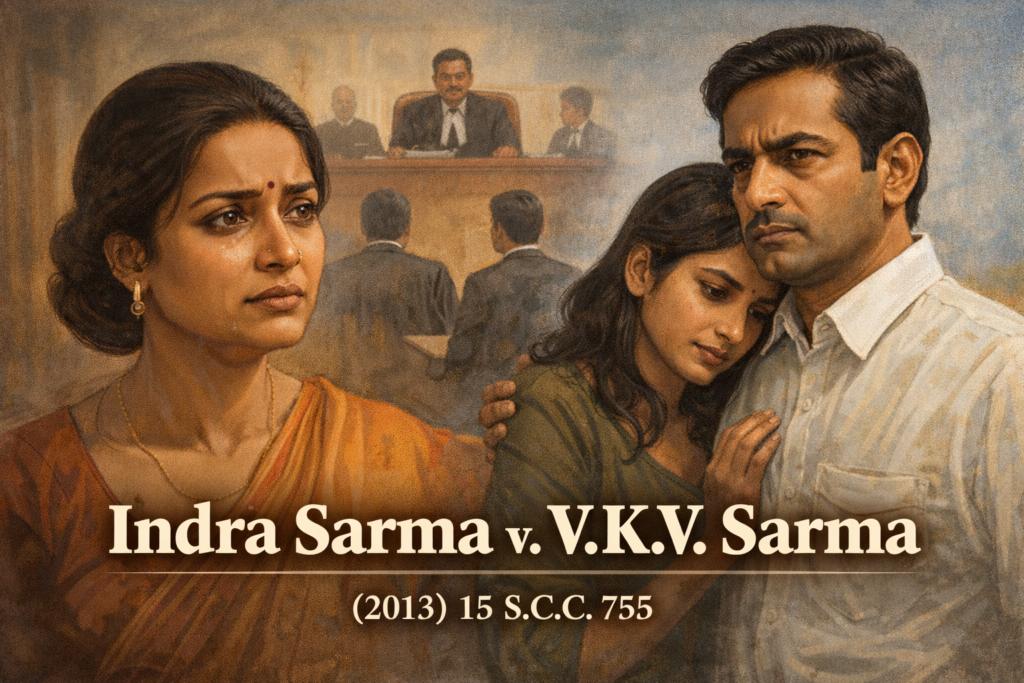
Indra Sarma v. V.K.V. Sarma (2013) 15 SCC 755
Author: Soham Tanaji Bhosale
Student, KES Shri Jayantilal H Patel Law College, Mumbai
———————————————————————————————————-
💡 3 Quick Takeaways
- The Supreme Court laid down guidelines to determine when a live-in relationship qualifies as a “relationship in the nature of marriage.”
- A subsisting prior marriage is a key bar to claiming maintenance under Section 125 CrPC.
- The judgment balances protection of women with preservation of the institution of marriage.
INTRODUCTION
The evolution of societal norms in India has necessitated a reinterpretation of legal constructs, particularly those concerning familial relationships and marriage. The Indian judiciary, often acting as an agent of social change, has been tasked with defining the legal status of live-in relationships—a concept that, while increasingly common, remains in tension with traditional matrimonial laws.
In Indra Sarma v. V.K.V. Sarma, the Supreme Court of India provided a framework for determining when a live-in relationship warrants legal protection similar to that of a valid marriage, particularly in the context of maintenance under Section 125 of the Code of Criminal Procedure, 1973.
This case is significant not only for its outcome but also for its attempt to categorize live-in relationships. The Court acknowledged a “middle ground” between formal marriage and illegitimacy while establishing stringent guidelines to prevent misuse of maintenance provisions.
FACTS OF THE CASE
The appellant, Indra Sarma, and the respondent, V.K.V. Sarma, entered into a relationship around the year 2000. At that time, the respondent was already married and had two children from his existing marriage. Despite this, the parties began cohabiting in 2002.
The appellant contended that they presented themselves as husband and wife and maintained a household similar to that of a married couple. However, the relationship deteriorated around 2008–2009, after which the respondent left the shared household.
The appellant filed a petition under Section 125 of the Code of Criminal Procedure, 1973, seeking maintenance, claiming that she was either the respondent’s “wife” or that their relationship was in the nature of marriage.
The respondent argued that his subsisting marriage prevented any recognition of the relationship as marriage or marriage-like. He further contended that the appellant was aware of his marital status.
The Family Court dismissed the petition, and the High Court upheld the decision. The appellant then approached the Supreme Court.
ISSUES RAISED
- Whether the term “wife” under Section 125 CrPC includes a woman in a live-in relationship.
- What criteria must be satisfied for a live-in relationship to qualify as a “relationship in the nature of marriage.”
- Whether a subsisting prior marriage acts as a bar to claiming maintenance.
- Whether the Protection of Women from Domestic Violence Act, 2005 extends to such relationships.
ANALYSIS
Judicial Reasoning and the Guidelines
The Supreme Court acknowledged the growing prevalence of live-in relationships but clarified that not all such relationships qualify for legal protection as marriage-like arrangements.
Relying on D. Velusamy v. D. Patchaiammal, the Court formulated guidelines to determine whether a relationship qualifies as one “in the nature of marriage.” These include:
• Duration of cohabitation must be significant
• Existence of a shared household
• Financial interdependence and pooling of resources
• Domestic arrangements similar to marriage
• Social recognition as a couple
• Intention and conduct reflecting long-term commitment
• Absence of a subsisting valid marriage
The Court emphasized that short-term or casual relationships do not qualify for protection under Section 125 CrPC.
Application to the Facts
Applying these principles, the Court rejected the appellant’s claim. The decisive factor was the respondent’s subsisting marriage.
The Court held that under the Hindu Marriage Act, 1955, monogamy is mandatory. Since the respondent’s first marriage was valid and subsisting, the live-in relationship could not be treated as a marriage or a relationship in the nature of marriage.
The Court further held that awareness of this legal impediment negated the intention required to establish a marriage-like relationship.
Full text of the judgment: https://indiankanoon.org/doc/11131528/
CRITICAL ASSESSMENT
Strengths of the Judgment
The judgment provides much-needed clarity and safeguards against misuse of maintenance laws. By setting objective criteria, the Court ensured that only stable, marriage-like relationships receive legal protection.
It also protects the rights of the legally wedded spouse. Recognizing claims from live-in partners where a valid marriage exists could undermine the institution of marriage and adversely affect the legitimate family unit.
Weaknesses and Critique
Despite its strengths, the judgment has been criticized for its restrictive approach. The requirement of financial contribution and resource pooling may disadvantage women who are economically dependent.
Further, the strict exclusion of relationships involving a married man creates a legal vacuum for women who may have been in long-term, dependent relationships. Such women are left without remedy despite potential vulnerability.
The judgment also highlights the distinction between remedies under Section 125 CrPC and the broader protections available under the Protection of Women from Domestic Violence Act, 2005, thereby limiting the scope of relief under criminal law.
CONCLUSION
Indra Sarma v. V.K.V. Sarma is a landmark decision that attempts to balance evolving social realities with established legal principles. The guidelines laid down by the Court serve as an important benchmark for determining the legal status of live-in relationships.
While the judgment safeguards the institution of marriage and prevents misuse of maintenance laws, it also exposes gaps in legal protection for certain vulnerable individuals. The case underscores the need for comprehensive legislative reform to address the complexities of modern relationships.
Disclaimer: The views expressed in this article are those of the author and do not necessarily reflect the views of The Lawscape.
The Lawscape — clear, practical legal insight for students and future lawyers.