
Rationality on Trial: Cognitive Bias, Prejudice, and the Psychological Limits of Criminal Justice Decision-Making
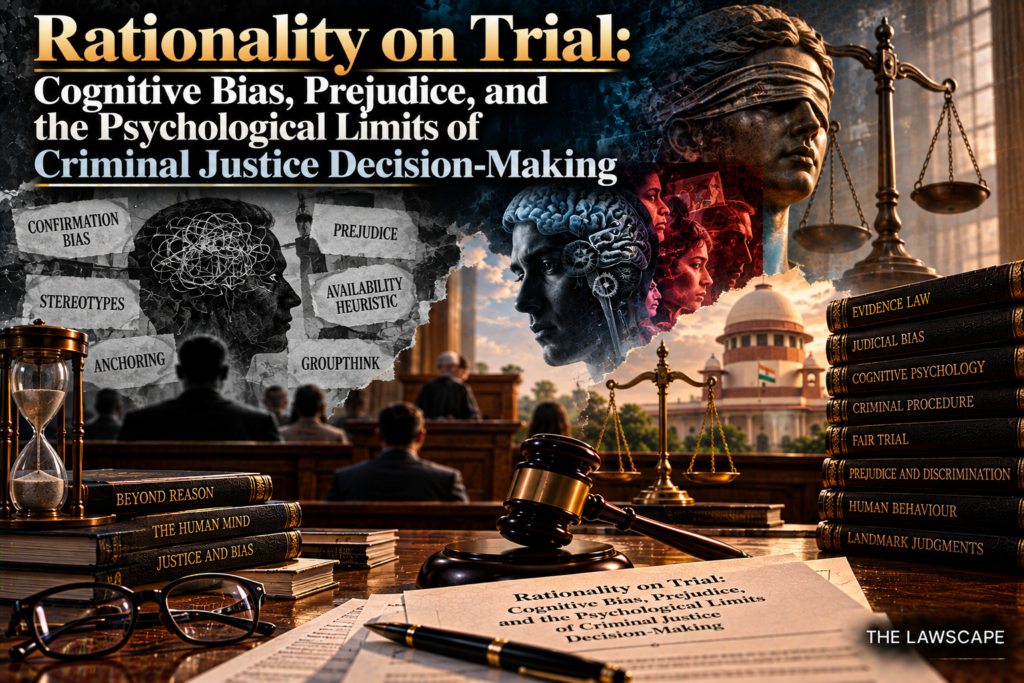
Author: Ramsha Saeed
B.A. LL.B. Candidate, Shambhunath Institute of Law, Prayagraj, India
————————————————————————————————————————
Research Interests: Criminal law, behavioural law and economics, and legal psychology.
💡 3 Quick Takeaways
- Human judgment is not entirely rational: Confirmation bias, hindsight bias, availability heuristics and anchoring can influence how investigators, judges and jurors interpret evidence.
- Cognitive bias can affect criminal proceedings: Investigative tunnel vision, contextual influences on forensic analysis and pre-trial publicity may affect the reliability of evidence and the fairness of adjudication.
- Procedural safeguards can reduce these risks: Blind investigative protocols, sequential unmasking in forensic analysis, cognitively informed jury instructions and structured sentencing frameworks can help account for the psychological limits of human judgment.
Abstract
Criminal justice systems worldwide presume that legal actors, including judges, investigators, prosecutors and jurors, evaluate evidence through rational and impartial reasoning. This foundational assumption of the “rational actor” underlies evidentiary standards, procedural safeguards and burdens of proof. Research in cognitive psychology, however, demonstrates systematic departures from this ideal. Confirmation bias can produce investigative tunnel vision, hindsight bias may distort judicial fact-finding, and availability heuristics and anchoring effects can influence jury deliberations and sentencing outcomes.
This article adopts an interdisciplinary approach, integrating criminal procedure doctrine with empirical insights from cognitive psychology to examine how cognitive biases shape decision-making across the investigative, adjudicative and sentencing stages of criminal proceedings. It argues that acknowledging human cognitive limitations does not undermine legal institutions; rather, it calls for psychologically informed institutional design.
The article proposes procedural reforms, including blind investigative protocols, sequential unmasking in forensic analysis, cognitively informed jury instructions and structured sentencing frameworks designed to constrain arbitrary numerical anchors.
By connecting law with behavioural science, this analysis contributes to interdisciplinary criminal justice scholarship and identifies institutional reforms intended to promote fairness, evidentiary accuracy and public confidence in the administration of justice.
Keywords: Cognitive bias, criminal justice, confirmation bias, judicial decision-making, forensic evidence, behavioural law, implicit prejudice.
I. Introduction
Modern criminal justice systems are grounded in the assumption that legal decision-makers, including police investigators, prosecutors, judges and juries, evaluate evidence objectively and apply legal rules impartially. This assumption forms a cornerstone of classical legal thought and underlies procedural safeguards intended to ensure fairness in criminal adjudication. The expectation of rationality presumes that individuals involved in criminal justice can weigh evidence neutrally, resist external influences and reach conclusions guided primarily by logic and legal principles. In theory, this model promotes accuracy, fairness and legitimacy within legal institutions.¹
Developments in psychology and behavioural science have increasingly challenged this foundational assumption. Research in cognitive psychology demonstrates that human judgment is rarely entirely rational or detached. Individuals frequently rely on cognitive shortcuts, commonly known as heuristics, which simplify complex decision-making processes but can also produce systematic biases.² Although these shortcuts are often efficient in everyday situations, they can distort reasoning and influence how evidence is perceived, remembered and evaluated.
Research by Daniel Kahneman and Amos Tversky has demonstrated that individuals frequently depart from idealised models of rational decision-making. Rather than engaging exclusively in analytical reasoning, people often rely on intuitive processes that are susceptible to contextual influences and prior beliefs. Within criminal justice, where decisions can determine liberty, punishment and social stigma, the consequences of these cognitive limitations may be particularly significant.
One extensively studied distortion is confirmation bias. As explained by psychologist Raymond Nickerson, confirmation bias involves the tendency to seek, interpret and recall information in ways that support existing beliefs while discounting contradictory information. In criminal investigations, this tendency may lead investigators to focus on evidence supporting an initial theory of guilt while overlooking or minimising exculpatory material. Such investigative tunnel vision can influence evidence collection, prosecutorial decisions and eventual courtroom outcomes.
The Central Park Five case is frequently discussed as an illustration of how investigative tunnel vision and problematic interrogation practices can contribute to wrongful convictions. Five teenagers were convicted in connection with a highly publicised assault case after giving statements during lengthy interrogations. Their convictions were subsequently vacated following the emergence of DNA evidence and the confession of another perpetrator.³ The case demonstrates the importance of testing initial investigative theories against contradictory evidence rather than allowing an early assumption of guilt to determine the direction of an investigation.
Other cognitive mechanisms may also influence legal decision-making. The availability heuristic describes the tendency to assess the likelihood or significance of an event according to how easily examples come to mind.⁴ In criminal justice, extensive media coverage of particularly vivid or emotionally charged offences may influence perceptions of crime prevalence and risk. These perceptions can affect assessments of dangerousness, sentencing attitudes and wider debates concerning crime and punishment.
Prejudice and implicit bias create additional challenges. Individuals may unconsciously associate particular social groups with certain characteristics, influencing their assessment of credibility, dangerousness or guilt. Research by Mahzarin Banaji and Anthony Greenwald has explored how implicit associations may persist even among people who consciously endorse egalitarian values.⁵ Within criminal proceedings, such influences may affect investigative priorities, charging decisions, witness assessments and sentencing.
External pressures can also affect the presentation and evaluation of evidence. In Zahira Habibullah Sheikh v. State of Gujarat, the Supreme Court of India considered the impact of intimidation and other pressures on witnesses and the fairness of criminal proceedings.⁶ The case illustrates that problems in fact-finding may arise not only from internal cognitive biases but also from social and institutional conditions affecting the evidence presented to a court.
These concerns are relevant across legal systems, although their effects may vary according to cultural norms, institutional structures and procedural arrangements. Legal realism has also questioned whether judicial outcomes can be explained exclusively through formal rules and logical deduction. Scholars associated with this movement emphasised the importance of social and contextual influences on judicial decision-making.
Against this background, the central question is how far cognitive biases influence criminal justice decision-making and how legal institutions can respond to these limitations to promote fairness and accuracy. This article argues that recognising cognitive limitations does not establish that legal decision-making is inherently irrational. Instead, it highlights the need for procedural safeguards that account for predictable patterns of human judgment.
The discussion proceeds in six substantive stages. It first examines the rational actor assumption underlying criminal justice. It then considers the psychological foundations of cognitive bias before analysing its influence on criminal investigations, courtroom adjudication and sentencing. Finally, it evaluates institutional reforms intended to reduce bias and improve the reliability of criminal justice outcomes.
II. The Rational Actor Assumption in Criminal Justice
A. Objectivity and the Architecture of Evidence
Modern criminal justice doctrine rests on the normative premise that legal decision-making can achieve a meaningful degree of rational objectivity. Judges, jurors and investigators are expected to evaluate evidence through disciplined reasoning, separating relevant facts from emotional or prejudicial influences. The credibility of criminal adjudication therefore depends not only on procedural fairness but also on the belief that legal institutions can approximate rational judgment when determining guilt or innocence.
This orientation is particularly evident in evidence law. Rules governing admissibility regulate the information available to decision-makers by distinguishing relevant evidence from irrelevant material and, where applicable, probative evidence from prejudicial influence. In theory, these rules create conditions conducive to rational deliberation by limiting sources of distortion before they reach the fact-finder.
Underlying this structure is the assumption that decision-makers can evaluate evidence logically. When judges assess competing interpretations of facts or jurors consider witness testimony, the law presumes that they can scrutinise information and reach reasoned conclusions. This assumption does not deny the possibility of error; rather, it reflects the institutional expectation that disciplined procedures encourage rational judgment.⁷
B. Neutral Fact-Finding and Adversarial Reasoning
The ideal of evidentiary objectivity is closely connected to neutral fact-finding. Criminal trials are structured to test competing accounts of events, with the fact-finder expected to evaluate each account without predetermined conclusions.
The adversarial system reinforces this ideal. Prosecutors and defence counsel present competing arguments and evidence, while cross-examination tests the credibility of witnesses and the strength of opposing narratives. The legitimacy of the process rests partly on the belief that a structured contest between competing claims can expose weaknesses and help the fact-finder identify the account best supported by the evidence.
However, the existence of adversarial procedures does not necessarily eliminate cognitive bias. The information presented during a trial may already have been shaped by earlier investigative decisions. Moreover, the fact-finder must still interpret the evidence through ordinary human cognitive processes. Procedural contestation can expose weaknesses in a case, but it cannot guarantee that every decision-maker will interpret the available information impartially.
C. Rational Adjudication as a Normative Ideal
The rational actor assumption is not merely a descriptive claim about human behaviour. It is also a normative ideal that defines how legal decision-making ought to occur. Judges and jurors are expected to avoid speculation, disregard prejudice and evaluate evidence carefully.
The criminal standard of proof beyond reasonable doubt reflects this commitment. It requires the fact-finder to consider whether the prosecution has established guilt to the legally required standard rather than relying on intuition or suspicion alone.
In State of Punjab v. Baldev Singh, the Supreme Court of India emphasised the importance of procedural safeguards in protecting individual rights and ensuring lawful criminal proceedings.⁸ The broader principle is that fair outcomes depend on the proper application of legal procedures.
Nevertheless, the existence of procedural rules does not necessarily ensure freedom from cognitive distortion. Recognising this tension does not diminish the importance of rational deliberation. Instead, it invites closer examination of how individuals actually interpret evidence, evaluate credibility and reach conclusions under conditions of uncertainty.
III. Cognitive Psychology and the Limits of Human Decision-Making
A. Heuristics and the Structure of Human Judgment
Cognitive psychology offers an empirical account of how people make decisions. Research by Daniel Kahneman and Amos Tversky demonstrates that individuals often use mental shortcuts, or heuristics, to make judgments under uncertainty. These shortcuts reduce cognitive effort by allowing people to reach conclusions without evaluating every available piece of information.
Such processes can be useful, particularly when decisions must be made quickly. However, they may also produce systematic errors when individuals assess probabilities, interpret ambiguous information or draw causal conclusions from incomplete evidence.
A common distinction in cognitive psychology is between rapid, intuitive thinking and slower, more reflective reasoning. Although both contribute to human judgment, intuitive responses may dominate in situations involving time pressure, uncertainty or complex information.
In criminal justice, this does not mean that judges, jurors or investigators deliberately act irrationally. Rather, it suggests that their reasoning may be influenced by cognitive mechanisms that differ from the purely deliberative model often assumed by legal doctrine. Understanding these mechanisms is therefore important when assessing how evidence is interpreted in practice.
B. Confirmation Bias and the Interpretation of Evidence
Confirmation bias occurs when individuals interpret information in ways that reinforce their existing beliefs or expectations. Raymond Nickerson’s work describes this tendency as a pervasive feature of human reasoning, affecting how people seek information, interpret ambiguous evidence and recall events.
Once an initial hypothesis has formed, supporting information may receive greater attention, while contradictory details may be discounted or interpreted as less significant. As this process continues, the initial hypothesis can become increasingly resistant to challenge.
Criminal investigations are particularly vulnerable to this pattern because investigators must develop working theories to organise evidence and identify potential suspects. If an early theory is treated as established fact, later evidence may be interpreted primarily in light of that theory.
Wrongful conviction cases, including the Central Park Five case, illustrate how investigative interpretations can become closely aligned with early assumptions of guilt. The concern is not necessarily deliberate misconduct; it is that ordinary cognitive processes can influence the direction of an investigation.
Confirmation bias may also interact with prosecutorial disclosure obligations. In Brady v. Maryland, the United States Supreme Court held that the prosecution’s suppression of material evidence favourable to the accused violates due process.⁹ Although the legal obligation to disclose exculpatory evidence is distinct from the psychological concept of confirmation bias, the case demonstrates the importance of ensuring that evidence favourable to the defence is not excluded from the process through which guilt is assessed.
C. The Availability Heuristic and Perceptions of Probability
The availability heuristic describes the tendency to assess the likelihood or significance of an event according to how readily examples come to mind.¹⁰ Dramatic, emotionally charged or widely reported incidents are often easier to recall than ordinary events.
As a result, a widely publicised crime may influence perceptions of how frequently similar offences occur, even when broader statistical evidence presents a different picture. The vividness of an example can therefore affect judgments about risk and prevalence.
In criminal justice, such perceptions may influence bail decisions, assessments of dangerousness, sentencing and public policy debates. If a decision-maker relies heavily on memorable cases rather than representative information, the resulting judgment may reflect the psychological accessibility of particular events rather than their actual frequency.
The relevance of this mechanism is not limited to one jurisdiction. Cultural narratives and social experiences may influence which events people readily recall, while the underlying tendency to rely on accessible examples remains a feature of human judgment.
D. Cognitive Foundations and Legal Interpretation
Heuristics and biases demonstrate that judgment frequently involves mental processes that simplify complexity rather than reproduce idealised models of rational deliberation. These mechanisms do not eliminate analytical reasoning, but they may influence attention, memory, inference and the interpretation of evidence.
Legal institutions depend heavily on human evaluation. Investigations require decisions about which evidence to pursue; courtroom proceedings require assessments of credibility and competing explanations; and sentencing requires judgments about culpability and punishment.
Cognitive psychology therefore provides a framework for examining how legal judgments form under uncertainty. Rather than treating decision-making as purely abstract reasoning, it situates legal judgment within the broader structure of human cognition.
IV. Cognitive Bias in Criminal Investigations
A. Investigative Hypothesis Formation
Criminal investigations are intended to uncover the facts surrounding an alleged offence. Investigators gather evidence, consider competing explanations and develop an account of the events under investigation.
In practice, investigations often begin with incomplete information. Initial witness statements, forensic observations and contextual details may be ambiguous, requiring investigators to develop tentative hypotheses that guide further inquiries.
These hypotheses serve a practical purpose by helping investigators organise information and allocate limited resources. However, they can also shape how new evidence is interpreted. Evidence is rarely assessed in complete isolation; instead, it is often considered in relation to the developing explanation of the crime.
Time pressures, public expectations and institutional demands to resolve serious offences may further strengthen the influence of an early investigative theory.
B. Confirmation Bias and Investigative Tunnel Vision
Investigative tunnel vision occurs when attention narrows around a particular suspect or explanation, reducing consideration of alternative possibilities. Once a hypothesis begins to dominate an investigation, evidence consistent with it may reinforce the existing narrative, while contradictory information receives less attention.
The Central Park Five case illustrates how early assumptions about suspects can shape the interpretation of statements and other evidence. Subsequent DNA evidence demonstrated that the original investigative narrative did not accurately reflect the underlying facts.
These risks reinforce the importance of maintaining alternative hypotheses, documenting contradictory evidence and ensuring that exculpatory material receives proper consideration. Investigators should remain prepared to revise an initial theory when new information challenges it.
C. Forensic Contextual Bias and Institutional Consequences
Forensic analysis is often treated as an objective scientific process. However, the interpretation of forensic evidence may also be influenced by contextual information, including details about a suspect, an alleged confession or the investigative theory.
Where scientific findings are ambiguous, exposure to such information may influence an analyst’s interpretation. This creates a risk that forensic conclusions will reflect expectations about the case rather than the physical evidence alone.
Blind or sequential testing protocols offer possible safeguards. By limiting an analyst’s exposure to potentially biasing information, these procedures seek to preserve the independence of forensic evaluation.
Because investigators, forensic analysts and prosecutors work within a connected process, early assumptions can influence several stages of a criminal case. Safeguards at the investigative stage can therefore help reduce the risk that an unsupported theory becomes embedded in the prosecution’s overall narrative.
V. Cognitive Bias in Courtroom Adjudication
A. Judicial Fact-Finding and Hindsight Bias
Judges are expected to act as neutral decision-makers who evaluate evidence through disciplined legal reasoning. Evidentiary rules, appellate review and adversarial proceedings are designed, in part, to support this responsibility.
However, judicial reasoning remains a form of human judgment. Hindsight bias refers to the tendency to perceive an outcome as more predictable after it has occurred. Once the outcome of an investigation or trial is known, earlier events may appear more obvious or foreseeable than they actually were at the time.
This can affect how decision-makers assess investigative conduct, evidentiary weaknesses or alternative explanations during later proceedings. Evidence that was initially ambiguous may appear more decisive when viewed through the lens of an established outcome.
Legal training and procedural safeguards remain essential, but they do not necessarily eliminate the influence of outcome knowledge. Awareness of hindsight bias can encourage more careful consideration of what was reasonably knowable at each stage of the proceedings.
B. Jury Deliberation: Availability and Implicit Bias
Juries play a central role in criminal adjudication in common-law systems. They provide a mechanism for community participation in determining questions of fact. However, jurors must often assess complex evidence without the professional training available to judges.
Vivid testimony, emotionally charged narratives and repeated media coverage may influence how jurors perceive the significance of evidence. The availability heuristic may cause memorable details to receive disproportionate weight, while less dramatic but legally important information receives less attention.
Pre-trial publicity presents a related concern. In Sheppard v. Maxwell, the United States Supreme Court considered the effect of extensive publicity on the fairness of criminal proceedings and emphasised the need for measures protecting the trial process from prejudicial external influences.¹¹
Implicit social biases may also affect how jurors assess witness credibility or interpret disputed evidence. Such influences need not be conscious or deliberate to affect judgment. Careful jury selection, appropriate instructions and effective judicial management of prejudicial information may help address these risks, although no single measure can eliminate them entirely.
C. Sentencing and Anchoring Effects
Sentencing involves judgments about culpability, deterrence, rehabilitation and proportionality. Although statutory ranges and sentencing guidelines provide legal boundaries, judges may retain discretion in determining an appropriate sentence.
Anchoring occurs when an initial numerical reference point influences a later judgment. In sentencing, a prosecutor’s recommendation, a statutory maximum or a guideline figure may serve as an anchor against which the eventual sentence is assessed.
Research by Birte Englich, Thomas Mussweiler and Fritz Strack examined the influence of numerical anchors on judicial sentencing judgments.¹² Their work raises questions about how reference points may affect the exercise of sentencing discretion, even when those reference points are not independently decisive under the law.
This does not establish that every sentencing decision is distorted by anchoring. It does, however, suggest that decision-making frameworks should encourage judges to explain their reasoning by reference to legally relevant factors rather than relying uncritically on an initial numerical proposal.
VI. Institutional Reforms: Designing Cognitively Aware Criminal Procedure
The influence of cognitive bias across investigations, adjudication and sentencing suggests the need for procedures that account for the psychological limits of human judgment. These reforms need not abandon existing legal safeguards. Instead, they can strengthen them by aligning institutional design with research on human cognition.
A. Blind Investigative Protocols
Blind investigative protocols seek to reduce exposure to contextual information that may bias the evaluation of evidence. Where practicable, an investigator or examiner assessing a particular item of evidence may be shielded from information about a suspect’s identity or the prevailing investigative theory.
The aim is not to eliminate investigative hypotheses, which are often necessary, but to ensure that the evaluation of particular evidence is not unnecessarily influenced by assumptions about the case.
A related example is the use of blind administration in eyewitness identification procedures. Such procedures are intended to prevent investigators from unintentionally signalling which person a witness is expected to identify.
Extending similar safeguards to appropriate investigative and evidentiary contexts may help preserve independent assessment and encourage the consideration of alternative explanations.
B. Sequential Unmasking in Forensic Analysis
Sequential unmasking is designed to regulate the order in which contextual information is disclosed to forensic examiners.¹³ Under this approach, analysts first examine the physical evidence without access to potentially biasing details. Additional contextual information is disclosed later, where necessary.
This staged process aims to reduce the possibility that an analyst’s interpretation will be influenced by a pre-existing investigative narrative. It also recognises that scientific evidence is evaluated by human beings whose judgments can be affected by contextual information.
The adoption of such procedures may strengthen forensic reliability by making the conditions under which evidence is assessed more transparent and methodologically disciplined.
C. Cognitively Informed Jury Instructions
Traditional jury instructions generally explain the applicable legal standards and the principles governing evidentiary evaluation. Some scholars have proposed that these instructions could also address common cognitive biases.
For example, instructions might encourage jurors to distinguish the vividness of evidence from its actual probative value, consider alternative explanations and remain cautious about the influence of extensive pre-trial publicity.
Such instructions cannot guarantee unbiased deliberation. Their potential value lies in encouraging jurors to reflect on how they reach conclusions rather than accepting an initial impression without scrutiny.
The effectiveness of these measures would depend on their clarity, practical application and compatibility with existing procedural rules.
D. Structured Sentencing Frameworks
Structured sentencing frameworks offer another response to cognitive bias. Sentencing guidelines, decision matrices and reason-giving requirements can encourage judges to connect their decisions to publicly articulated legal standards.
Such measures may reduce the influence of arbitrary numerical anchors by requiring explicit consideration of legally relevant factors, including the seriousness of the offence, the circumstances of the offender and the applicable statutory framework.
Structured approaches should not remove judicial discretion where the law provides for it. Instead, they can promote consistency and transparency while preserving the individualised assessment required in criminal sentencing.
Taken together, these reforms illustrate how behavioural science can inform criminal procedure. By structuring the conditions under which evidence is collected, analysed and evaluated, legal institutions may strengthen fairness, accountability and evidentiary reliability.
VII. Conclusion
Criminal justice systems have traditionally presumed that legal actors evaluate evidence through rational and impartial reasoning. Research in cognitive psychology demonstrates, however, that confirmation bias, hindsight bias, availability heuristics, anchoring and implicit prejudice may influence decision-making at different stages of criminal proceedings.
These findings do not establish that legal institutions are inherently irrational or that individual judgments are necessarily biased. Rather, they demonstrate that legal procedures operate within the limits of human cognition. The existence of evidentiary rules, judicial training and adversarial safeguards remains essential, but these mechanisms should be understood alongside the psychological processes that affect how evidence is interpreted.
Blind investigative protocols, sequential unmasking in forensic analysis, cognitively informed jury instructions and structured sentencing frameworks offer possible ways to address these risks. Their purpose is not to eliminate human judgment but to create conditions in which evidence can be evaluated more independently and conclusions can be justified through transparent reasoning.
Ultimately, the relationship between law and behavioural science should be understood as complementary rather than conflicting. Acknowledging the psychological limits of decision-making can help legal institutions refine their procedures, improve evidentiary accuracy and strengthen public confidence in criminal justice.
The pursuit of justice requires more than an aspiration to rationality. It requires institutions that recognise how people actually reason and that design safeguards accordingly.
References and Endnotes
- Amos Tversky and Daniel Kahneman, “Judgment Under Uncertainty: Heuristics and Biases,” 185 Science 1124 (1974).
- Daniel Kahneman, Thinking, Fast and Slow (Farrar, Straus & Giroux, 2011).
- Sarah Burns, The Central Park Five: The Untold Story Behind One of New York City’s Most Infamous Crimes (Vintage, 2012).
- Chris Guthrie, Jeffrey J. Rachlinski and Andrew J. Wistrich, “Inside the Judicial Mind,” 86 Cornell Law Review 777 (2001).
- Mahzarin R. Banaji and Anthony G. Greenwald, Blindspot: Hidden Biases of Good People (Delacorte Press, 2013).
- Zahira Habibullah Sheikh v. State of Gujarat, (2004) 4 SCC 158.
- Karl N. Llewellyn, “Some Realism about Realism—Responding to Dean Pound,” 44 Harvard Law Review 1222 (1931).
- State of Punjab v. Baldev Singh, (1999) 6 SCC 172.
- Brady v. Maryland, 373 U.S. 83 (1963).
- Cass R. Sunstein, Laws of Fear: Beyond the Precautionary Principle (Cambridge University Press, 2005).
- Sheppard v. Maxwell, 384 U.S. 333 (1966).
- Birte Englich, Thomas Mussweiler and Fritz Strack, “Playing Dice with Criminal Sentences: The Influence of Irrelevant Anchors on Experts’ Judicial Decision Making,” 32 Personality and Social Psychology Bulletin 188 (2006).
- National Research Council, Strengthening Forensic Science in the United States: A Path Forward (National Academies Press, 2009).
Disclaimer: The views expressed in this article are those of the author and do not necessarily reflect the views of The Lawscape.
The Lawscape — clear, practical legal insight for students and future lawyers.