
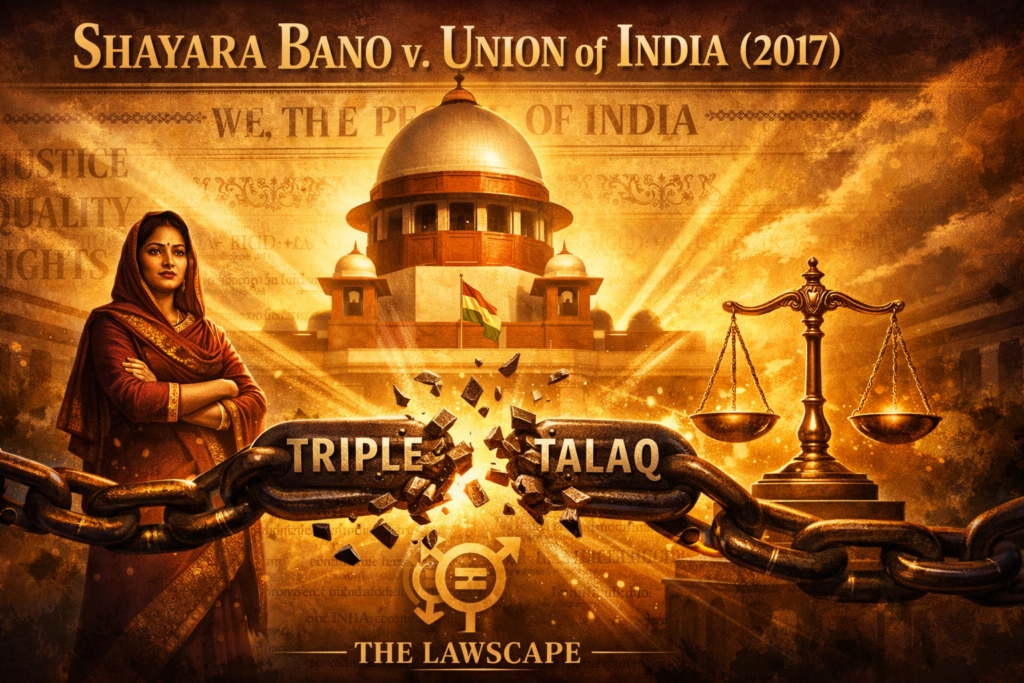
Shayara Bano v. Union of India (2017) 9 SCC 1
Author: Samiksha Mahendra Dhoke
Student, Kes Shri. Jayantilal H. Patel Law College
—————————————————————————————-
💡 3 Quick Takeaways
- The Supreme Court declared instant triple talaq (talaq-e-biddat) unconstitutional.
- The judgment reinforced that personal laws must align with fundamental rights.
- It marked a significant step toward gender equality and constitutional morality.
INTRODUCTION
Shayara Bano v. Union of India is a landmark judgment delivered by the Supreme Court of India in 2017. The case is popularly known as the Triple Talaq Case. It dealt with the constitutional validity of talaq-e-biddat (instant triple talaq), a practice under Muslim personal law where a husband could divorce his wife by pronouncing “talaq” three times in one sitting.
The main constitutional question before the Court was whether this practice violated fundamental rights guaranteed under the Constitution of India, especially the right to equality (Article 14), non-discrimination (Article 15), dignity and personal liberty (Article 21), and freedom of religion (Article 25).
A five-judge Constitution Bench of the Supreme Court delivered a 3:2 majority decision, declaring instant triple talaq unconstitutional and void.
BACKGROUND OF THE CASE
The case began when Shayara Bano challenged the practice of talaq-e-biddat before the Supreme Court of India. She was married in 2002 according to Muslim personal law. After several years of marriage, disputes arose between her and her husband. In 2016, her husband pronounced triple talaq in one sitting, thereby instantly and irrevocably dissolving the marriage.
Following the divorce, Shayara Bano filed a writ petition under Article 32 of the Constitution. She challenged not only talaq-e-biddat, but also polygamy and nikah halala. However, during the proceedings, the Court primarily focused on the constitutional validity of instant triple talaq. The case evolved beyond an individual dispute into a matter of constitutional importance.
ISSUES BEFORE THE COURT
- Whether talaq-e-biddat is an essential religious practice protected under Article 25 of the Constitution.
- Whether Muslim personal law is subject to fundamental rights under Article 13 of the Constitution.
- Whether instant triple talaq violates fundamental rights, particularly:
• Article 14 – Right to equality
• Article 15 – Prohibition of discrimination
• Article 21 – Right to life and dignity - Whether a balance can be maintained between religious freedom under Article 25 and constitutional morality.
ARGUMENTS OF THE PETITIONERS
The petitioner, Shayara Bano, along with supporting intervenors, challenged the constitutional validity of talaq-e-biddat on several grounds:
• It violated Article 14 as it was manifestly arbitrary, allowing a Muslim husband to dissolve marriage unilaterally without reason or procedure.
• It amounted to gender discrimination under Article 15, as it granted unequal rights to men and women.
• It infringed Article 21 by affecting a woman’s dignity, social status, and economic security.
• The practice was not an essential religious practice, as it is not sanctioned by the Quran and is considered irregular by many Islamic scholars.
• Since Muslim personal law was recognized under the Muslim Personal Law (Shariat) Application Act, 1937, it should be subject to constitutional scrutiny under Article 13.
ARGUMENTS OF THE RESPONDENTS
The primary respondent, the All India Muslim Personal Law Board, defended the practice on the following grounds:
• Talaq-e-biddat is protected under Article 25 as part of religious freedom.
• Personal laws are not “law” within the meaning of Article 13 and therefore cannot be challenged on the ground of violating fundamental rights.
• Judicial interference in personal laws may disturb the balance in a pluralistic society and affect minority rights.
It is notable that the Union of India supported the petitioners.
JUDGMENT
The Supreme Court, by a 3:2 majority, declared instant triple talaq unconstitutional.
Full text of the judgment: https://indiankanoon.org/doc/115701246/
Majority Opinion (3 Judges)
Justices R.F. Nariman, U.U. Lalit, and Kurian Joseph formed the majority.
Justice Nariman held that the Muslim Personal Law (Shariat) Application Act, 1937 gives statutory recognition to Muslim personal law, thereby bringing it within the ambit of “law” under Article 13. He further held that talaq-e-biddat is manifestly arbitrary as it allows unilateral and irreversible divorce without scope for reconciliation, thus violating Article 14.
Justice Kurian Joseph concurred with the outcome but adopted a different reasoning. He held that talaq-e-biddat is not sanctioned by the Quran and therefore is not an essential religious practice. Consequently, it does not receive protection under Article 25.
Minority Opinion (2 Judges)
Chief Justice J.S. Khehar and Justice Abdul Nazeer dissented. They held that personal laws are not “law” under Article 13 and that courts should not interfere in religious practices. They suggested that reform should be undertaken by Parliament rather than the judiciary and recommended a temporary stay on the practice.
CONSTITUTIONAL SIGNIFICANCE
The judgment holds deep constitutional importance as it reaffirmed the supremacy of fundamental rights over discriminatory personal practices. It strengthened the application of Article 14 by striking down arbitrary practices.
The Court also clarified the scope of the “essential religious practices” doctrine, holding that only those practices which are fundamental to a religion are protected under Article 25. Since instant triple talaq was not essential to Islam, it did not qualify for constitutional protection.
CRITICAL ANALYSIS
The judgment has been widely appreciated for advancing gender equality and reinforcing constitutional values. It successfully balanced religious freedom with the protection of fundamental rights, ensuring that personal laws do not override equality and dignity.
However, certain criticisms remain. The split reasoning among the majority judges created doctrinal complexity, as different legal approaches were used to reach the same conclusion. The dissenting opinion also raised concerns about judicial overreach, suggesting that reforms in personal laws should ideally come through legislative action.
CONCLUSION
Shayara Bano v. Union of India stands as a transformative constitutional judgment. It reaffirmed that personal laws cannot operate independently of constitutional principles. By invalidating instant triple talaq, the Supreme Court ensured that religious freedom does not become a shield for gender injustice.
The decision marks a significant step toward substantive equality and reflects the evolving nature of constitutional interpretation in India. It underscores that constitutional morality and individual dignity form the foundation of the Indian legal system.
Disclaimer: The views expressed in this article are those of the author and do not necessarily reflect the views of The Lawscape.
The Lawscape — clear, practical legal insight for students and future lawyers.