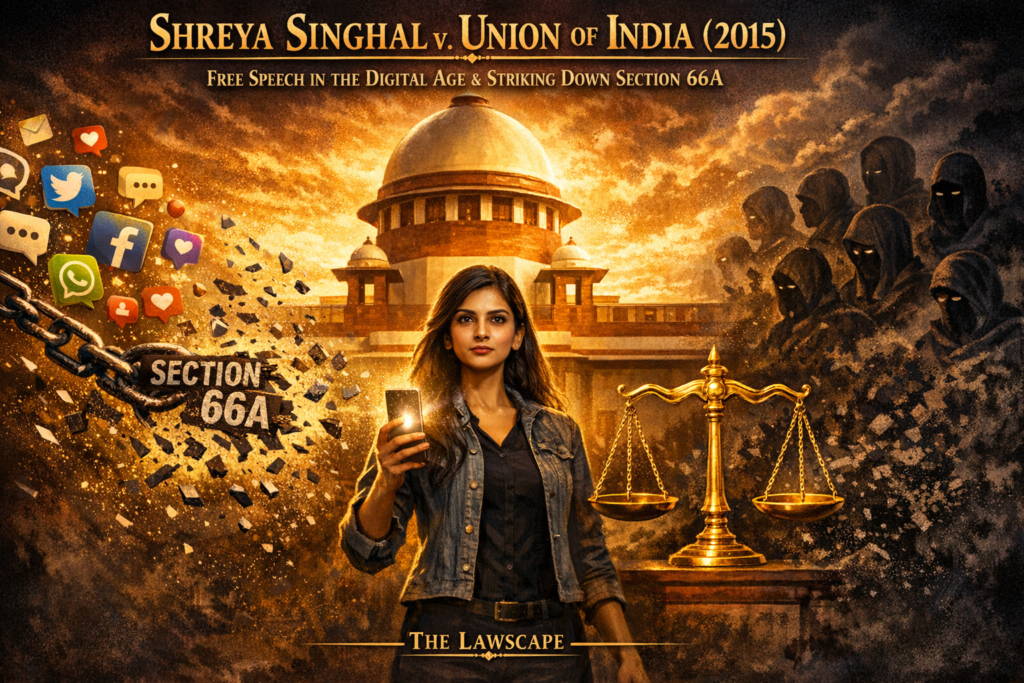
Shreya Singhal v. Union of India (2015)
Author: Anushka Bharat Gavande
Student, Lords Universal College
——————————————————————————-
💡 3 Quick Takeaways
- Section 66A of the Information Technology Act, 2000 was struck down for being vague and unconstitutional.
- The judgment reinforced the importance of freedom of speech and expression under Article 19(1)(a).
- The Court clarified limits on state power and protected online expression from arbitrary restrictions.
INTRODUCTION
The Supreme Court, in a landmark judgment, struck down Section 66A of the Information Technology Act, 2000, which provided for the arrest of individuals for posting allegedly offensive content on the internet, thereby upholding freedom of expression. Section 66A defined punishment for sending offensive messages through a computer or any other communication device such as a mobile phone or tablet, with a maximum penalty of three years’ imprisonment and a fine.
Over the years, there had been several instances where the police arrested individuals for broadcasting information through a computer resource or communication device that was considered “grossly offensive,” “menacing,” or causing “annoyance,” “inconvenience,” or “obstruction.” In a judgment authored by Justice R. F. Nariman on behalf of a bench comprising himself and Justice J. Chelameswar, the Court declared that Section 66A was vague, arbitrary, and disproportionately invaded the right to free speech.
In quashing Section 66A, the Supreme Court not only revitalized free speech in India but also reaffirmed its role as a constitutional guardian.
The landmark case of Shreya Singhal v. Union of India (2015) plays a crucial role in the Indian legal system. The case revolves around the fundamental right to freedom of speech and expression under Article 19(1)(a) of the Constitution of India and challenged the constitutional validity of Section 66A of the Information Technology Act, 2000.
FACTS
• In 2012, Mumbai police arrested two girls, Shaheen Dhada and Rini Srinivasan, who had posted comments on Facebook following the death of Shiv Sena founder Bal Thackeray, suggesting that Mumbai had shut down due to fear rather than respect.
• Dhada was charged under Section 295A of the Indian Penal Code and Section 66A of the Information Technology Act, 2000.
• Although the girls were later released and charges were dropped, the arrests sparked nationwide protests. The police were accused of misusing Section 66A, which was seen as an infringement of the fundamental right to freedom of speech and expression under Article 19(1)(a).
• The offences under the Act were cognizable, allowing authorities to arrest without a warrant. This led to several controversial arrests of individuals for expressing opinions online, often involving dissenting political views.
• Post-2013, the government introduced procedural safeguards, requiring approval from a senior police officer before making arrests. However, ambiguity in defining offences persisted.
• Consequently, multiple petitions were filed before the Supreme Court, which were clubbed together into a single Public Interest Litigation (PIL) known as Shreya Singhal v. Union of India.
ISSUES
- Whether Sections 66A, 69A, and 79 of the Information Technology Act, 2000 are constitutionally valid.
- Whether Section 66A violates the fundamental right to freedom of speech and expression.
- Whether the petitioners’ rights under Articles 14 and 21 are infringed.
CONTENTIONS OF THE PETITIONERS
(i) Section 66A infringes the right to freedom of speech and expression guaranteed under Article 19(1)(a).
(ii) Terms such as “annoyance” and “inconvenience” are not covered under the reasonable restrictions of Article 19(2).
(iii) The provision is vague and undefined, allowing arbitrary interpretation by authorities.
(iv) It violates Article 14 due to the absence of intelligible differentia and results in discriminatory treatment.
(v) It grants excessive discretionary powers to authorities.
CONTENTIONS OF THE RESPONDENTS
(i) The writ petition was challenged on grounds of maintainability.
(ii) There is a presumption in favour of the constitutionality of legislation, and courts should interfere only when Part III rights are violated.
(iii) The possibility of misuse is not a valid ground for declaring a law unconstitutional.
(iv) Vagueness alone is insufficient to invalidate a statute unless it is inherently arbitrary.
JUDGMENT
The Supreme Court held:
• Section 66A of the Information Technology Act, 2000 is unconstitutional and was struck down.
• The provision violated the fundamental right to freedom of speech and expression under Article 19(1)(a) and was not protected under Article 19(2).
Reasons for striking down Section 66A:
• The section used vague terms such as “grossly offensive,” “annoying,” and “menacing.”
• These terms lacked clear definitions, allowing arbitrary interpretation.
• The vagueness created a chilling effect on free speech, discouraging individuals from expressing opinions online.
• Section 79 was read down: intermediaries are required to remove content only upon receiving a court order or government notification, not merely on private complaints.
• Section 69A was upheld as constitutional, as it contains procedural safeguards for blocking online content.
Full text of the judgment: https://indiankanoon.org/doc/110813550/
CASE ANALYSIS
The verdict in Shreya Singhal v. Union of India is an immensely important landmark judgment. It is rare for the Supreme Court to declare a statutory provision unconstitutional in its entirety, and this decision significantly expanded the scope of free speech in India.
Justice Nariman emphasized that the liberty of thought and expression is not merely aspirational but a “cardinal value” of constitutional importance. The Court agreed that none of the grounds under Article 19(2) justified the restrictions imposed by Section 66A.
The provision failed constitutional tests such as “clear and present danger” and the likelihood of inciting public disorder. The Court observed that the expressions penalized under Section 66A did not necessarily lead to such consequences.
The term “offensive” was inherently subjective, varying from person to person, leading to ambiguity and misuse. The arrests in the present case reflected an overreach by law enforcement, often influenced by political or social pressures rather than objective legal standards.
Freedom of speech and expression is essential both for individual liberty and for the functioning of a democratic system. While reasonable restrictions such as defamation exist, they must be clearly defined and justified.
Section 66A lacked clarity and failed to distinguish between legitimate expression and punishable conduct, thereby discouraging individuals from expressing their views online.
CONCLUSION
The judgment in Shreya Singhal v. Union of India reaffirmed the importance of freedom of speech and expression in a democratic society. It ensured that vague and arbitrary laws cannot be used to suppress dissent or restrict legitimate expression.
The decision strengthened constitutional protections and reinforced the idea that restrictions on free speech must be reasonable, precise, and justified. It remains a cornerstone in safeguarding digital rights and democratic values in India.
Disclaimer: The views expressed in this article are those of the author and do not necessarily reflect the views of The Lawscape.
The Lawscape — clear, practical legal insight for students and future lawyers.