
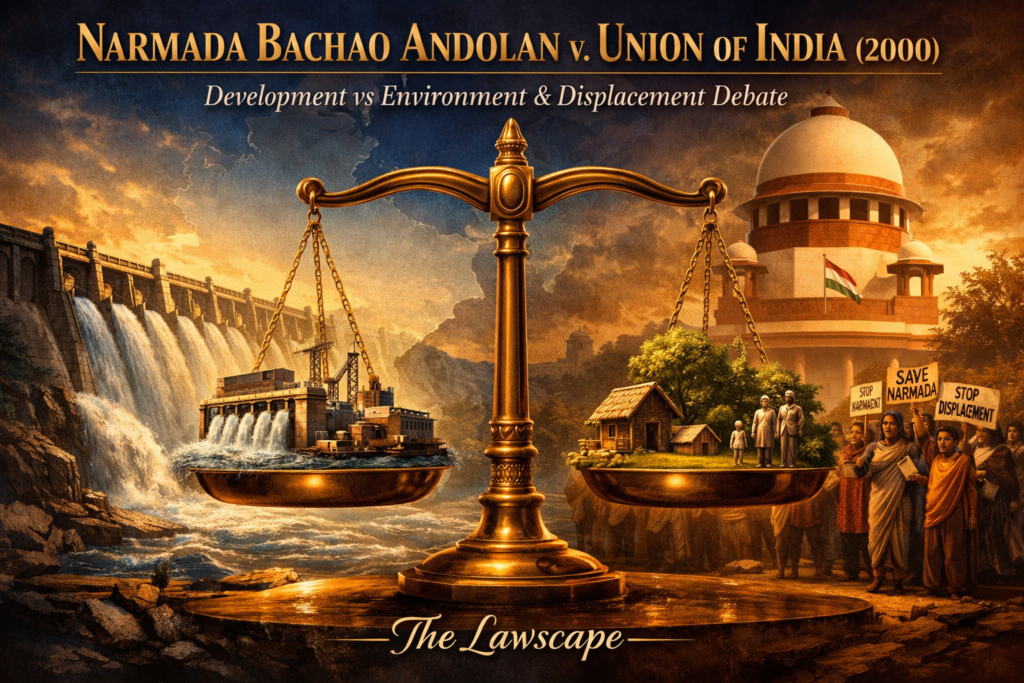
Narmada Bachao Andolan v. Union of India and Ors (AIR 2000 SC 3751)
Author: Diya Darshan Babel
Student, University of Mumbai
————————————————————
💡 3 Quick Takeaways
- The Supreme Court upheld the Sardar Sarovar Project, emphasizing the importance of national development.
- Rehabilitation and environmental safeguards must proceed pari passu (simultaneously) with development.
- The case highlights the balance between fundamental rights, environmental protection, and economic growth.
ABSTRACT
The case of Narmada Bachao Andolan v. Union of India and Ors (AIR 2000 SC 3751) is a landmark judgment that highlights the complex relationship between economic development, environmental protection, and human rights in India. The dispute arose from the construction of the Sardar Sarovar Dam on the Narmada River, which aimed to provide irrigation, drinking water, and hydroelectric power to various states. The Narmada Bachao Andolan (NBA), led by socialist activist Medha Patkar, challenged the project, arguing that it violated the fundamental rights of displaced tribal and rural communities under Articles 14 and 21 of the Constitution of India
The petitioners contended that the project was approved without conducting an adequate environmental impact assessment and that the rehabilitation measures for displaced families were insufficient. However, in a 2:1 majority decision, the Supreme Court permitted the continuation of the project while directing that rehabilitation and environmental safeguards should proceed simultaneously (pari passu). The Court recognized that there must be a balance between environmental protection and the safeguarding of human rights.
INTRODUCTION
Narmada Bachao Andolan v. Union of India and Ors is one of the most significant leading cases dealing with issues of environmental law, development policy, and human rights in India. The case revolved around the construction of the Sardar Sarovar Dam on the Narmada River, which formed part of the broader Narmada Valley Development Project. The dispute brought attention to the ongoing tension between development objectives, environmental sustainability, and the rights of indigenous communities.
The project was designed to supply irrigation water, drinking water, and hydroelectric power to the states of Gujarat, Madhya Pradesh, Maharashtra, and Rajasthan. Despite these intended benefits, the project also raised serious concerns regarding the displacement of thousands of families, particularly tribal and rural populations, along with potential environmental damage.
The Narmada Bachao Andolan (NBA), a social movement led by activist Medha Patkar, challenged the project before the Supreme Court of India. The petitioners argued that the project violated the fundamental rights guaranteed under Articles 14 and 21 of the Constitution. They also claimed that the environmental consequences of the project had not been adequately studied and that the rehabilitation measures for displaced persons were insufficient. The Supreme Court was therefore required to examine the balance between developmental priorities and the protection of environmental and human rights.
FACTS OF THE CASE
The Narmada Valley Development Project (NVDP) is one of the largest river development schemes in India. The project aims to construct a series of dams across the Narmada River to utilize its water resources effectively. Among these dams, the Sardar Sarovar Project (SSP) is considered one of the most significant components. The main objective of the project was to provide irrigation facilities, drinking water supply, and hydroelectric power to several Indian states such as Gujarat, Madhya Pradesh, Maharashtra, and Rajasthan. It was also expected that the project would increase agricultural productivity, address water shortages in drought-affected regions, and contribute to economic development in the concerned areas.
Even after the developmental benefits promised by the project, it soon became the subject of widespread criticism and public opposition. The Narmada Bachao Andolan (NBA), a social movement led by activist Medha Patkar, strongly opposed the construction of the dam. The movement raised serious concerns regarding the social and environmental consequences of the project. According to the NBA, the dam would submerge vast areas of land and lead to the displacement of a large number of people, particularly those belonging to tribal and rural communities.
The petitioners further argued that the government had not implemented adequate rehabilitation and resettlement policies for individuals who would be displaced due to the project. They also alleged that the authorities had approved the project without conducting a thorough environmental impact assessment.
As the dispute intensified, the NBA filed a writ petition before the Supreme Court of India seeking an order to stop the construction of the dam. The petitioners claimed that the forced displacement of people without proper rehabilitation violated their fundamental rights guaranteed under Articles 14 and 21 of the Constitution of India. They also requested the Court to review the feasibility of the project and examine its long-term environmental consequences, such as deforestation, loss of biodiversity, and disturbance to the river ecosystem.
On the other hand, the Union of India and the Government of Gujarat defended the project by emphasizing its importance for development and water security. They argued that the project had already been granted environmental clearance and that suitable rehabilitation policies had been designed to safeguard the interests of the displaced populations.
Initially, the Planning Commission had granted conditional approval to the project, subject to the fulfillment of environmental requirements. Later, in 1987, the Ministry of Environment and Forests granted environmental clearance for the project. However, critics maintained that this approval was granted without completing all the necessary environmental studies.
In its judgment delivered in 2000, the Supreme Court allowed the continuation of the dam’s construction, observing that the project was essential for national development. At the same time, the Court directed that rehabilitation and resettlement must be carried out in accordance with the guidelines laid down by the Narmada Water Disputes Tribunal (NWDT). The decision generated mixed responses; supporters considered it a victory for development, whereas critics viewed it as a setback for environmental protection and the rights of displaced communities.
LITIGATION HISTORY
Opposition to the Sardar Sarovar Project began long before the case reached the Supreme Court. The Narmada Bachao Andolan had been protesting against the project since 1986, even before it received environmental clearance.
In 1994, the movement filed a writ petition before the Supreme Court of India, seeking a halt to the construction of the Sardar Sarovar Project. The petition argued that the project violated the fundamental rights of displaced people and that the rehabilitation measures were inadequate.
During the proceedings, the Court appointed expert committees to assess the environmental and social impacts of the project. However, disputes continued among authorities and the state governments regarding the project’s implementation.
ISSUES IN THE CASE
- Whether the construction of the Sardar Sarovar Dam violated the fundamental rights of the people who were displaced due to the project.
- Whether the authorities had taken sufficient steps to ensure proper rehabilitation and resettlement of the affected persons.
- Whether the environmental clearance granted to the project was legally valid.
Whether interference by the judiciary in such development projects would conflict with the doctrine of separation of powers.
ARGUMENTS OF THE PETITIONERS
The petitioners argued before the Supreme Court of India that the environmental clearance granted in 1987 for the Sardar Sarovar Project was based on incomplete environmental studies and failed to properly assess long-term ecological impacts.
They contended that the displacement of tribal communities without proper rehabilitation violated Article 21 of the Constitution of India, which protects the right to life and livelihood. The petitioners also highlighted that many families had already been displaced without an effective rehabilitation policy, making tribal communities especially vulnerable.
Additionally, they argued that the project would destroy the cultural identity and traditional lifestyle of indigenous populations. The petitioners further suggested exploring alternatives such as smaller dams or decentralized irrigation systems and emphasized the need to follow environmental protection principles and proper impact assessments before undertaking large development projects.
ARGUMENTS OF THE RESPONDENTS
The respondents, including the Union Government of India and the Government of Gujarat, argued that the Sardar Sarovar Project was essential for providing irrigation, drinking water, and electricity to several states.
They stated that rehabilitation was already provided under the Narmada Water Disputes Tribunal Award, 1979, and that environmental clearance had been properly granted by the Ministry of Environment and Forests.
They also argued that the Supreme Court of India should not interfere in policy decisions related to large development projects.
JUDGMENT
In a 2:1 majority decision, the Supreme Court of India allowed the continuation of the Sardar Sarovar Project, stating that the project was important for national development as it would provide irrigation, drinking water, and electricity to millions.
The Court held that while large development projects may cause displacement, their benefits can outweigh the hardships if proper rehabilitation is ensured. It directed that rehabilitation and resettlement of affected families must occur pari passu (simultaneously) with the construction of the dam.
The Court also found the 1987 environmental clearance valid and stated that judicial interference in development policy should be limited unless constitutional rights are clearly violated.
Although the majority permitted the project to proceed with strict rehabilitation and environmental safeguards, Justice S. P. Bharucha gave a dissenting opinion, stating that the rehabilitation measures were inadequate and the rights of displaced persons were not fully protected.
CONCLUSION
The decision of the Supreme Court of India in Narmada Bachao Andolan v. Union of India became a landmark judgment in the field of environmental law and development policy in India. The case highlighted the conflict between large-scale development projects and the protection of environmental and human rights. It emphasized that while projects like the Sardar Sarovar Project are necessary for economic growth, the rights of displaced communities and environmental safeguards must not be ignored. The judgment therefore reinforced the principle that development and environmental protection must be balanced through proper rehabilitation policies, monitoring mechanisms, and responsible governance.
References
Harsh Ram, ‘Narmada Bachao Andolan vs Union of India’ (2023)
Aishwarya Agrawal, ‘Narmada Bachao Andolan vs Union of India’ (2024)
B.N. Kirpal, ‘Narmada Bachao Andolan vs Union of India’
Disclaimer: The views expressed in this article are those of the author and do not necessarily reflect the views of The Lawscape.
The Lawscape — clear, practical legal insight for students and future lawyers.