
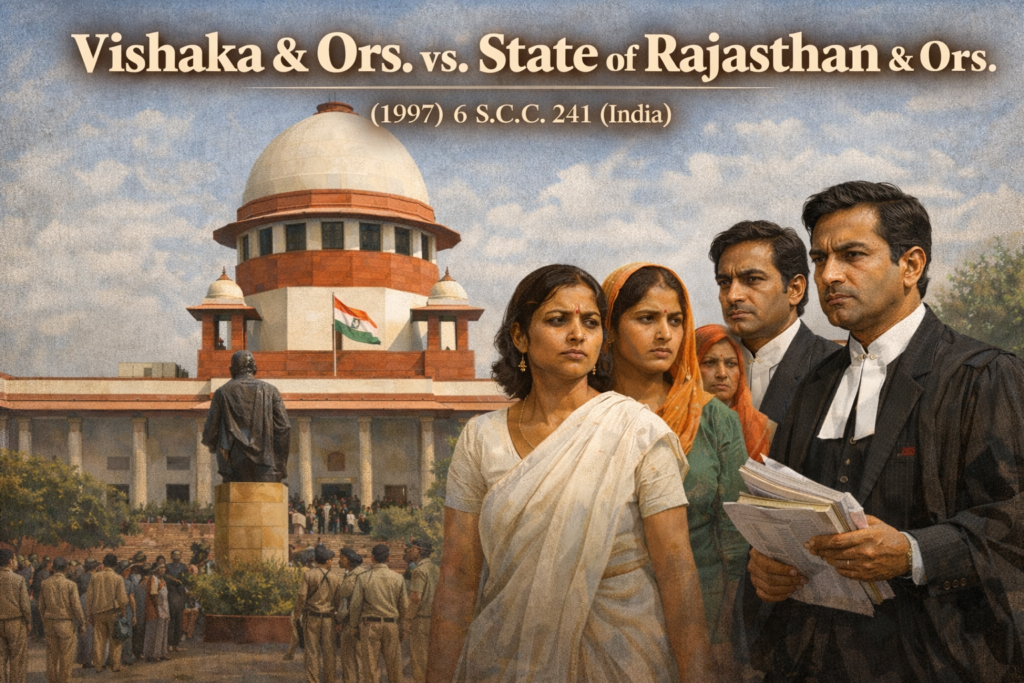
Vishaka & Ors. vs. State of Rajasthan & Ors. [(1997) 6 S.C.C. 241 (India)]
Author: Vanshika Haritwal
Student, Subhash Desai College of Law (Nirmal Education Society’s)
——————————————————————————————————————————-
💡 3 Quick Takeaways
- The Supreme Court of India, in the absence of specific domestic legislation, framed the binding “Vishaka Guidelines” to address sexual harassment at the workplace, exercising its powers under Article 32 of the Constitution.
- The judgment recognized that sexual harassment at the workplace constitutes a violation of fundamental rights guaranteed under Articles 14, 15, 19(1)(g), and 21 of the Indian Constitution.
- The Vishaka Guidelines eventually led to the enactment of the Sexual Harassment of Women at Workplace (Prevention, Prohibition and Redressal) Act, 2013 — the POSH Act — institutionalizing protections for working women across India.
Court & Bench: Supreme Court of India; Three-Judge Bench comprising Chief Justice of India J.S. Verma, Mrs. Sujata V. Manohar, and B.N. Kirpal, JJ.
Date of Judgement: 13th August, 1997.
Parties: Petitioners: Vishaka & Other Women’s Rights Organizations (Public Interest Litigation Group) Respondents: State of Rajasthan & Ors.
Introduction
The judgement in Vishaka & Ors. vs. State of Rajasthan & Ors. marks a watershed moment in Indian Constitutional Jurisprudence and Gender Justice. Delivered by the Supreme Court of India in 1997, the judgment addressed the pressing issue of sexual harassment at the workplace at a time when Indian statutory law was conspicuously silent on the subject. The case emerged from a deeply disturbing incident involving the gang rape of social worker Bhanwari Devi, which exposed systemic inadequacies in safeguarding the dignity and safety of working women.
Before this judgement, there was no specific domestic legislation in India dealing with workplace sexual harassment. The absence of a legal framework meant that women had limited remedies and employers had no binding statutory obligations to prevent or address such misconduct. Recognizing this legislative emptiness, the Supreme Court was confronted with a constitutional challenge: whether the judiciary could intervene to protect fundamental rights in the absence of enacted law.
The Court responded by articulating binding guidelines, famously known as the “Vishaka Guidelines,” which operated as law until Parliament enacted appropriate legislation. The case is thus a classic example of judicial creativity, purposive constitutional interpretation, and the judiciary’s proactive role in advancing gender equality.
Facts of the Case
The case originated after the brutal gang rape of Bhanwari Devi, a social worker in Rajasthan. She was employed as a “Saathin” under the Women’s Development Programme of the Government of Rajasthan and was responsible for preventing child marriage in the village.
During her duty, she attempted to stop the marriage of a young girl in a Gujjar family in Bhateri Village. Although Government officials initially stopped the marriage on 5th May, 1992, it was performed the next day. Her intervention angered the local community members, which resulted in social boycott and hostility against her and her family.
On 22nd September, 1992, several men from the Gujjar community attacked her and brutally gang-raped her while her husband was tied up and forced to witness the assault. When the couple approached the police, the investigation was delayed and she faced obstacles in seeking justice. Her medical examination was conducted after a delay of 52 hours. The medical examiner did not report commission of rape, but mentioned the age of the victim.
The incident caused outrage among women’s rights groups and non-governmental organizations. They filed a Public Interest Litigation (PIL) in the Supreme Court, including Vishaka. The petition sought protection of women’s fundamental rights and led to the landmark judgement that laid down guidelines to prevent sexual harassment at the workplace.
Issues Raised
- Whether the brutal gang rape of Bhanwari Devi, which occurred as a consequence of performing her official duties, and the decision of the Trial Court acquitting the accused, resulted in a violation of her fundamental rights guaranteed under Articles 14, 15, 19(1)(g), and 21 of the Indian Constitution?
- Whether the Supreme Court of India can apply international conventions and norms in the absence of specific domestic legislation addressing the issue of sexual harassment at the workplace?
- Whether an employer has a legal responsibility to ensure a safe working environment and to prevent sexual harassment committed by or against its employees?
Arguments by the Petitioner
The petitioners approached the Supreme Court of India by filing a writ petition seeking the issuance of a Writ of Mandamus to address the serious issue of sexual harassment faced by women at the workplace. They argued that acts of sexual harassment at the workplace violate the fundamental rights of women guaranteed under Articles 14, 15, 19(1)(g), and 21 of the Indian Constitution. Such acts infringe the right to equality, the right against discrimination on the grounds of sex, the right to work in a safe environment, and the right to live with dignity.
India did not have any specific legislation dealing with sexual harassment at the workplace. This absence of a legal framework created an unsafe and discouraging environment for women who wished to participate in their professional lives. The petitioners also referred to the fact that India had ratified the Convention on the Elimination of All Forms of Discrimination Against Women (CEDAW). According to them, this placed an obligation on the State to take appropriate steps to eliminate discrimination against women and ensure their protection from sexual harassment.
The petitioners emphasized that in situations where specific legislation is lacking, it becomes the responsibility of the Courts to step in and lay down guidelines to protect fundamental rights. They highlighted that the incident involving Bhanwari Devi was not an isolated case — many women across the country face harassment at the workplace but often remain silent due to fear, stigma, and social pressure.
Arguments by the Respondent
The notice of the petition was issued to the State of Rajasthan and the Union of India. The Solicitor General appearing for the Union of India largely supported the arguments put forward by the petitioners.
The Court was also assisted by Amicus Curiae Fali S. Nariman, along with Ms. Naina Kapur and Ms. Meenakshi, who provided important assistance in addressing the legal issues involved.
It was further suggested that all States should submit reports regarding cases of sexual harassment and the measures taken to prevent such incidents, so that effective steps could be implemented to ensure the safety and protection of women at workplaces.
Critical Assessment of Reasoning and Judgement
The judgement delivered by the Supreme Court of India in Vishaka vs. State of Rajasthan is considered a landmark decision in advancing gender justice and protecting women’s fundamental rights at the workplace. The Court relied on Articles 14, 15, 19(1)(g), and 21 of the Constitution of India to establish that sexual harassment at the workplace violates the fundamental rights of women, particularly the rights to equality, non-discrimination, freedom to practise any profession, and the right to life and personal dignity.
A significant aspect of the Court’s reasoning was its proactive interpretation of constitutional provisions. In the absence of specific domestic legislation addressing workplace sexual harassment, the Court referred to international conventions — particularly the Convention on the Elimination of All Forms of Discrimination Against Women (CEDAW) — to strengthen its interpretation of constitutional guarantees. By doing so, the Court affirmed that international norms consistent with fundamental rights could be read into domestic law when legislative gaps exist.
The Court exercised its powers under Article 32 of the Constitution to frame the “Vishaka Guidelines,” which laid down preventive and remedial measures for addressing sexual harassment at workplaces. These guidelines required employers and institutions to establish complaint committees, ensure awareness, and provide mechanisms for redressal. The Court clarified that these guidelines would have the force of law until Parliament enacted appropriate legislation.
Critically, the judgement represents an example of judicial activism, where the judiciary stepped in to address a pressing social issue due to legislative inaction. While some critics argue that the Court entered the legislative domain, many scholars view the decision as a necessary intervention to protect fundamental rights and ensure gender equality. The judgement significantly expanded the scope of Article 21 by linking workplace dignity with the Right to Life.
The decision also had a transformative impact on Indian labour and constitutional law, as it recognized sexual harassment as a violation of human rights and workplace equality. The reasoning of the Court laid the foundation for later statutory protection.
Conclusion
The decision in Vishaka vs. State of Rajasthan, 1997 represents a landmark development in Indian Constitutional and Gender Justice Jurisprudence. Through this judgement, the Supreme Court of India recognized that sexual harassment at the workplace is not merely a matter of personal misconduct but a serious violation of women’s fundamental rights — including the rights to equality, dignity, and safe working conditions — guaranteed under the Constitution of India.
One of the most significant observations of the Court was that in the absence of specific legislation, the judiciary has the authority and responsibility to protect fundamental rights. By framing the “Vishaka Guidelines,” the Court ensured immediate protection for working women and placed clear obligations on employers and institutions to maintain a safe working environment. The judgment also highlighted the relevance of international human rights norms, particularly the Convention on the Elimination of All Forms of Discrimination Against Women (CEDAW), in interpreting constitutional guarantees.
The implications of the judgement were far-reaching. The “Vishaka Guidelines” served as the primary legal framework governing workplace sexual harassment in India for several years and ultimately led to the enactment of the Sexual Harassment of Women at Workplace (Prevention, Prohibition and Redressal) Act, 2013, also known as the “POSH Act.” This legislation institutionalized mechanisms for prevention and redressal, thereby strengthening the protection of women in workplaces across the country.
Overall, the judgement demonstrates the proactive role of the judiciary in addressing social justice and safeguarding fundamental rights. It continues to remain a cornerstone in the development of gender-sensitive jurisprudence and the promotion of safe and equitable workplaces in India.
Endnotes
- Vishaka & Ors. v. State of Rajasthan & Ors., (1997) 6 S.C.C. 241, available at https://indiankanoon.org/doc/1031794/
- Ministry of Women & Child Development, Govt. of NCT of Delhi, Sexual Harassment of Women at Workplace (Prevention, Prohibition and Redressal) Act, 2013, https://wcd.delhi.gov.in/wcd/sexual-harassment-women-workplaceprevention-prohibition-and-redressal-act-2013sh-act-2013
- Manupatra Academy, Vishaka v. State of Rajasthan, MANU/SC/0786/1997, https://www.manupatracademy.com/legalpost/manu-sc-0786-1997
- Centre for Law and Policy Research, Vishaka & Ors. v. State of Rajasthan & Ors. (Case Document), https://clpr.org.in/wp-content/uploads/2024/12/18.-Vishaka_and_Ors_vs_State_of_Rajasthan_and_Ors_13080519s970198COM805691.pdf
Disclaimer: The views expressed in this article are those of the author and do not necessarily reflect the views of The Lawscape.
The Lawscape — clear, practical legal insight for students and future lawyers.