
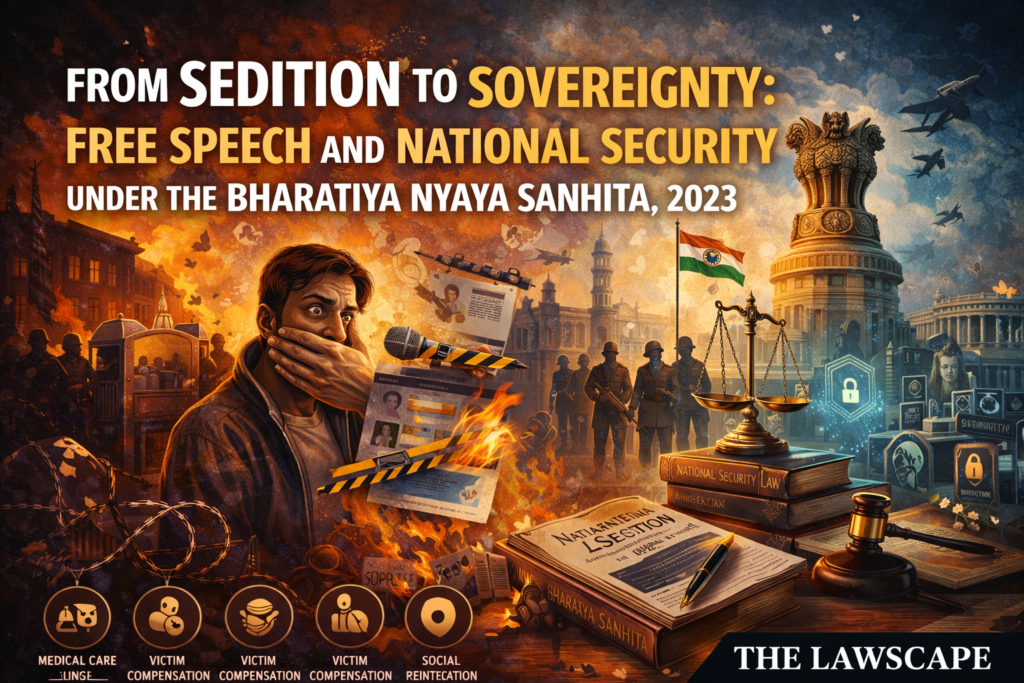
FROM SEDITION TO SOVEREIGNTY: FREE SPEECH AND NATIONAL SECURITY UNDER THE BHARATIYA NYAYA SANHITA, 2023
Author: Pooja Bujji Shridharla
Student, KES Shri Jayantilal H Patel Law College, Mumbai
————————————————————————————-
💡 3 Quick Takeaways
1. The Bharatiya Nyaya Sanhita (BNS), 2023, replaces the colonial “sedition” (Section 124A IPC) with Section 152, shifting the focus from protecting the government to safeguarding national sovereignty.
2. While the BNS explicitly protects “lawful criticism” and dissent, concerns remain regarding the “vague and broad” terminology such as “subversive activities”.
3. The new provision expands legal scrutiny to include electronic communication and financial means, significantly increasing the risk of overreach in the digital age.
Introduction
The evolution of criminal law in India reflects not only legal transformation but also the changing values of society and governance. One of the most debated and controversial provisions in Indian legal history has been the offence of sedition. With the introduction of the Bharatiya Nyaya Sanhita (BNS), 2023, the Indian legislature has taken a significant step by removing the colonial-era sedition law and replacing it with a new framework that seeks to balance free speech with national security. This shift is not merely a technical amendment; it represents a deeper attempt to redefine the relationship between citizens and the State in a modern democracy.
The Colonial Legacy of Section 124A
Sedition, as previously defined under Section 124A of the Indian Penal Code, 1860, had its origins in British colonial rule. The provision was introduced to suppress dissent and maintain control over the Indian population by criminalizing any expression that brought hatred, contempt, or disaffection against the government. While this served colonial interests, its continuation in independent India raised serious concerns. The broad language allowed authorities to interpret it expansively, often silencing activists, journalists, and students, thereby creating a “chilling effect” on dissenting opinions.
Judicial Interventions and the Narrowing of Scope
Recognizing these concerns, the judiciary played a crucial role in limiting the misuse of sedition. In the landmark case of Kedar Nath Singh v. State of Bihar (1962), the Supreme Court ruled that only acts involving incitement to violence or the intention to create public disorder would fall within the ambit of sedition. Mere criticism of the government, however strong, would not constitute an offence.
Subsequent judgments reinforced this. In Vinod Dua v. Union of India (2021), the Court reiterated the right of journalists to criticize the government without fear of prosecution. Finally, in S. G. Vombatkere v. Union of India (2022), the Court took the unprecedented step of effectively suspending the operation of the sedition law, calling for a legislative reconsideration.
The Shift to Section 152 BNS
The enactment of the BNS, 2023, marks a turning point. By removing the offence of “sedition,” the legislature has attempted to break away from its colonial legal legacy. Instead, the new law introduces Section 152, which addresses acts endangering the sovereignty, unity, and integrity of India.
This shift moves the focus from protecting the “government” to safeguarding the “nation”. Governments are temporary and subject to criticism, whereas the nation represents a collective identity that must be protected. Importantly, Section 152 includes an explanation protecting lawful criticism intended to bring about change through legal means. This safeguard acknowledges the importance of dissent in a democratic society, grounded in the Article 19(1)(a) right to freedom of speech and expression.
Persistent Concerns and the Risk of Overreach
Despite these improvements, critics remain concerned. Primary among these issues is the use of vague terms such as “subversive activities” and “endangering sovereignty,” which are not clearly defined. This ambiguity raises the possibility that the law could be applied in ways similar to the old sedition provision, targeting peaceful protest or criticism.
Furthermore, the new law explicitly includes electronic communication and financial means. In today’s digital age, sharing content online or contributing funds could potentially be scrutinized, increasing the risk of administrative overreach. Some argue this represents a “rebranding” of the same concept under a different name, especially given that the severity of punishment—including life imprisonment—remains intense.
Conclusion: The Path Forward
The success of this reform depends on how it is enforced. Law enforcement agencies must exercise restraint, and the judiciary must continue to play an active role in safeguarding fundamental rights by adhering to the principles laid down in the Kedar Nath case.
From a student’s perspective, this development offers an opportunity to reflect on the evolving nature of law. As future legal professionals, students must understand not only the letter of the law but also its spirit, ensuring that laws are used to promote justice rather than suppress it. If applied responsibly and with continuous judicial oversight, this reform has the potential to strengthen democratic values; if misused, it could perpetuate the very problems it seeks to address.
Disclaimer: The views expressed in this article are those of the author and do not necessarily reflect the views of The Lawscape.
The Lawscape — clear, practical legal insight for students and future lawyers.