
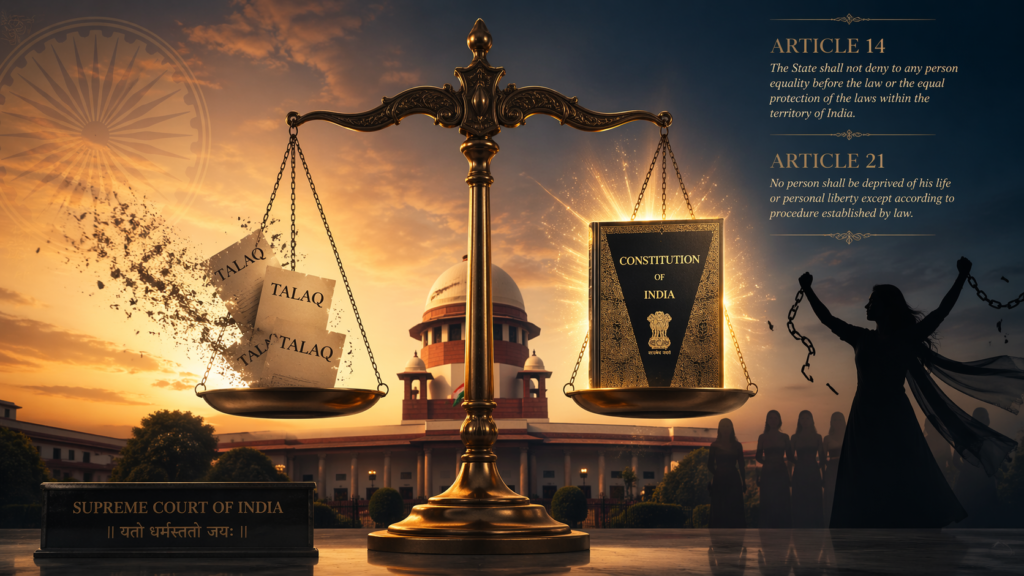
Talaq-e-Biddat and the Constitution: Unpacking the Majority and Minority in Shayara Bano v. Union of India
Case Citation: Shayara Bano v. Union of India, (2017) 9 SCC 1
Author: Priyanka Pawar
Student, Government Law College, Mumbai
———————————————————————————–
3 Quick Takeaways
- In Shayara Bano v. Union of India (2017), the Supreme Court of India held by a majority of 3:2 that the practice of talaq-e-biddat (instant triple talaq) is unconstitutional, finding it manifestly arbitrary and violative of Article 14 of the Constitution.
- The majority opinions reflected distinct but complementary approaches: Justice Nariman grounded the decision in constitutional arbitrariness under Article 14, while Justice Kurian Joseph held that the practice was contrary to the Holy Quran itself and therefore not a valid part of Islamic law entitled to protection under Article 25.
- The judgment led directly to the enactment of the Muslim Women (Protection of Rights on Marriage) Act, 2019, which criminalised the pronouncement of instant triple talaq, demonstrating how judicial intervention in personal law can catalyse broader legislative reform.
Introduction
Gender equality across nations continues to evolve, and in India the principle of gender equality forms a fundamental pillar of the Constitution. The judiciary plays a vital role in acknowledging the dignity and rights of women. However, as India is a secular state that respects all religions, tensions often arise when certain practices appear to conflict with constitutional guarantees of equality. Certain personal laws in India have long generated precisely this form of debate.
One such contested practice was talaq-e-biddat, commonly known as triple talaq. This is an Islamic practice that permits a Muslim husband to arbitrarily and unilaterally effect an instant and irrevocable divorce by pronouncing the word “talaq” (the Arabic word for divorce) three times in one sitting, whether orally, in writing, or, more recently, by electronic means. The practice does not require the wife’s consent. In Shayara Bano v. Union of India (2017), the constitutional validity of this practice was brought before the Supreme Court of India. The judgment represents a significant moment in which the Indian judiciary acknowledged the intersection of gender justice, religious freedom, and personal law, and stands as a landmark decision in Indian constitutional jurisprudence.
Facts
In 2002, Shayara Bano married Rizwan Ahmed in Uttar Pradesh according to Muslim personal law. The marriage lasted several years, but the relationship became strained over time. Shayara Bano claimed that her husband subjected her to cruelty and harassment, and that her family had been coerced into paying dowry for the marriage, following which she continued to be abused by her husband. The couple had two children.
In October 2015, her husband unilaterally dissolved the marriage by pronouncing talaq-e-biddat, ending the marriage instantaneously without any process of reconciliation and without Shayara Bano’s consent.
Under Muslim law, divorce may be effected through several recognised forms. Islamic jurists have broadly classified these into two categories: talaq-ul-sunnat, which is regarded as the approved form of divorce and includes talaq-e-ahsan and talaq-e-hasan (both of which involve a waiting period to allow for reconciliation), and talaq-ul-biddat, which involves pronouncing divorce in a single sitting. Although many Islamic scholars regard talaq-e-biddat as improper or sinful, it had historically been recognised as legally valid in certain Sunni schools of Islamic jurisprudence, particularly the Hanafi school.
In February 2016, Shayara Bano filed a writ petition before the Supreme Court of India. She challenged the constitutional validity of certain practices under Muslim personal law, including talaq-e-biddat, polygamy, and nikah-halala. She argued that these practices violated the right to equality and were discriminatory in nature, thereby violating her fundamental rights under Article 14 (Right to Equality), Article 15 (Prohibition of Discrimination), and Article 21 (Right to Life and Personal Liberty) of the Constitution. She submitted that these practices create inequality for women and undermine their dignity, and that religious freedom cannot serve as a shield to override other constitutional values.
The petition was supported by several women’s rights organisations. Religious bodies, including the All India Muslim Personal Law Board (AIMPLB), defended the practice as an integral part of Muslim personal law and argued that it was protected under Article 25, which guarantees the freedom of religion.
Issues
- Whether the practice of talaq-e-biddat (instant triple talaq) violates the fundamental rights guaranteed under the Constitution of India.
- Whether the practice of instant triple talaq is protected as an essential religious practice under Article 25 of the Constitution.
- Whether a personal law practice can be invalidated by the judiciary when it is found to be arbitrary or discriminatory.
Judgment
The Supreme Court delivered its judgment on 22 August 2017. A five-judge Constitution Bench comprising Chief Justice J.S. Khehar and Justices Kurian Joseph, R.F. Nariman, U.U. Lalit, and Abdul Nazeer heard the matter. By a majority of 3:2, the Court held that the practice of talaq-e-biddat is unconstitutional and arbitrary. The Court held that “an action that is arbitrary must necessarily involve negation of equality” and found that since triple talaq allows the marital tie to be broken capriciously without any attempt at reconciliation, this arbitrariness violates Article 14. The majority accordingly declared the practice of talaq-e-biddat invalid.
The minority opinion, delivered by Chief Justice Khehar and Justice Abdul Nazeer, held that the practice formed part of Muslim personal law and that the Court should not interfere. The minority suggested instead that Parliament should enact legislation to address the issue.
Following the Supreme Court’s declaration, the Government argued that specific legislation was needed to ensure that Muslim women were actually protected from the practice. Parliament accordingly enacted the Muslim Women (Protection of Rights on Marriage) Act, 2019, under which instant triple talaq was declared void and illegal, and its pronouncement was made a criminal offence punishable with imprisonment of up to three years and a fine. The law also provides for maintenance for the wife and custody rights for minor children.
Critical Analysis
The Article 14 Argument
One of the central questions in the case was the application of Article 14 of the Constitution, which prohibits the state from acting arbitrarily. Justice Rohinton F. Nariman held that talaq-e-biddat creates a form of manifest arbitrariness, as it allows a Muslim husband to dissolve a marriage unilaterally without any justification, procedure, or opportunity for reconciliation. This reasoning strengthens the constitutional commitment to equality by ensuring that personal law practices cannot operate in a manner that creates discrimination, inequality, or harm to the dignity of women.
However, this reasoning has attracted criticism on the ground that the Court did not clarify the broader constitutional status of personal laws, and specifically whether personal law practices are fully subject to fundamental rights scrutiny under the Constitution. The relationship between Article 13 (which renders laws inconsistent with fundamental rights void) and codified or uncodified personal laws remains a question that the judgment did not conclusively resolve, leaving the scope of judicial review over personal law somewhat uncertain.
The Religious Doctrine Argument
Justice Kurian Joseph took a distinct path. He held that talaq-e-biddat was contrary to the tenets of the Holy Quran and therefore could not be considered a valid part of Islamic law in the first place. Since the practice was not an integral part of the religion, it could not claim protection under Article 25 of the Constitution as an essential religious practice. This reasoning allowed the Court to invalidate instant triple talaq without directly confronting the question of whether personal law as a whole is subject to constitutional override.
This approach has been criticised for requiring courts to engage in the interpretation of religious doctrine, which raises legitimate questions about the appropriate limits of judicial involvement in matters of faith and scriptural interpretation. The authority of courts to determine what is or is not integral to a religion is itself a contested institutional question.
The Minority and the Role of the Legislature
Chief Justice Khehar and Justice Abdul Nazeer dissented, holding that the practice was part of Muslim personal law and fell outside the scope of judicial invalidation. Chief Justice Khehar suggested that reforms to such practices should come from the legislature rather than the judiciary. While this perspective reflects an important concern for the separation of powers and the protection of religious autonomy, critics of the minority position argue that leaving discriminatory practices entirely to legislative reform may unduly delay the protection of women’s fundamental rights. The legislature had the option of reforming this practice for decades and had not done so, which was itself part of the context in which the case arose.
Conclusion
Shayara Bano v. Union of India (2017) is among the most consequential judgments in the history of Indian personal law. By declaring the practice of talaq-e-biddat invalid, the Supreme Court of India reaffirmed the importance of constitutional principles such as equality, dignity, and non-arbitrariness. The judgment demonstrated that personal laws, however deeply rooted in religious tradition, cannot operate as instruments that deny fundamental rights to women.
While the Court invalidated instant triple talaq, scholars continue to debate whether it fully addressed the constitutional status of personal laws under Article 13 and the extent to which the judiciary may review religious practices under Part III of the Constitution. Despite these open questions, the judgment remains a significant step toward promoting gender justice within personal law frameworks.
The ruling also had direct legislative consequences, leading to the enactment of the Muslim Women (Protection of Rights on Marriage) Act, 2019, which translated the judicial prohibition into a criminal sanction. The case as a whole illustrates the ongoing and evolving dialogue between constitutional values and religious autonomy in India, and the critical role the Supreme Court plays in calibrating that balance when fundamental rights are at stake.
References
- Shayara Bano v. Union of India, (2017) 9 SCC 1 (India).
- Muslim Women (Protection of Rights on Marriage) Act, No. 20 of 2019, https://www.indiacode.nic.in/bitstream/123456789/11564/1/a2019-20.pdf.
- India Const. arts. 14, 15, 21, 25.
- Asaf A.A. Fyzee, Outlines of Muhammadan Law 164 (3rd ed. 1948).
- Supreme Court Observer, Shayara Bano v. Union of India: Case Background, https://www.scobserver.in/cases/shayara-bano-union-india-triple-talaq-case-background (last visited Mar. 7, 2026).
- ESCR-Net, Shayara Bano and Others v. Union of India and Others, Writ Petition (C) No. 118 of 2016, https://www.escr-net.org/caselaw/2018/shayara-bano-and-others-v-union-india-and-others-writ-petition-c-no-118-2016/ (last visited Mar. 8, 2026).
Disclaimer: The views expressed in this article are those of the author and do not necessarily reflect the views of The Lawscape.
The Lawscape — clear, practical legal insight for students and future lawyers.