
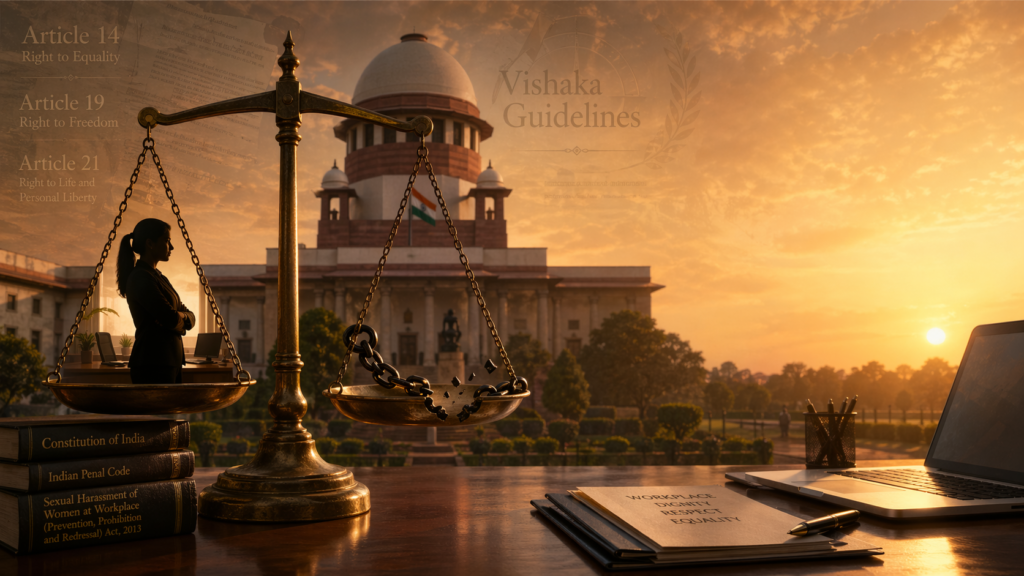
Vishaka and Others v. State of Rajasthan: Judicial Activism and the Birth of Workplace Sexual Harassment Law in India
(1997) 6 SCC 241 | AIR 1997 SC 3011
Author: Prajakta Patil Student
———————————————————————-
3 Quick Takeaways
- In Vishaka and Others v. State of Rajasthan (1997), the Supreme Court of India laid down binding guidelines, known as the Vishaka Guidelines, to protect working women from sexual harassment, exercising its power under Article 32 to fill a legislative vacuum in the absence of any specific statute on the subject.
- The Court held that sexual harassment at the workplace violates the constitutional rights of women under Articles 14, 15, 19(1)(g), and 21, and that international conventions such as CEDAW may be used to interpret and give effect to these domestic fundamental rights guarantees.
- The Vishaka Guidelines operated as binding law for over sixteen years until they were superseded by the Sexual Harassment of Women at Workplace (Prevention, Prohibition and Redressal) Act, 2013, which translated the Court’s directions into a comprehensive statutory framework.
I. Case Details
Case Name: Vishaka and Others v. State of Rajasthan and Others
Citation: (1997) 6 SCC 241; AIR 1997 SC 3011
Court: Supreme Court of India, Original Jurisdiction under Article 32
Bench: Division Bench comprising Chief Justice J.S. Verma, Justice Sujata V. Manohar, and Justice B.N. Kirpal
Date of Judgment: 13 August 1997
Petitioners: Vishaka and Others (women’s rights activists, social activists, and NGOs including Sakshi)
Respondents: State of Rajasthan and Others (authorities responsible for the safety of employees under the Rajasthan Government’s Women’s Development Programme)
II. Facts
Bhanwari Devi, a woman from Bhateri, Rajasthan, worked as a social worker under the State’s Women Development Project (WDP) from 1985. Her role involved supporting various community initiatives, including efforts to prevent child marriage and address gender-related issues. In 1992, she participated in a campaign organised by the Government to prevent child marriage. The villagers resisted the campaign despite the legal prohibition on the practice.
Ram Karan Gurjar planned to marry off his underage daughter. Social worker Bhanwari Devi attempted to stop the marriage but was unsuccessful. Despite her efforts, the marriage proceeded after police intervention on 5 May 1992, with authorities failing to prevent it. As a consequence of her involvement in opposing the child marriage, Bhanwari Devi and her family were ostracised by the villagers, and she was dismissed from her job.
On 22 September 1992, five men, including four members of the Gurjar family, sought to take revenge upon her and her family. Bhanwari Devi filed a complaint, but the police investigation was delayed and the medical report failed to support her allegations. The Trial Court acquitted all the accused individuals due to lack of evidence and what was described as political backing from a local MLA.
Aggrieved by the acquittal, women’s rights organisations and activists rallied to support Bhanwari Devi. The Vishaka organisation filed a Public Interest Litigation (PIL) under Article 32 of the Constitution, seeking to enforce the fundamental rights of women at the workplace. The PIL highlighted the urgent need for legal measures to protect women from sexual harassment at work.
III. Issues
The Court was called upon to consider the following issues:
- Whether sexual harassment at the workplace amounts to a violation of the rights to gender equality and the right to life and liberty under the Constitution.
- Whether the employer bears any legal responsibility when sexual harassment is committed by or against its employees.
IV. Arguments of Both Parties
A. Petitioners: Vishaka and Others
The petitioners argued that sexual harassment is not merely a personal issue but a violation of constitutional rights, specifically the right to equality under Article 14, the right against discrimination under Article 15, the right to life and dignity under Article 21, and the right to practise any profession under Article 19(1)(g), each of which is impaired when women are unable to work with dignity and safety.
The petitioners relied upon international conventions, particularly the Convention on the Elimination of All Forms of Discrimination Against Women (CEDAW), arguing that international law should guide Indian courts in the interpretation of domestic rights in the absence of specific domestic legislation on the subject.
On the question of remedies, the petitioners argued that a post-incident remedy was insufficient. The Court needed to mandate employer liability and establish preventive guidelines. Employers, whether in the public or private sector, are responsible for maintaining a safe and non-hostile working environment and for preventing sexual harassment. The petitioners also argued that due to the absence of specific and comprehensive legislation, the Supreme Court was obliged to use its powers under Article 32 to fill this void with binding guidelines, including the creation of a formal complaints mechanism at workplaces.
B. Respondents: State of Rajasthan and Others
The respondents contended that in the absence of comprehensive legislation, definitive mechanisms for prevention could not be judicially established. They argued that formulating such guidelines was a legislative rather than a judicial function, and that the creation of judicially mandated workplace norms would raise serious concerns about the separation of powers. The respondents further raised practical concerns regarding the enforceability of judicially created guidelines and contended that proper legislative action, together with existing, if inadequate, laws, was the appropriate remedy rather than judicial intervention.
V. Judgment and Final Decision
In 1997, the Supreme Court delivered a landmark judgment laying down the Vishaka Guidelines: a comprehensive set of directions to be followed by all establishments in dealing with complaints of sexual harassment at the workplace. The Court stated that these guidelines would have the force of law and would remain operative until Parliament enacted legislation specifically dealing with the subject.
The Court held that international conventions and norms are significant for interpreting the constitutional guarantees of gender equality, the right to work with human dignity under Articles 14, 15, 19(1)(g), and 21, and the safeguards against sexual harassment implicit in those provisions. In the absence of any inconsistency between domestic law and international conventions, the Court held that such conventions may be used to construe fundamental rights expressly guaranteed under the Constitution.
The Court also provided a comprehensive definition of sexual harassment, covering all unwelcome sexually determined behaviour, whether directly or by implication, including physical contact and advances, demands or requests for sexual favours, sexually coloured remarks, showing pornography, and any other unwelcome physical, verbal, or non-verbal conduct of a sexual nature. The Court recognised that where any such act is committed in circumstances under which the victim has a reasonable apprehension that objecting to the conduct would disadvantage her in relation to her employment, including in matters of recruitment, promotion, or working conditions, such conduct is discriminatory and violates her fundamental rights. The Court further clarified that sexual harassment need not involve physical contact; any act that creates a hostile work environment, whether through lewd jokes, verbal abuse, the circulation of lewd rumours, or similar conduct, constitutes sexual harassment. Such a hostile environment may be created not by a single act but by a pattern of behaviour comprising many such acts.
The Court also acknowledged that victims may report incidents of sexual harassment after a significant period of time, given the psychological stigma and personal courage required to do so. The guidelines therefore do not require complaints to be made within a short time following the incident, and compliance mechanisms must ensure time-bound treatment of complaints without imposing unduly restrictive timelines on victims.
VI. Ratio Decidendi
Fundamental Rights Violation: Sexual harassment at the workplace is not merely misconduct but a violation of constitutional rights, specifically the right to equality under Article 14, the right against discrimination under Article 15, the right to practise any profession under Article 19(1)(g), and the right to life and dignity under Article 21.
Judicial Activism and Gap-Filling: In the absence of enacted law, the Supreme Court has both the power and the duty under Article 32 to formulate binding guidelines to protect fundamental rights, drawing on international conventions such as CEDAW where appropriate.
Incorporation of International Law: International conventions such as CEDAW (particularly Articles 11 and 24) are to be used as aids in interpreting domestic constitutional provisions and in filling legislative gaps where no domestic law exists.
Employer Liability: Employers in both the public and private sectors are legally responsible for providing a safe and non-hostile working environment and for establishing formal mechanisms for the redressal of complaints of sexual harassment.
Definition of Workplace Harassment: Any unwelcome physical, verbal, or non-verbal conduct of a sexual nature that creates a hostile work environment is recognised as sexual harassment, regardless of whether a single incident or a pattern of conduct is involved.
VII. Conclusion and Observations
The Vishaka judgment stands as one of the most significant exercises of judicial activism in Indian legal history. By issuing the Vishaka Guidelines, the Supreme Court stepped into a space left vacant by the legislature and created binding law in a domain where none existed, directly protecting the constitutional rights of working women across the country.
The constitutional principles of equality and liberty affirmed in the judgment reflect both a normative commitment and a practical recognition that women form an essential part of the working population and are entitled, as a matter of legal right, to a working environment free from harassment and hostility. The Court’s invocation of CEDAW as an interpretive aid for domestic constitutional provisions was itself a significant development, establishing a clear methodology for using international human rights standards to illuminate and expand the content of domestic fundamental rights.
The Vishaka Guidelines operated as binding law for over sixteen years. They were ultimately superseded by the Sexual Harassment of Women at Workplace (Prevention, Prohibition and Redressal) Act, 2013, which gave legislative form to many of the principles the Court had articulated. However, the Act’s implementation has not been without criticism. Several provisions have been identified as inadequate, including the absence of guaranteed legal expertise, clinical counselling facilities, medical support, and employer-funded compensation mechanisms for victims. The gap between the statutory framework and its effective enforcement remains a significant concern.
The legacy of the Vishaka case lies not only in the guidelines it produced but in the question it placed firmly at the centre of constitutional discourse: whether any law or practice that tolerates the harassment of women in the workplace can be reconciled with the values of equality, dignity, and liberty that the Constitution demands. That question continues to shape the ongoing evolution of workplace safety law in India.
References
- Vishaka and Others v. State of Rajasthan and Others, (1997) 6 SCC 241; AIR 1997 SC 3011 (India).
- India Const. arts. 14, 15, 19(1)(g), 21.
- Convention on the Elimination of All Forms of Discrimination Against Women (CEDAW), Dec. 18, 1979.
- Sexual Harassment of Women at Workplace (Prevention, Prohibition and Redressal) Act, No. 14 of 2013 (India).
Disclaimer: The views expressed in this article are those of the author and do not necessarily reflect the views of The Lawscape.
The Lawscape — clear, practical legal insight for students and future lawyers.