
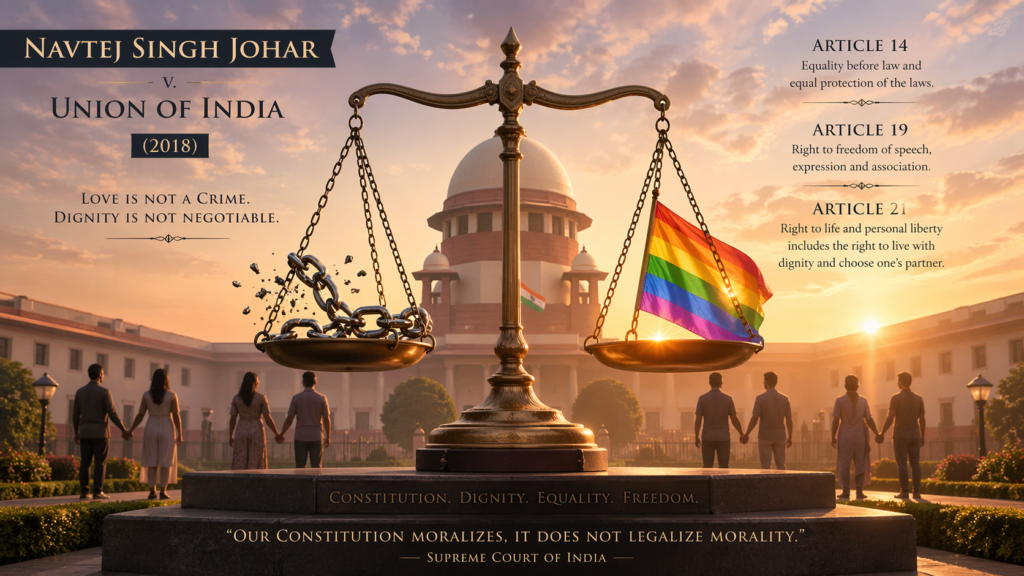
Decriminalising Love: A Case Commentary on Navtej Singh Johar v. Union of India (2018)
Citation: (2018) 10 SCC 1
Author: Mritika Raj Student
KES Shri Jayantilal H Patel Law College, Mumbai
——————————————————————————————
3 Quick Takeaways
- In Navtej Singh Johar v. Union of India (2018), a unanimous five-judge Constitution Bench of the Supreme Court of India partially struck down Section 377 of the Indian Penal Code, holding that its criminalisation of consensual adult same-sex relations was violative of Articles 14, 15, 19, and 21 of the Constitution.
- The judgment overruled Suresh Kumar Koushal v. Naz Foundation (2013), firmly establishing that constitutional morality must prevail over social or majoritarian morality, and that the fundamental rights of a minority cannot be curtailed merely because the majority disapproves of their identity or conduct.
- While the decision was a historic step toward dignity and equality for the LGBTQIA+ community, it left significant legislative gaps unaddressed, including the absence of marriage equality, adoption rights, and comprehensive anti-discrimination protections, issues that continue to demand judicial and legislative attention.
I. Case Details
Case Name: Navtej Singh Johar and Others v. Union of India, Ministry of Law and Justice Secretary
Citation: (2018) 10 SCC 1
Court: Supreme Court of India
Bench: Five-Judge Constitution Bench comprising Chief Justice Dipak Misra, Justice A.M. Khanwilkar, Justice R.F. Nariman, Justice D.Y. Chandrachud, and Justice Indu Malhotra
Date of Judgment: 6 September 2018
II. Facts
Section 377 of the Indian Penal Code, 1860, criminalises carnal intercourse against the order of nature and had historically been applied to consensual same-sex relations between adults.
The constitutional challenge to Section 377 has a significant procedural history. In 2009, the Delhi High Court in Naz Foundation v. Government of NCT of Delhi declared Section 377 unconstitutional insofar as it applied to consensual acts between adults, holding that it violated Articles 21, 14, and 15 of the Constitution. In 2013, a two-judge bench of the Supreme Court in Suresh Kumar Koushal v. Naz Foundation overturned the Delhi High Court decision, reinstated Section 377 in full, and granted it what was described as “the stamp of constitutional approval,” holding that amending the law was a matter for the legislature.
Following the 2013 decision, curative petitions were filed. In 2016, Navtej Singh Johar, a dancer who identified as part of the LGBTQ+ community, filed a writ petition directly before the Supreme Court challenging the 2013 decision and seeking recognition of the right to sexuality, right to sexual autonomy, and right to choice of a sexual partner as part of the right to life guaranteed by Article 21. A three-judge bench of the Supreme Court referred the matter to a larger bench, and a five-judge Constitution Bench was accordingly constituted to hear it.
The petitioner also argued that Section 377 was unconstitutionally vague in its failure to define “carnal intercourse against the order of nature,” that there was no intelligible differentia or reasonable classification between natural and unnatural consensual sex, that it was violative of Article 15 insofar as it discriminated on the basis of the sex of a person’s sexual partner, and that it violated Article 19 by having a chilling effect on individuals’ ability to express their sexual identity through speech and choice of partner. The provision subjected LGBTQ+ individuals to fear, humiliation, and social stigma for their way of life.
Some NGO and religious groups argued against the petitioners, contending that the right to privacy is not absolute, that same-sex acts undermine constitutional dignity, that decriminalisation could increase HIV/AIDS transmission, that striking down Section 377 would harm the institution of marriage, and that such action could conflict with Article 25, which guarantees freedom of religion.
III. Procedural History
Lower Court Decision
In 2009, the Delhi High Court in Naz Foundation v. Government of NCT of Delhi declared Section 377 unconstitutional insofar as it applied to consensual acts between adults in private.
In 2013, the Supreme Court in Suresh Kumar Koushal v. Naz Foundation reversed the Delhi High Court decision, reinstating Section 377 and holding that amending the law was a matter for the legislature.
Appeals
Following the 2013 decision, curative petitions were filed. The Supreme Court referred the matter to a larger Constitutional Bench, which resulted in the five-judge bench hearing the present case.
IV. Issues
- Whether Section 377 violates the fundamental right to expression under Article 19(1)(a) by criminalising the gender expression of persons belonging to the LGBTQIA+ community.
- Whether the rationale of the Supreme Court judgment in Suresh Kumar Koushal was sound in its understanding of morality as social morality.
- Whether Section 377 violates Articles 14 and 15 by allowing discrimination on the basis of sexual orientation and gender identity.
- Whether Section 377 violates the right to autonomy and dignity under Article 21 by penalising private consensual acts between same-sex persons.
V. Arguments of the Parties
A. Petitioners
Homosexuality, bisexuality, and other sexual orientations are equal in the eyes of nature and should be equal in the eyes of the law. The criminalisation of consensual same-sex relations creates a dignity crisis for persons whose gender identity is thereby stigmatised, invades their right to privacy under Article 21, and impairs the full development of personality, the building of relationships, and other essential liberties guaranteed under Article 19(1)(a).
The LGBTQ+ community comprises a substantial portion of the Indian population and faces constant discrimination on the basis of sexual orientation, which violates their basic constitutional rights. They are entitled to protection to live their lives freely and without fear of criminal prosecution on account of their sexual identity.
The petitioners pointed to the recognition of transgender persons as a third gender in National Legal Services Authority v. Union of India (the NALSA case), and argued that it was inconsistent to extend such recognition while simultaneously treating the consensual activities of transgender and same-sex persons as criminal offences.
The petitioners sought an amendment to Section 377 of the Indian Penal Code, 1860, to confine its operation to non-consensual sexual acts. They argued that there is no intelligible differentia or reasonable constitutional classification between natural and unnatural consensual sex that could justify the provision’s application to consenting adults.
B. Respondents
The respondents contended that sufficient rights had already been extended to the LGBTQ+ community through the NALSA judgment and that the further relief sought by the petitioners amounted to an abuse of constitutional rights. They argued that Section 377 retained relevance on the ground that homosexual acts carry a higher risk of HIV transmission, and that such acts should therefore not be protected under the right to privacy.
The respondents further contended that striking down Section 377 would weaken the traditional family structure, the institution of marriage, and the country’s social, political, economic, and cultural foundations. They argued that the provision is constitutionally valid because the state has authority to impose reasonable restrictions on certain sexual acts to prevent conduct considered harmful or offensive, and that Section 377 does not violate Article 14 because the state may create reasonable classifications when defining offences and prescribing punishments.
The respondents also argued that Section 377 does not violate Article 15 because that article prohibits discrimination on the basis of sex, and sexual orientation is not expressly mentioned within it. Finally, they contended that striking down Section 377 could affect personal laws including the Parsi Marriage and Divorce Act, the Special Marriage Act, the Indian Divorce Act, and Hindu marriage laws.
VI. Judgment
The Court held that even if the LGBTQIA+ community forms a small minority, its members are equally entitled to the right to privacy, which includes autonomy and freedom of sexual orientation. Choosing a partner of the same sex cannot constitute a ground for criminal punishment. Section 377 undermined their dignity and personal choice, thereby violating the right to privacy under Article 21.
Although Section 377 was historically justified as protecting women and children from sexual abuse, consensual same-sex relations between adults do not harm women or children. Since non-consensual sexual acts are already punishable under Section 375 of the IPC, Section 377 was unnecessary in its application to consenting adults and unfairly targeted a specific group, violating Article 14’s guarantee of equality.
While fundamental rights may be subject to reasonable restrictions, the choice of a sexual partner is a deeply personal matter that cannot be curtailed arbitrarily. By restricting consensual same-sex relationships, Section 377 was irrational and violated individual freedom. Restrictions on expression under Article 19(1)(a) can only be grounded in public order, decency, or morality; private or consensual expressions of affection by LGBTQIA+ persons do not disrupt public order or societal morality. Section 377 therefore failed the test of proportionality and infringed the community’s fundamental rights, including freedom of expression.
The Supreme Court accordingly held Section 377 unconstitutional to the extent that it criminalised consensual adult same-sex relations, finding it violative of Articles 14, 15, 19, and 21, and expressly overruled Suresh Kumar Koushal v. Naz Foundation. The Court clarified that Section 377 would continue to apply to non-consensual acts, acts involving minors, and bestiality. The decision was unanimous (5:0).
VII. Separate Opinions
Chief Justice Dipak Misra and Justice A.M. Khanwilkar emphasised that societal morality cannot override constitutional morality and stressed the imperative of an inclusive society that recognises the equal dignity of all its members.
Justice Rohinton Fali Nariman highlighted the historical injustices faced by the LGBTQ+ community and the necessity of judicial intervention to correct them, drawing attention to the years of suffering caused by the provision’s application.
Justice D.Y. Chandrachud focused on the right to privacy and the protection of intimate decisions of individuals as fundamental rights intrinsic to life and personal liberty, building upon the framework established in K.S. Puttaswamy v. Union of India.
Justice Indu Malhotra noted the necessity of offering an acknowledgment of the delay in providing justice to the LGBTQ+ community and emphasised the importance of non-discrimination as a constitutional value.
VIII. Legal Principles Applied
1. Right to Privacy and Dignity (Article 21)
The Court reaffirmed that the right to privacy is intrinsic to life and personal liberty under Article 21, relying on Justice K.S. Puttaswamy v. Union of India. It held that sexual orientation is an essential attribute of identity, and that criminalising consensual same-sex relations violated the rights to privacy, dignity, and individual autonomy.
2. Equality before Law (Article 14)
The Court held that Section 377 was arbitrary and failed to satisfy the test of reasonable classification. By criminalising consensual same-sex relations, it denied equal protection of laws to the LGBTQIA+ community and was therefore violative of Article 14.
3. Non-Discrimination (Article 15)
The Court gave an expansive interpretation to the term “sex” under Article 15, holding that it includes sexual orientation. Discrimination on the basis of sexual orientation was accordingly declared unconstitutional.
4. Freedom of Expression (Article 19(1)(a))
The judgment recognised that sexual orientation and choice of partner form part of an individual’s expression and identity. Section 377 imposed an unreasonable restriction on this freedom and did not satisfy constitutional standards of proportionality.
5. Doctrine of Manifest Arbitrariness
The Court applied the doctrine of manifest arbitrariness, holding that a law can be struck down if it is irrational, excessive, or disproportionate. Section 377, insofar as it criminalised consensual acts between adults, was found to be manifestly arbitrary.
6. Constitutional Morality
The Court emphasised that constitutional morality must prevail over social or majoritarian morality. The fundamental rights of minorities cannot be curtailed merely because a section of society disapproves of their identity or conduct.
7. Transformative Constitutionalism
The judgment reflected the principle of transformative constitutionalism, recognising the Constitution as a living document aimed at promoting inclusivity, dignity, and substantive equality for historically marginalised communities.
8. Overruling of Precedent
The Court overruled its earlier decision in Suresh Kumar Koushal v. Naz Foundation, acknowledging that the earlier judgment had committed a constitutional error by giving primacy to social morality over constitutional morality.
These principles collectively led the Court to partially strike down Section 377, decriminalising consensual same-sex relations between adults while retaining the provision’s application to non-consensual acts, acts involving minors, and bestiality.
IX. Critical Analysis
The judgment in Navtej Singh Johar v. Union of India marks a transformative moment in Indian constitutional law by affirming dignity, privacy, and equality for the LGBTQIA+ community. The Court rightly prioritised constitutional morality over social morality and corrected the restrictive and constitutionally unsustainable reasoning in Suresh Kumar Koushal. Its expansive reading of Articles 14, 15, 19, and 21 significantly strengthened substantive equality jurisprudence in India.
However, critics have rightly pointed out that while decriminalisation was an essential and long-overdue step, the judgment stopped short of addressing broader issues such as marriage equality and comprehensive anti-discrimination protections. The absence of legislative action on these questions following the judgment has left significant gaps in securing full civil rights for sexual minorities. The question of whether the Constitution affirmatively guarantees same-sex couples the right to marry has since been considered and, as of 2023, declined by a larger bench of the Supreme Court, leaving the matter to Parliament. The Navtej Singh Johar judgment thus remains both a milestone achieved and a foundation from which the continuing struggle for full equality proceeds.
X. Impact and Significance
The judgment in Navtej Singh Johar v. Union of India has profound legal and social significance. By partially striking down Section 377, the Supreme Court decriminalised consensual same-sex relations between adults, restoring dignity, equality, and constitutional protection to the LGBTQIA+ community. The decision reinforced that sexual orientation is an intrinsic aspect of identity protected under Articles 14, 15, 19, and 21 of the Constitution.
The ruling strengthened the doctrine of constitutional morality, affirming that fundamental rights cannot be denied on the basis of majoritarian social morality. It also expanded the scope of privacy jurisprudence established in Justice K.S. Puttaswamy v. Union of India. Socially, the judgment reduced stigma and validated the lived realities of sexual minorities.
However, while it marked a historic step toward inclusivity and substantive equality, issues including marriage equality, adoption rights, and comprehensive anti-discrimination protections remain to be fully addressed by both the legislature and the judiciary.
XI. Conclusion
The decision in Navtej Singh Johar v. Union of India represents a watershed moment in India’s constitutional journey. By decriminalising consensual same-sex relations between adults, the Supreme Court reaffirmed that the Constitution is a living and transformative document that protects individual dignity, autonomy, and equality. The judgment firmly established that sexual orientation is an intrinsic part of identity and cannot be subjected to criminal sanction or social prejudice. In doing so, the Court corrected the earlier position taken in Suresh Kumar Koushal v. Naz Foundation and aligned Indian constitutional law with evolving human rights standards.
The ruling underscored the primacy of constitutional morality over societal morality and strengthened the interpretation of fundamental rights under Articles 14, 15, 19, and 21. It not only removed the fear of prosecution but also symbolically restored respect and recognition to the LGBTQIA+ community. However, while the judgment marked a crucial step toward equality, it also highlighted the continuing need for legislative and judicial action to secure broader civil rights, including protection against discrimination and recognition of same-sex relationships. The case stands as both a milestone achieved and a foundation for future progress.
References
- Navtej Singh Johar v. Union of India, (2018) 10 SCC 1.
- Suresh Kumar Koushal v. Naz Foundation, (2014) 1 SCC 1.
- Naz Foundation v. Government of NCT of Delhi, (2009) 111 DRJ 1.
- Justice K.S. Puttaswamy v. Union of India, (2017) 10 SCC 1.
Disclaimer: The views expressed in this article are those of the author and do not necessarily reflect the views of The Lawscape.
The Lawscape — clear, practical legal insight for students and future lawyers.