Freedom of Speech vs Digital Misinformation: Regulating Social Media Influence in India
Author: Deepti Agrawal
Student, Kanoria School of Law for Women, Jaipur
————————————————————————————–
💡 3 Quick Takeaways
- Social media influencers increasingly shape public understanding of law, medicine, finance, and politics, raising concerns about accountability and misinformation.
- India’s constitutional framework protects freedom of speech under Article 19(1)(a) while permitting reasonable restrictions under Article 19(2).
- A balanced regulatory approach focusing on transparency, accountability, and digital literacy is preferable to excessive restrictions on online expression.
Introduction
The rapid growth of social media platforms has transformed the way information is created, consumed, and disseminated in contemporary society. Platforms such as Instagram, YouTube, X (formerly Twitter), and Facebook have evolved beyond spaces for entertainment and communication into influential sources of information on law, medicine, finance, politics, and other matters of public importance.
In India, a growing number of individuals, particularly young people, increasingly rely on digital influencers to understand social issues, professional matters, and public affairs. While this shift has expanded opportunities for democratic participation and freedom of expression, it has also intensified concerns regarding misinformation, manipulation, and the spread of unverified advice.
The question of regulating online influence has become a matter of global concern. China, for instance, has introduced measures requiring influencers who discuss professional subjects such as law, medicine, finance, and education to possess recognised qualifications. Although these measures evolved from broader livestreaming regulations, they reflect a growing emphasis on accountability in digital communication.
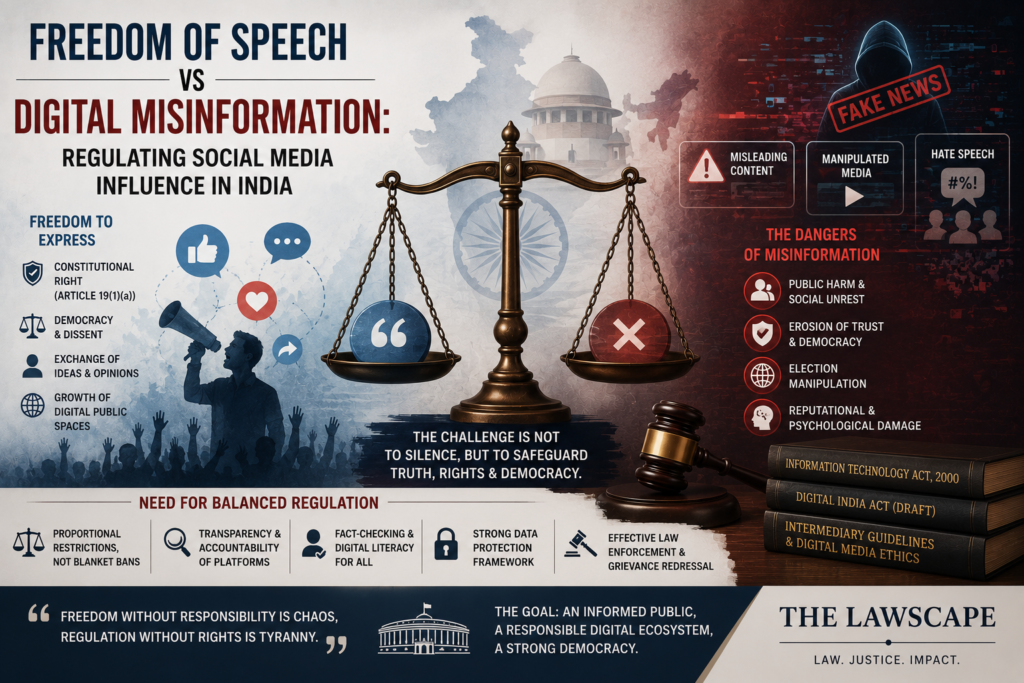
India, however, operates within a fundamentally different constitutional framework. Freedom of speech and expression is guaranteed under Article 19(1)(a) of the Constitution, subject only to the reasonable restrictions permitted under Article 19(2). Consequently, the challenge lies in balancing democratic freedoms with the risks posed by misinformation disseminated through social media platforms.
This article examines whether India’s existing legal framework adequately addresses the growing influence of digital creators and whether additional safeguards are required to combat misinformation while preserving constitutional freedoms.
Freedom of Speech under the Indian Constitution
Article 19(1)(a) of the Constitution guarantees every citizen the fundamental right to freedom of speech and expression. The Supreme Court has repeatedly emphasised that this freedom is indispensable to a democratic society.
The right encompasses the freedom to express opinions, criticise government policies, participate in public discourse, and disseminate information through various mediums, including digital platforms and the internet.
However, freedom of speech is not absolute.
Article 19(2) permits the State to impose reasonable restrictions in specified circumstances. These restrictions may be justified on grounds such as sovereignty and integrity, public order, decency, morality, defamation, incitement to offences, and the security of the State.
The Supreme Court’s decision in Shreya Singhal v. Union of India remains particularly significant in the context of digital communication. The Court struck down Section 66A of the Information Technology Act, 2000, holding that the provision was vague and unconstitutional. The judgment reaffirmed that discussion, advocacy, and even unpopular opinions remain protected forms of expression under Article 19(1)(a).
Similarly, in Kedar Nath Singh v. State of Bihar, the Supreme Court held that criticism of the government does not amount to sedition unless it incites violence or public disorder.
These decisions underscore the importance of protecting speech in a constitutional democracy. At the same time, constitutional protection does not automatically extend to misinformation, deceptive representations, or harmful professional advice disseminated through digital platforms. The issue therefore requires examination through the lens of permissible restrictions and accountability mechanisms.
The Rise of Social Media Influence and Digital Misinformation
Digital influencers have emerged as powerful actors in shaping public opinion.
Their influence now extends well beyond entertainment into specialised fields such as law, medicine, finance, governance, and public policy. Many individuals increasingly turn to social media content creators for guidance on legal rights, healthcare decisions, investment strategies, and political developments.
This democratisation of communication has undoubtedly expanded opportunities for participation in public discourse. However, it has also created significant risks associated with inaccurate information and unverified expertise.
Unlike licensed professionals who are subject to educational requirements, ethical obligations, and regulatory oversight, many influencers operate without comparable standards of accountability. As a result, audiences may receive advice that is inaccurate, misleading, or incomplete.
The consequences can be substantial.
Misleading financial advice may lead to significant economic losses. Inaccurate medical information can endanger public health. Incorrect legal guidance may cause confusion regarding rights and obligations. Political misinformation can distort public understanding and influence democratic decision-making.
The commercial nature of influencer activity further complicates the issue. Influencers frequently generate revenue through sponsorships, advertisements, affiliate marketing, and promotional partnerships. Consequently, digital content often combines expressive activity with commercial interests, increasing the need for transparency and accountability.
Legal Framework Governing Digital Content in India
Although India does not currently require influencers to possess professional qualifications before discussing specialised subjects online, several legal frameworks indirectly regulate digital content and online conduct.
Information Technology Act, 2000
The Information Technology Act, 2000 serves as India’s principal legislation governing cyber activities and electronic communication.
Certain provisions address misconduct committed through digital platforms.
Section 66D penalises cheating by personation through computer resources and communication devices. Section 67 addresses the publication and transmission of obscene material in electronic form.
While these provisions do not directly regulate influencers, they establish legal consequences for unlawful conduct occurring online.
The Act also forms the basis for intermediary regulation in India.
Information Technology Rules, 2021
The Information Technology (Intermediary Guidelines and Digital Media Ethics Code) Rules, 2021 impose obligations upon social media intermediaries and digital platforms.
These Rules require intermediaries to exercise due diligence, establish grievance redressal mechanisms, and remove unlawful content in specified circumstances. Platforms are also required to cooperate with authorised government agencies when legally necessary.
Although the Rules do not prescribe qualifications for influencers, they represent an important step towards addressing harmful digital content and improving platform accountability.
Consumer Protection Act, 2019
The Consumer Protection Act, 2019 has become increasingly relevant in regulating influencer conduct, particularly in relation to endorsements and advertising.
The Act prohibits misleading advertisements and unfair trade practices. Influencers who promote false or deceptive claims through sponsored content may potentially attract liability under consumer protection laws.
This reflects recognition of the substantial influence digital creators can exercise over consumer decision-making.
ASCI Guidelines for Influencer Advertising
The Advertising Standards Council of India (ASCI) has issued guidelines requiring influencers to disclose paid partnerships, sponsorships, and promotional relationships.
Influencers are expected to use clear labels such as “advertisement,” “sponsored,” or “paid partnership” to ensure transparency regarding commercial relationships.
These guidelines seek to enable consumers to distinguish independent opinions from paid promotional content.
Sector-Specific Regulatory Concerns
Certain professional sectors already operate under specialised regulatory frameworks that emphasise accountability and professional responsibility.
In the financial sector, the Securities and Exchange Board of India (SEBI) has expressed concerns regarding unregistered financial influencers, commonly referred to as “finfluencers,” who provide investment advice without appropriate authorisation. Regulatory initiatives have been proposed to address misleading financial recommendations and protect investors.
Similarly, medical practice remains regulated through professional bodies and statutory requirements. Individuals providing medical advice without proper qualifications may face legal consequences.
The legal profession is likewise regulated through the Advocates Act, 1961 and the Bar Council of India.
These examples demonstrate that Indian law already recognises the importance of professional accountability in specialised fields. The challenge lies in determining how such principles should apply within the digital influencer ecosystem.
Comparative Perspective: China’s Regulatory Model
China has adopted a significantly stricter approach to digital governance.
Regulatory authorities have introduced policies requiring influencers who discuss professional subjects such as law, medicine, finance, and education to possess recognised qualifications. Digital platforms may verify such qualifications before permitting creators to publish professional content.
Supporters argue that this approach reduces misinformation, enhances consumer protection, and improves accountability.
However, critics contend that such measures may facilitate censorship and excessive governmental control over online expression.
Importantly, China’s regulatory framework operates within a constitutional and political structure fundamentally different from India’s democratic and rights-based constitutional order. Consequently, direct transplantation of the Chinese model into India would raise serious constitutional concerns.
Nevertheless, China’s experience contributes to the broader global debate regarding the appropriate level of accountability for individuals who influence public opinion through digital platforms.
Should India Introduce Verification Mechanisms for Influencers?
The regulation of influencers in India requires a careful constitutional balance.
Excessive governmental control over online speech risks undermining democratic values and creating a chilling effect on expression. Conversely, unrestricted dissemination of professional advice without accountability may expose individuals to significant harm.
A middle path may therefore be preferable.
Rather than imposing blanket restrictions, India could consider measures designed to improve transparency and promote informed decision-making.
One possible approach would involve voluntary or platform-based verification systems identifying individuals who possess recognised expertise in particular fields. Such systems would enable users to distinguish between professional advice and personal opinion without restricting speech itself.
Mandatory disclosure requirements could also enhance transparency regarding qualifications, sponsorship arrangements, and commercial interests.
Stronger measures against fraudulent impersonation, deceptive practices, and deliberate misinformation may further strengthen accountability while preserving constitutional freedoms.
Additionally, digital literacy initiatives can equip citizens with the skills necessary to critically evaluate online information and identify unreliable content.
Any future regulatory framework must remain consistent with Article 19(1)(a) and avoid suppressing legitimate discussion, criticism, or dissent.
Conclusion
The emergence of social media influencers has fundamentally transformed the contemporary information ecosystem. Digital creators now exert significant influence over public understanding of law, politics, finance, healthcare, and numerous other fields.
While this transformation has enhanced access to information and expanded opportunities for participation in public discourse, it has also amplified the risks associated with misinformation, unverified expertise, and deceptive content.
India’s constitutional framework provides robust protection for freedom of speech and expression. At the same time, constitutional protections do not extend to fraudulent conduct, misleading commercial practices, or harmful misinformation.
Existing laws, including the Information Technology Act, 2000, the Consumer Protection Act, 2019, and sector-specific regulatory mechanisms, offer partial safeguards. However, the growing influence of digital creators presents new challenges that existing frameworks may not fully address.
The central challenge is not whether speech should be regulated, but how accountability can be strengthened without compromising constitutional freedoms. Achieving this balance is essential to preserving democratic values while protecting the public from the harms associated with digital misinformation.
As technology continues to evolve, responsible governance must ensure that freedom of expression and public accountability remain mutually reinforcing rather than mutually exclusive.
Disclaimer: The views expressed in this article are those of the author and do not necessarily reflect the views of The Lawscape.
The Lawscape — clear, practical legal insight for students and future lawyers.