
The Architecture of Checks and Balances: A Comparative Analysis of Functional Overlap in India, the United States, and the United Kingdom
Author: Namanroop Kaur
Student, Khalsa College Of Law, Amritsar
Co-Author: Iqroop Kaur
Student, Guru Nanak Dev University
—————————————————————————————————-
💡 3 Quick Takeaways
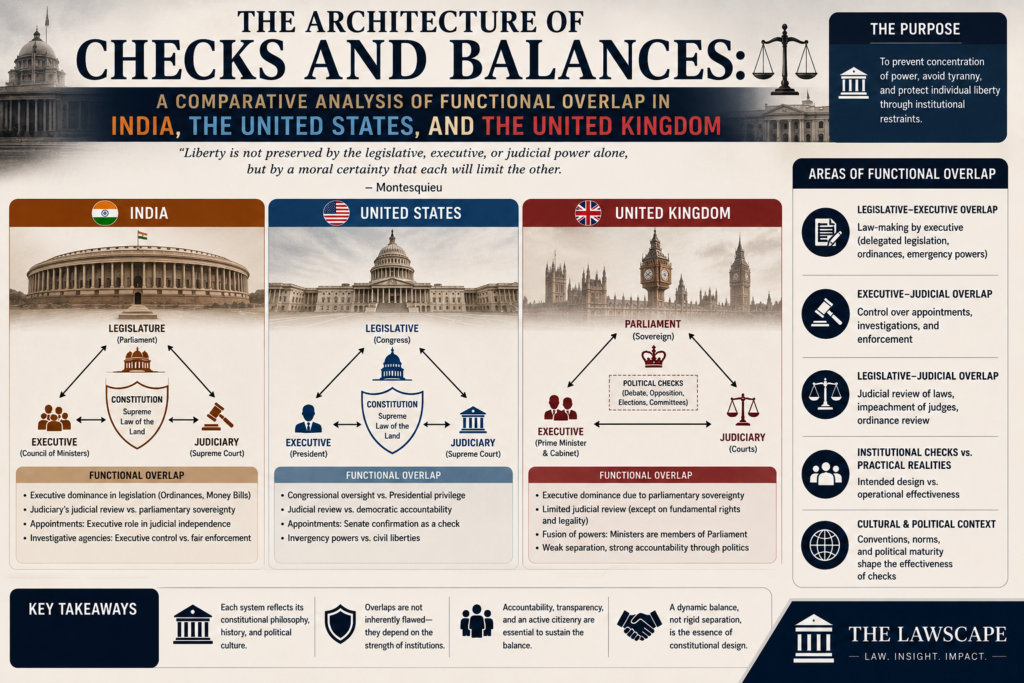
- Modern constitutional systems do not follow a rigid separation of powers; instead, they rely on carefully designed functional overlaps to ensure accountability and prevent concentration of power.
- The United States, the United Kingdom, and India each employ distinct constitutional mechanisms that combine institutional independence with interdependence.
- Functional overlap is not a constitutional defect but a structural feature that strengthens democratic governance through mutual oversight and checks on governmental authority.
Introduction
The doctrine of checks and balances is designed to ensure that different organs of government possess the ability both to check and to be checked by one another. Its primary objective is to prevent the concentration of power in a single authority and thereby safeguard democratic governance.
The intellectual foundations of the doctrine are commonly traced to the French philosopher Montesquieu, who, in The Spirit of Laws, argued that governmental power should be divided among the Legislature, the Executive, and the Judiciary. According to Montesquieu, liberty could only be preserved where these institutions functioned independently while simultaneously restraining one another.
However, modern constitutional systems have demonstrated that a rigid separation of powers is neither entirely practical nor desirable. Contemporary democracies increasingly rely on institutional overlap, shared responsibilities, and coordinated governance mechanisms to maintain constitutional equilibrium.
The constitutional systems of the United States, the United Kingdom, and India illustrate three distinct approaches to this balance. The United States operates through a presidential system characterized by separated institutions sharing powers. The United Kingdom follows a Westminster model in which executive and legislative functions are substantially fused. India adopts a hybrid parliamentary structure where the Executive and Legislature share powers while the Judiciary remains an independent constitutional guardian.
This article examines the doctrine of checks and balances through a comparative analysis of these three constitutional models and evaluates the significance of functional overlap in preserving democratic governance.
The Doctrine of Checks and Balances
Checks and balances constitute a constitutional mechanism designed to prevent excessive concentration of governmental authority.
Under this framework, each organ of government possesses the capacity to supervise, limit, or influence the actions of the others. The doctrine promotes:
- Accountability;
- Transparency;
- Institutional coordination;
- Prevention of abuse of power; and
- Protection of individual rights and liberties.
While the doctrine of separation of powers distributes governmental functions among distinct branches, checks and balances establish the mechanisms through which those branches remain accountable to one another.
The result is a system of mutual restraint rather than complete institutional isolation.
Modern Democratic Constitutionalism
Montesquieu’s classical formulation of separation of powers envisioned distinct governmental functions performed by independent institutions. The Legislature would enact laws, the Executive would implement them, and the Judiciary would interpret them.
Modern democratic constitutionalism, however, recognizes the limitations of absolute separation.
Governance in contemporary societies requires coordination, cooperation, and institutional interdependence. A complete division of governmental authority would often prove impractical and could impede effective administration.
Consequently, modern constitutional systems combine elements of separation with mechanisms of mutual accountability. Rather than eliminating interaction between institutions, they regulate and structure such interaction.
Functional overlap therefore emerges not as a departure from constitutionalism but as one of its defining features.
India: Hybrid Constitutionalism and Functional Overlap
India’s constitutional framework deliberately rejects a rigid separation of powers.
The Constitution, largely shaped under the leadership of Dr. B.R. Ambedkar, establishes a parliamentary system operating under the supremacy of the Constitution rather than parliamentary sovereignty.
In Ram Jawaya Kapur v. State of Punjab, the Supreme Court observed that the Constitution does not recognize the doctrine of separation of powers in its absolute rigidity but sufficiently differentiates the functions of the various branches of government.
The Executive-Legislative Nexus
Like the Westminster model, India’s Executive is drawn from the Legislature.
Article 75(3) provides that the Council of Ministers is collectively responsible to the Lok Sabha. Ministers are ordinarily required to be Members of Parliament, and a non-member appointed as a minister must secure membership within six months.
This arrangement creates an institutional overlap between executive and legislative functions.
India also grants the Executive an important legislative instrument through the ordinance-making power.
Under Article 123, when Parliament is not in session, the President may promulgate ordinances on the advice of the Council of Ministers. These ordinances possess the same force and effect as parliamentary legislation until they are considered by Parliament.
The ordinance mechanism demonstrates how executive authority may temporarily assume legislative functions in circumstances requiring immediate action.
The Expansive Role of the Judiciary
The Indian Judiciary exercises some of the most extensive constitutional powers among democratic systems.
The Basic Structure Doctrine
The Supreme Court’s decision in Kesavananda Bharati v. State of Kerala established that Parliament’s amending power under Article 368 is not unlimited.
The Court held that constitutional amendments cannot alter or destroy the Constitution’s basic structure. Subsequent decisions have identified judicial review and separation of powers as components of that basic structure.
This doctrine empowers the Judiciary not only to invalidate ordinary legislation but also to review constitutional amendments enacted by Parliament.
Public Interest Litigation
Through decisions such as Bandhua Mukti Morcha v. Union of India, the Supreme Court significantly expanded access to justice by relaxing traditional rules of locus standi.
Individuals may initiate proceedings on behalf of disadvantaged groups, allowing the Judiciary to address broader issues of public concern and constitutional rights.
Structural Injunctions and Continuing Mandamus
The Court has also developed innovative remedial techniques, including continuing mandamus, enabling ongoing judicial supervision of administrative action.
In matters involving environmental protection, governance failures, and public welfare programmes, courts have occasionally assumed a supervisory role extending beyond conventional adjudication.
These developments illustrate the extensive overlap between judicial and administrative functions within the Indian constitutional framework.
The United States: Formal Separation with Deliberate Overlap
The Constitution of the United States establishes a presidential system founded upon a formal separation of powers.
Article I vests legislative authority in Congress, Article II vests executive authority in the President, and Article III vests judicial authority in the federal courts.
Despite this formal separation, the Framers deliberately created mechanisms enabling each branch to influence the others.
James Madison argued in Federalist No. 48 that some degree of institutional interconnection was necessary to preserve separation itself. Accordingly, the American constitutional system incorporates extensive functional overlap.
Executive Participation in Legislation and Adjudication
Presidential Veto
Article I, Section 7 empowers the President to veto legislation passed by Congress.
This authority directly inserts the Executive into the legislative process and requires Congress to secure a two-thirds majority in both houses to override a veto.
Executive Orders and Administrative Agencies
The modern administrative state has further blurred institutional boundaries.
Administrative agencies within the Executive branch exercise:
- Quasi-legislative powers through rule-making;
- Quasi-judicial powers through adjudication; and
- Executive powers through enforcement.
These agencies therefore perform functions traditionally associated with multiple branches of government.
Legislative Checks on Executive and Judicial Power
Congress exercises several important checks on both the Executive and Judiciary.
Advice and Consent
Under Article II, Section 2, the Senate must approve presidential appointments to major executive offices, ambassadorships, and the federal judiciary.
This mechanism allows the Legislature to participate directly in the composition of the Executive and Judicial branches.
The Power of the Purse
Congress controls federal expenditure through its appropriations authority.
Because no funds may be drawn from the Treasury without legislative authorization, Congress retains substantial influence over executive programmes and judicial administration.
Impeachment
Congress possesses the authority to impeach and remove presidents, judges, and other federal officials for serious misconduct.
This provides an important mechanism for institutional accountability.
Judicial Review
Although the Judiciary lacks direct control over military or financial resources, it exercises considerable influence through judicial review.
In Marbury v. Madison, the Supreme Court asserted its authority to determine the constitutionality of legislative and executive actions.
Subsequent decisions such as Youngstown Sheet & Tube Co. v. Sawyer and United States v. Nixon demonstrated the Judiciary’s ability to restrain executive overreach and uphold constitutional limitations on governmental authority.
Judicial review remains one of the most significant checks within the American constitutional system.
The United Kingdom: From Fusion to Constitutional Evolution
The United Kingdom represents a fundamentally different constitutional model.
Unlike the United States, the British constitutional tradition historically emphasized fusion rather than separation of powers.
Walter Bagehot famously described the Cabinet as the “hyphen” connecting the executive and legislative branches of government. Under the doctrine of parliamentary sovereignty, Parliament possesses supreme legislative authority.
The Westminster model therefore operates through institutional integration rather than strict division.
Executive-Legislative Fusion
In the United Kingdom, the Executive is drawn directly from Parliament.
The Prime Minister and Cabinet ministers are members of either the House of Commons or the House of Lords.
Because the government is ordinarily formed by the majority party in the House of Commons, the Executive typically exercises substantial influence over the legislative agenda.
However, this influence is balanced by the principle of parliamentary confidence.
A government that loses the confidence of the House of Commons cannot continue in office, making parliamentary accountability a central feature of the British constitutional system.
Historical and Modern Judicial Structures
Historically, the British Judiciary was deeply integrated with the Legislature.
The Appellate Committee of the House of Lords functioned as the highest court of appeal, while the Lord Chancellor simultaneously performed legislative, executive, and judicial functions.
This institutional overlap was substantially reformed by the Constitutional Reform Act 2005.
The Act established the Supreme Court of the United Kingdom and removed judicial functions from the House of Lords. It also redefined the role of the Lord Chancellor, strengthening the separation between judicial and political institutions.
Judicial Oversight in a System of Parliamentary Sovereignty
Unlike courts in India and the United States, British courts cannot invalidate primary legislation enacted by Parliament.
Nevertheless, judicial influence has expanded through statutory interpretation and constitutional principles.
Human Rights Act 1998
Under Section 4 of the Human Rights Act 1998, courts may issue a Declaration of Incompatibility where legislation conflicts with the European Convention on Human Rights.
Although such declarations do not invalidate legislation, they exert significant political pressure on Parliament to enact reforms.
The Miller Cases
The decisions in R (Miller) v. Secretary of State for Exiting the European Union and R (Miller) v. Prime Minister illustrate the modern role of judicial oversight.
In Miller II, the Supreme Court held that the Prime Minister’s advice to prorogue Parliament was unlawful because it frustrated Parliament’s constitutional functions.
The decision demonstrated that even within a system of parliamentary sovereignty, courts remain capable of enforcing constitutional boundaries and protecting democratic accountability.
Structural Strengths and Vulnerabilities
Each constitutional model presents unique advantages and challenges.
The United States: Institutional Gridlock
The American system is vulnerable to institutional deadlock when different political parties control the Executive and Legislature.
Such divisions may impede governance and encourage reliance upon executive action or judicial intervention.
The United Kingdom: Executive Dominance
Because governments generally control parliamentary majorities, there is a risk that executive authority may dominate legislative processes.
In such circumstances, judicial oversight becomes increasingly important as a constitutional safeguard.
India: Judicial Overreach
India’s constitutional structure occasionally generates concerns regarding judicial activism and judicial overreach.
The Judiciary’s willingness to intervene in policy matters has strengthened the protection of fundamental rights but has also raised questions regarding democratic legitimacy and institutional boundaries.
These challenges demonstrate that functional overlap, while beneficial, requires careful constitutional management.
Conclusion
The architecture of checks and balances demonstrates that constitutional governance cannot be sustained through rigid institutional separation alone.
The United States maintains a formal separation of powers while incorporating extensive mechanisms of functional overlap. The United Kingdom continues to operate through executive-legislative fusion while gradually strengthening judicial independence. India adopts a hybrid constitutional model in which parliamentary government coexists with a powerful constitutional judiciary.
Despite their differences, all three systems recognize that governance requires interaction among institutions. Functional overlap is therefore not a constitutional defect but an essential feature of democratic government.
The true objective of constitutional design is not to isolate governmental institutions from one another but to ensure that power remains divided, accountable, and subject to legal constraints. Through carefully structured checks and balances, each system seeks to prevent tyranny, preserve democratic accountability, and uphold the rule of law.
Ultimately, the comparative experience of India, the United States, and the United Kingdom demonstrates that constitutional stability depends not upon absolute separation but upon a dynamic balance between institutional independence and interdependence.
Disclaimer: The views expressed in this article are those of the author and do not necessarily reflect the views of The Lawscape.
The Lawscape — clear, practical legal insight for students and future lawyers.