
Navtej Singh Johar v. Union of India: Decriminalisation, Constitutional Morality, and the Reclaiming of Dignity
Author: Hitesh Bhootra
Student, Aishwarya College of Education (Law)
——————————————————————————————
💡 3 Quick Takeaways
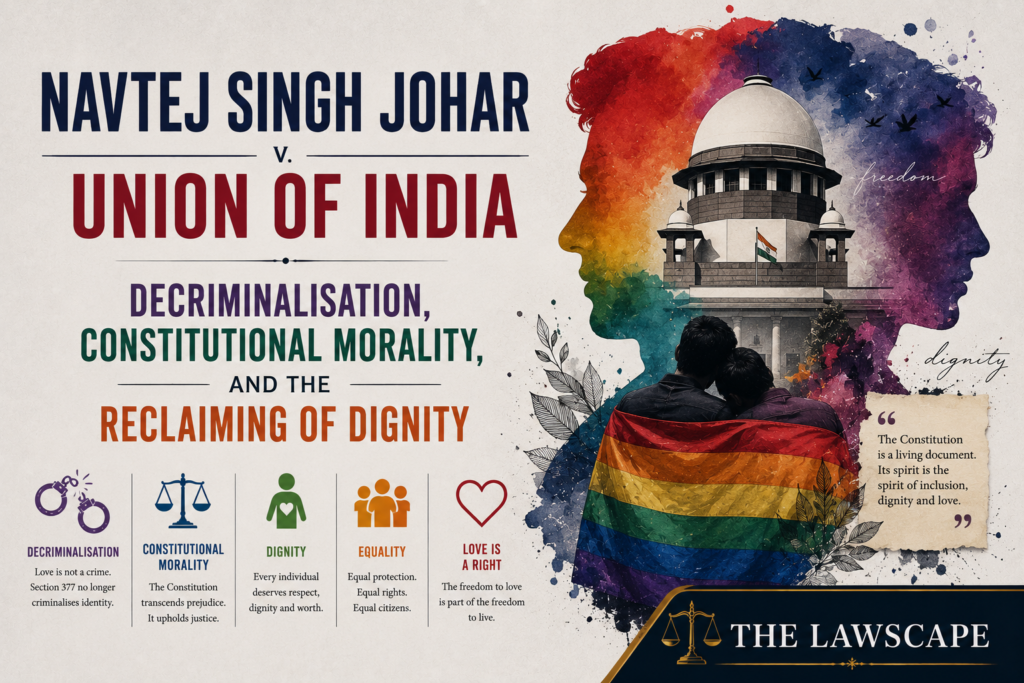
1. Navtej Singh Johar v. Union of India partially struck down Section 377 of the Indian Penal Code to decriminalise consensual same-sex relations between adults.
2. The Supreme Court held that criminalising private consensual intimacy violates dignity, privacy, equality, and personal liberty under the Constitution.
3. The judgment rejected majoritarian morality as a basis for limiting fundamental rights and placed constitutional morality at the centre of LGBTQ+ rights jurisprudence in India.
Introduction
Navtej Singh Johar v. Union of India is one of the most important constitutional landmark judgments in recent Indian legal history. In this case, the Supreme Court upheld Section 377 of the Indian Penal Code, 1860, but only to the extent that it continued to apply to non-consensual acts, acts involving minors, and bestiality. In doing so, the Court held that the Constitution cannot permit the criminalisation of sexual orientation or intimate personal choice by using the criminal law to punish consenting adults for who they are.
At its core, the case concerned whether the State could continue to punish consenting adults for private conduct merely because society considered that conduct unacceptable. The Court answered this in the negative and held that such criminalisation collides with dignity, privacy, equality, and personal liberty.
Background
Section 377 was a colonial-era provision that criminalised “carnal intercourse against the order of nature.” Over time, it became more than just a penal provision; it came to symbolise stigma, fear, and discrimination against LGBTQ+ persons across India. The first major constitutional challenge to it emerged in Naz Foundation v. Government of NCT of Delhi, where the Delhi High Court read down Section 377 and held that it could not be used to criminalise consensual same-sex relations between adults.
However, this progress was reversed in Suresh Kumar Koushal v. Naz Foundation, where the Supreme Court upheld the provision and observed that the affected class constituted a “minuscule minority.” That line of reasoning was heavily criticised because it appeared to make the protection of fundamental rights dependent on numbers rather than principle. The constitutional position shifted again with K.S. Puttaswamy v. Union of India, where privacy was recognised as a fundamental right and sexual orientation was acknowledged as a core aspect of identity, dignity, and personal autonomy.
Navtej Singh Johar must therefore be understood as the culmination of this evolving constitutional journey. It did not emerge in isolation; rather, it built upon earlier rights-based developments and corrected the course of the law by placing dignity and autonomy at the centre of constitutional interpretation.
Analysis
The judgment deserves strong approval because it finally brought Indian constitutional law in line with the basic principle that criminal law should not police consensual intimacy between adults. Section 377, insofar as it applied to such conduct, had no rational constitutional justification. It created fear, stigma, and vulnerability for LGBTQ+ persons and, in doing so, struck at the heart of dignity under Article 21.
What makes the decision especially significant is that the Court did not treat homosexuality as a “special” or “exceptional” matter requiring mere social tolerance. Instead, it recognised that LGBTQ+ persons possess the same constitutional rights as everyone else. That shift is deeply important because it moves the law away from a model of conditional acceptance and towards one of equal citizenship.
The Court also gave real force to the idea of constitutional morality, which is one of the judgment’s most powerful contributions. By holding that constitutional values must prevail over popular morality, the Court affirmed that the Constitution exists precisely to protect individuals and minorities from majoritarian prejudice. In a country where social morality has often been used to justify exclusion, this principle carries enormous significance.
Another strength of the judgment is that it directly corrects the weakness of Koushal. The earlier case had reduced the issue to the number of people affected and failed to appreciate that even a small group is fully entitled to fundamental rights protection. Navtej decisively rejects that logic and makes clear that rights do not become less valuable because fewer people claim them.
The reasoning is also impressive because the Court did not rely on only one constitutional provision. Rather, it wove together Articles 14, 15, 19, and 21 into a broader constitutional framework grounded in dignity, privacy, autonomy, and equality. As a result, the judgment is more durable than a narrow reading-down exercise. It also recognised that the harm caused by Section 377 was not merely legal, but social, psychological, and symbolic.
At the same time, the judgment is not without limits. The Court consciously confined itself to the question of decriminalisation and did not decide broader issues such as marriage, adoption, inheritance, or a comprehensive anti-discrimination framework for LGBTQ+ persons. This makes the ruling historic, but not complete. In practical terms, it removed the shadow of criminality, but it did not by itself create full civil equality.
That limitation should not necessarily be viewed as a flaw in a narrow sense, but it does reveal the gradual nature of constitutional change. The Court opened the path, yet many questions remain for future judicial determination and legislative reform. In that sense, Navtej is both an endpoint and a beginning.
Conclusion
Navtej Singh Johar v. Union of India is a transformative judgment because it restores constitutional dignity to a community that had long been pushed to the margins. It is correct in its result, largely sound in its reasoning, and remarkable in the clarity with which it rejects stigma, colonial morality, and majoritarian control over matters that are deeply personal.
Its most lasting contribution is that it recognises LGBTQ+ persons as full constitutional citizens, not as exceptions or permanent outsiders. While the case did not settle every issue connected to queer rights, it laid a strong constitutional foundation for later advances in equality and personal liberty. For that reason, Navtej remains one of the defining judgments in India’s modern constitutional landscape.
Disclaimer: The views expressed in this article are those of the author and do not necessarily reflect the views of The Lawscape.
The Lawscape — clear, practical legal insight for students and future lawyers.