
X v. Principal Secretary, Health and Family Welfare Department: Reproductive Autonomy, Equality, and Abortion Rights Beyond Marriage
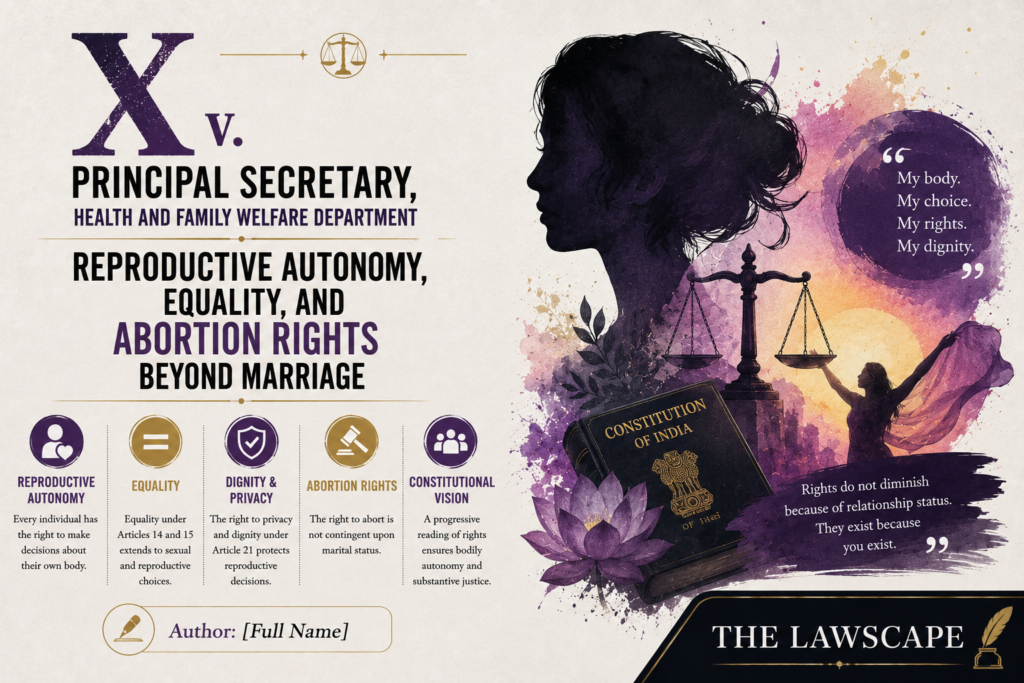
Author: Kartik m Khanaganni
Student, R.L.Law College, Belagavi
———————————————————————————-
💡 3 Quick Takeaways
1. X v. Principal Secretary, Health and Family Welfare Department affirmed that unmarried women are entitled to seek termination of pregnancy under the Medical Termination of Pregnancy framework on the same basis as married women.
2. The Supreme Court held that reproductive choice, bodily autonomy, dignity, and decisional privacy form part of Article 21 and cannot be denied on the basis of marital status.
3. The judgment marked a major step in Indian reproductive rights jurisprudence by rejecting status-based discrimination and privileging constitutional morality over social morality.
Introduction
X v. Principal Secretary, Health and Family Welfare Department is one of the most significant decisions in recent Indian constitutional and reproductive rights jurisprudence. Through this judgment, the Supreme Court recognised that unmarried women are entitled to access abortion services on the same basis as married women under the Medical Termination of Pregnancy Act, 1971 and the Medical Termination of Pregnancy Rules, 2003.
Before this decision, uncertainty existed regarding whether an unmarried woman could seek termination of pregnancy between twenty and twenty-four weeks under the categories provided in Rule 3B of the MTP Rules. The Supreme Court clarified that the law cannot be interpreted in a manner that excludes unmarried women from benefits available to married women. Such an interpretation would defeat the purpose of the amended MTP framework and would also violate constitutional principles of equality, dignity, privacy, and personal liberty.
The case therefore goes beyond the issue of abortion. It addresses a broader constitutional question: whether a woman’s rights can depend upon her marital status. The Court answered this question in the negative and emphasised that constitutional rights belong equally to all women, irrespective of whether they are married or unmarried. In doing so, the judgment marked an important step towards recognising women as autonomous individuals capable of making decisions concerning their own bodies and lives.
Facts of the Case
The petitioner was a twenty-five-year-old unmarried woman who became pregnant as a result of a consensual relationship. During the course of her pregnancy, her relationship with her partner ended. As a result, she decided that she did not wish to continue with the pregnancy.
By the time she approached the courts, she was approximately twenty-two weeks pregnant. Under the Medical Termination of Pregnancy Act, termination of pregnancy after twenty weeks is permitted only under specific circumstances and categories provided by law. The petitioner argued that continuation of the pregnancy would cause grave injury to her mental health and therefore sought permission for termination.
The petitioner first approached the Delhi High Court. However, the High Court rejected her request. It adopted a narrow interpretation of Rule 3B and held that the category referring to a “change of marital status” applied only to women who became widows or divorcees during pregnancy. Since the petitioner had never been married, the Court held that she did not fall within the scope of the provision.
Aggrieved by this decision, the petitioner approached the Supreme Court of India. Considering the urgency of the matter, the Supreme Court initially granted interim relief by directing that she be medically examined and subsequently delivered a detailed judgment on the broader legal and constitutional issues involved.
Issues Raised
The Supreme Court was required to answer several important legal questions:
- Whether an unmarried woman is entitled to seek termination of pregnancy up to twenty-four weeks under Section 3(2)(b) of the Medical Termination of Pregnancy Act, 1971 read with Rule 3B of the Medical Termination of Pregnancy Rules, 2003.
- Whether restricting the benefit of Rule 3B only to married women amounts to discrimination and violates Article 14 of the Constitution of India.
- Whether reproductive choice, bodily autonomy, decisional privacy, and the right not to procreate form part of the right to life and personal liberty guaranteed under Article 21 of the Constitution.
- Whether the amended MTP framework should be interpreted broadly to include pregnancies arising from relationships outside marriage.
- Whether constitutional values such as dignity, equality, and privacy should guide the interpretation of reproductive rights legislation.
Analysis
The Supreme Court’s judgment is widely regarded as progressive because it combines statutory interpretation with constitutional principles. Rather than reading the MTP Rules in isolation, the Court examined the overall purpose of the MTP Act and the amendments introduced in 2021.
A. Purposive Interpretation of the MTP Act
One of the most significant aspects of the judgment is the Court’s purposive approach to interpretation. The Court noted that Parliament had consciously amended the language of the MTP Act. Earlier provisions referred to a “married woman and her husband.” However, the amended law uses the broader expression “any woman and her partner.”
This change reflected Parliament’s intention to recognise that pregnancies may occur in a variety of relationships and not only within marriage. The Court observed that social realities have evolved and that many women become pregnant outside formal marriage. Excluding such women from the protection of the law would undermine the very objective of the amendment.
Accordingly, the Court concluded that Rule 3B should not be interpreted narrowly. Instead, it should be interpreted in a manner that advances the purpose of the legislation and provides protection to all women facing similar circumstances.
B. Equality Under Article 14
One of the strongest aspects of the judgment is its commitment to the constitutional principle of equality. The Court emphasised that there is no rational basis for granting abortion rights to married women while denying them to unmarried women who face the same difficulties. The consequences of an unwanted pregnancy do not differ merely because one woman is married and another is not.
According to the Court, a classification based solely on marital status is arbitrary and unreasonable. It reflects outdated social assumptions rather than legitimate legal objectives. The Constitution does not permit the State to deny rights simply because an individual does not conform to traditional social norms.
Therefore, denying reproductive healthcare to unmarried women would amount to unconstitutional discrimination and violate Article 14. This aspect of the judgment is particularly important because it moves Indian constitutional law away from status-based discrimination and toward a more substantive understanding of equality.
C. Reproductive Autonomy and Article 21
Another major contribution of the judgment lies in its interpretation of Article 21. The Court held that reproductive choice is an integral part of personal liberty. Decisions regarding pregnancy directly affect a woman’s body, mental health, future opportunities, relationships, and overall well-being. Therefore, reproductive decisions fall within the sphere of privacy and bodily autonomy protected under Article 21.
The Court explained that reproductive autonomy includes both the right to have children and the right not to have children. Women must therefore have the freedom to decide whether to continue or terminate a pregnancy without unnecessary interference from the State.
By recognising reproductive choice as part of dignity, privacy, and bodily integrity, the Court strengthened the constitutional foundation of reproductive rights in India.
D. Recognition of Women’s Dignity
The judgment also places considerable emphasis on dignity. The Court acknowledged that forcing a woman to continue an unwanted pregnancy can have serious physical, emotional, psychological, and social consequences. Such a decision affects not only her body but also her education, employment opportunities, personal relationships, and future life choices.
The Court therefore held that respect for human dignity requires recognising a woman’s capacity to make decisions concerning her own body. Importantly, it rejected the idea that reproductive rights should depend upon social approval of a woman’s personal relationships. Constitutional protections cannot be limited only to those whose lives conform to traditional expectations regarding marriage and family.
E. Constitutional Morality Over Social Morality
A particularly noteworthy feature of the judgment is its preference for constitutional morality over social morality. Historically, reproductive rights have often been influenced by social attitudes that regard marriage as the only legitimate setting for pregnancy and childbearing. The Court recognised that such assumptions cannot determine the scope of constitutional rights.
The Constitution protects individuals irrespective of prevailing social prejudices. Therefore, access to reproductive healthcare cannot be restricted merely because a woman’s pregnancy arises outside marriage. Through this reasoning, the Court reaffirmed that constitutional values must prevail over conservative social norms whenever the two come into conflict.
F. Criticism of the Judgment
Although the judgment is widely celebrated, it is not free from criticism. First, the decision continues to operate within the framework of the MTP Act, which remains largely medicalised. Women seeking abortion after certain stages of pregnancy still depend on medical opinions and statutory requirements. Consequently, reproductive choice is not entirely based on individual autonomy but continues to be mediated by doctors, medical boards, and institutional procedures.
Second, the practical implementation of the judgment may present challenges. Hospitals and medical authorities may continue to create delays, especially in cases involving pregnancies close to the statutory limit. Since abortion is often a time-sensitive matter, procedural delays can significantly affect a woman’s ability to exercise her rights.
Third, social stigma surrounding unmarried pregnancies remains prevalent in many parts of India. While the judgment removes legal barriers, it cannot by itself eliminate social attitudes that discourage women from seeking reproductive healthcare.
Nevertheless, these criticisms relate more to the broader framework of abortion law than to the reasoning adopted by the Court in this particular case.
G. Significance of the Judgment
The importance of this case extends far beyond the immediate dispute before the Court. The judgment:
- establishes that unmarried women have equal reproductive rights under the MTP Act;
- strengthens the constitutional principles of equality, dignity, privacy, and personal liberty;
- recognises reproductive autonomy as an essential component of bodily integrity;
- rejects discrimination based on marital status;
- encourages courts to interpret welfare legislation in a manner consistent with constitutional values; and
- contributes significantly to the development of gender justice and women’s rights jurisprudence in India.
The case is therefore regarded as a landmark decision in both constitutional law and reproductive rights law.
Conclusion
X v. Principal Secretary, Health and Family Welfare Department represents a major advancement in the protection of reproductive rights in India. The Supreme Court recognised that a woman’s entitlement to reproductive healthcare cannot depend upon whether she is married. By extending the benefits of the MTP Act to unmarried women, the Court ensured that constitutional guarantees of equality and personal liberty are applied in a meaningful and inclusive manner.
The judgment affirms that reproductive choice is an essential aspect of dignity, privacy, and autonomy. It recognises women as independent rights-bearing individuals capable of making decisions regarding their own bodies and futures. At the same time, the Court acknowledged the realities of modern society, where pregnancies may occur outside traditional marital relationships.
Although practical challenges relating to abortion access continue to exist, the judgment removes an important legal barrier and sets a strong precedent for future cases involving reproductive autonomy, healthcare discrimination, and gender equality. For these reasons, the decision remains one of the most significant developments in contemporary Indian constitutional jurisprudence and serves as a powerful affirmation of women’s rights and individual freedom.
Disclaimer: The views expressed in this article are those of the author and do not necessarily reflect the views of The Lawscape.
The Lawscape — clear, practical legal insight for students and future lawyers.