
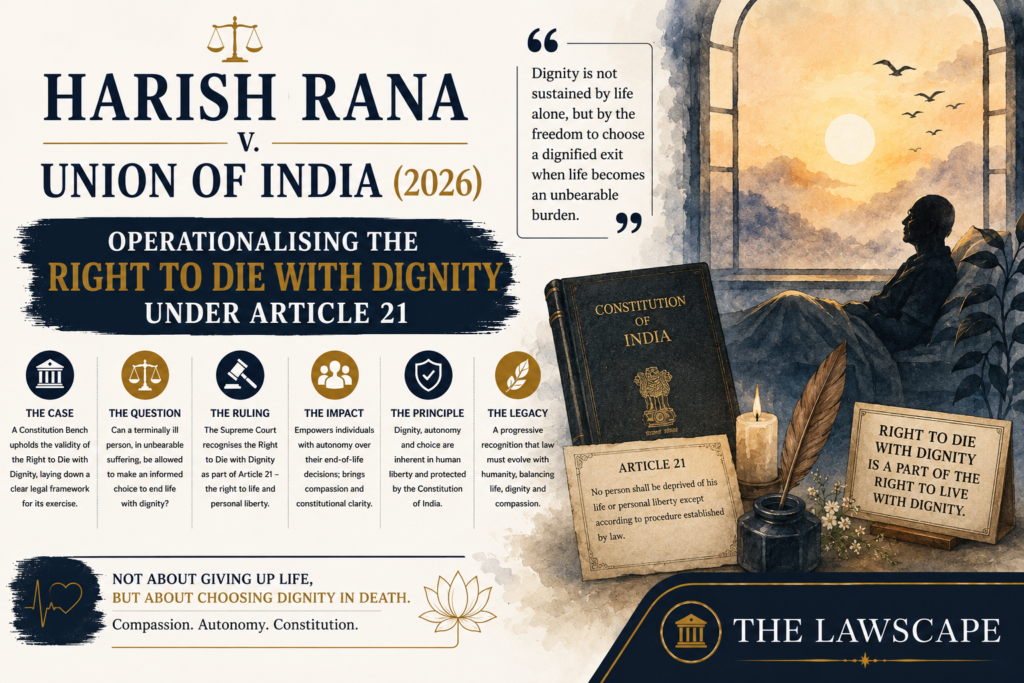
Harish Rana v. Union of India (2026): Operationalising the Right to Die with Dignity under Article 21
.Author: Hiba Iliyas
Student, UNiversity of Lucknow, Lucknow
——————————————————————
💡 3 Quick Takeaways
1. The Supreme Court recognised Clinically Assisted Nutrition and Hydration (CANH) as withdrawable medical treatment rather than basic care.
2. The judgment transformed the constitutional right to die with dignity into a practical and enforceable right for patients in irreversible vegetative states.
3. The Court strengthened India’s passive euthanasia jurisprudence by extending constitutional safeguards to long-term home-care patients.
Introduction
The Constitution of India guarantees every individual the right to live with dignity under Article 21. Since the earliest interpretations of Article 21, the Supreme Court has consistently expanded its scope to include various facets of human dignity and personal liberty.
A particularly difficult constitutional question arises where a person can be kept biologically alive through artificial medical support but has permanently lost consciousness and can no longer communicate personal wishes. In such circumstances, the continued administration of life-sustaining treatment raises important legal and ethical questions regarding dignity, autonomy, and the constitutional meaning of life itself.
The Supreme Court addressed these concerns in Harish Rana v. Union of India (2026), significantly advancing India’s end-of-life jurisprudence. Building upon the constitutional principles recognised in Common Cause v. Union of India, the Court, for the first time, permitted the withdrawal of Clinically Assisted Nutrition and Hydration (CANH) from a patient in a Persistent Vegetative State (PVS). The decision transformed the previously recognised constitutional right to die with dignity into a practical and enforceable constitutional guarantee.
Statement of Facts
Harish Rana, a student of Panjab University, suffered a catastrophic fall from the fourth floor of his accommodation in 2013. The accident resulted in a severe head injury causing Diffuse Axonal Injury, leaving him in a Permanent Vegetative State (PVS) accompanied by quadriplegia and 100% permanent physical disability. By the time the matter reached final adjudication in 2026, Mr. Rana had remained entirely dependent upon artificial nutrition and hydration administered through a Percutaneous Endoscopic Gastrostomy (PEG) tube for nearly thirteen years.
In 2024, Mr. Rana’s parents approached the Delhi High Court seeking permission to withdraw CANH. They argued that the treatment merely prolonged his irreversible vegetative condition without providing any therapeutic benefit. The High Court rejected the request, holding that since Mr. Rana was not dependent upon artificial ventilation, withdrawal of the feeding tube would amount to starvation rather than passive euthanasia.
Aggrieved by this decision, the family approached the Supreme Court under Article 21 of the Constitution.
The Supreme Court allowed the petition and clarified that Clinically Assisted Nutrition and Hydration constitutes medical treatment rather than ordinary care. Where such treatment merely prolongs biological existence without any realistic possibility of recovery, its withdrawal is legally permissible under the constitutional framework established in Common Cause. The Court consequently directed the withdrawal of CANH while ensuring appropriate palliative and end-of-life care.
Background
To appreciate the significance of Harish Rana, it is necessary to understand the evolution of passive euthanasia jurisprudence in India.
In Gian Kaur v. State of Punjab, the Supreme Court held that Article 21 does not include a general right to die. Nevertheless, it recognised that the right to life includes the right to die with dignity in the context of terminal illness.
Subsequently, Aruna Ramachandra Shanbaug v. Union of India recognised passive euthanasia under limited judicial supervision, requiring approval from the High Court before withdrawal of life support.
The constitutional position evolved further in Common Cause v. Union of India (2018), where the Supreme Court declared the right to die with dignity to be a fundamental right under Article 21 and recognised Advance Medical Directives (Living Wills). The Court simultaneously prescribed detailed safeguards governing passive euthanasia.
However, the procedural framework established in Common Cause proved difficult to implement in practice. Accordingly, the Supreme Court modified the procedural requirements through its 2023 order in the same case, simplifying the approval process for passive euthanasia.
Despite these developments, uncertainty persisted regarding whether CANH constituted ordinary care or medical treatment and whether patients receiving long-term home care could effectively exercise the constitutional right recognised under Article 21. These unresolved questions formed the backdrop against which Harish Rana was decided.
Issues Raised Before the Supreme Court
The Court considered the following constitutional and legal questions:
- Whether Clinically Assisted Nutrition and Hydration (CANH) administered through a PEG tube constitutes withdrawable medical treatment or non-withdrawable basic care.
- Whether passive euthanasia applies only to mechanically ventilated patients or also extends to artificial feeding and other life-sustaining interventions.
- How the “Best Interests” and “Substituted Judgment” principles should operate where a permanently unconscious patient has not executed a Living Will.
- What procedural safeguards are necessary to ensure that long-term home-care patients can effectively exercise their constitutional rights.
Analysis
1. Classification of CANH as Medical Treatment
The Supreme Court clarified that CANH administered through a PEG tube constitutes medical treatment rather than ordinary food or water. The Court observed that PEG feeding involves surgical intervention, continuous medical supervision, specialised nutritional formulations, and ongoing clinical assessment. Consequently, it cannot be equated with ordinary caregiving.
This finding resolved an important ambiguity within India’s passive euthanasia jurisprudence. The Delhi High Court had earlier treated withdrawal of CANH as starvation. The Supreme Court distinguished the withdrawal of medically futile treatment from intentionally causing death and held that treatment serving no therapeutic purpose may lawfully be discontinued.
2. Scope of Life-Sustaining Interventions
The Court rejected the narrow proposition that passive euthanasia applies only to patients dependent upon mechanical ventilation.
Instead, it held that the principles established in Common Cause apply equally to all forms of life-sustaining medical treatment, including artificial tube feeding. The decisive consideration is whether the treatment merely prolongs biological existence without any realistic possibility of recovery.
By adopting this approach, the Court expanded constitutional protection under Article 21 beyond ventilator-dependent patients to all permanently unconscious individuals sustained through medical intervention.
3. Application of “Best Interests” and “Substituted Judgment”
The Court refined the “Best Interests” standard by emphasising that judicial determination must extend beyond biological survival alone. Courts must evaluate medical futility, human dignity, invasiveness of treatment, and the patient’s likely wishes and personal values.
The judgment also applied the doctrine of substituted judgment by allowing close family members to provide evidence regarding the patient’s preferences before incapacity. At the same time, the Court ensured that such subjective assessments remained supported by objective medical evidence through independent evaluations conducted by Primary and Secondary Medical Boards.
4. Procedural Relief for Home-Care Patients
Recognising that previous passive euthanasia guidelines primarily addressed hospitalised patients, the Court acknowledged the practical challenges faced by families caring for permanently unconscious patients at home.
To address these concerns, the Court directed that family members may approach hospitals for appointment of treating physicians and initiation of the medical board process. It further instructed High Courts to expedite proceedings involving Judicial Magistrates to minimise procedural delays.
The Court also criticised the practice of hospitals relying upon “Discharge Against Medical Advice” (DAMA) to avoid legal responsibility. It reaffirmed that withdrawal of treatment must occur only through a legally supervised process accompanied by appropriate palliative and end-of-life care.
These procedural directions transformed passive euthanasia from a theoretical constitutional guarantee into an accessible legal remedy.
Critical Evaluation
The reasoning adopted by the Supreme Court effectively resolves several longstanding uncertainties surrounding India’s passive euthanasia framework. The judgment clarifies the legal status of CANH, extends constitutional protection beyond ventilator-dependent patients, strengthens application of the “Best Interests” standard, and addresses procedural barriers confronting home-care patients.
Nevertheless, the decision also highlights the continuing absence of comprehensive legislative regulation governing end-of-life decision-making in India. While judicial intervention has substantially developed this area of law, statutory enactment remains necessary to ensure certainty, consistency, and uniform implementation.
Accordingly, Harish Rana serves not only as an important constitutional precedent but also as a reminder of the urgent need for legislative reform.
Conclusion
Harish Rana v. Union of India (2026) represents a historic development in India’s constitutional and medical jurisprudence. By recognising CANH as medical treatment capable of lawful withdrawal, the Supreme Court removed one of the most significant uncertainties within passive euthanasia law.
The judgment expanded constitutional protection beyond terminally ill patients dependent upon ventilators and clarified the proper application of the “Best Interests” and “Substituted Judgment” principles where patients are permanently incapacitated.
Equally significant are the Court’s procedural safeguards for home-care patients, which ensure that constitutional rights remain practically accessible rather than merely theoretical. These directions reaffirm that dignity, compassion, and individual autonomy remain central to the interpretation of Article 21.
At the same time, the judgment exposes the continuing legislative vacuum governing end-of-life care in India. Although judicial precedents have significantly advanced the law, comprehensive legislation remains necessary to provide certainty, consistency, and humane implementation of the constitutional right to die with dignity.
Disclaimer: The views expressed in this article are those of the author and do not necessarily reflect the views of The Lawscape.
The Lawscape — clear, practical legal insight for students and future lawyers.