
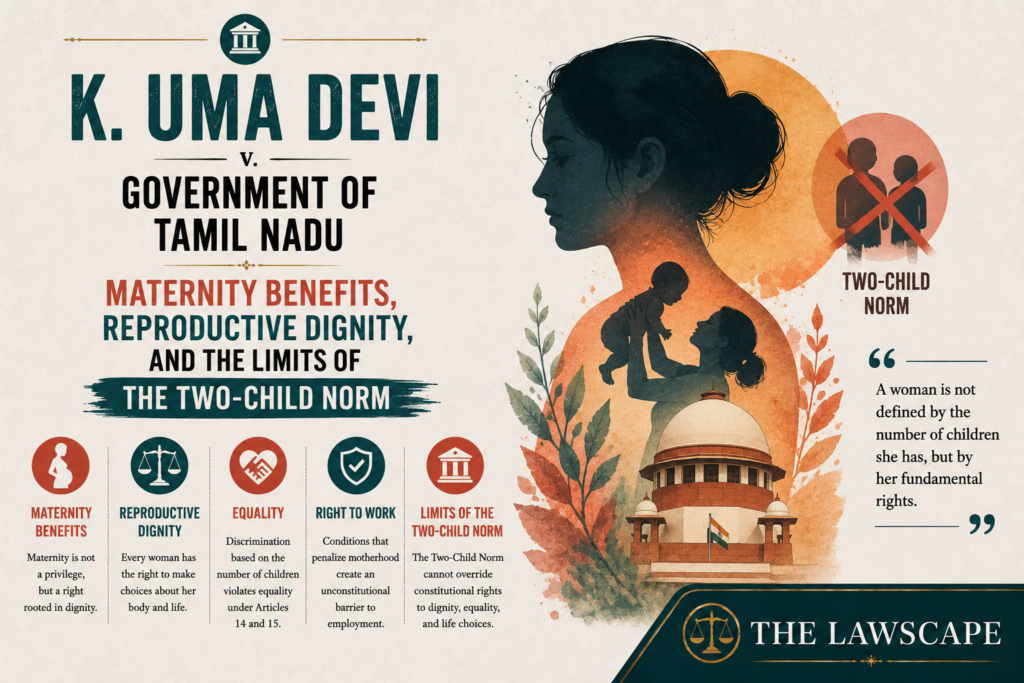
K. Uma Devi v. Government of Tamil Nadu: Maternity Benefits, Reproductive Dignity, and the Limits of the Two-Child Norm
Author: SUNKARI VAISHNAVI
Student, PG COLLEGE OF LAW HYDERABAD
——————————————————————————————–
💡 3 Quick Takeaways
1. K. Uma Devi v. Government of Tamil Nadu reaffirmed that maternity benefits are not a mere statutory concession but are closely tied to women’s dignity, reproductive autonomy, and constitutional protections under Articles 14 and 21.
2. The Supreme Court rejected a rigid application of the two-child norm where such an interpretation would defeat the purpose of maternity relief and ignore the realities of divorce, remarriage, and child custody.
3. The judgment highlights that population-control policies and service rules cannot be applied in a manner that overrides constitutional guarantees or defeats the welfare objective of maternity protection.
Introduction
In India, employment law, social welfare policy, and constitutional guarantees often intersect in ways that expose tension between administrative rules and human dignity. K. Uma Devi v. Government of Tamil Nadu is a significant judgment in this landscape because it addresses whether maternity benefits can be denied to a woman government employee merely because she had two children from a previous marriage, even though those children were in the custody of her former husband after divorce.
The case raised an important question concerning the validity of denying maternity benefits for a child born out of a subsequent marriage on the ground that the woman had already crossed the statutory limit of “two surviving children” under the applicable State rules. The appellant challenged this rigid application of the rule as being contrary to the constitutional guarantees of equality under Article 14 and dignity and personal liberty under Article 21.
The Supreme Court’s ruling is important because it elevates maternity relief beyond a narrow administrative concession and places it within the broader framework of reproductive dignity, constitutional equality, and social welfare. The judgment reflects an attempt to dismantle a mechanical and inflexible application of service rules in matters directly affecting women’s health, work, and motherhood.
Facts of the Case
The petitioner was married to Suresh in 2006, and from this marriage two children were born, the first in 2007 and the second in 2011. In December 2012, she was appointed as an English teacher in a Government Higher Secondary School in Gollapatti, Dharmapuri District. Subsequently, differences arose between the spouses, and they were legally separated in 2017. It was stated that the two children born from the first marriage were in the custody of the petitioner’s former husband.
In September 2018, the petitioner married Rajkumar. Upon conceiving in the second marriage, she applied for maternity leave for the period 2021–2022 for approximately nine months to cover pre-natal and post-natal care.
The Government of Tamil Nadu rejected her application on the basis of the applicable service rules, contending that maternity leave was available only to women government employees having fewer than two surviving children. Since the petitioner already had two children from her earlier marriage, the authorities held that she was not entitled to maternity leave for a third child, despite the fact that this was her first pregnancy after remarriage and despite the custody arrangement concerning the earlier children.
Aggrieved by this decision, the appellant filed a writ petition before the Madras High Court. A learned Single Judge held that she was entitled to maternity benefits and that the rejection of her application was illegal. However, in an intra-court appeal, the Division Bench of the High Court overturned that decision and held that since the appellant already had two surviving children, she was not entitled to claim maternity benefits under the applicable rules. The matter was then carried to the Supreme Court.
Issues Raised
The case raised the following legal questions:
- Whether denial of maternity leave on the basis of the two-child norm violates the constitutional rights to equality under Article 14 and personal liberty under Article 21.
- Whether service rules, particularly Fundamental Rule 101(a), which bar maternity leave to women with two or more children, can override the statutory protection available under the Maternity Benefit Act, 1961.
- Whether the State’s population-control policy can justify the denial of maternity benefits in a case involving remarriage and prior children not in the custody of the employee.
Arguments of the Parties
Appellant’s Arguments
The appellant argued that the Maternity Benefit Act, 1961 does not impose an absolute bar on maternity benefits merely because a woman has had more than two pregnancies. Rather, it only adjusts the duration of leave in certain cases and does not completely extinguish the right to claim maternity relief.
It was further contended that maternity leave is not merely a statutory concession or an administrative exception. Instead, it is a vital aspect of a woman’s reproductive rights, bodily autonomy, and dignity. The appellant submitted that forcing a woman to choose between her livelihood and her right to childbearing would violate her right to live with dignity and privacy under Article 21 of the Constitution.
The appellant also argued that the two-child norm created an unreasonable classification and thereby violated Article 14. It was submitted that the rigid application of the rule discriminated against women and ignored relevant social realities, including divorce, remarriage, and custody arrangements.
Reliance was also placed on Article 42 of the Constitution, which obligates the State to make provision for just and humane conditions of work and maternity relief. According to the appellant, State regulations must promote, rather than frustrate, this constitutional objective.
On statutory interpretation, the appellant challenged the narrow reading of Fundamental Rule 101(a) and contended that the expression “surviving children” must be understood contextually. Since the children from the first marriage were in the custody of the former husband, denying maternity leave for the first child from the subsequent marriage would be contrary to the welfare purpose of maternity legislation.
Respondents’ Arguments
The State argued that Fundamental Rule 101(a) was mandatory and applicable to all women government employees. Under this rule, maternity leave could be granted only to women with fewer than two surviving children. Since the appellant already had two children, she did not qualify.
The State also contended that the Maternity Benefit Act, 1961 did not govern State government employees, who were instead regulated by the State’s own service rules. It relied on the two-child norm as part of a broader population-control policy and argued that granting maternity leave in such circumstances would undermine the State’s efforts to promote small family norms.
Additionally, the State submitted that extending maternity benefits to women government employees with more than two children would impose a financial burden and create administrative complications. It therefore defended the denial of leave as being consistent with service conditions and public policy.
Judgment
The Supreme Court set aside the judgment of the Division Bench of the Madras High Court and held that the appellant was entitled to maternity leave under the applicable framework. The Court directed that maternity benefits be granted to her and ordered compliance within two months. The appeal was accordingly allowed, with no order as to costs.
Analysis of Law
Article 14 and the Rejection of Mechanical Equality
The judgment is significant for its treatment of Article 14. The Court recognised that denying maternity leave solely on the basis of the number of biological children, without accounting for the appellant’s divorce, remarriage, and custody circumstances, amounted to an unreasonable classification. Treating unequal situations as though they were identical can itself produce substantive inequality.
The Court’s approach therefore reflects a move away from formal equality toward substantive equality. By refusing to mechanically apply the two-child rule across all family structures, the Court acknowledged that children living with an ex-husband after divorce are not situated in the same way as children born to and raised by the employee in her present marital and custodial setting.
Article 21, Reproductive Rights, and Dignity
The Court also gave an expansive reading to Article 21. It treated maternity leave as an important component of a woman’s reproductive rights, dignity, and right to life. In doing so, the Court aligned maternity relief with the broader constitutional understanding of privacy, autonomy, and bodily integrity.
The judgment therefore moves beyond viewing maternity benefits as a simple employment-related privilege. Instead, it recognises maternity protection as a constitutional concern closely tied to a woman’s ability to make reproductive choices and live with dignity. This reasoning is consistent with the broader constitutional trajectory reflected in cases recognising privacy and reproductive autonomy as part of Article 21.
Article 42 and the Welfare Objective of Maternity Relief
The Court’s reasoning also resonates with Article 42 of the Constitution, which directs the State to secure just and humane conditions of work and maternity relief. Although Article 42 is a Directive Principle and not directly enforceable, it provides important constitutional guidance in interpreting labour and welfare legislation.
The judgment reinforces the idea that maternity relief must be interpreted in a manner consistent with its welfare objective. Administrative rules should therefore not be construed so rigidly that they defeat the social justice purpose underlying maternity protection.
Maternity Benefit Legislation and Service Rules
The appellant had argued that the Maternity Benefit Act does not impose a complete bar upon women with more than two children and that it only regulates the extent of benefits. The judgment reflects a broader concern that State service rules cannot be used to strip away core maternity protections in a manner inconsistent with welfare legislation and constitutional values.
This aspect of the case is particularly important because it highlights the conflict that can arise between central social welfare legislation and restrictive service conditions framed by State authorities. The Court’s reasoning suggests that service rules must be interpreted harmoniously with the object of maternity legislation and cannot be applied in a way that destroys the substance of maternity protection.
Population-Control Policy and Constitutional Limits
One of the more significant dimensions of the case concerns the State’s reliance on population-control policy. The Court implicitly rejected the idea that demographic objectives can justify the denial of maternity benefits in every case. While the State may pursue population management policies, such policies cannot be enforced in a manner that ignores individual circumstances and overrides constitutional guarantees.
The appellant was not seeking repeated maternity entitlements in a way that would undermine the rationale of the policy. Rather, she sought maternity leave for her first child in the context of her current marriage and custodial reality. The Court recognised that the policy’s stated purpose did not justify its rigid application to her circumstances.
Conclusion
K. Uma Devi v. Government of Tamil Nadu is an important decision in the continuing development of Indian constitutional and labour jurisprudence. The Supreme Court made it clear that maternity benefits cannot be reduced to a mere statutory concession or an administrative favour granted at the discretion of the State. Instead, maternity relief is deeply connected with women’s reproductive autonomy, dignity, and the right to life under Article 21.
By setting aside the rigid application of the two-child norm and taking into account the realities of divorce, remarriage, and child custody, the Court affirmed a more humane and constitutionally grounded approach to maternity protection. The judgment also underscores that service rules and population-control policies cannot be applied mechanically in a manner that defeats the welfare objective of maternity relief or undermines fundamental rights.
Ultimately, the ruling stands as a strong affirmation of gender justice, substantive equality, and constitutional supremacy. It not only secured relief for the appellant but also laid down an important precedent for interpreting maternity benefits in a manner consistent with dignity, social justice, and the lived realities of women in contemporary India.
Disclaimer: The views expressed in this article are those of the author and do not necessarily reflect the views of The Lawscape.
The Lawscape — clear, practical legal insight for students and future lawyers.