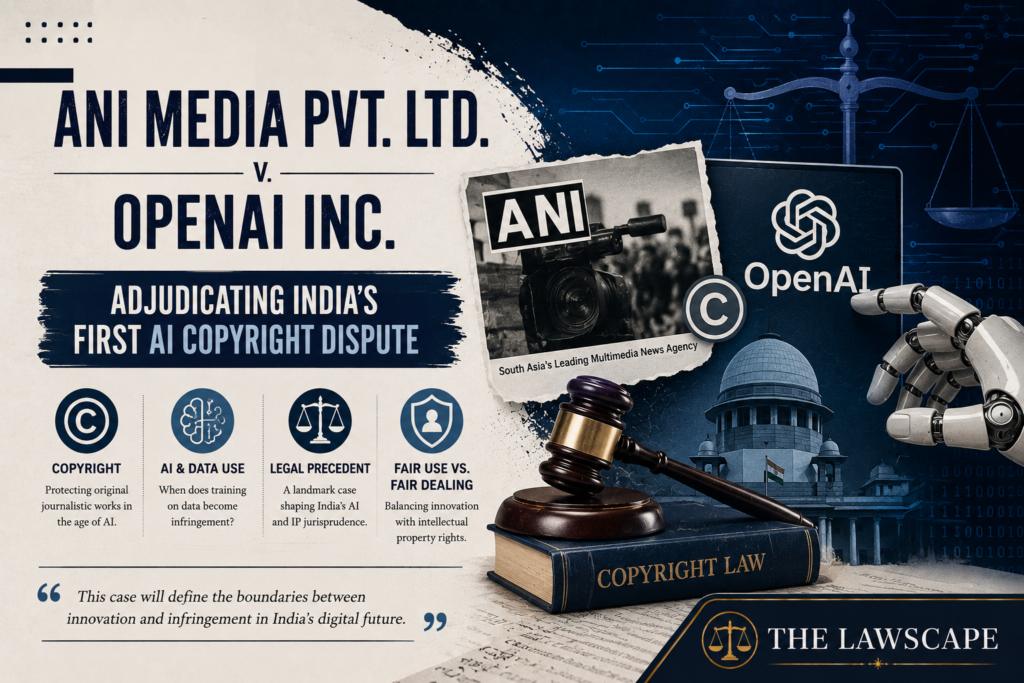
ANI Media Pvt. Ltd. v. OpenAI Inc.: Adjudicating India’s First AI Copyright Dispute
Author: Nikhil Saini
Student, Manipal University Jaipur
——————————————————————————————
💡 3 Quick Takeaways
1. ANI Media Pvt. Ltd. v. OpenAI Inc. is India’s first major copyright dispute to directly examine whether AI training on copyrighted journalistic content is permissible under the Copyright Act, 1957.
2. The case raises three central questions: territorial jurisdiction over a foreign AI company, whether training-stage ingestion of copyrighted content amounts to infringement under Sections 14 and 51, and whether Section 52 fair dealing can shield commercially driven AI training.
3. The Delhi High Court’s eventual ruling may shape not only Indian copyright doctrine, but also the country’s emerging AI policy and licensing framework.
Introduction
For several years, the intersection of artificial intelligence and copyright has been litigated in courts across the United States, the United Kingdom, and Europe. In 2024, India formally entered this global legal conversation when ANI Media Pvt. Ltd., one of India’s leading multimedia news agencies, instituted a civil suit against OpenAI Inc. before the Intellectual Property Division of the Delhi High Court. The case, ANI Media Pvt. Ltd. v. OpenAI Inc., CS(COMM) 1028/2024, is currently pending at the interim stage and marks India’s first judicial engagement with the question of whether the use of copyrighted material for AI training is permissible under existing Indian copyright law.
The significance of the dispute extends well beyond the immediate interests of the parties. It places before the Delhi High Court three foundational questions that the Copyright Act, 1957 was never designed to answer in the context of generative AI: first, whether an Indian court can exercise territorial jurisdiction over a foreign AI company; second, whether large-scale use of copyrighted journalistic material to train an AI model infringes the reproduction right under Sections 14 and 51 of the Act; and third, whether the fair dealing exception under Section 52(1)(a) can immunise commercially driven AI training. The case has also arisen at a time when India is actively considering copyright reform in response to AI development, making it not only a dispute about infringement but also a case that may influence the future architecture of AI governance in India.
Facts of the Case
ANI Media Pvt. Ltd. is a prominent Indian multimedia news agency established in 1967. It supplies broadcasters, print and digital media outlets with video footage, photographs, written reports, and other forms of journalistic content. Over the decades, ANI has created and disseminated a substantial body of original journalistic material, including news reports, headline stories, dispatches, and analytical pieces, all of which it claims are protected as literary works under the Copyright Act, 1957.
OpenAI Inc., on the other hand, is a Delaware-incorporated, California-based artificial intelligence company and the developer of ChatGPT. According to the allegations made in the suit, ChatGPT was trained on large volumes of internet-based text that had not been individually licensed from content publishers. ANI claims that this process involved the scraping, ingestion, tokenisation, and storage of ANI’s copyrighted journalistic content in OpenAI’s training datasets without consent or compensation. ANI further contends that when users prompt ChatGPT, the model is capable of producing outputs that resemble ANI’s journalistic expression and, in some cases, wrongly attribute such output to ANI, thereby causing reputational and legal harm.
ANI’s suit seeks, among other reliefs, a permanent injunction restraining OpenAI from continuing to use ANI’s content, delivery up of infringing material, rendition of accounts, and damages. OpenAI has challenged the suit at the threshold by contesting the Delhi High Court’s territorial jurisdiction. It argues that it is incorporated in the United States, does not maintain a registered place of business or fixed establishment in India, and that the acts of training complained of were undertaken on servers located outside India. The matter is presently pending at the ad interim stage, where the Court must decide both the jurisdictional objection and ANI’s prayer for interim relief.
Issues Raised
The case raises the following principal legal issues before the Delhi High Court:
- Whether the Delhi High Court has territorial jurisdiction to entertain a copyright infringement suit against OpenAI Inc., a company incorporated and operating outside India, in respect of acts allegedly performed on servers located abroad.
- Whether the large-scale ingestion of ANI’s copyrighted news content into OpenAI’s training datasets amounts to infringement of ANI’s exclusive reproduction right under Sections 14 and 51 of the Copyright Act, 1957.
- Whether the fair dealing exception under Section 52(1)(a) of the Copyright Act is available to OpenAI as a defence in relation to training-stage use of ANI’s content.
- Whether ChatGPT’s generation of outputs that reproduce ANI’s journalistic expression and falsely attribute content to ANI constitutes output-stage infringement and a violation of ANI’s moral rights under Section 57 of the Act.
- Whether ANI has established a prima facie case, balance of convenience, and irreparable injury sufficient to justify an interim injunction.
Analysis
A. Territorial Jurisdiction: Can Indian Courts Reach OpenAI?
The first major hurdle in the case is jurisdiction. OpenAI’s objection is straightforward: it is a foreign company, incorporated in Delaware and operating from California, with no registered office or fixed place of business in India. Under Section 20 of the Code of Civil Procedure, 1908, a suit may be instituted where the defendant carries on business or where the cause of action, wholly or in part, arises. The “carries on business” limb may not be easily satisfied merely because ChatGPT is accessible online in India.
However, ANI’s stronger argument lies in the “cause of action” limb. In copyright law, the place where the infringing content is communicated, accessed, or causes injury can be relevant for territorial jurisdiction. ANI is a Delhi-based entity, and the alleged injury to its copyrighted material and reputation is said to have occurred in India. Further, OpenAI’s own public acknowledgment of India as one of its largest user markets may strengthen the claim that the alleged infringement has a sufficient territorial nexus with India. The invocation of Section 75 of the Information Technology Act, 2000, which extends Indian law to certain extra-territorial acts involving computer resources located in India, further bolsters ANI’s jurisdictional case. On this reasoning, the Delhi High Court may legitimately hold that it is not acting beyond its territorial competence by entertaining the suit.
B. Training-Stage Infringement: Sections 14 and 51 of the Copyright Act
The central doctrinal question in the case is whether AI training on ANI’s content amounts to copyright infringement. Section 14 of the Copyright Act confers upon the copyright owner the exclusive right to reproduce the work in any material form, while Section 51 provides that copyright is infringed when a person, without licence, does any act reserved exclusively to the owner. ANI’s case is that OpenAI’s training process necessarily involved the copying, digitisation, tokenisation, storage, and computational use of its journalistic works, all of which amount to acts of reproduction.
This is where the Indian position becomes especially significant. Unlike some other jurisdictions, Indian copyright law does not currently recognise a distinct “non-expressive use” or text-and-data-mining exception. The DPIIT Working Paper referred to in the submission itself acknowledges that Indian law does not presently contain a separate defence for AI training on copyrighted works. Thus, the question is not whether the copied material was used expressively or merely statistically, but whether the act of copying itself falls within the owner’s exclusive rights.
ANI’s position appears stronger because its journalistic content qualifies as original literary work under Section 13 of the Copyright Act, and Indian jurisprudence has already recognised originality based on skill and judgment, most notably in Eastern Book Company v. D.B. Modak. If OpenAI has indeed systematically ingested, stored, and processed ANI’s content in the course of model training, that activity may fit squarely within the language of “reproduction” under Section 14. On the face of the statutory text, ANI’s claim of prima facie infringement therefore appears substantial.
C. Fair Dealing Under Section 52: A Difficult Defence
OpenAI’s most likely statutory defence would be to invoke Section 52(1)(a) of the Copyright Act, which provides for fair dealing for certain specified purposes such as private or personal use, including research. However, the commentary argues that this defence is structurally difficult to sustain in the context of commercial AI training.
First, Indian copyright law does not contain the open-ended “fair use” doctrine found in the United States. Section 52 sets out a closed list of exceptions, and Indian courts do not have the same freedom to develop a broad transformative-use defence of the kind often argued in American AI litigation. Second, the notion of “research” in Section 52(1)(a) has traditionally been understood as personal or scholarly research, not the large-scale ingestion of copyrighted works to build and commercialise a generative AI product. Third, even where a purpose is enumerated, the dealing must still be fair and proportionate. Wholesale copying of decades of journalistic content for a commercially monetised AI model is difficult to characterise as proportionate or fair. On this reasoning, the fair dealing defence appears weak if the allegations of large-scale unauthorised copying are established.
D. Output-Stage Infringement and Moral Rights
An important aspect of ANI’s claim extends beyond training-stage copying and concerns the outputs generated by ChatGPT. ANI alleges that upon prompting, ChatGPT can produce text resembling ANI’s journalistic expression and, in certain instances, falsely attribute such content to ANI. This gives rise to a separate layer of legal concern: output-stage infringement and moral rights violation.
If an AI-generated output reproduces protected expression from ANI’s works, that reproduction and communication to users may itself amount to copyright infringement under Section 14, independent of the training-stage question. In addition, false attribution of AI-generated text to ANI could implicate Section 57 of the Copyright Act, which protects the author’s moral rights, including the right to claim authorship and to object to distortions or misattributions that harm reputation. This is a particularly significant aspect of the dispute because it moves beyond economic rights and touches reputational integrity in journalistic work.
E. The Broader Significance of the Case
The importance of ANI v. OpenAI lies not only in its resolution of a private dispute, but also in its potential to shape the future of AI regulation in India. The jurisdictional ruling will indicate whether Indian rightsholders can meaningfully sue foreign AI developers in Indian courts. The Court’s approach to training-stage infringement may become the doctrinal foundation for future claims by Indian publishers, authors, and content creators whose works are used in AI datasets without licence.
The case is also unfolding alongside an important policy moment. The DPIIT Working Paper on AI and Copyright has reportedly considered an “obligatory blanket licensing” model with retrospective royalty obligations for AI developers who have already monetised models trained on copyrighted material. If the Delhi High Court finds a prima facie case of infringement and grants interim relief, that may significantly strengthen the case for legislative intervention. Conversely, if the Court declines relief on jurisdictional or balance-of-convenience grounds, the legislature may be left to act first. In either event, the litigation is likely to influence the shape and pace of India’s emerging AI copyright framework.
Conclusion
ANI Media Pvt. Ltd. v. OpenAI Inc. is arguably the most important intellectual property dispute presently pending before an Indian court in the field of artificial intelligence. It is the first Indian case to directly confront whether mass ingestion of copyrighted content for commercial AI training is lawful under the Copyright Act, 1957. On current Indian copyright doctrine, ANI appears to have a substantial prima facie case: Section 14 confers a broad reproduction right, Section 52 contains a closed and limited fair dealing framework, and Indian law presently lacks any explicit text-and-data-mining or non-expressive use exception. The output-stage claims relating to false attribution and reproduction of ANI’s expression may present an even clearer legal issue.
At the same time, the case is not merely about ANI and OpenAI. It places the Delhi High Court in a position to influence how AI training is legally understood in India and how far Indian courts can regulate global technology companies whose products are widely used within the country. Its outcome may affect copyright litigation strategy, AI licensing markets, legislative reform, and India’s role in the global debate over who pays for the data that powers artificial intelligence. For that reason, ANI v. OpenAI is not just a dispute between a news agency and an AI company; it is a gateway case for India’s AI copyright future.
Disclaimer: The views expressed in this article are those of the author and do not necessarily reflect the views of The Lawscape.
The Lawscape — clear, practical legal insight for students and future lawyers.