
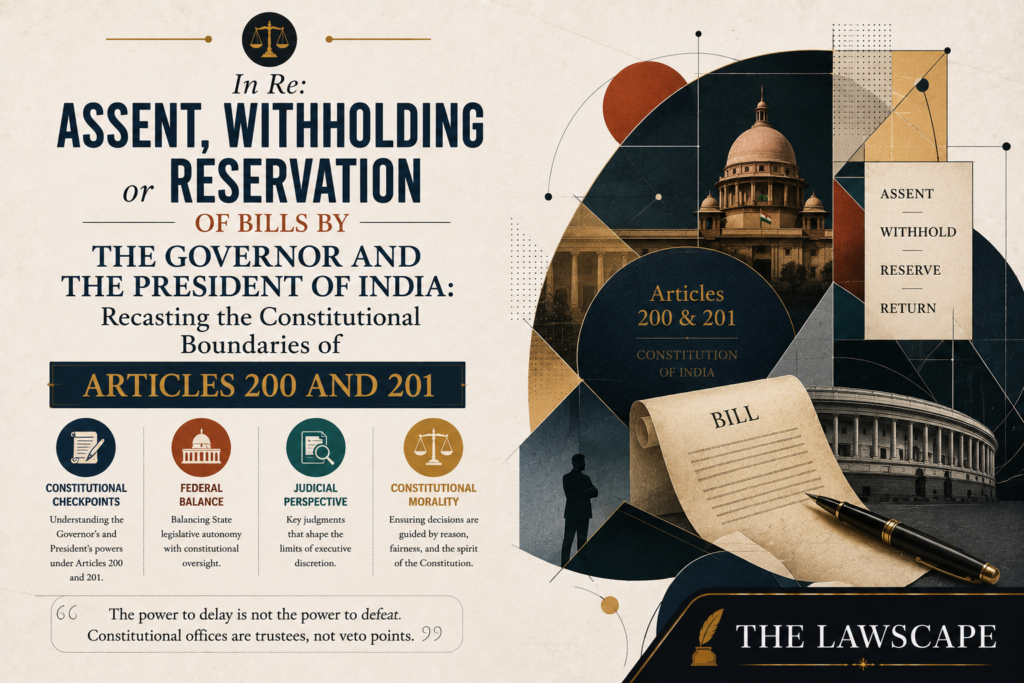
In Re: Assent, Withholding or Reservation of Bills by the Governor and the President of India: Recasting the Constitutional Boundaries of Articles 200 and 201
Author: Srishti singh
Student, Gujarat national law University, silvassa
——————————————————————————————-
💡 3 Quick Takeaways
1. The Supreme Court’s advisory opinion in In Re: Assent, Withholding or Reservation of Bills by the Governor and the President of India clarified that a Governor has only three options under Article 200—assent, return the Bill for reconsideration, or reserve it for the President—and cannot exercise an absolute veto through indefinite inaction.
2. The Court held that while the substantive decision of the Governor under Article 200 and the President under Article 201 is generally non-justiciable, prolonged inaction can still be addressed through a limited mandamus compelling a decision.
3. The judgment rejected both judicially imposed timelines and the doctrine of “deemed assent,” thereby reaffirming separation of powers and limiting the use of Article 142 as a tool to override constitutional discretion.
Introduction
The Indian Constitution establishes a federal structure with a strong Centre, within which the Governor occupies a constitutionally sensitive position as a bridge between the Union and the States. Among the Governor’s most significant powers is the authority under Article 200 to assent to, withhold assent from, return, or reserve Bills passed by the State Legislature. A parallel role is performed by the President under Article 201 when a Bill is reserved for presidential consideration. For decades, these provisions remained relatively uncontroversial. However, the rise of politically divided governments—where State governments are run by parties opposed to the ruling party at the Centre—has transformed the Governor’s assent power into a site of intense constitutional conflict.
This controversy culminated in a Presidential Reference under Article 143(1) following the Supreme Court’s judgment in State of Tamil Nadu v. Governor of Tamil Nadu (2025). In that case, the Court had set time limits for the Governor to act on pending Bills and, by invoking Article 142, treated several Bills as having effectively received assent. The ruling triggered sharp constitutional criticism and led President Droupadi Murmu to refer fourteen questions to the Supreme Court concerning the constitutional limits of gubernatorial and presidential assent powers. The resulting advisory opinion in In Re: Assent, Withholding or Reservation of Bills by the Governor and the President of India, 2025 INSC 1333, has now become the most detailed judicial exposition of Articles 200 and 201 since the Constitution came into force. It addresses the scope of the Governor’s options, the justiciability of assent-related decisions, the permissibility of judicially imposed timelines, the doctrine of deemed assent, and the role of Article 142 in constitutional disputes.
Facts of the Case
The Presidential Reference arose out of a prolonged constitutional impasse between the Government of Tamil Nadu and the Governor of Tamil Nadu, R.N. Ravi. Ten Bills passed by the Tamil Nadu Legislature remained pending before the Governor for an extended period. The Governor neither assented to the Bills, nor returned them for reconsideration, nor reserved them for the President’s consideration. Faced with this prolonged inaction, the State Government approached the Supreme Court.
In State of Tamil Nadu v. Governor of Tamil Nadu, the Supreme Court held that the Governor’s indefinite withholding of assent was unconstitutional. It interpreted Article 200 as offering the Governor only three options: to assent, to return the Bill for reconsideration with a message, or to reserve it for the President. The Court also fixed timelines for the Governor to act and, in exercise of its powers under Article 142, treated certain Bills as having received assent. This judgment immediately attracted criticism from constitutional commentators and political functionaries, including the Vice President, who argued that the Court had trespassed into the constitutional domain of the Governor and the President. In response, the President of India made a reference under Article 143(1), seeking the Court’s opinion on fourteen constitutional questions concerning the scope of Articles 200 and 201, the justiciability of gubernatorial and presidential action, the permissibility of judicially imposed timelines, and the validity of “deemed assent.”
Issues Raised
The Constitution Bench was called upon to determine several foundational constitutional questions, including:
- What are the constitutional options available to a Governor under Article 200 when a Bill is presented for assent, and whether the Governor can absolutely refuse assent without returning the Bill.
- Whether the actions of the Governor under Article 200 and the President under Article 201 are justiciable, and if so, to what extent.
- Whether courts can prescribe time limits for the exercise of constitutional powers under Articles 200 and 201.
- Whether the Presidential Reference under Article 143(1) was maintainable despite the earlier judgment in Tamil Nadu Governor, or whether it was merely an appeal in disguise.
- Whether the Supreme Court, in exercise of Article 142, can replace the constitutional discretion of the Governor or President by presuming that assent has been granted.
- Whether the concept of “deemed assent” fits within the constitutional framework of Articles 200 and 201.
Analysis
A. Maintainability of the Presidential Reference
A preliminary objection was raised that the Presidential Reference was an impermissible attempt to reopen a binding judicial decision through advisory proceedings instead of review or curative jurisdiction. The Constitution Bench rejected this contention. It held that Article 143(1) confers an independent and sui generis constitutional power upon the President to seek the Court’s advisory opinion on questions of public importance. This power is not conditioned on the absence of prior judicial decisions on related issues.
This reasoning is constitutionally persuasive. Advisory jurisdiction serves a distinct constitutional purpose: it allows the Court to provide authoritative guidance on unsettled questions of broad public significance. The fact that a coordinate bench had previously dealt with related issues did not bar the Court from answering questions placed before it by the President in exercise of Article 143. The Court’s acceptance of the reference was therefore doctrinally sound and consistent with the constitutional design of advisory jurisdiction.
B. The Governor’s Options Under Article 200: Three, Not Four
On the substantive question of Article 200, the Court reaffirmed the three-option framework recognised in Tamil Nadu Governor. It held that the Governor may: (i) assent to the Bill; (ii) withhold assent and return the Bill to the Legislature with a message for reconsideration; or (iii) reserve the Bill for the President’s consideration. Crucially, the Court categorically rejected the idea that the Governor may exercise an “absolute veto” by simply sitting on a Bill indefinitely.
This conclusion is consistent with both constitutional text and democratic structure. The first proviso to Article 200 links the withholding of assent to the obligation to return the Bill for reconsideration. The Constitution therefore does not contemplate a situation where a Governor may indefinitely obstruct legislation passed by an elected State Legislature through silence or inaction. The Court correctly relied on the broader constitutional principle that the Governor is a constitutional head who ordinarily acts on the aid and advice of the Council of Ministers, as recognised in Shamsher Singh v. State of Punjab. Allowing indefinite inaction would distort this role and convert the office of Governor into a partisan political instrument. The Court also clarified that once a Bill is reconsidered and re-passed by the Legislature, the Governor must grant assent; a second withholding is impermissible.
C. Justiciability and the Limits of Judicial Review
One of the most analytically important aspects of the advisory opinion is its treatment of justiciability. The Court held that the Governor’s substantive choice among the constitutionally permissible options under Article 200 is non-justiciable. Similarly, the President’s decision under Article 201 is not subject to judicial review on its merits. Courts cannot determine whether assent ought to have been granted rather than reserved, because there are no judicially manageable standards for evaluating such constitutional discretion. This conclusion is rooted in separation of powers and reinforced by Article 361(1), which grants constitutional protection to the Governor for acts done in exercise of official powers.
However, the Court drew a careful distinction between the substance of a constitutional choice and complete inaction. While courts cannot review the merits of a Governor’s decision, they may intervene where the Governor fails to exercise any option for an unexplained and indefinite period. In such cases, the Court held that a “limited mandamus” may issue, compelling the Governor to act without dictating which option must be chosen. This is perhaps the most balanced part of the opinion. It preserves constitutional discretion while ensuring that the democratic process is not paralysed by inaction. The Court’s nuanced distinction between non-justiciable choice and reviewable inaction provides a workable middle path between total immunity and full merits review.
D. Judicial Timelines and Separation of Powers
The Constitution Bench expressly rejected the approach taken in Tamil Nadu Governor of prescribing judicial timelines for the Governor and President to act under Articles 200 and 201. It held that the constitutional silence on timelines is deliberate, and that judicially fixing deadlines would amount to an impermissible amendment of the Constitution by interpretation. Such a course, according to the Court, would violate the separation of powers, which forms part of the Constitution’s basic structure.
This conclusion is doctrinally defensible. The judiciary cannot add a requirement that the framers chose not to include. The remedy for delay, the Court reasoned, lies in constitutional accountability and the issuance of limited mandamus, not in the judicial creation of rigid timelines. At the same time, the judgment candidly exposes a governance gap: without specific deadlines, a politically motivated Governor may still use delay as a strategic tool. The Court’s answer is that such structural problems must be addressed through constitutional conventions, political accountability, and legislative reform rather than judicial timeline-fixing. While this may be normatively unsatisfying to some, it remains institutionally consistent with constitutional boundaries.
E. Deemed Assent and the Limits of Article 142
Perhaps the most doctrinally consequential part of the advisory opinion is its rejection of the doctrine of “deemed assent.” The Constitution Bench held that the idea of treating a Bill as having received assent by judicial order is alien to the constitutional scheme of Articles 200 and 201. Consequently, the use of Article 142 in Tamil Nadu Governor to deem Bills as having received assent was declared constitutionally impermissible.
The Court drew a necessary distinction between using Article 142 to do complete justice between parties and using it to override or substitute the constitutional powers of co-equal constitutional authorities. As the Court noted, Article 142 cannot be employed to supplant substantive constitutional design. If courts were permitted to deem assent granted, the Supreme Court would effectively become the ultimate legislative authority in the country—an outcome wholly incompatible with the Constitution. This part of the judgment therefore serves as a significant corrective to the expansion of Article 142 and reasserts that even extraordinary judicial powers must remain within constitutional limits.
F. Implications for Indian Federalism
The advisory opinion has important consequences for Indian federalism. Governors, as Union appointees, have often been criticised for acting as political agents of the Centre rather than impartial constitutional heads. By limiting judicial review of assent-related decisions, the Court has preserved constitutional discretion, but it has also narrowed the enforceable legal tools available to States confronting gubernatorial obstruction. The recognition of limited mandamus for inaction offers some protection, but its practical effectiveness remains uncertain where a Governor acts, but acts in a manner inconsistent with the democratic will of the elected State government.
At the same time, the opinion provides an important structural safeguard by clarifying that the Governor cannot exercise an absolute veto and must assent once a Bill is re-passed by the Legislature. This prevents the Governor from permanently blocking the legislative will of the State. Yet the broader challenge remains unresolved: how to ensure that Governors function in accordance with constitutional obligations rather than partisan political expectations. The Court itself acknowledges that this deeper problem lies beyond the reach of judicial orders alone and must instead be addressed through constitutional culture, political accountability, and institutional reform.
Conclusion
The advisory opinion in In Re: Assent, Withholding or Reservation of Bills by the Governor and the President of India is the most authoritative judicial exposition of Articles 200 and 201 since independence. By affirming the three-option structure under Article 200, rejecting the concept of deemed assent, disapproving judicially imposed timelines, and calibrating judicial review through the doctrine of limited mandamus, the Constitution Bench has restored constitutional discipline to an area destabilised by the earlier Tamil Nadu Governor ruling.
Its contribution to separation of powers jurisprudence is particularly significant. The judgment makes clear that Article 142 cannot be used to override the constitutional discretion of co-equal authorities, and it insists that judicial review must remain sensitive to the limits of institutional competence. At the same time, the opinion exposes a continuing governance deficit: the structural problem of Governors functioning as political agents of the Centre cannot be solved through adjudication alone. That problem demands reform in gubernatorial appointments, stronger constitutional conventions, and legislative attention to the Governor’s office. In that sense, the advisory opinion is both a doctrinal settlement and a constitutional warning—it resolves the law, but leaves the politics of federal friction for the political branches to confront.
Disclaimer: The views expressed in this article are those of the author and do not necessarily reflect the views of The Lawscape.
The Lawscape — clear, practical legal insight for students and future lawyers.