
Munawar Harun Shah v. State of Maharashtra: Delay, Death Row, and the Limits of Reformative Justice
Author: Ashika D
Student, Government Law College, Chengalpattu
———————————————————————————-
💡 3 Quick Takeaways
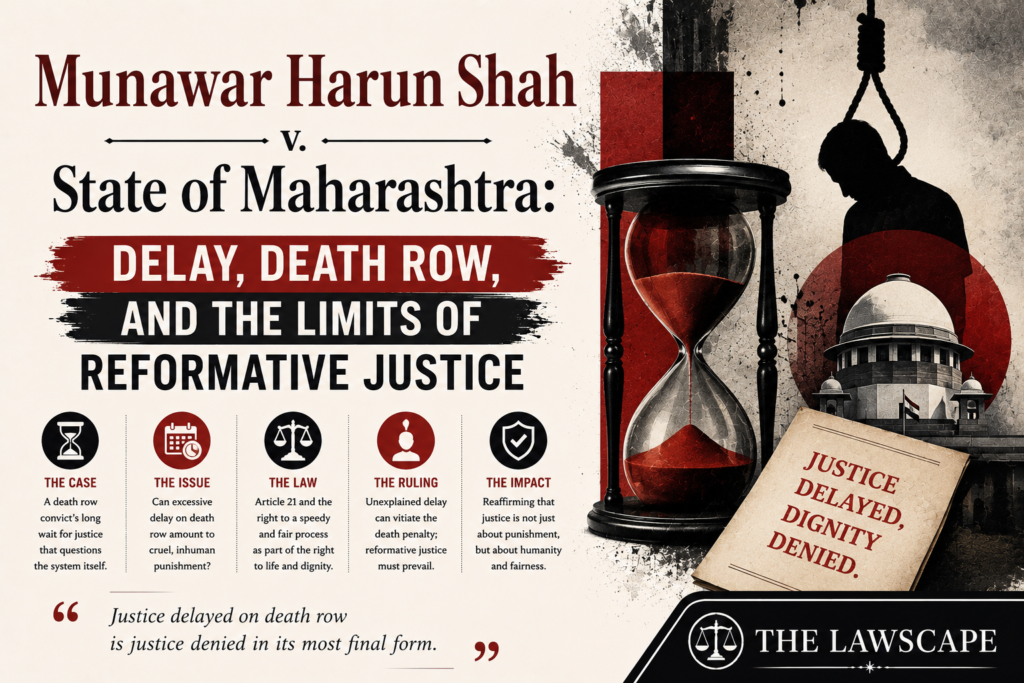
1. Munawar Harun Shah v. State of Maharashtra addressed whether prolonged delay in the execution of a death sentence and evidence of reform in prison could justify commutation to life imprisonment.
2. The Supreme Court refused to commute the sentence, holding that the delay was not exceptional and that much of it resulted from legal proceedings initiated by the convicts themselves.
3. The case reflects an earlier judicial approach to capital punishment in India, one that gave decisive weight to the brutality, repetition, and organised nature of the crimes over arguments based on reformation and mental suffering on death row.
Introduction
The Supreme Court’s ruling in Munawar Harun Shah v. State of Maharashtra occupies an important place in India’s constitutional and criminal law relating to the death penalty. The case raised a significant constitutional question: whether prolonged delay in carrying out a death sentence, together with evidence of good behaviour and reform during imprisonment, could justify commuting the sentence to life imprisonment. It emerged at a time when Indian courts were attempting to balance the constitutional guarantee of life and personal liberty under Article 21 with the continued use of capital punishment.
The case arose out of the infamous Joshi-Abhyankar serial murders in Pune between 1976 and 1977, which created widespread fear because of their repeated, organised, and financially motivated nature. Although the accused were educated college students, they repeatedly engaged in robbery and murder over a sustained period. The planned and brutal character of the offences played a decisive role in the judicial reasoning at every stage. In the end, the Supreme Court refused to commute the death sentences. It held that neither the delay in execution nor the prisoners’ reformative conduct in jail was sufficient to outweigh the seriousness of the crimes. The Court emphasised that the offences revealed calculated criminal behaviour, complete disregard for human life, and a grave impact on society.
Facts of the Case
Between January 1976 and March 1977, a series of violent robberies and murders took place in Pune, Maharashtra. The principal accused were Munawar Harun Shah, Shantaram Kanhoji Jagtap, and Dilip Dhyanoba Sutar, along with others. According to the prosecution, these men deliberately targeted individuals for financial gain, committing robbery and murder as part of a planned and continuing criminal enterprise. These were not isolated incidents, but part of a pattern of organised violence that spread fear and insecurity throughout society. The prosecution maintained that the crimes were carefully planned and executed with complete disregard for human life, and that their repeated and financially motivated nature made them far more serious than ordinary homicide cases.
Following investigation and trial before the Sessions Court, the accused were convicted of offences including murder and robbery and were sentenced to death in 1978. The Bombay High Court affirmed both the conviction and the sentence. When the Supreme Court dismissed their Special Leave Petitions in 1980, the death penalty attained finality. After spending several years in prison awaiting execution, the convicts filed petitions under Article 32 of the Constitution seeking commutation of their death sentences to life imprisonment. They advanced two principal arguments. First, they contended that the prolonged delay had caused severe mental suffering and amounted to cruel treatment in violation of Article 21. Secondly, they argued that their good conduct in prison—including participation in educational, literary, philosophical, and religious activities—demonstrated reformation and entitled them to mercy. The State opposed the petitions and argued that the brutal, organised, and repeated nature of the crimes far outweighed these considerations. It also pointed out that much of the delay had been caused by legal proceedings initiated by the convicts themselves and could not therefore serve as a valid ground for commutation.
Issues Raised
The case raised several important questions:
- Whether prolonged delay in the execution of a death sentence violates Article 21 and justifies commutation to life imprisonment.
- Whether delay substantially caused by legal proceedings initiated by the convicts themselves can be relied upon as a ground for commutation.
- Whether good conduct in prison, including participation in educational, literary, philosophical, and religious activities, can outweigh the gravity of exceptionally serious crimes.
- Whether the crimes in question fell within the category of offences justifying the death penalty.
- Whether the constitutional right to life under Article 21 extends to the mental suffering caused by prolonged incarceration on death row after conviction.
Judgment of the Supreme Court
The Supreme Court refused to commute the death sentences and upheld the punishment. It held that the delay between sentencing and execution was not so extraordinary as to justify judicial intervention. The Court also noted that a substantial part of the delay had been caused by the legal proceedings pursued by the convicts themselves and therefore could not automatically be treated as a constitutional ground for commutation. With respect to reformative conduct, the Court acknowledged the prisoners’ participation in educational and philosophical activities, but held that this was insufficient to outweigh the seriousness, brutality, and repeated nature of the offences. The crimes were not sudden or isolated acts, but part of an organised, deliberate, and money-driven pattern of criminal conduct demonstrating a clear disregard for human life.
On the challenge under Article 21, the Court adopted a strict approach. It held that not every delay in executing a death sentence renders the punishment unconstitutional. A distinction was drawn between ordinary judicial delay and unusual executive delay. In the present case, the Court concluded that the delay was not exceptional enough to warrant commutation. It also attached significant weight to the social impact of the crimes. The repeated murders and robberies had spread fear in society and reflected organised criminal behaviour, which in the Court’s view justified retaining the death penalty. The petitions seeking commutation were therefore dismissed.
Critical Analysis
The decision reflects the strong emphasis placed by Indian courts at that time on deterrence and retributive proportionality in death penalty jurisprudence. It reveals a judicial preference for protecting society and ensuring punishment commensurate with the offence in cases involving extremely grave organised crime. It also illustrates the comparatively narrow constitutional approach that characterised early death penalty decisions in India. One of the most significant features of the judgment is the Court’s refusal to treat delay caused by the convicts’ own legal proceedings as a ground for relief. By distinguishing between ordinary judicial delay and extraordinary executive delay, the Court established a principle that later became important in death row jurisprudence. The reasoning suggests that Article 21 cannot be invoked automatically merely because of delay; the source and character of that delay must also be examined.
Another important aspect of the case is the Court’s treatment of the organised and repetitive nature of the crimes. The offences were not viewed as isolated acts committed in the heat of the moment, but as part of a continuing pattern of robbery and murder for financial gain. The Court regarded this repetition as evidence of calculated criminal intent and a high degree of moral culpability. The fact that the accused were educated and fully conscious of the consequences of their actions was also treated as aggravating, reinforcing the view that the crimes could not be explained away by ignorance or immaturity. In this sense, the judgment anticipates later death penalty jurisprudence by focusing on factors such as planning, repetition, and social impact in determining the appropriateness of capital punishment.
The Court also took a limited view of reformative theory in the context of capital punishment. Although it acknowledged the prisoners’ educational and cultural engagement while in prison, it held that such post-conviction conduct could not erase the extreme gravity of repeated and brutal crimes. This demonstrates the narrow space afforded to reform-based arguments in death penalty cases during that period, particularly where multiple innocent lives had been taken in an organised and financially motivated series of offences. The judgment therefore reflects the limits of reformative justice when weighed against the perceived need for deterrence, public confidence, and proportional punishment.
At the same time, the case must be understood against the subsequent development of constitutional law relating to execution delay. Later decisions, such as Shatrughan Chauhan v. Union of India, adopted a more humane approach by recognising that prolonged incarceration on death row and the accompanying psychological suffering are relevant considerations in deciding whether a death sentence should be commuted. By contrast, Munawar Harun Shah represents an earlier and stricter phase of death penalty jurisprudence, in which the seriousness of the offence and the interests of society were given clear priority over the mental suffering of the convict. Nevertheless, the distinction it drew between normal judicial delay and extraordinary executive delay remains an important feature of the judgment and helps explain why the Court reached a different conclusion in this case.
The judgment also demonstrates the Court’s attempt to balance the rights of convicts with the interests of society. It recognised that criminal law is not concerned solely with the rights of offenders, but also with preserving social order, public trust in the justice system, and justice for victims and their families. The repeated murders in this case had spread fear and caused deep social harm. For that reason, the Court treated the crimes as warranting the harshest penalty. At the same time, the judgment was not framed as a simple endorsement of capital punishment in all murder cases. The Court emphasised the specific aggravating factors present here: the planned, repeated, financially motivated, and brutal character of the offences. In that sense, the case illustrates the ongoing judicial struggle to reconcile constitutional morality, proportionality in punishment, the possibility of reform, and the need to protect society.
Conclusion
Munawar Harun Shah v. State of Maharashtra remains an important decision in India’s constitutional and criminal law on the death penalty. It shows the Supreme Court’s reluctance to commute capital sentences in cases involving organised, repeated, and brutal crimes with a deep impact on society. The Court refused to treat ordinary procedural delay or limited reformative conduct in prison as sufficient to outweigh the seriousness of such offences.
The case also highlights the enduring tension in Indian criminal law between deterrence, punishment, and reformation. While later judgments have taken a more rights-based approach to prolonged delay and mental suffering on death row, Munawar Harun Shah reflects an earlier judicial emphasis on accountability for organised crime, proportional punishment, and the protection of society. Even today, the case remains relevant for understanding how courts weigh the constitutional rights of convicts against the broader demands of public justice and social security in the most serious criminal cases.
Disclaimer: The views expressed in this article are those of the author and do not necessarily reflect the views of The Lawscape.
The Lawscape — clear, practical legal insight for students and future lawyers.