
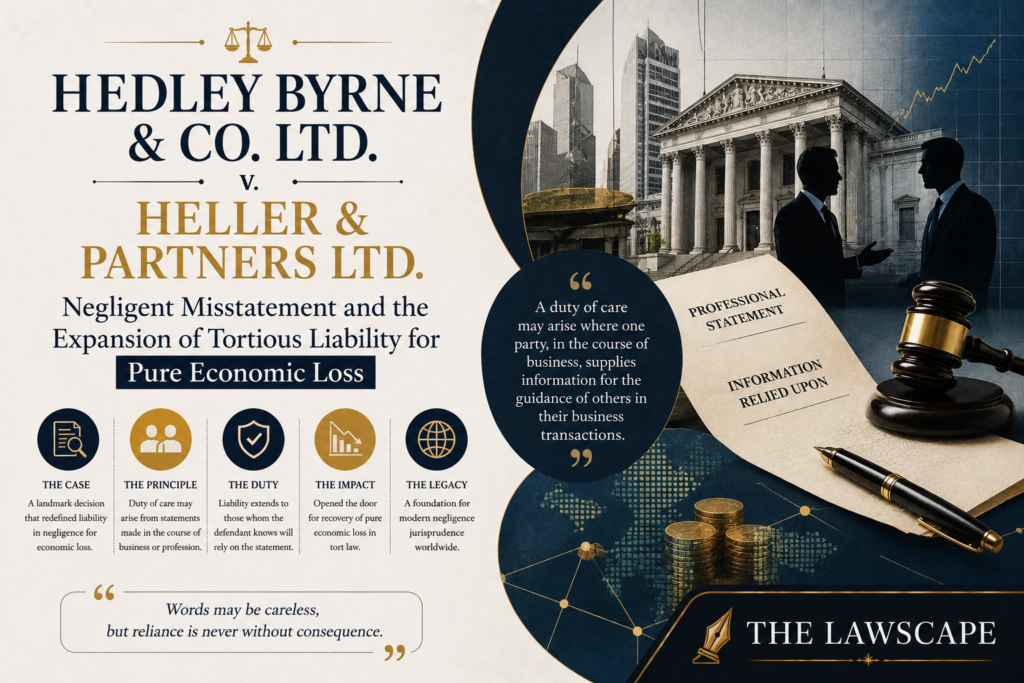
Hedley Byrne & Co. Ltd. v. Heller & Partners Ltd.: Negligent Misstatement and the Expansion of Tortious Liability for Pure Economic Loss
Author: Beckshite Justice Chukwujiukah
Student, University of Jos,
———————————————————————————–
💡 3 Quick Takeaways
1. Hedley Byrne & Co. Ltd. v. Heller & Partners Ltd. marked a major turning point in common law by recognising that negligent misstatements causing pure economic loss may give rise to a duty of care in tort.
2. The House of Lords introduced the doctrine of “assumption of responsibility” and the idea of a “special relationship” as the basis for liability in cases of negligent advice or information.
3. Although the House of Lords accepted the existence of such a duty in principle, the disclaimer used by Heller & Partners defeated liability on the facts by negating any assumption of responsibility.
Introduction
For decades after Donoghue v. Stevenson entrenched the “neighbour principle” in negligence, the common law maintained a firm line against recovery for pure economic loss unaccompanied by physical injury or property damage. Contract law, with its doctrines of privity and bargain, was traditionally viewed as the proper legal mechanism for allocating financial risk in commercial dealings. Against this backdrop, Hedley Byrne & Co. Ltd. v. Heller & Partners Ltd. marked a major reorientation in common law jurisprudence by recognising that a duty of care could arise in respect of negligent misstatements causing pure economic loss.
In this landmark decision, the House of Lords accepted that liability in negligence could extend to statements or advice where the defendant had assumed responsibility within a “special relationship” and the claimant had reasonably relied upon that statement to their detriment. The case thus expanded the law of negligence into the sphere of commercial reliance and professional advice, while also setting clear limits through the doctrines of reliance, proximity, and disclaimers.
Facts of the Case
The appellants, Hedley Byrne & Co. Ltd., were advertising agents who had entered into substantial advertising commitments on behalf of their client, Easipower Ltd. Under these arrangements, Hedley Byrne was personally liable to the media suppliers for the costs of the advertisements. Before proceeding with further commitments, the appellants sought reassurance regarding Easipower’s financial standing and solvency. They therefore requested their bankers, National Provincial Bank, to obtain a credit reference from Easipower’s bankers, Heller & Partners Ltd.
Heller & Partners furnished two financial references, one orally over the telephone and another through formal correspondence. Both references described Easipower as a “respectably constituted” company and indicated that it was capable of meeting its financial obligations in the ordinary course of business. However, each communication was expressly qualified by the words: “Confidential… for your private use and without responsibility on the part of this bank or its officials.” Relying on these favourable references, Hedley Byrne proceeded with the advertising arrangements. Soon afterwards, Easipower became insolvent, leaving Hedley Byrne with unpaid liabilities amounting to approximately £17,000. The appellants then brought an action against Heller & Partners, claiming damages for negligence in providing an inaccurate credit reference.
Core Issues Raised
The House of Lords was required to determine two central issues. First, whether a duty of care in tort could arise for a negligently made statement causing pure economic loss in the absence of a contract or fiduciary relationship between the parties. Secondly, whether the express disclaimer stating “without responsibility” effectively negatived any assumption of responsibility and thereby defeated any duty of care that might otherwise arise.
Analytical Discussion
From Donoghue to Hedley Byrne: The Special Relationship
The importance of Hedley Byrne lies in the fact that it extended negligence beyond the traditional categories of physical injury and property damage. While Donoghue v. Stevenson had grounded negligence in foreseeability and proximity, its application had largely remained confined to physical harm. Hedley Byrne expanded the principle by holding that negligent words, and not merely negligent acts, may give rise to liability where a sufficiently close relationship exists between the parties.
The House of Lords did not adopt an unrestricted approach. Instead, it crafted a narrow framework in which a duty of care would arise where the defendant possessed special skill or knowledge, voluntarily supplied information or advice for a known purpose, knew or ought reasonably to have known that the claimant would rely on that advice, and the claimant in fact relied upon it to their detriment. This framework established that the law would protect reasonable commercial reliance, but only within carefully defined limits.
Assumption of Responsibility
The doctrinal centrepiece of the case is the concept of “assumption of responsibility.” Lord Devlin conceptualised the relationship between the parties as one “equivalent to contract,” meaning that although no contract existed, the defendant could nevertheless incur a tortious duty by voluntarily undertaking responsibility for the accuracy of the information supplied. This idea served a dual function: it established legal proximity and limited the scope of liability.
Under this framework, proximity could not be established by mere foreseeability of reliance. Instead, there had to be a specific transactional setting, an identified purpose for which the information was sought, and a relationship in which the defendant knew that the claimant would rely upon the statement. By insisting on these elements, the House of Lords sought to prevent indeterminate liability while still protecting claimants in clearly defined advisory relationships.
The Disclaimer and Its Effect
Although the House of Lords recognised that a duty of care could, in principle, arise for negligent misstatements causing pure economic loss, the appellants failed on the facts because of the disclaimer. The phrase “without responsibility” was treated as an express negation of any assumption of responsibility. Since the bank had explicitly disclaimed liability, no duty of care arose in the circumstances of the case.
This aspect of the judgment is particularly significant because it reveals the balance the Court attempted to strike between commercial autonomy and tortious accountability. On the one hand, the law was prepared to recognise liability for careless professional advice; on the other, it was equally prepared to respect clear attempts by parties to allocate or exclude risk in advance. The result was a doctrine that simultaneously created a new avenue of liability and a ready mechanism for limiting it.
Reasonable Reliance and Professional Advice
The decision also clarified that reliance is not a purely formal requirement. Courts must examine whether the defendant invited reliance, whether the advice was specific to the transaction in question, and whether the claimant had access to independent verification. This made the doctrine especially relevant in cases involving bankers, auditors, solicitors, surveyors, and other professionals whose advice is frequently relied upon in commercial decision-making.
At the same time, the House of Lords did not open the door to limitless liability. The duty was confined to situations involving a defined purpose and an identifiable recipient or class of persons. This limitation later became central to the development of cases such as Caparo Industries plc v. Dickman, where courts refused to impose liability for general financial statements addressed to the investing public at large.
Relationship with Derry v. Peek
A further significance of Hedley Byrne lies in its relationship with Derry v. Peek. The latter had confined tortious liability for misrepresentation to cases of fraud. Hedley Byrne did not overrule that principle. Instead, it supplemented the common law by recognising a separate negligence-based action for pure economic loss caused by careless statements. In this way, the law came to distinguish between deceit, which addresses intentional dishonesty, and negligent misstatement, which addresses professional carelessness in circumstances of induced reliance.
Global and Comparative Influence
The judgment’s impact extended far beyond English law. Commonwealth jurisdictions, including Canada, Australia, and New Zealand, adopted and developed its logic of proximity, reliance, and assumption of responsibility. The case also transformed professional practice by encouraging advisers, bankers, and commercial lawyers to clearly define the scope of their responsibilities, identify intended recipients, and use disclaimers where appropriate. In that sense, Hedley Byrne not only reshaped doctrine but also altered the practical structure of modern professional and commercial communication.
Doctrinal Legacy and Caparo
The long-term doctrinal legacy of Hedley Byrne can be seen in its relationship with Caparo Industries plc v. Dickman. While Hedley Byrne established the possibility of liability for negligent misstatements causing pure economic loss, Caparo later refined duty analysis through its tripartite test of foreseeability, proximity, and whether it is fair, just, and reasonable to impose a duty. The two cases work together: Hedley Byrne provides the foundational reliance-based logic, while Caparo imposes a broader policy filter to prevent open-ended liability.
Conclusion
Hedley Byrne & Co. Ltd. v. Heller & Partners Ltd. remains one of the most important decisions in the law of negligence. It dismantled the rigid rule that pure economic loss caused by negligent words could never be recovered in tort and replaced it with a more nuanced framework based on assumption of responsibility, a specific purpose, and reasonable reliance. At the same time, by recognising the effectiveness of disclaimers, the House of Lords preserved commercial freedom to allocate risk in advance.
The enduring significance of the case lies in its careful balance. It acknowledged that careless words can cause serious financial harm and that the law must, in appropriate circumstances, provide a remedy. Yet it also ensured that liability would remain confined within principled limits rather than expanding without control. For this reason, Hedley Byrne stands as a foundational authority on negligent misstatement, professional liability, and the expansion of tortious responsibility into the sphere of commercial reliance.
Disclaimer: The views expressed in this article are those of the author and do not necessarily reflect the views of The Lawscape.\
The Lawscape — clear, practical legal insight for students and future lawyers