
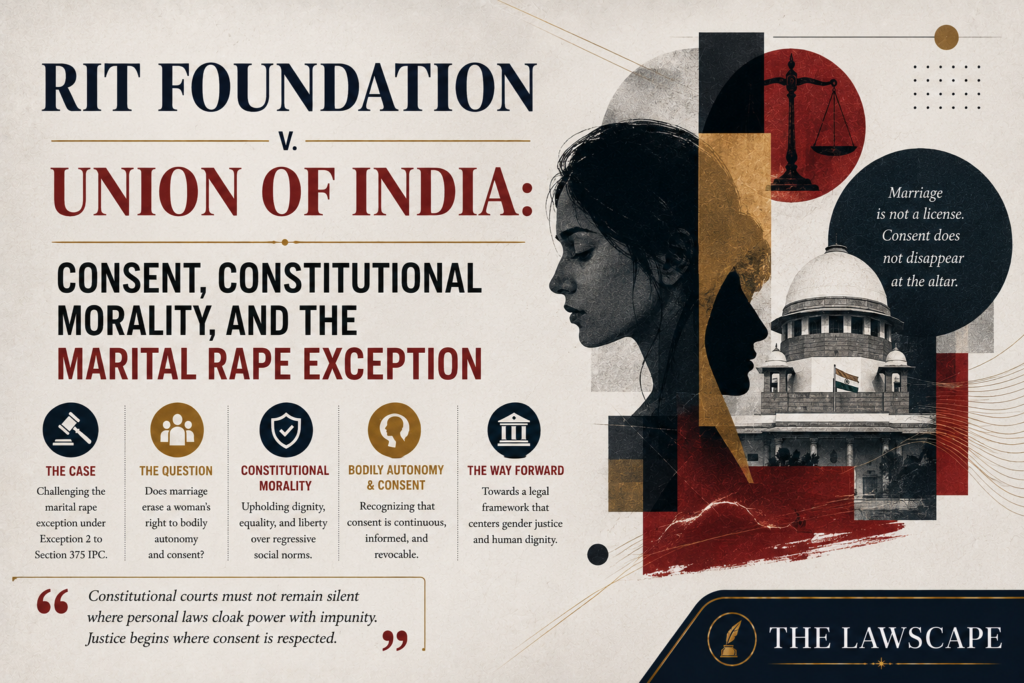
RIT Foundation v. Union of India: Consent, Constitutional Morality, and the Marital Rape Exception
Author: Manjiri Vaidya
Student, Government New Law College Indore
————————————————————————————-
💡 3 Quick Takeaways
1. RIT Foundation v. Union of India placed the marital rape exception at the centre of constitutional scrutiny by questioning whether marriage can negate a woman’s right to consent, bodily autonomy, and dignity.
2. The Delhi High Court delivered a split verdict: Justice Rajiv Shakdher held the exception unconstitutional, while Justice C. Hari Shankar upheld it and left the issue to Parliament.
3. The case intensified the national debate on gender justice, constitutional morality, and whether the institution of marriage can justify differential treatment in cases of sexual violence.
Introduction
Indian society is deeply rooted in traditions and customs, with marriage often treated as one of its most significant institutions. RIT Foundation v. Union of India is one of the most debated cases concerning women’s rights and bodily autonomy in India. It raised serious constitutional questions under Articles 14 and 21 of the Constitution by challenging the validity of the marital rape exception under Indian criminal law. At the heart of the case lay issues of consent, dignity, gender equality, constitutional morality, and the personal liberty of a married woman within marriage.
Under Exception 2 to Section 375 of the Indian Penal Code, sexual intercourse by a husband with his wife is not considered rape if the wife is above eighteen years of age. The controversy surrounding this provision arises because it denies married women equal legal protection against sexual violence and treats consent within marriage differently from consent outside marriage. For this reason, the provision has been widely criticised. Despite such criticism, the issue of marital rape has remained deeply controversial in India due to the continuing conflict between traditional social values and evolving constitutional principles relating to gender equality and individual autonomy.
The constitutional validity of the marital rape exception was challenged through several petitions filed before the Delhi High Court. The petitioners argued that marriage does not take away a woman’s right to bodily autonomy, privacy, and consent. They contended that Exception 2 to Section 375 violates Articles 14 and 21 of the Constitution by creating an unreasonable distinction between married and unmarried women. The case attracted national attention because it reopened broader debates concerning constitutional morality, women’s dignity, and the extent to which marriage can limit the fundamental rights guaranteed under the Constitution.
Facts of the Case
Several petitions were filed before the Delhi High Court by NGOs and individuals, including the RIT Foundation, challenging the constitutional validity of Exception 2 to Section 375 of the Indian Penal Code. The impugned provision stated that sexual intercourse by a man with his own wife would not amount to rape if the wife was above eighteen years of age.
The petitioners argued that consent remains relevant even after marriage, that forced sexual intercourse within marriage is still violence, that the law discriminates between married and unmarried women, and that the exception is unconstitutional. The Union Government opposed the challenge by arguing that criminalising marital rape could affect the institution of marriage, that there was a possibility of misuse of the law, and that such reform should be made by Parliament rather than by the judiciary.
On 11 May 2022, the Delhi High Court delivered a split verdict. Justice Rajiv Shakdher held the marital rape exception unconstitutional, while Justice C. Hari Shankar upheld the validity of the provision and took the view that Parliament should decide the issue. Owing to the split decision, the matter was referred to the Supreme Court.
Issues Raised
The case raised several important constitutional and legal questions:
- Whether Exception 2 to Section 375 of the Indian Penal Code violates Articles 14 and 21 of the Constitution.
- Whether a married woman has the same right to consent and bodily autonomy as an unmarried woman.
- Whether the marital rape exception is discriminatory and unconstitutional.
- Whether protecting the institution of marriage can justify the denial of legal remedies to married women against sexual violence.
- Whether marriage can be treated as implied or irrevocable consent to sexual intercourse.
- Whether the judiciary has the power to strike down the marital rape exception, or whether such reform should be left to the legislature.
Analysis
Reasoning of the Court
Justice Rajiv Shakdher observed that marriage does not extinguish a woman’s sexual autonomy or her right to refuse consent. He emphasised that forcing a woman into non-consensual sexual relations solely because she is married violates her dignity, bodily integrity, and personal liberty under Article 21. His opinion further highlighted that the marital rape exception creates an unreasonable classification between married and unmarried women and therefore violates the equality guarantee under Article 14. The judgment stressed that, irrespective of marital status, consent remains central to sexual relationships.
Justice C. Hari Shankar, on the other hand, took the view that any change relating to marital rape should be made by Parliament rather than by the judiciary. By upholding the provision, he observed that marriage as a social institution carries certain expectations and legal distinctions that may justify separate treatment under criminal law.
Judgment
The Delhi High Court delivered a split verdict on the constitutional validity of the marital rape exception. Justice Rajiv Shakdher declared Exception 2 to Section 375 unconstitutional on the ground that it violated women’s rights to equality, dignity, and bodily autonomy. However, Justice C. Hari Shankar upheld the validity of the provision, reasoning that criminalisation of marital rape involves legislative policy considerations. As a result of the split verdict, the matter was referred to the Supreme Court for final determination.
Principle Established
The case strongly supported the proposition that a woman’s right to consent cannot be denied or nullified merely because of her marital status. It also strengthened discussions surrounding bodily autonomy, gender equality, and constitutional morality. The proceedings emphasised that constitutional rights continue even within marriage and that personal relationships cannot override the fundamental rights guaranteed under the Constitution. In this sense, the case foregrounded the principle that consent remains a vital element in governing sexual relations, including within marriage.
Impact of the Judgment
The case significantly intensified public and legal debate regarding marital rape laws in India. It brought attention to the need to recognise consent within marriage and challenged deeply rooted patriarchal assumptions. The judgment also contributed to wider discussions on women’s dignity, sexual autonomy, and gender justice. Although the issue remains pending before the Supreme Court, the case marked an important step towards reconsidering outdated legal provisions relating to marriage and sexual violence. The split verdict also reflected the continuing tension in Indian jurisprudence between constitutional morality and traditional social values.
Legal Framework
I. Constitutional Framework
1. Article 14 – Equality Before Law
Article 14 guarantees equality before the law and equal protection of the laws. The petitioners argued that Exception 2 to Section 375 IPC creates an unreasonable classification between married and unmarried women by denying married women equal protection against sexual violence.
2. Article 21 – Right to Life and Personal Liberty
Article 21 protects the right to life and personal liberty, which includes dignity, privacy, bodily autonomy, and sexual autonomy. The petitioners contended that forced sexual intercourse within marriage violates a woman’s dignity and bodily integrity and therefore infringes Article 21.
II. Statutory Framework
Section 375 of the Indian Penal Code, 1860
Section 375 defines the offence of rape and explains the circumstances in which sexual intercourse amounts to rape, particularly in the absence of consent.
Exception 2 to Section 375 IPC
This exception provides that sexual intercourse by a man with his own wife, if the wife is above eighteen years of age, would not amount to rape. This provision formed the central issue in the present case.
Protection of Women from Domestic Violence Act, 2005
The Act recognises sexual abuse within marriage as a form of domestic violence and provides civil remedies to women facing abuse by their husbands.
Criminal Law (Amendment) Act, 2013
This amendment expanded the understanding of sexual offences and strengthened the law relating to consent, bodily autonomy, and the protection of women against sexual violence following the recommendations of the Justice Verma Committee.
Conclusion
RIT Foundation v. Union of India represents a crucial constitutional challenge concerning women’s bodily autonomy, dignity, and equality within marriage. The proceedings questioned the long-standing assumption that marriage implies irrevocable consent to sexual relations and highlighted the conflict between patriarchal social norms and modern constitutional values. The split verdict of the Delhi High Court reflected the continuing divide between traditional understandings of marriage and the evolving recognition of individual rights under the Constitution. While one opinion emphasised constitutional morality and women’s autonomy, the other stressed judicial restraint and legislative supremacy.
The case demonstrates how Indian constitutional jurisprudence is gradually moving towards a more rights-based and gender-sensitive approach. It highlights the importance of consent, privacy, and bodily integrity even within marital relationships. At the same time, it exposes the limitations of outdated legal provisions that continue to treat married and unmarried women differently in matters of sexual violence.
The implications of this case extend beyond criminal law and directly affect discussions on gender justice, marital relationships, and constitutional equality in India. The final decision of the Supreme Court may significantly influence future reforms relating to women’s rights, consent, and sexual offences. It may also encourage a broader recognition that marriage cannot override the fundamental rights guaranteed under Articles 14 and 21 of the Constitution.
Disclaimer: The views expressed in this article are those of the author and do not necessarily reflect the views of The Lawscape.
The Lawscape — clear, practical legal insight for students and future lawyers.