
Shambhu Ram Yadav v. Hanuman Das Khatry: Professional Misconduct, Judicial Integrity, and the Ethics of Advocacy
Author: Devangana M
Student, Mar Gregorios College of Law, Thiruvananthapuram
—————————————————————————————————————
💡 3 Quick Takeaways
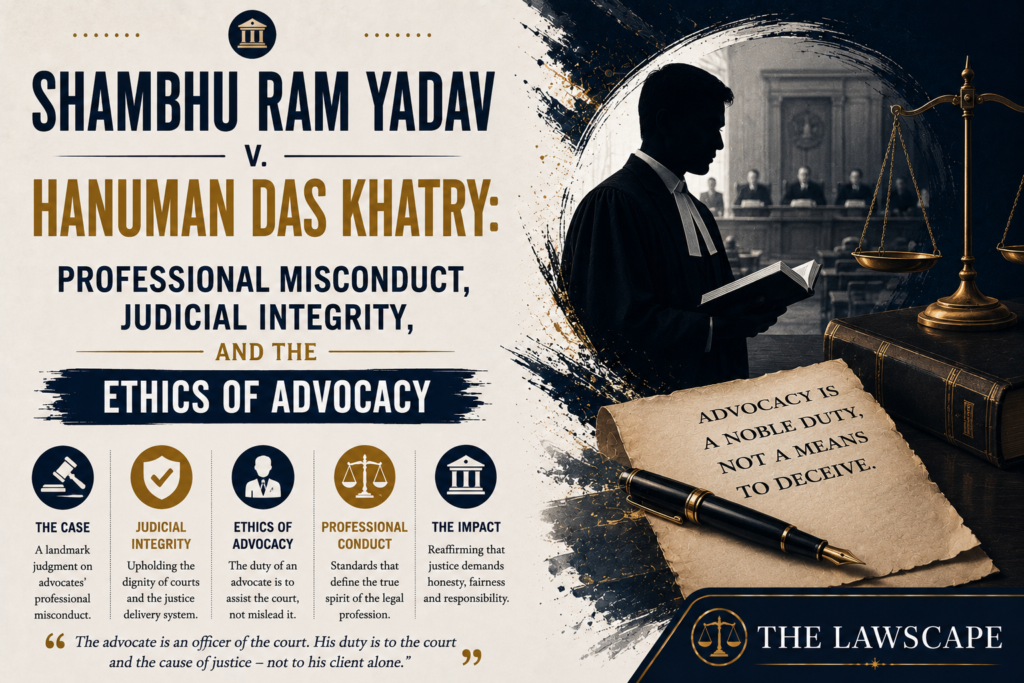
1. Shambhu Ram Yadav v. Hanuman Das Khatry reaffirmed that the legal profession is a public calling grounded in integrity, and that even suggesting bribery of a judicial officer amounts to grave professional misconduct.
2. The Supreme Court held that disciplinary bodies under the Advocates Act cannot use review powers to effectively rehear a case and reduce punishment merely because a different committee takes a more lenient view of the same facts.
3. By restoring the punishment of permanent debarment, the Court stressed that public confidence in the judiciary depends substantially on the ethical conduct of advocates, who are officers of the court as much as representatives of clients.
Introduction
The legal profession occupies a distinctive position within the justice delivery system. Unlike ordinary occupations pursued primarily for financial gain, advocacy is regarded as a noble profession carrying with it its own ethical obligations. Advocates act not only as representatives of their clients but also as officers of the court entrusted with the responsibility of preserving the integrity of the judicial process. Public confidence in the judiciary is closely connected with the conduct, behaviour, and professionalism of advocates. Consequently, any deviation from ethical standards by members of the Bar may undermine the administration of justice and diminish societal faith in the legal system.
Shambhu Ram Yadav v. Hanuman Das Khatry is a significant decision of the Supreme Court of India dealing with professional ethics and misconduct under the Advocates Act, 1961. The judgment highlights the fundamental principle that the legal profession is not merely a means of livelihood but a noble calling that demands dignity, honesty, and adherence to ethical standards. The case arose from disciplinary proceedings against an advocate who was accused of suggesting bribery of a judicial officer in order to secure a favourable decision for his client. This raised serious concerns regarding the duties of advocates toward the court, their clients, and society at large, as well as the role of Bar Councils in maintaining professional discipline. The judgment remains an important precedent in reinforcing ethical accountability among advocates and ensuring that disciplinary bodies exercise their powers in a fair, consistent, and legally sound manner.
Facts of the Case
The case arose out of disciplinary proceedings initiated against an advocate for professional misconduct. The petitioner had engaged the advocate in connection with legal proceedings. A complaint was subsequently filed before the Bar Council of Rajasthan alleging that the advocate had written a letter to his client stating that the judge in the matter allegedly accepted bribes and requesting the client to send ₹10,000 in order to influence the judgment and secure a favourable decision. Doubts then emerged regarding the advocate’s conduct and intentions, and the client came to believe that he had been deceived and that the advocate had dishonestly misused his professional position by invoking the name of the judiciary for personal gain.
The advocate admitted writing the letter but claimed that he had merely conveyed information to protect the client’s interests and had no intention of actually bribing the judge. The State Bar Council found the advocate guilty of misconduct and suspended his practice for two years. Thereafter, upon a review petition under Section 44 of the Advocates Act, the disciplinary committee modified the punishment to a mere reprimand. The matter then travelled through disciplinary proceedings and eventually reached the Supreme Court. The disciplinary authorities, after examining oral and documentary evidence, concluded that the advocate had committed professional misconduct of a grave nature. The act of demanding money in the name of bribing a judge was held to be wholly incompatible with the dignity and ethics of legal practice. Severe punishment, including permanent debarment from practice, was therefore imposed.
Issues of the Case
The Supreme Court was called upon to consider the following issues:
- Whether the act of writing such a letter amounted to professional misconduct under the Advocates Act, 1961.
- Whether a disciplinary committee could review and modify an earlier order passed by another committee under Section 44 of the Advocates Act.
- Whether the punishment of permanent debarment was justified in the facts of the case.
Arguments of the Petitioner
The petitioner challenged the order of the Disciplinary Committee of the Bar Council of India that had reduced the punishment from permanent debarment to a mere reprimand. It was argued that the respondent advocate had committed serious professional misconduct and that even suggesting or facilitating bribery was sufficient to constitute grave misconduct, regardless of whether any money was actually paid. According to the petitioner, such conduct directly undermined the integrity of the judiciary and could not be treated lightly or excused on sympathetic grounds.
The petitioner further contended that the original punishment of debarment was proportionate to the seriousness of the misconduct. A major plank of the petitioner’s case was that the disciplinary committee had exceeded its jurisdiction under Section 44 of the Advocates Act. The review, it was argued, amounted to an impermissible rehearing of the case rather than a lawful exercise of review power. The petitioner maintained that one disciplinary committee could not overrule another merely because it held a different opinion on the same facts. It was also emphasised that Bar Councils have a statutory duty to maintain discipline in the profession and to protect the reputation of the Bar. In cases involving corruption-related misconduct, personal considerations could not outweigh public interest. The petitioner therefore urged the Court to restore the original punishment in order to maintain public trust and preserve the credibility of the justice delivery system.
Arguments of the Respondent
The respondent, on the other hand, sought to support the review order reducing the punishment to a reprimand. He contended that he had no intention of bribing the judge and that the letter was merely a response to the client’s query regarding the conduct of the judge. It was argued that the act was done in the client’s interest and that the disciplinary committee had misinterpreted the letter as an offer to bribe.
The respondent also emphasised mitigating factors such as past good conduct, reputation, age, and personal circumstances. It was argued that these considerations justified leniency in disciplinary matters. The respondent further supported the review order by contending that Section 44 permits review in order to rectify errors and ensure fairness in disciplinary proceedings. According to him, the punishment imposed must be proportionate and not excessively punitive. It was also submitted that no actual bribe had been paid and that the absence of actual damage could justify reduction in punishment.
Judgment
The Supreme Court held that the respondent advocate was guilty of grave professional misconduct for writing a letter suggesting bribery of a judge. The Court found that the Disciplinary Committee of the Bar Council of India had wrongly exercised its power of review under Section 44 of the Advocates Act, 1961. As a result, the review order reducing the punishment was set aside, and the original punishment of permanent debarment from practice was restored. Costs were also imposed on the respondent. The Court reaffirmed the need for strict adherence to professional ethics and discipline within the legal profession.
The Court took a firm stand in favour of ethical accountability and professional responsibility. Although the punishment may appear severe, the judgment considered it justified in light of the need to protect the sanctity of the legal profession and the administration of justice. The Supreme Court made it clear that the legal profession cannot tolerate members who seek to enrich themselves by misleading clients and tarnishing the reputation of the judiciary. It also emphasised that public confidence forms the foundation of judicial legitimacy. Judicial decisions derive their authority from the belief that they are rendered impartially and in accordance with law. Any suggestion that judicial outcomes can be purchased through illicit payments threatens this foundational principle and therefore constitutes misconduct of the gravest nature.
Ratio Decidendi and Analysis
The case is significant because it places professional ethics at the centre of legal practice. The Court recognised that an advocate’s role is not confined to serving the immediate interests of a client. An advocate is also an officer of the court and a participant in the administration of justice. Once an advocate invokes the name of the judiciary and suggests that a judge may be bribed for a favourable outcome, the misconduct transcends a private dispute between lawyer and client. It becomes a direct assault on public faith in the justice delivery system.
The judgment also clarifies the scope of review under Section 44 of the Advocates Act. A power of review cannot be used as a device for rehearing the case on the same material merely because a different disciplinary committee takes a different view. If such a course were permitted, disciplinary proceedings would lose certainty and consistency. The Court therefore drew an important distinction between correcting an apparent legal error and substituting a fresh opinion for an earlier adjudicatory conclusion. In doing so, it protected the integrity of disciplinary adjudication under the Advocates Act.
The decision further underlines the principle that the punishment imposed in disciplinary proceedings must reflect the gravity of the misconduct. In cases involving corruption, dishonesty, or conduct that directly undermines the credibility of the judiciary, the need for deterrence becomes particularly strong. The respondent attempted to rely on mitigating circumstances such as age, good reputation, and the absence of an actual bribe. However, the Court gave primacy to the larger public interest. The seriousness of the allegation lay not only in whether money changed hands, but in the very act of representing to a client that judicial outcomes could be manipulated through bribery. Such conduct attacks the core values of the profession—integrity, honesty, and respect for the administration of justice.
The ratio of the judgment also draws support from earlier precedents emphasising ethical discipline in the legal profession. The decision refers to principles reflected in cases such as Bar Council of Maharashtra v. M.V. Dabholkar, P.O. Gupta v. Ram Murti, V.C. Rangadurai v. D. Gopalan, In Re: Vinay Chandra Mishra, and Supreme Court Bar Association v. Union of India. These authorities collectively affirm that the legal profession requires high ethical standards, that misconduct includes acts lowering the dignity of the profession, and that Bar Councils bear the primary responsibility of disciplining advocates.
At a broader level, the case reflects the Court’s insistence that public respect for the legal profession cannot be maintained unless integrity is treated as non-negotiable. The profession enjoys privileges and autonomy precisely because it performs a public function in the administration of justice. That autonomy is sustainable only if the Bar remains committed to professional ethics. Where an advocate exploits the trust of a client by invoking the possibility of bribing a judge, the misconduct strikes simultaneously at the client, the court, and the public image of the legal system.
Conclusion
In Shambhu Ram Yadav v. Hanuman Das Khatry, the Supreme Court made it clear that the legal profession requires honesty, integrity, and high moral standards. An advocate must never suggest or support any illegal activity such as bribery, even if it appears only in the form of advice or communication. Such behaviour damages public trust in both the judiciary and the legal system. The Court also explained that the power of review cannot be used to alter a disciplinary decision merely because another authority takes a different view of the same facts.
The judgment highlights the importance of discipline among lawyers and helps preserve the dignity and credibility of the legal profession. Advocates are expected to maintain dignity in their professional dealings and to avoid conduct capable of undermining public confidence in the administration of justice. By restoring the punishment of permanent debarment, the Court sent a strong message that serious professional misconduct will not be treated lightly. Ultimately, the case underscores that the legal profession can retain public respect only when its members uphold integrity as a non-negotiable professional value.
Disclaimer: The views expressed in this article are those of the author and do not necessarily reflect the views of The Lawscape.
The Lawscape — clear, practical legal insight for students and future lawyers.