
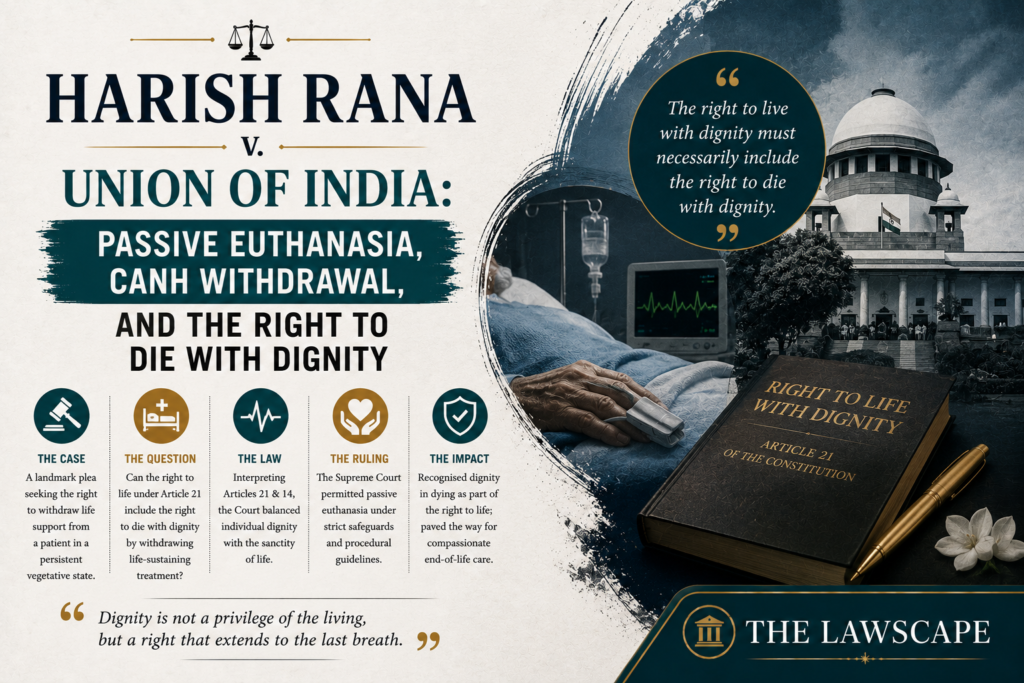
Harish Rana v. Union of India: Passive Euthanasia, CANH Withdrawal, and the Right to Die with Dignity
Author: NAMANROOP KAUR
Student, Khalsa College Of Law, Amritsar
Co – Author: Iqroop Kaur
Student, Guru Nanak Dev University
————————————————————————————–
💡 3 Quick Takeaways
1. Harish Rana v. Union of India is a significant development in India’s euthanasia jurisprudence because it operationalised the passive euthanasia framework recognised in Aruna Ramachandra Shanbaug and Common Cause.
2. The Supreme Court clarified that clinically assisted nutrition and hydration (CANH) through a PEG tube constitutes medical treatment and may, in appropriate circumstances, be withdrawn as part of passive euthanasia.
3. The judgment strengthened the constitutional understanding of dignity under Article 21 by recognising that the right to live with dignity may, in exceptional cases, include the right to die with dignity where recovery is medically impossible.
Introduction
Over the past two decades, India’s legal understanding of euthanasia, or the “right to die with dignity,” has changed dramatically. The first major step was taken in Aruna Ramachandra Shanbaug v. Union of India. The Supreme Court later reinforced this recognition through its decision in Common Cause v. Union of India. Ultimately, over time, the Supreme Court concluded that the right to life under Article 21 of the Constitution does include, in exceptional circumstances, a right to die with dignity. The decision in Harish Rana v. Union of India is an important development because it marks the Supreme Court’s first thorough implementation of the passive euthanasia framework established in earlier decisions.
This decision incorporates ethics, legal rights, and constitutional considerations in deciding whether a terminally ill person in a permanent vegetative state can stop receiving artificial support. The ruling strengthened the idea that human dignity applies both to living and to dying with dignity. It also allowed clinically assisted nutrition and hydration (CANH) to be withdrawn from a patient unable to eat or drink independently while in a long-term comatose condition. The judgment has far-reaching implications for constitutional law, medical jurisprudence, and human rights in India.
Facts of the Case
In 2013, Harish Rana, an engineering student, suffered a serious brain injury after falling from the fourth floor of his accommodation near Panjab University, Chandigarh. As a result of the injuries, he remained in a permanent vegetative state with complete paralysis of his limbs. He had no conscious awareness of his surroundings and required complete assistance for nutrition through a PEG tube for over thirteen years. Most medical professionals concluded that there was virtually no possibility of Harish regaining neurological function.
This prolonged condition caused immense emotional and financial stress to his family. His parents, who had cared for him over the years, approached the Delhi High Court seeking permission to withdraw life support. The High Court denied the request on the ground that Harish Rana was not on a ventilator and therefore could not be classified as terminally ill. It also held that removing the feeding tube would amount to active rather than passive euthanasia.
The family then appealed to the Supreme Court. During the proceedings, two separate medical boards, including specialists from the All India Institute of Medical Sciences (AIIMS), New Delhi, were constituted. Both boards unanimously concluded that Harish Rana’s condition was irreversible and that continued medical treatment would only prolong his biological existence without offering any meaningful recovery. The case was therefore heard by a Bench comprising Justice J.B. Pardiwala and Justice K.V. Viswanathan.
Issues Before the Court
The principal issues before the Supreme Court were:
- Whether clinically assisted nutrition and hydration administered through a PEG tube constituted “medical treatment” capable of withdrawal under the passive euthanasia framework.
- Whether the withdrawal of such treatment would amount to passive euthanasia or prohibited active euthanasia.
- Whether the constitutional right to life under Article 21 includes the right to die with dignity where recovery is medically impossible.
- Whether surrogate consent by family members could substitute for an advance medical directive or living will in the absence of one.
Judgment of the Supreme Court
The Supreme Court allowed the petition and granted permission for passive euthanasia. It directed AIIMS to admit Harish Rana to its palliative care department and formulate a comprehensive end-of-life care plan. The Court further authorised the withdrawal of clinically assisted nutrition and hydration while ensuring that adequate palliative and comfort care continued throughout the process.
The Bench emphasised that the decision was rooted in compassion, constitutional morality, and respect for human dignity. It held that artificially prolonging life where no possibility of recovery exists does not necessarily serve the interests of the patient. Rather, it may undermine the very dignity that Article 21 seeks to protect.
Analysis of the Court’s Reasoning
Recognition of the Right to Die with Dignity
The Court’s ruling reaffirms the principle established in Common Cause v. Union of India. It emphasised that under Article 21, “life” is not merely biological existence but includes human dignity, and that such dignity should extend to the final stages of life as well. If a person is in a permanent unconscious state with no chance of recovery, compelling life-sustaining treatment may transform medical care into a means of prolonging suffering rather than preserving dignity. The constitutional right to dignity can therefore serve as the basis for allowing a natural death in narrowly defined and strictly regulated circumstances. This approach is consistent with modern constitutional values that place patient autonomy and dignity at the centre of end-of-life decisions.
Clarification of Passive Euthanasia
A major contribution of the judgment lies in its clarification of the distinction between active and passive euthanasia. Active euthanasia involves a deliberate act intended to cause death, such as administering a lethal injection. Passive euthanasia, on the other hand, involves withholding or withdrawing medical treatment and allowing nature to take its course.
The Delhi High Court had concluded that removing a feeding tube amounted to starvation and therefore resembled active euthanasia. The Supreme Court rejected this reasoning. It held that clinically assisted nutrition and hydration require medical expertise, continuous clinical supervision, and invasive procedures. Consequently, CANH is properly characterised as medical treatment rather than ordinary care. Once classified as treatment, it may lawfully be withdrawn under the passive euthanasia framework established by earlier judgments.
This clarification is particularly important because many patients in vegetative states survive solely through artificial nutritional support. The judgment therefore removes a major ambiguity in Indian euthanasia law.
Surrogate Decision-Making
Another significant aspect of the case was the absence of a living will. In Common Cause, the Supreme Court recognised advance medical directives as a valid means of expressing a patient’s wishes regarding future medical treatment. Since Harish Rana had been injured at a young age and had never executed an advance directive, the Court permitted surrogate decision-making by his parents, subject to strict medical review and judicial oversight. The Court observed that the parents, who had cared for Harish throughout his life and illness, were in the best position to represent his wishes. The unanimous recommendations of the two independent medical boards also ensured that the decision was based on objective medical evidence rather than subjective considerations.
Importance of Palliative Care
The Court was careful to emphasise that passive euthanasia does not amount to abandoning the patient. Instead, it directed AIIMS to provide adequate supportive care to minimise discomfort and preserve dignity during the patient’s final days. This included ensuring that proper palliative care and other support services remained available throughout the process.
This reflects current medical ethics, which place strong emphasis on compassion, symptom management, and quality of life. By integrating palliative care into the passive euthanasia process, the Court ensured that dignity remained central even after the withdrawal of life-sustaining medical treatment.
Relationship with Earlier Precedents
Aruna Ramachandra Shanbaug v. Union of India
The foundation of euthanasia jurisprudence in India was laid in Aruna Ramachandra Shanbaug v. Union of India, (2011) 4 SCC 454. In that case, the Supreme Court recognised passive euthanasia in principle and established judicial safeguards for its implementation. However, the Court refused to permit euthanasia in Aruna Shanbaug’s own case, with the result that the judgment remained largely theoretical in operation.
Common Cause v. Union of India
The Constitution Bench decision in Common Cause v. Union of India, AIR 2018 SC 1665, significantly expanded the legal framework. It recognised the validity of living wills and held that the right to die with dignity forms part of Article 21. It also established detailed procedural safeguards involving medical boards and judicial oversight.
The significance of Harish Rana lies in the fact that it transformed these principles from abstract constitutional doctrine into practical reality. It is therefore best understood as the operational implementation of Common Cause.
Critical Evaluation
The judgment deserves appreciation for its humanistic and constitutionally sensitive approach. The Court not only upheld the sanctity of life but also recognised that dignity may, in certain circumstances, require allowing a person to die naturally. By giving substantial weight to dignity as a constitutional value, the Court affirmed that the law must remain attentive to human suffering and the realities of irreversible medical conditions.
Another strength of the judgment lies in its reliance on extensive medical evidence. The requirement of multiple medical boards reduces the possibility of abuse and ensures that the conclusions reached are based on scientific and objective criteria. Judicial oversight further strengthens fairness and procedural legitimacy.
At the same time, the case also reveals certain continuing concerns. First, India still lacks comprehensive legislation governing euthanasia, and much of the legal framework remains dependent upon judicial guidelines rather than statutory provisions. This creates uncertainty regarding procedural requirements and institutional responsibilities. Secondly, surrogate decision-making may raise concerns in future cases where family members disagree or where financial motivations are alleged. Although no such issue arose in Harish Rana’s case, the possibility cannot be ignored. Thirdly, access to palliative care remains uneven across India. The effectiveness of passive euthanasia as a dignified process depends heavily on the availability of quality palliative services, which remain inadequate in many parts of the country.
Despite these concerns, the safeguards established by the Court substantially reduce the possibility of misuse and provide a workable framework until comprehensive legislation is enacted.
Conclusion
Harish Rana v. Union of India is a significant decision in Indian constitutional and medical law. By allowing the withdrawal of clinically assisted nutrition and hydration from a patient in a permanent vegetative state, the Supreme Court reaffirmed that the right to die with dignity forms part of the broader guarantee of life and dignity under Article 21 of the Constitution. It also clarified that CANH constitutes medical treatment, advanced the doctrine of passive euthanasia, and illustrated the practical application of the principles established in Common Cause.
The ruling reflects a compassionate approach to human suffering and constitutional dignity. It also highlights the urgent need for a comprehensive legislative framework governing end-of-life decision-making in India. As one of the first major decisions in India to operationalise passive euthanasia in practice, the case is likely to remain an important precedent in the continuing development of the law on euthanasia, patient autonomy, and dignity.
Disclaimer: The views expressed in this article are those of the author and do not necessarily reflect the views of The Lawscape.
The Lawscape — clear, practical legal insight for students and future lawyers.