
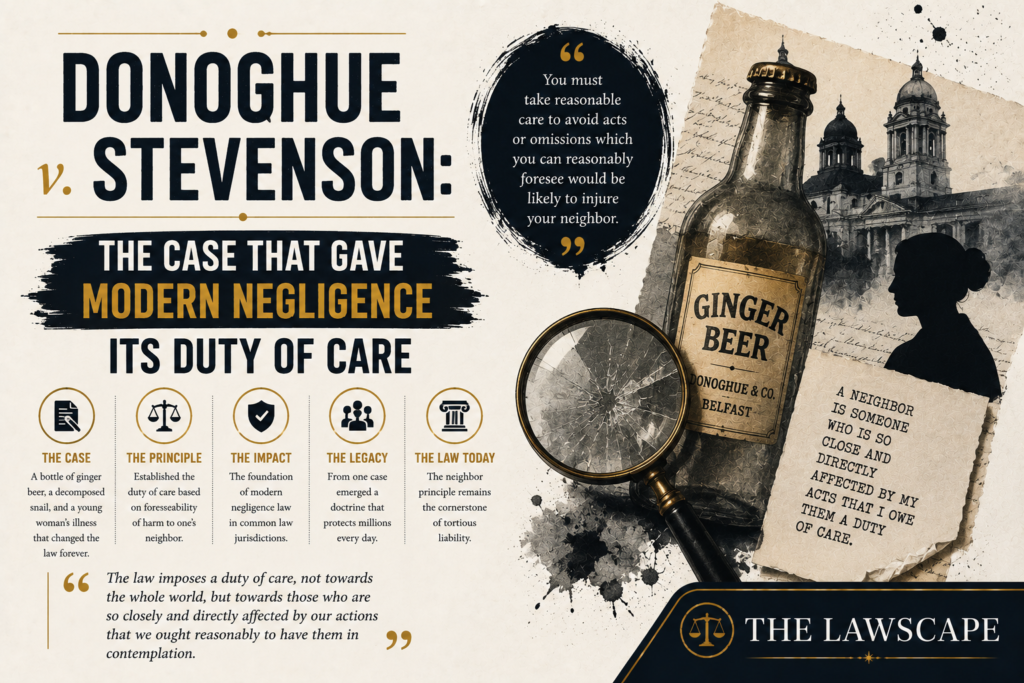
Donoghue v Stevenson: The Case That Gave Modern Negligence Its Duty of Care
Author: Dondavis Chisom David
Student, Nnamdi Azikiwe University (Akwa, Nigeria)
————————————————————————————
💡 3 Quick Takeaways
1. Donoghue v Stevenson established the modern concept of duty of care through Lord Atkin’s “Neighbour Principle.”
2. The House of Lords held that a manufacturer may owe a duty directly to the ultimate consumer even in the absence of a contractual relationship.
3. The decision transformed negligence from a collection of isolated rules into a coherent legal doctrine that continues to shape tort law across common law jurisdictions.
Introduction
The decision in Donoghue v Stevenson remains one of the most significant judicial authorities in the development of the law of negligence. The case established the modern concept of duty of care through Lord Atkin’s celebrated “Neighbour Principle.” Prior to this decision, liability for negligence was largely confined to situations where a contractual relationship existed between the parties or where specific exceptions had been recognised by law.
The judgment transformed negligence from a collection of isolated legal rules into a coherent legal doctrine. It laid the foundation upon which modern tort law has been built and continues to influence judicial reasoning in common law jurisdictions, including Nigeria.
This commentary examines the facts of the case, the issues before the court, the arguments advanced by both parties, the ratio decidendi, and the continuing significance of the decision in contemporary negligence law.
Facts of the Case
On 26 August 1928, Mrs May Donoghue accompanied a friend to the Wellmeadow Café in Paisley, Scotland. Her friend purchased for her a bottle of ginger beer manufactured by the respondent, Mr David Stevenson.
The ginger beer was contained in an opaque bottle sealed with a metal cap, preventing its contents from being inspected before consumption. After Mrs Donoghue had consumed part of the drink, her friend poured the remaining contents into a tumbler. A decomposed snail emerged from the bottle.
As a consequence of consuming the contaminated drink and witnessing the decomposed snail, Mrs Donoghue allegedly suffered severe gastroenteritis and nervous shock.
Since her friend had purchased the drink, Mrs Donoghue had no contractual relationship with either the café owner or the manufacturer. She therefore instituted an action directly against Stevenson in negligence.
Issues for Determination
The House of Lords was called upon to determine:
- Whether a manufacturer owes a duty of care to the ultimate consumer of its products.
- Whether such a duty can arise in the absence of a contractual relationship between the manufacturer and the consumer.
Arguments of the Parties
Appellant’s Argument
The appellant contended that Stevenson owed a duty to ensure that his manufacturing process was reasonably safe. She argued that the respondent ought to have maintained an effective system of inspection capable of preventing snails and other contaminants from entering bottles during production.
It was further submitted that manufacturers should not be exempt from liability merely because the ultimate consumer did not purchase the product directly from them. According to the appellant, the existence of a duty of care should depend upon the circumstances of each case rather than the existence of a contractual relationship.
The appellant therefore maintained that the respondent’s negligence in the manufacturing process directly caused her injuries.
Respondent’s Argument
The respondent argued that the appellant’s pleadings disclosed no legally recognisable cause of action. He maintained that no duty of care was owed to Mrs Donoghue because there was no contractual relationship between them. Stevenson relied on existing authorities which generally restricted liability for negligence to recognised categories.
The respondent therefore contended that even if all the facts alleged by the appellant were accepted as true, the law did not provide a remedy and the action should be dismissed without proceeding to trial.
Ratio Decidendi
By a majority of three to two, the House of Lords held that the manufacturer owed a duty of care to the ultimate consumer.
Lord Atkin formulated the famous Neighbour Principle, stating:
“You must take reasonable care to avoid acts or omissions which you can reasonably foresee would be likely to injure your neighbour.”¹
He further explained:
“Who, then, in law is my neighbour? The answer seems to be—persons who are so closely and directly affected by my act that I ought reasonably to have them in contemplation…”²
The court held that where a manufacturer places a product into circulation in a form that prevents intermediate examination, and injury to the consumer is reasonably foreseeable, a duty of care arises.
Accordingly, the respondent could be held liable for negligence notwithstanding the absence of a contractual relationship with the appellant.
Legal Analysis
The significance of Donoghue v Stevenson cannot be overstated. The decision fundamentally altered the law of negligence and continues to shape modern tort jurisprudence.
Creation of the Modern Duty of Care Principle
Before Donoghue v Stevenson, negligence liability was largely confined to contractual relationships and a few recognised exceptions. The judgment introduced a general principle capable of determining when a duty of care exists. The Neighbour Principle became the foundation upon which subsequent negligence cases were decided and remains one of the most influential legal principles in common law history.
Expansion of Manufacturer’s Liability
The case established that manufacturers may owe duties directly to consumers even where no contract exists between them. This development provided significant protection for consumers and ensured that manufacturers could be held accountable for foreseeable harm resulting from defective products. It effectively closed a major gap in the law that previously shielded manufacturers from liability.
Transformation of Negligence into a Coherent Legal Doctrine
Prior to the decision, negligence law consisted largely of disconnected rules developed through individual cases. Donoghue v Stevenson transformed negligence into a unified doctrine built around essential elements including:
- Duty of care
- Breach of duty
- Causation
- Damage
These elements continue to form the basis of negligence claims in modern legal systems.
Influence Beyond the United Kingdom
The impact of the decision extends far beyond the United Kingdom. Courts across common law jurisdictions, including Nigeria, India, Australia, and Canada, have relied upon the principles established in the case. Nigerian courts have consistently recognised duty of care as an essential ingredient of negligence actions and have drawn upon common law authorities influenced by Donoghue v Stevenson.
Although the Neighbour Principle remains foundational, courts have subsequently refined the scope of duty of care. A notable example is Caparo Industries plc v Dickman, where the House of Lords introduced the three-stage test of foreseeability, proximity, and whether it is fair, just and reasonable to impose liability. Nevertheless, these developments do not diminish the authority of Donoghue v Stevenson. Rather, they represent judicial refinements of the principle first articulated by Lord Atkin.
Conclusion
Donoghue v Stevenson remains the cornerstone of modern negligence law. Its enduring legacy lies in the establishment of the duty of care doctrine and the formulation of the Neighbour Principle, which continue to guide courts in determining liability for negligence.
The case revolutionised product liability, expanded the protection afforded to consumers, and transformed negligence into a coherent legal doctrine. Nearly a century after it was decided, its influence remains visible in judicial decisions across the common law world, including Nigeria. The decision therefore stands not merely as a landmark case but as one of the most important judicial developments in the history of tort law.
Disclaimer: The views expressed in this article are those of the author and do not necessarily reflect the views of The Lawscape.
The Lawscape — clear, practical legal insight for students and future lawyers.