
Kesavananda Bharati v. State of Kerala: The Judgment That Drew the Constitutional Line
Author: Avni sood
Student, Army institute of law, mohali sec 68
—————————————————————————————
💡 3 Quick Takeaways
- Kesavananda Bharati established the Basic Structure Doctrine and held that Parliament’s power to amend the Constitution is wide, but not unlimited.
- The Supreme Court clarified that even Fundamental Rights may be amended, provided the amendment does not damage the Constitution’s essential framework.
- The judgment remains a constitutional safeguard against authoritarian amendments and continues to shape Indian constitutional law.
Introduction
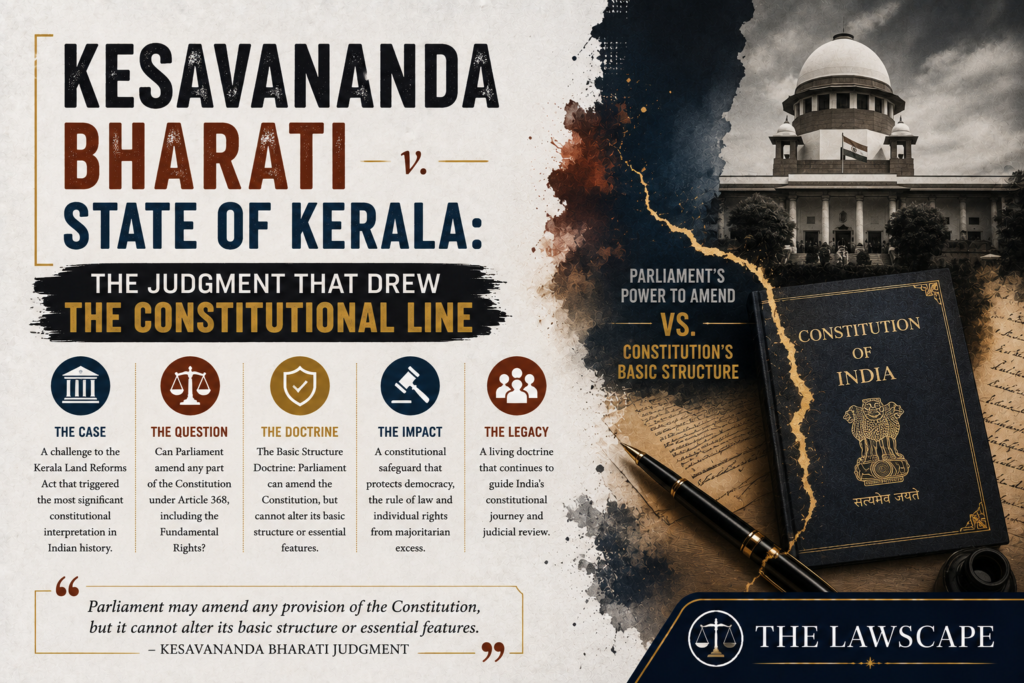
The judgment in Kesavananda Bharati v. State of Kerala is regarded as one of the most significant constitutional decisions in Indian legal history. Delivered on 24 April 1973 by a thirteen-judge bench of the Supreme Court of India, the case established the “Basic Structure Doctrine,” which limits the amending power of Parliament under Article 368 of the Constitution. The decision attempted to balance two important constitutional principles: parliamentary sovereignty and constitutional supremacy.
Before this judgment, Parliament claimed that it possessed unlimited power to amend any part of the Constitution, including the Fundamental Rights. However, the Supreme Court in Kesavananda Bharati held that although Parliament has wide powers to amend the Constitution, it cannot alter or destroy its “basic structure.” This doctrine turned out to be a constitutional safeguard against authoritarian amendments and the arbitrary exercise of power by the legislature.
However, the case remains controversial because the doctrine was not expressly mentioned in the Constitution. Critics argue that the Court acted beyond its judicial role by creating limitations not written in the constitutional text. Supporters, on the other hand, believe that the doctrine preserved democracy, judicial review, secularism, federalism, and the rule of law in India.
Background
The roots of the dispute can be traced to the constitutional and political developments that followed independence. After 1950, the Government of India introduced various agrarian reform laws aimed at abolishing the zamindari system and redistributing land to achieve socio-economic justice. These reforms frequently came into conflict with the Fundamental Right to Property guaranteed under Articles 19(1)(f) and 31 of the Constitution.
The constitutional conflict between Parliament and the judiciary began with Shankari Prasad v. Union of India, where the Supreme Court held that Parliament possessed the power to amend Fundamental Rights under Article 368. This view was later reaffirmed in Sajjan Singh v. State of Rajasthan.
However, the position changed dramatically in I.C. Golaknath v. State of Punjab, where the Supreme Court held by majority that Parliament could not amend Fundamental Rights because they were transcendental and immune in nature. The judgment significantly restricted Parliament’s amending powers and eventually created tension between the legislature and judiciary.
In response, Parliament enacted the Twenty-Fourth, Twenty-Fifth, and Twenty-Ninth Constitutional Amendments to restore its power. The Twenty-Fourth Amendment expressly affirmed Parliament’s amending power under Article 368. The Twenty-Fifth Amendment curtailed the scope of judicial review in matters relating to property and Directive Principles, while the Twenty-Ninth Amendment placed certain Kerala land reform statutes into the Ninth Schedule to protect them from judicial scrutiny.
Swami Kesavananda Bharati, the head of the Edneer Mutt in Kerala, challenged the Kerala Land Reforms Act, 1969, which adversely affected the property owned by the religious institution. During the proceedings, the constitutional validity of the aforementioned amendments was also challenged, thereby transforming the dispute into one of the largest constitutional cases ever heard in India.
Issues
The Supreme Court in Kesavananda Bharati v. State of Kerala dealt with several crucial constitutional questions relating to Parliament’s amending powers under Article 368 of the Constitution. The major issues before the Court were:
- Whether Parliament possesses unlimited power under Article 368 to amend every part of the Constitution, including Fundamental Rights.
- Whether the Twenty-Fourth Constitutional Amendment Act, 1971, was constitutionally valid in granting Parliament unrestricted amending power.
- Whether the Twenty-Fifth Constitutional Amendment Act, 1971, which curtailed the right to property and limited judicial review, violated the Constitution.
- Whether the Twenty-Ninth Constitutional Amendment Act, 1972, which placed certain Kerala land reform laws under the Ninth Schedule, was valid and immune from judicial review.
- Whether Fundamental Rights are amendable or whether they are beyond the scope of Parliament’s amending powers.
- Whether there exist implied limitations upon Parliament’s constituent power even though such limitations are not expressly mentioned in the Constitution.
- Whether Parliament can alter or destroy the essential features or identity of the Constitution through constitutional amendments.
- Whether judicial review itself can be restricted or abolished by constitutional amendment.
- Whether the balance between Fundamental Rights and Directive Principles of State Policy could be changed completely through amendment.
- Whether the supremacy of the Constitution is higher than parliamentary supremacy in the Indian constitutional framework.
These issues ultimately led the Supreme Court to formulate the Basic Structure Doctrine, which became the central principle emerging from the case.
Arguments
Arguments by the Petitioner
The petitioner, Swami Kesavananda Bharati, along with other petitioners challenging the constitutional amendments, argued that Parliament’s amending power under Article 368 should not be unlimited and must be exercised in a manner that does not destroy the essential features of the Constitution. The petitioners stated that the Constitution of India is founded upon certain basic principles such as democracy, rule of law, judicial review, secularism, and the protection of Fundamental Rights, which form the core identity of the Constitution and therefore cannot be abrogated even through constitutional amendment.
The petitioners strongly relied upon the judgment in I.C. Golaknath v. State of Punjab and argued that Fundamental Rights occupy a transcendental position within the constitutional framework. According to them, Article 368 merely prescribes the procedure for amendment of the Constitution and does not provide absolute power to Parliament. Therefore, Parliament cannot use Article 368 to destroy or violate Fundamental Rights.
It was further argued that the Twenty-Fourth Amendment, which sought to grant unlimited amending power to Parliament, was unconstitutional because Parliament itself is a body created by the Constitution and cannot enlarge its powers beyond constitutional limitations. The petitioners contended that if Parliament were given unrestricted authority, it could abolish democracy, suspend elections, eliminate judicial review, or even convert India into an authoritarian state, thereby destroying the Constitution entirely.
Regarding the Twenty-Fifth Amendment, the petitioners argued that the amendment severely restricted the scope of judicial review and subordinated Fundamental Rights to Directive Principles of State Policy. They maintained that judicial review is an essential feature of the Constitution and cannot be removed by constitutional amendment.
The petitioners also challenged the Twenty-Ninth Amendment, under which the Kerala land reform statutes were placed in the Ninth Schedule. They argued that laws inserted into the Ninth Schedule should still be subject to judicial review to ensure that they do not violate essential constitutional principles or Fundamental Rights forming part of the Constitution’s basic framework.
Overall, the petitioners urged the Court to recognise implied limitations upon Parliament’s amending power and to preserve the supremacy and identity of the Constitution.
Arguments by the Respondents
The State, represented primarily by the Government of India, argued that Parliament possesses complete and unlimited power to amend the Constitution under Article 368. The respondents contended that the Constitution does not impose any restrictions upon Parliament’s constituent power and therefore courts cannot create any limitations through judicial interpretation.
The Government argued that constitutional amendments are different from ordinary legislation because they are an exercise of constituent power rather than legislative power. Therefore, amendments passed under Article 368 cannot be challenged on the ground that they violate Fundamental Rights.
The respondents relied upon the earlier decisions in Shankari Prasad v. Union of India and Sajjan Singh v. State of Rajasthan, where the Supreme Court had upheld Parliament’s authority to amend Fundamental Rights. According to the Government, the judgment in Golaknath was wrongly decided because it unnecessarily restricted Parliament’s ability to implement socio-economic reforms.
The State further argued that Parliament, as the representative body elected by the people, must possess sufficient flexibility to amend the Constitution according to changing social, economic, and political conditions. Restricting Parliament’s amending power would hinder social justice reforms, land redistribution policies, and implementation of Directive Principles of State Policy.
The Government also contended that the Twenty-Fourth and Twenty-Fifth Amendments were enacted to restore constitutional balance after the Golaknath decision and to ensure that Parliament could effectively pursue welfare objectives. According to the respondents, the judiciary should not interfere with constitutional amendments passed by elected representatives because such interference would undermine democratic principles and parliamentary sovereignty.
In relation to the Twenty-Ninth Amendment, the State argued that placing laws in the Ninth Schedule protects important legislation from prolonged litigation and judicial obstruction. The Government therefore requested the Court to uphold Parliament’s unrestricted amending power and validate all the challenged amendments.
Judgment
The Supreme Court in Kesavananda Bharati v. State of Kerala delivered its historic judgment on 24 April 1973 by a narrow majority of 7:6. The Court attempted to resolve the long-standing constitutional conflict between Parliament and the judiciary regarding the extent of Parliament’s amending powers under Article 368 of the Constitution.
The majority of the Court held that Parliament possesses very wide powers to amend the Constitution and that such powers also extend to Fundamental Rights. In this respect, the Court overruled the earlier decision in I.C. Golaknath v. State of Punjab to the extent that Golaknath had held that Fundamental Rights were completely beyond amendment.
However, while recognising Parliament’s broad amending authority, the Court also imposed an important limitation upon that power. The Supreme Court held that Parliament cannot alter, destroy, or damage the “basic structure” or “essential features” of the Constitution. This principle later became famous as the Basic Structure Doctrine.
The Court did not provide an exhaustive list of what constitutes the basic structure of the Constitution, but several judges identified certain features as fundamental, including:
- Supremacy of the Constitution
- Rule of law
- Judicial review
- Separation of powers
- Federalism
- Secularism
- Democracy
- Republican form of government
- Dignity and freedom of the individual
The Court upheld the constitutional validity of the Twenty-Fourth Constitutional Amendment Act, 1971, which affirmed Parliament’s power to amend the Constitution under Article 368. The judges held that Parliament can amend any provision of the Constitution, including Fundamental Rights, so long as the amendment does not destroy the Constitution’s essential framework.
The Twenty-Fifth Constitutional Amendment Act, 1971, was upheld only partially. The Court accepted the first part of Article 31C, which gave primacy to certain Directive Principles over Fundamental Rights, but struck down the second part that attempted to exclude judicial review completely. The Court held that judicial review is an important part of the basic structure of the Constitution and therefore cannot be removed by amendment.
The Twenty-Ninth Constitutional Amendment Act, 1972, which inserted certain Kerala land reform laws into the Ninth Schedule, was also upheld. However, the Court clarified that laws placed under the Ninth Schedule would still remain subject to judicial review if they violated the basic structure of the Constitution.
The majority judgment therefore established a balance between constitutional flexibility and constitutional stability. Parliament retained broad authority to amend the Constitution in order to meet changing social and economic needs, but it could not use that authority to destroy the Constitution’s identity itself.
The dissenting judges disagreed strongly with the majority. They argued that Article 368 grants Parliament unlimited constituent power and that the judiciary cannot impose restrictions not expressly mentioned in the Constitution. According to the dissent, constitutional amendments passed by Parliament reflect the sovereign will of the people and should not be invalidated by judicial interpretation.
Despite the divided opinions, the majority decision ultimately prevailed and became one of the most important constitutional precedents in Indian legal history. The Basic Structure Doctrine established through this judgment later became the foundation for several landmark constitutional decisions, including Minerva Mills v. Union of India and I.R. Coelho v. State of Tamil Nadu.
Case Analysis
The Supreme Court made an important decision in Kesavananda Bharati v. State of Kerala on 24 April 1973. The Court held that Parliament has extensive power to amend the Constitution, and this includes the power to amend Fundamental Rights.
The Court departed from its earlier position in I.C. Golaknath v. State of Punjab. In that case, the Court had held that Fundamental Rights could not be amended. However, in Kesavananda Bharati, the Court held that Parliament can amend Fundamental Rights. At the same time, it also held that Parliament cannot alter the “basic structure” or “essential features” of the Constitution.
The Court did not provide a fixed or exhaustive list of what these basic features are. However, several judges identified features such as the supremacy of the Constitution, rule of law, judicial review, separation of powers, federalism, secularism, democracy, and the republican form of government. The dignity and freedom of the individual were also recognised as important constitutional values. These elements emerged through the opinions of various judges.
The Court held that Parliament can amend any part of the Constitution, including Fundamental Rights, but it cannot destroy the basic identity of the Constitution.
The Court also examined the constitutional amendments in question. It upheld the Twenty-Fourth Constitutional Amendment Act, 1971, which affirmed Parliament’s power to amend the Constitution.
With regard to the Twenty-Fifth Constitutional Amendment Act, 1971, the Court held that part of the amendment was valid but some part of it was not. While the Court accepted the portion that gave primacy to certain Directive Principles, it held that judicial review is a basic part of the Constitution and cannot be excluded, since it is essential to ensure that laws made by Parliament do not violate the Constitution’s basic identity.
The Court also examined the Twenty-Ninth Constitutional Amendment Act, 1972. It upheld the amendment but clarified that even if a law is placed in the Ninth Schedule, it can still be reviewed by the Court if it violates the basic structure of the Constitution.
In this way, the Court struck a balance between constitutional change and constitutional preservation. Parliament can amend the Constitution to meet the needs of the country, but it cannot destroy the Constitution’s essential framework.
Some judges disagreed with the majority. They argued that Parliament has complete power to amend the Constitution and that the Court should not impose limitations not found in the text. They maintained that Parliament’s decisions reflect the will of the people and that the judiciary should not interfere.
Even though the judges were deeply divided, the majority decision prevailed. The Basic Structure Doctrine became an important part of Indian constitutional law and was later relied upon in major constitutional cases, including Minerva Mills v. Union of India and I.R. Coelho v. State of Tamil Nadu. The Kesavananda Bharati case therefore remains one of the most important decisions in Indian constitutional history.
Ratio Decidendi
In the landmark case of Kesavananda Bharati v. State of Kerala, the Supreme Court determined that despite the expansive authority granted to Parliament under Article 368 to amend the Constitution, such authority is limited. It cannot be exercised in a manner that compromises the “basic structure” of the Constitution. The Court drew a clear distinction between the power to “amend” the Constitution and the power to “abrogate” or “destroy” it.
The majority opinion asserted that while amendments may permit modifications and changes, they do not empower Parliament to alter the Constitution’s core identity or essential character. This judicial interpretation emphasised that constitutional supremacy prevails over parliamentary supremacy in India, since Parliament derives its authority from the Constitution itself.
Consequently, Parliament cannot extend its powers to destroy the basic principles on which the Constitution is built. Judicial review was affirmed as an integral component of the basic structure and therefore immune from removal through constitutional amendment. The judgment also recognised democracy, federalism, secularism, separation of powers, and the rule of law as important constitutional features protected from Parliament’s destructive influence.
The significance of this judgment lies in the boundaries it placed upon the power of constitutional amendment, thereby safeguarding democratic governance. The Basic Structure Doctrine introduced by the Court acts as a constitutional bulwark against authoritarian amendments and the concentration of political power.
Its relevance was particularly highlighted during the Emergency period, when the Forty-Second Constitutional Amendment sought to expand parliamentary authority and limit judicial review. The Supreme Court’s invocation of the Basic Structure Doctrine in Minerva Mills v. Union of India served to invalidate provisions that disturbed the constitutional equilibrium.
Justification of the Judgment
The judgment can largely be considered justified because it prevents Parliament from having unlimited power to amend the Constitution. If Parliament had unrestricted powers, such authority could be misused to abolish elections, permanently suspend Fundamental Rights, or even remove the power of judicial review through constitutional amendments.
At the same time, the judgment was criticised for promoting judicial activism because the Basic Structure Doctrine is not expressly mentioned in the Constitution and was judicially evolved. Critics argued that the Supreme Court created a new limitation without a textual basis and thereby increased the power of the judiciary over Parliament.
Even with these criticisms, the doctrine has played an important role in protecting democracy in India. Events following the Emergency showed that the Basic Structure Doctrine acts as a safeguard against the misuse of constitutional powers. Therefore, although the Court’s reasoning was not entirely free from ambiguity, the judgment ultimately strengthened constitutional democracy rather than weakened it.
Conclusion
Kesavananda Bharati v. State of Kerala was a landmark ruling that had a lasting effect on Indian constitutional law because it defined the relationship between constitutional supremacy and parliamentary power. Through the formulation of the Basic Structure Doctrine, the Court clarified that while the power to amend the Constitution under Article 368 is broad, it is not limitless, and Parliament cannot exercise that power in a manner that destroys the Constitution’s essential identity.
This ruling ensured that the Constitution remains paramount over Parliament, and that core constitutional values such as democracy, rule of law, judicial review, secularism, federalism, and separation of powers cannot be arbitrarily amended away. The ruling thus served as a necessary check on the concentration of power and the possibility of authoritarianism through constitutional means.
There are, of course, criticisms of the judgment. Critics point out that the Constitution nowhere expressly refers to the Basic Structure Doctrine or indicates that the Supreme Court may impose such limitations on Parliament’s constituent authority. Additionally, since the Constitution does not provide a precise definition of “basic structure,” courts retain discretion in interpreting the doctrine, which can create ambiguity.
Despite these criticisms, the judgment has had a largely positive impact on the Constitution in the long run. The doctrine later played a crucial role during the Emergency period and in several constitutional cases by preventing attempts to weaken democratic institutions and judicial review. The judgment therefore demonstrated that constitutional governance requires limitations even upon the power of constitutional amendment in order to preserve constitutional identity and democratic stability.
Ultimately, Kesavananda Bharati transformed Indian constitutional law by ensuring that the Constitution remains a living yet protected document whose essential framework cannot be destroyed by temporary political majorities. The case continues to stand as a symbol of constitutionalism, judicial independence, and the protection of democratic values in India.
Disclaimer: The views expressed in this article are those of the author and do not necessarily reflect the views of The Lawscape.
The Lawscape — clear, practical legal insight for students and future lawyers.