
Problems Faced by Women in Society and the Family: Legal Protections and Continuing Challenges
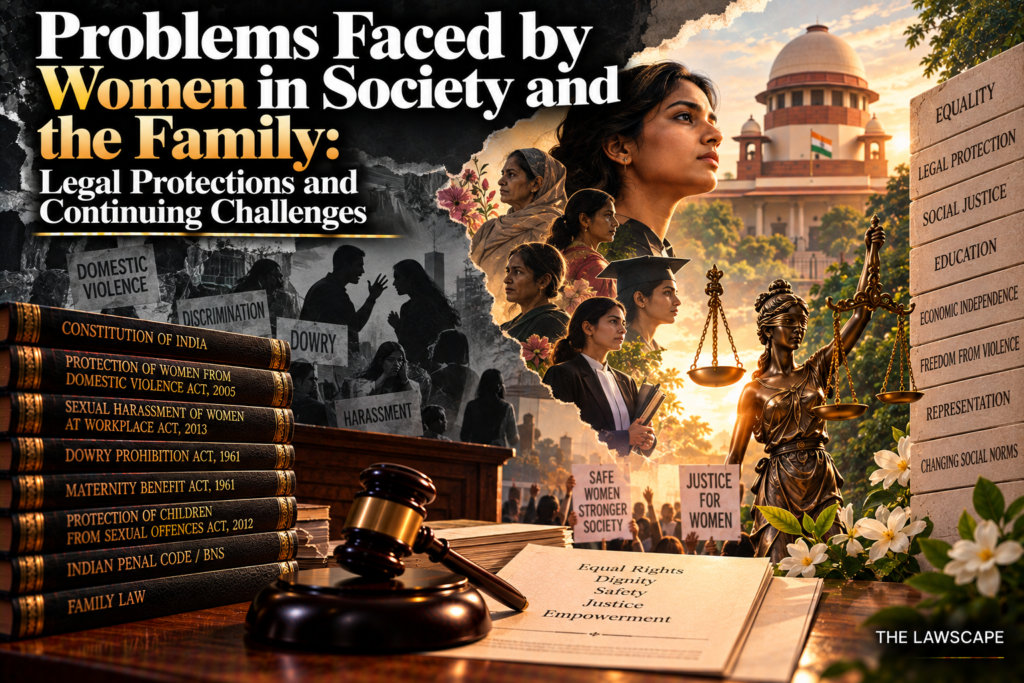
Author: Sangeetha Mathiyazhagan
Student, Government law college, vellore
—————————————————————————————
💡 3 Quick Takeaways
- Gender inequality persists: Women continue to face discrimination in education, employment, property rights, family life and access to opportunities.
- Legal protections are available: The Constitution of India and legislation addressing domestic violence, dowry, workplace sexual harassment and maternity benefits provide important safeguards for women.
- Awareness and social change are essential: Effective enforcement of the law, awareness of legal rights and a more equitable distribution of domestic responsibilities are important to addressing the challenges women face.
Introduction
Women play a vital role in the development of a country. Despite their contributions, they continue to face numerous challenges, including sexual harassment, rape, acid attacks, domestic violence and discrimination. These problems can create fear and restrict women’s freedom to pursue education, employment and other opportunities outside the home. Since the development of a nation depends on the contributions of both men and women, barriers to women’s participation also affect the country’s overall progress.
Even though Lady Justice holds her scales in balance, an important question remains: why does society continue to treat men and women differently? Although women have gained greater access to education and employment, they still encounter discrimination within their families, educational institutions and workplaces.
From birth onwards, women may experience gender bias, stress, anxiety and unequal expectations. These challenges affect their physical and mental well-being and can limit their independence. This article examines the problems women face in society and within their families, together with the constitutional provisions and legal remedies available to protect their rights.
Keywords: Gender discrimination, sexual harassment, domestic violence, women’s rights, gender equality.
1. Gender Discrimination
Gender discrimination remains a significant obstacle to women’s social and economic development. Although equality is recognised as a fundamental principle, women continue to face unequal treatment in many areas of life. Such discrimination may be particularly pronounced in communities where limited access to education and awareness of legal rights reinforces traditional gender roles.
Within families, men may be allowed greater freedom to make decisions, pursue education and choose their careers, while women face restrictions justified on grounds of safety, tradition or social expectations. Although safety concerns may be genuine, restricting women’s opportunities rather than addressing the underlying risks can limit their independence and development.
1.1 Education
In some families, girls receive fewer opportunities for higher education than boys. Financial constraints, early marriage, household responsibilities and concerns about safety may prevent women from continuing their studies. Unequal access to education can affect their employment prospects, financial independence and awareness of their legal rights.
1.2 Sexual Harassment
Sexual harassment is a serious problem affecting women’s participation in education, employment and public life. Fear of harassment may lead families to restrict women’s mobility or discourage them from working outside the home. Such restrictions can reduce their access to professional opportunities and economic independence.
1.3 Discrimination Within the Family
Some families give greater importance to male members in matters of education, inheritance, decision-making and financial support. Such unequal treatment can undermine women’s confidence and limit their ability to make independent choices.
1.4 Traditional and Social Expectations
Traditional expectations may impose restrictions on women’s behaviour, clothing, mobility and personal decisions. Women may be discouraged from questioning these expectations, even when they affect their rights and opportunities. Respect for cultural traditions should not prevent women from exercising their legal rights or participating equally in society.
1.5 Property Rights
Women may face resistance when claiming their rightful share in family property. Families sometimes prefer male heirs, leaving women unaware of or unable to exercise their legal entitlements. Awareness of applicable succession laws is therefore essential to ensuring that women can claim their rights.
1.6 Unequal Wages
Women may receive lower wages than men for comparable work. Unequal remuneration affects their financial security and reinforces economic dependence. Equal remuneration and fair employment practices are important to ensuring women’s economic independence.
2. Constitutional Provisions Protecting Women in India
The Constitution of India provides several safeguards that support gender equality and protect women against discrimination.
2.1 Article 14: Equality Before the Law
Article 14 guarantees equality before the law and equal protection of the laws. It establishes a constitutional foundation for challenging arbitrary and discriminatory treatment.
2.2 Article 15(1): Prohibition of Discrimination
Article 15(1) prohibits the State from discriminating against citizens on grounds only of religion, race, caste, sex, place of birth or any of them. The provision is particularly relevant to preventing discrimination based solely on sex.
2.3 Article 15(3): Special Provisions for Women and Children
Article 15(3) permits the State to make special provisions for women and children. It provides a constitutional basis for measures intended to address disadvantage and promote their welfare.
2.4 Article 16: Equality of Opportunity in Public Employment
Article 16 guarantees equality of opportunity for citizens in matters relating to public employment. It supports the principle that women should not be denied equal opportunities in public services on discriminatory grounds.
2.5 Article 39(a): Adequate Means of Livelihood
Article 39(a), a Directive Principle of State Policy, directs the State to ensure that men and women equally have the right to an adequate means of livelihood.
2.6 Article 42: Humane Working Conditions and Maternity Relief
Article 42 directs the State to make provisions for securing just and humane conditions of work and maternity relief. It provides a constitutional foundation for maternity-related protections and safeguards for working women.
Together, these provisions establish an important constitutional framework for promoting women’s equality, dignity and participation in public and private life.
3. Domestic Violence and Legal Protection
Domestic violence is another serious problem faced by women within families. It may involve physical, emotional, verbal, sexual or economic abuse. Such abuse may be perpetrated by a husband, members of his family or other persons within a domestic relationship. In some cases, violence or harassment is connected with demands for dowry or other financial expectations.
The Protection of Women from Domestic Violence Act, 2005 (PWDVA) provides civil remedies and protective measures for women experiencing domestic violence. Its protections may also extend to women in qualifying relationships in the nature of marriage, subject to the requirements of the Act.
Important Provisions of the PWDVA
- Section 3 — Definition of domestic violence: Defines domestic violence and identifies forms of conduct covered by the Act.
- Section 12 — Application to the Magistrate: Enables an aggrieved person, or another person acting on her behalf as permitted by the Act, to seek relief from a Magistrate.
- Section 17 — Right to reside in a shared household: Recognises an aggrieved woman’s right to reside in the shared household in accordance with the Act, irrespective of whether she has ownership rights.
- Section 18 — Protection orders: Authorises the Magistrate to issue protection orders to prevent further domestic violence.
- Section 19 — Residence orders: Provides for residence-related relief, including measures concerning the shared household.
- Section 20 — Monetary relief: Enables the Magistrate to grant monetary relief for expenses and losses resulting from domestic violence, as provided by the Act.
Relevant Case Laws
1. Satish Chander Ahuja v. Sneha Ahuja (2020), (2021) 1 SCC 414
The Supreme Court examined the meaning of a “shared household” under the PWDVA. The decision clarified that a woman’s right to reside in a shared household is not necessarily dependent on her ownership of the property. The judgment is significant in understanding the residential protections available to women facing domestic difficulties.
2. Indra Sarma v. V.K.V. Sarma (2013), (2013) 15 SCC 755
The Supreme Court considered the circumstances in which a relationship outside marriage may qualify as a relationship in the nature of marriage under the PWDVA. The judgment explains that the nature and circumstances of the relationship are relevant to determining whether the Act’s protections apply.
3. D. Velusamy v. D. Patchaiammal (2010), (2010) 10 SCC 469
The Supreme Court discussed the characteristics of a relationship in the nature of marriage for the purposes of the PWDVA. The decision is relevant to understanding when a woman in a live-in relationship may claim protection under the Act.
These decisions illustrate the role of judicial interpretation in explaining the scope of legal protection available to women in domestic relationships.
4. Sexual Harassment in Public Places and Workplaces
Sexual harassment can occur in educational institutions, workplaces, neighbourhoods and other public settings. It can undermine women’s dignity, safety and confidence and discourage their participation in professional and social life. Online harassment also creates additional challenges, particularly where women are subjected to unwanted messages, threats or the circulation of private material.
Fear of harassment may lead women and their families to restrict their movement or avoid educational and employment opportunities. However, restricting women’s freedom does not address the underlying problem. Effective prevention, accessible complaint mechanisms and appropriate legal action are necessary to ensure that women can participate safely in society.
Relevant Case Laws
1. Vishaka v. State of Rajasthan (1997), (1997) 6 SCC 241
The Supreme Court recognised workplace sexual harassment as a violation of women’s fundamental rights, including rights protected under Articles 14, 19 and 21 of the Constitution. In the absence of specific legislation at the time, the Court laid down guidelines for preventing and addressing sexual harassment at the workplace. These guidelines played a significant role in the development of India’s legal framework on workplace harassment.
2. Apparel Export Promotion Council v. A.K. Chopra (1999), (1999) 1 SCC 759
The Supreme Court addressed workplace sexual harassment and emphasised the importance of protecting women’s dignity at work. The judgment is relevant to understanding the seriousness of unwelcome conduct and the responsibility of employers to maintain a workplace free from sexual harassment.
The Sexual Harassment of Women at Workplace (Prevention, Prohibition and Redressal) Act, 2013, subsequently established a statutory framework for the prevention and redressal of workplace sexual harassment.
5. The Dowry System
The dowry system continues to affect women’s lives despite legislation prohibiting the giving, taking and demanding of dowry. In some families, marriage is accompanied by demands for cash, jewellery or other valuable property. Such demands can place considerable financial pressure on a woman’s family and may contribute to harassment, domestic violence and other forms of abuse after marriage.
Several factors may contribute to the persistence of dowry practices:
- Economic dependence can make it more difficult for women to resist coercive demands.
- Some families use dowry demands to pursue social status or material benefits.
- Limited awareness of legal rights and available remedies can prevent women from seeking assistance.
- Parents may provide money or valuables out of fear that refusing to do so will expose their daughters to mistreatment in their marital homes.
Relevant Legal Provisions
1. Dowry Prohibition Act, 1961
The Act prohibits the giving, taking and demanding of dowry, subject to its statutory provisions. It also prescribes penalties for offences relating to dowry. Awareness of the Act is important for women and families who experience dowry-related demands or harassment.
2. Section 80 of the Bharatiya Nyaya Sanhita, 2023
Section 80 addresses dowry death. It applies where the statutory requirements are satisfied, including the circumstances concerning a woman’s death within seven years of marriage and the required connection with dowry-related cruelty or harassment.
Legal prohibitions are essential, but their effectiveness also depends on awareness, accessible reporting mechanisms and the proper investigation and prosecution of offences.
6. Problems Faced by Women in Rural Areas
Women in rural areas may face additional barriers relating to education, employment, wages, mobility and awareness of legal rights. Many work in agriculture or small-scale occupations but may receive lower wages than men performing comparable work. Some also face restrictions on pursuing higher education or travelling outside their villages.
Gender discrimination can also be reinforced by social expectations within families and communities. Women may sometimes participate in enforcing traditional restrictions on other women, including expectations concerning widowhood, marriage and family responsibilities. Such practices demonstrate how discriminatory norms can become embedded within social relationships.
Families may restrict women’s movement on the grounds that the outside world is unsafe. Although safety is an important concern, such restrictions can limit women’s access to education, employment and public participation.
Improving awareness of legal rights, expanding educational opportunities and supporting women’s economic independence can help address these barriers. Community engagement is also important because lasting change requires families and social institutions to recognise women’s equal dignity and autonomy.
7. Work–Life Balance and Unequal Domestic Responsibilities
Women frequently manage paid employment alongside household responsibilities. Even when they take leave from work, domestic chores and caregiving may continue. In some families, women are expected to manage cooking, childcare and care for elderly relatives while also fulfilling professional obligations.
When these responsibilities become difficult to balance, women may be expected to leave their jobs rather than share household work more equally with other family members. This can affect their professional experience, financial independence and career progression.
Major Work–Life Balance Challenges
1. Unequal distribution of household work
In dual-income households, women may continue to perform most domestic chores despite also contributing financially. This unequal division of work can leave them with limited time for rest and personal development.
2. Long working hours
Long working hours can make it difficult to balance professional commitments with family responsibilities. Without adequate support, women may experience additional stress and have less time for their families.
3. Maternity and career breaks
Maternity-related leave and caregiving responsibilities can interrupt women’s professional experience and affect opportunities for advancement. Appropriate maternity protections and supportive workplace policies are important in addressing these challenges.
Relevant Legislation
1. Maternity Benefit Act, 1961
The Act provides maternity-related benefits to eligible women employees, subject to its statutory conditions. It is intended to protect women’s employment-related interests during maternity.
2. Sexual Harassment of Women at Workplace (Prevention, Prohibition and Redressal) Act, 2013
This Act provides a statutory framework for preventing and addressing sexual harassment at the workplace. It establishes mechanisms through which workplace complaints can be addressed.
3. Code on Social Security, 2020
The Code contains provisions relating to social security, including maternity benefits within its statutory framework. Its application must be understood in light of the relevant commencement notifications and applicable legal provisions.
These legal protections are important, but a more equitable distribution of domestic responsibilities and supportive workplace practices are also necessary to enable women to pursue their careers without being unfairly burdened by expectations at home.
Conclusion
Women continue to face numerous challenges in society and within their families, including gender discrimination, sexual harassment, domestic violence, dowry-related abuse, unequal wages and the unequal distribution of household responsibilities. Although Indian law provides several constitutional and statutory safeguards, legal protections alone cannot eliminate these problems.
Awareness of legal rights is particularly important for women who face barriers to education, employment and access to justice. Families, educational institutions, employers and public authorities all have a role in ensuring that women can exercise their rights and participate fully in society.
Sexual harassment and domestic violence require effective prevention, accessible complaint mechanisms, timely investigations and appropriate legal consequences. At the same time, addressing gender inequality requires changes in social attitudes, greater economic independence for women and a fairer distribution of household work.
The progress of a nation depends on the meaningful participation of all its citizens. Women should not have to sacrifice their education, careers, safety or independence because of discrimination or unequal social expectations. Ensuring equality in practice requires both the effective implementation of existing laws and a sustained commitment to respecting women’s dignity and autonomy.
Disclaimer: The views expressed in this article are those of the author and do not necessarily reflect the views of The Lawscape.
The Lawscape — clear, practical legal insight for students and future lawyers.