
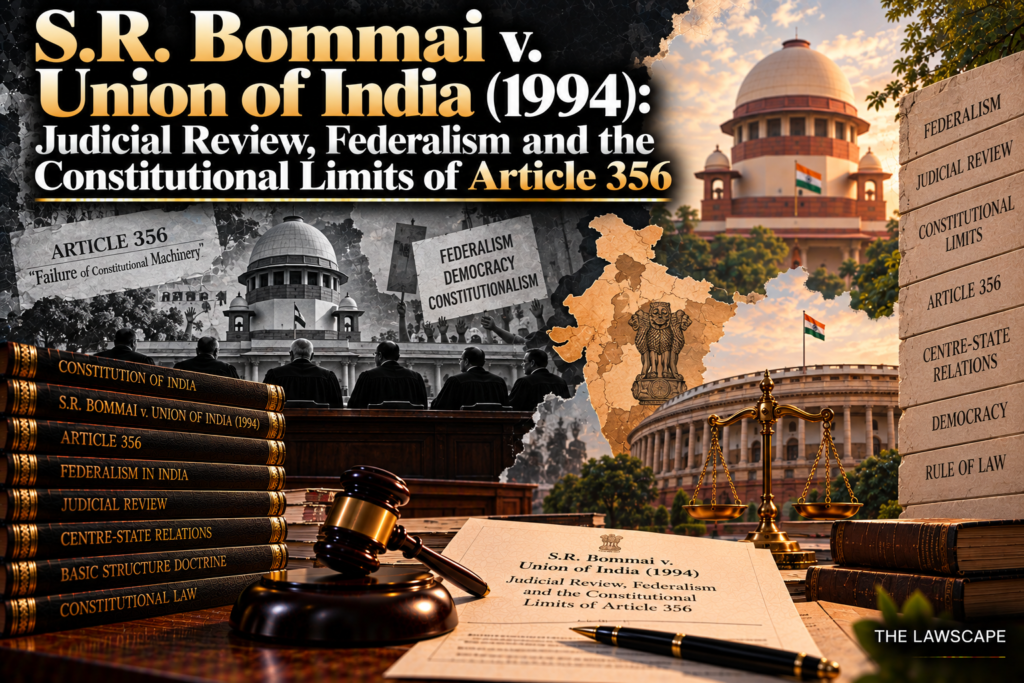
S.R. Bommai v. Union of India (1994): Judicial Review, Federalism and the Constitutional Limits of Article 356
Author: Arpita Rajawat
Student, Mata Sundri College For Women, University of Delhi
——————————————————————————————————————-
Case Citation: (1994) 3 SCC 1
Court: Supreme Court of India
Bench: Nine-Judge Constitution Bench comprising S. Ratnavel Pandian, A.M. Ahmadi, Kuldip Singh, J.S. Verma, P.B. Sawant, K. Ramaswamy, S.C. Agrawal, Yogeshwar Dayal and B.P. Jeevan Reddy, JJ.
Date of Judgment: 11 March 1994
Petitioners: S.R. Bommai and Others
Respondents: Union of India and Others
💡 3 Quick Takeaways
- Judicial review of Article 356: The President’s satisfaction under Article 356 is not immune from judicial review. Courts may examine whether relevant material supports the Proclamation and whether the power was exercised constitutionally.
- Importance of the floor test: Where the question is whether a ministry retains the confidence of the Legislative Assembly, its majority should ordinarily be tested on the floor of the House.
- Federalism and secularism: The judgment recognised federalism, democracy and secularism as fundamental features of the constitutional structure, placing constitutional limits on the exercise of executive power.
Introduction
The Indian Constitution empowers the Union to intervene in the affairs of a State when the government of that State cannot be carried on in accordance with the Constitution. This power is contained in Article 356, which provides for the imposition of President’s Rule. Although intended as a constitutional safeguard, the provision has historically raised concerns regarding its possible use for political purposes.
S.R. Bommai v. Union of India is a landmark decision that examined the constitutional limits on the exercise of power under Article 356. The case required the Supreme Court to determine whether the President’s satisfaction was subject to judicial review, whether an elected State government could be dismissed on the basis of the Governor’s assessment of legislative support, and how the federal and democratic character of the Constitution affected the exercise of Article 356.
The judgment established important safeguards against the arbitrary dismissal of State governments. It strengthened the principles of federalism, democracy and constitutional accountability by clarifying that the power to impose President’s Rule is not an unfettered executive power.
Facts of the Case
S.R. Bommai was the Chief Minister of Karnataka and headed a Janata Dal government. A political controversy arose when several members of the Legislative Assembly withdrew their support from his government, creating a dispute over whether the Council of Ministers continued to enjoy the confidence of the House.
Bommai met the Governor and expressed his willingness to prove his majority on the floor of the Assembly. Instead of allowing the question to be resolved through a floor test, the Governor submitted a report to the President stating that Bommai had lost his majority and that the State government could no longer function in accordance with the Constitution.
On the basis of the Governor’s report, the President issued a Proclamation under Article 356. The State government was dismissed, and the Legislative Assembly was subsequently dissolved.
The constitutional validity of the Proclamation was challenged before the Supreme Court. Similar challenges arising from the imposition of President’s Rule in other States were also pending before the Court. Since these petitions raised common and important questions concerning Article 356, they were considered together by a Nine-Judge Constitution Bench.
The case therefore extended beyond the immediate political dispute in Karnataka. It required the Court to examine the constitutional relationship between the Union and the States and the safeguards necessary to prevent the misuse of Article 356. In particular, the Court had to determine whether the President’s satisfaction was immune from judicial scrutiny and whether an elected State government could be dismissed without first determining its legislative majority on the floor of the House.
Issues Before the Court
The principal issues before the Supreme Court were:
- Whether the President’s satisfaction under Article 356 is subject to judicial review.
- Whether courts can examine the material forming the basis of a Proclamation under Article 356.
- Whether a Governor’s report concerning the loss of majority by a State government is conclusive.
- Whether the majority of a Chief Minister should ordinarily be determined through a floor test.
- Whether the dissolution of a State Legislative Assembly following a Proclamation under Article 356 can be judicially reviewed.
- Whether federalism and secularism constitute fundamental constitutional principles relevant to the exercise of Article 356.
- What relief a court may grant if a Proclamation under Article 356 is found to be unconstitutional.
Arguments of the Parties
Petitioners: S.R. Bommai and Others
The petitioners challenged the constitutional validity of the Proclamations issued under Article 356. They argued that the power could not be exercised merely on the basis of the subjective satisfaction of the President or the Union Government.
They contended that the Governor’s assessment could not, by itself, establish that the constitutional machinery of a State had failed. In a parliamentary system, if the question was whether the Chief Minister continued to command a majority, the appropriate method was to allow elected representatives to determine the issue on the floor of the Legislative Assembly.
The petitioners further argued that an elected State government could not be removed merely because the Governor or the Union Government had formed an opinion that it had lost legislative support. Such an approach, they submitted, would undermine the democratic mandate of the electorate.
They also challenged the proposition that Article 356 placed the President’s action entirely beyond judicial review. According to the petitioners, courts must be able to examine whether relevant constitutional material existed to support the Proclamation.
Finally, the petitioners emphasised the federal character of the Constitution. They argued that Article 356 should be interpreted narrowly because its unrestricted use could enable the Union to interfere with elected State governments and disturb the constitutional balance between the Union and the States.
Respondents: Union of India and Others
The Union Government defended the Proclamation and argued that the President was constitutionally authorised to determine whether the government of a State could be carried on in accordance with the Constitution.
The respondents contended that the President’s satisfaction involved political and constitutional considerations. Courts, they argued, should not substitute their own assessment for that of the constitutional authorities. The Governor, as the constitutional head of the State, was also considered competent to report on the political and constitutional situation prevailing in the State.
The Union further argued that the circumstances leading to the Proclamation had to be considered as a whole and should not be reduced merely to the question of whether the Chief Minister claimed to have a majority.
Judgment and Final Decision
The Supreme Court delivered its judgment through separate but substantially overlapping opinions. It rejected the view that the President’s satisfaction under Article 356 was completely immune from judicial review.
The Court held that, although the President must be satisfied before issuing a Proclamation, the existence of relevant material supporting that satisfaction can be examined by the judiciary. The executive’s assertion that a constitutional breakdown has occurred cannot, by itself, place the exercise of power beyond judicial scrutiny.
At the same time, the Court clarified that judicial review does not permit judges to substitute their own political assessment for that of the executive. Judicial scrutiny is concerned with constitutional legality, including whether relevant material existed and whether the power was exercised for a constitutionally permissible purpose.
The Floor Test and Legislative Majority
The Court gave considerable importance to the floor test. Where the question is whether a ministry continues to enjoy the confidence of the Legislative Assembly, the ordinary constitutional method is to determine the issue on the floor of the House.
This principle protects the democratic process by allowing elected representatives to determine whether the government retains legislative support. It also limits the possibility of dismissing an elected government solely on the basis of the Governor’s subjective assessment.
The floor test thus emerged as an important constitutional safeguard in situations where the majority of a government is in doubt.
Federalism and Democracy
The Court recognised federalism and democracy as essential features of the constitutional structure. Article 356 could not be interpreted so broadly that the Union Executive acquired a general power to remove State governments whenever it considered their functioning politically undesirable.
The judgment emphasised that States are constitutionally recognised units and not merely administrative divisions of the Union. The exercise of power under Article 356 must therefore respect the federal structure and the democratic mandate of elected State governments.
Secularism as a Basic Feature
The judgment also recognised secularism as a basic feature of the Constitution. The Court explained that secularism requires the State to maintain constitutional neutrality towards religion. Governmental action inconsistent with this constitutional commitment may have serious constitutional consequences.
By recognising secularism as a basic feature, the judgment affirmed that constitutional governance must remain consistent with the fundamental principles underlying the Constitution.
Judicial Review and Effective Remedies
With regard to the dissolution of a Legislative Assembly, the Court held that the consequences of an unconstitutional Proclamation could be addressed through judicial remedies. The Court was not restricted to merely declaring that the executive had acted unlawfully. Depending on the circumstances, it could grant effective relief to restore the constitutional position.
The judgment consequently placed significant limitations on the exercise of Article 356 while preserving the provision for genuine cases of constitutional breakdown.
Ratio Decidendi
The principal ratio decidendi of S.R. Bommai v. Union of India is that the exercise of power under Article 356 is subject to judicial review and cannot be treated as an unfettered executive power.
First, the Court held that the President’s satisfaction must have a constitutional basis. Courts may examine the material on which that satisfaction rests and determine whether the exercise of power suffers from constitutional defects, including the absence of relevant material, reliance on irrelevant considerations or mala fides.
Second, the judgment established the importance of the floor test in determining legislative majority. Where the survival of a ministry depends on whether it enjoys the confidence of the Legislative Assembly, the issue should ordinarily be tested on the floor of the House rather than determined solely through the Governor’s assessment. This principle strengthens legislative democracy and protects elected governments against arbitrary dismissal.
Third, the Court recognised federalism and democracy as essential features of the Constitution. Article 356 must therefore be interpreted in a manner that preserves, rather than undermines, the federal and democratic structure. The provision is intended to address a genuine failure of constitutional machinery and cannot be used merely as an instrument of political interference.
Fourth, the Court recognised secularism as a basic feature of the Constitution. The constitutional scheme does not permit the State to favour one religion over another, and constitutional governance must remain consistent with the principle of equal treatment of different faiths.
Fifth, the Court affirmed the importance of effective judicial remedies. Where a Proclamation is found to be unconstitutional, the Court may take appropriate measures to restore the constitutional position, depending on the circumstances.
The decision therefore placed the exercise of power under Article 356 within enforceable constitutional limits. It did not eliminate the Union’s power to impose President’s Rule; rather, it clarified that the power must operate consistently with democracy, federalism and judicial review.
Conclusion and Observations
S.R. Bommai v. Union of India remains one of the most significant constitutional decisions concerning Centre–State relations in India. The judgment addressed a fundamental constitutional problem: how to preserve the Union’s ability to respond to genuine constitutional breakdowns without allowing Article 356 to become a means of removing elected State governments.
The Court’s decision to subject the President’s satisfaction to judicial review established an important constitutional safeguard. It made clear that the existence of relevant material supporting a Proclamation is open to judicial examination and that the exercise of constitutional power must remain accountable to constitutional standards.
The emphasis on the floor test is equally significant. In a parliamentary democracy, legislative confidence is fundamentally a question for the elected House. Resolving such questions on the floor of the Assembly protects the democratic mandate and reduces the possibility of political manipulation through constitutional offices.
The judgment’s treatment of federalism also reaffirmed the constitutional position of State governments. Although the Constitution grants substantial powers to the Union, States remain constitutionally recognised units with their own democratic mandates. Article 356 cannot, therefore, be interpreted as conferring unrestricted authority on the Union to dismiss State governments.
The decision also affirmed the constitutional importance of secularism and the principle that the basic features of the Constitution impose substantive limits on governmental power.
At the same time, Bommai did not render Article 356 ineffective. Genuine constitutional breakdowns may still justify the imposition of President’s Rule. The significance of the judgment lies in ensuring that this exceptional power is exercised for constitutionally permissible purposes and remains subject to legal accountability.
Ultimately, S.R. Bommai v. Union of India represents an important development in the relationship between executive discretion and constitutional accountability. Its principles concerning judicial review, floor tests, federalism, democracy and secularism continue to provide safeguards within India’s constitutional system. The judgment stands not merely as a decision concerning Article 356, but also as an affirmation that constitutional powers must be exercised within the limits established by the Constitution.
Disclaimer: The views expressed in this article are those of the author and do not necessarily reflect the views of The Lawscape.
The Lawscape — clear, practical legal insight for students and future lawyers.