
Constitutional Perspective on the Uniform Civil Code
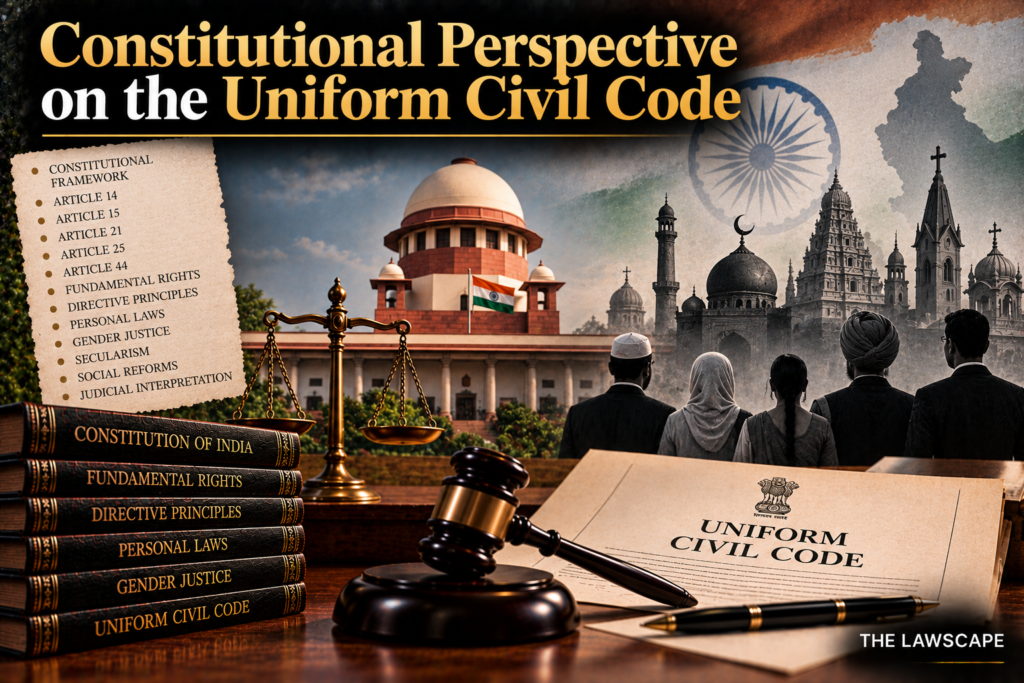
Author: Garima Bhatia
Student, Subodh Law College, Jaipur Rajasthan
———————————————————————————-
💡 3 Quick Takeaways
- Article 44 of the Constitution directs the State to endeavour to secure a Uniform Civil Code (UCC), but the provision is non-justiciable under Article 37.
- The constitutional debate surrounding the UCC involves balancing equality, non-discrimination and dignity under Articles 14, 15 and 21 with religious freedom and minority protections under Articles 25, 26, 29 and 30.
- Goa and Uttarakhand provide examples of civil-law frameworks discussed in the context of uniformity, while the implementation of a UCC raises questions about gender justice, religious freedom and cultural diversity.
Abstract
The Uniform Civil Code (UCC) is an important and widely debated issue under the Indian Constitution. It aims to establish a common set of civil laws for citizens in matters such as marriage, divorce, inheritance and succession, irrespective of religion. Its constitutional foundation lies in Article 44, which directs the State to endeavour to secure a Uniform Civil Code for citizens.
This article examines the UCC from a constitutional perspective by analysing Article 44 alongside the Fundamental Rights guaranteed under Part III of the Constitution, particularly Articles 14, 15, 21, 25 and 26. It also considers judicial precedents, including Sarla Mudgal v. Union of India, Mohd. Ahmed Khan v. Shah Bano Begum and S.R. Bommai v. Union of India, and discusses developments relating to the implementation of uniform civil-law frameworks in Goa and Uttarakhand.
The article explores whether legal uniformity can be achieved while respecting India’s religious and cultural diversity. It considers the relationship between the UCC, gender justice, individual dignity, equality and the constitutional principle of secularism.
Keywords: Uniform Civil Code; Constitutional Law; Personal Laws; Secularism; Article 44.
I. Introduction
The Uniform Civil Code is one of the significant and debated issues in the Indian constitutional system. It refers to a proposed common set of civil laws governing personal matters such as marriage, divorce, adoption, inheritance and succession, irrespective of an individual’s religion.
The constitutional foundation of the UCC is Article 44, which provides that “The State shall endeavour to secure for the citizens a Uniform Civil Code throughout the territory of India.”¹ Article 44 forms part of the Directive Principles of State Policy (DPSP) under Part IV of the Constitution. Although these principles are not enforceable by courts, Article 37 declares them fundamental to the governance of the country and makes it the duty of the State to apply them in making laws.² Accordingly, Article 44 provides constitutional direction rather than an immediately enforceable right to demand the enactment of a UCC.
The objectives commonly associated with the UCC include equality, national unity, gender justice and the protection of vulnerable sections of society. Differences in personal laws have raised concerns about discriminatory practices affecting women, including issues relating to marriage, polygamy, maintenance following divorce and inheritance.
India is a diverse country in which people belonging to different religions and communities follow distinct customs, traditions and cultural practices. Personal laws govern several aspects of family life, including marriage, divorce, maintenance, inheritance, adoption and succession. For example, Hindu personal-law legislation includes the Hindu Marriage Act, 1955, while Muslim personal-law matters are governed by different statutes and legal principles, including the Dissolution of Muslim Marriages Act, 1939.
The debate therefore involves two important constitutional considerations. On the one hand, a common civil-law framework is presented as a means of promoting equality, dignity and gender justice. On the other, concerns arise about religious freedom, cultural identity and the protection of minority communities. The constitutional question is how these values can be reconciled within India’s pluralistic society.
II. Constitutional Framework
The constitutional framework governing the UCC can be understood through three principal elements:
- Directive Principles of State Policy.
- Fundamental Rights.
- The constitutional principle of secularism.
1. Directive Principles of State Policy
Article 44 is the most direct constitutional provision concerning the UCC. It directs the State to endeavour to secure a common civil code throughout India. However, because Article 44 is a Directive Principle, it is not independently enforceable through court proceedings.
Article 37 clarifies that the Directive Principles are not enforceable by any court but are fundamental to the governance of the country. The State must therefore consider these principles when formulating legislation.
Article 44 consequently provides a constitutional objective. It does not, by itself, establish a uniform civil-law regime or require the immediate enactment of a particular legislative model.
2. Fundamental Rights
The constitutional debate surrounding the UCC involves the relationship between equality and individual dignity, on the one hand, and religious freedom and cultural diversity, on the other.
A. Article 14: Right to Equality
Article 14 guarantees equality before the law and equal protection of the laws.³ It is central to the UCC debate because different personal-law rules may produce different legal outcomes for people dealing with similar matters, such as marriage, divorce, adoption, inheritance and succession.
A common civil-law framework is therefore discussed as a possible means of reducing unequal treatment based on religion. However, whether a particular legal distinction violates Article 14 requires examination of the relevant law and its constitutional implications.
B. Article 15: Prohibition of Discrimination
Article 15 prohibits the State from discriminating against citizens on specified grounds, including religion, race, caste, sex and place of birth.⁴ The UCC debate frequently draws attention to differences in the treatment of men and women under personal laws, particularly in matters concerning maintenance, marriage and inheritance.
From this perspective, a common civil-law framework may be considered as a means of addressing gender-based inequalities. The constitutional analysis must nevertheless examine the particular provisions and their effects rather than assume that uniformity alone guarantees equality.
C. Article 21: Right to Life and Personal Liberty
Article 21 protects life and personal liberty, except according to the procedure established by law.⁵ The Supreme Court has interpreted this provision broadly, connecting it with dignity and other aspects of individual liberty.
Matters such as marriage, family relationships, divorce and inheritance affect an individual’s personal life and autonomy. Laws governing these matters must therefore be considered in light of constitutional protections for dignity and personal liberty.
The UCC debate raises the question of whether a common civil-law framework can protect individual rights and promote gender justice while respecting personal choices and other constitutional guarantees.
D. Articles 25 and 26: Freedom of Religion
Article 25 protects freedom of conscience and the right to profess, practise and propagate religion, subject to constitutional limitations.⁶ Article 26 provides religious denominations with certain rights concerning the management of their religious affairs.⁷
These provisions are particularly relevant because personal laws and customary practices may be connected with religious identity and tradition. Critics of a UCC may therefore raise concerns that a common civil-law framework could interfere with the practices of different communities.
However, religious freedom is not absolute. Article 25 itself recognises constitutional limitations and permits the regulation of certain secular activities associated with religious practice. This raises an important question: how should the law distinguish between matters of religion and civil matters that are subject to State regulation?
The relationship between Articles 25 and 26 and the directive contained in Article 44 remains a central issue in the constitutional debate.
E. Articles 29 and 30: Protection of Minority Rights
Article 29 protects the right to conserve a distinct language, script or culture. Article 30 protects the rights of religious and linguistic minorities to establish and administer educational institutions.⁸
Although these provisions do not directly establish a framework for personal laws, they are relevant to wider concerns about cultural identity and minority rights. Communities may express concern that a uniform legal framework could fail to accommodate their traditions and distinctive identities.
The constitutional challenge is therefore to consider equality alongside the protection of cultural diversity and minority rights.
3. Secularism as a Constitutional Principle
Secularism is another important constitutional principle relevant to the UCC. In the Indian constitutional context, it involves the State’s relationship with different religions and the protection of religious freedom.
In S.R. Bommai v. Union of India (1994), the Supreme Court recognised secularism as part of the basic structure of the Constitution.⁹ The UCC debate frequently invokes this principle in support of a common civil-law framework, on the ground that civil matters can be regulated without favouring a particular religion.
At the same time, the constitutional principle of secularism must be considered alongside the guarantees of religious freedom and minority rights. The significance of secularism in this debate therefore lies in the need to reconcile equal citizenship with India’s religious diversity.
III. Judicial Precedents
1. Sarla Mudgal v. Union of India (1995)
In Sarla Mudgal v. Union of India, the Supreme Court considered the legal consequences of a Hindu husband converting to Islam and entering into a second marriage without dissolving his first marriage.
The Court held that conversion did not, by itself, dissolve the existing Hindu marriage and addressed the consequences of a second marriage in those circumstances. The judgment also discussed the need for a Uniform Civil Code in the context of preventing the misuse of differences between personal-law systems.¹⁰
The case is relevant to the UCC debate because it illustrates the difficulties that may arise when personal laws interact and individuals seek to rely on differences between them.
2. Mohd. Ahmed Khan v. Shah Bano Begum (1985)
In Mohd. Ahmed Khan v. Shah Bano Begum, the Supreme Court considered a divorced Muslim woman’s claim for maintenance under Section 125 of the Code of Criminal Procedure, 1973.
The Court upheld Shah Bano’s entitlement to maintenance under the applicable statutory provision. The judgment also referred to the UCC and the difficulties that may arise from differences between personal-law systems.¹¹
The case remains an important part of the constitutional discussion concerning maintenance, gender justice and the relationship between personal laws and generally applicable legal protections.
3. Ahmedabad St. Xavier’s College Society v. State of Gujarat (1974)
In Ahmedabad St. Xavier’s College Society v. State of Gujarat, the Supreme Court considered minority educational rights under Article 30.
The case is relevant to the wider discussion of minority rights and the constitutional protection of cultural and institutional diversity. It does not directly determine the constitutionality of a UCC, but it provides context for considering the relationship between uniform legal rules and the protection of minority communities.
The judgment is therefore relevant to the broader constitutional question of how common legal standards can coexist with protections afforded to minorities.¹²
IV. Contemporary Developments and State Initiatives
1. Goa
Goa has a civil-law framework commonly referred to as the Goa Civil Code. Its historical origins lie in Portuguese civil legislation. The Portuguese Civil Code was enacted in 1867 and extended to Portuguese overseas territories, including Goa, in 1869.
Following Goa’s integration into India in 1961, laws in force in the territory continued, subject to the applicable legal arrangements. Goa is consequently frequently discussed in debates concerning a common civil-law framework.
Its legal framework is rooted in a distinct historical context. Accordingly, describing it as a uniform civil code requires attention to the particular provisions, exceptions and legal arrangements that apply.
2. Uttarakhand
Uttarakhand introduced a Uniform Civil Code through state legislation. The Code was brought into force in January 2025, following the notification of its implementing rules in 2024.
The legislation addresses matters including marriage, divorce, inheritance and the registration of live-in relationships. It establishes common statutory rules for the persons within its scope, subject to the legislation’s terms and exceptions.
Uttarakhand’s implementation represents a significant development in the practical application of the UCC debate. It also raises questions about the scope of the legislation, its implementation and its relationship with constitutional guarantees.
3. Madhya Pradesh
The source manuscript refers to a proposed Uniform Civil Code framework in Madhya Pradesh and describes provisions concerning monogamy, registration of live-in relationships and exemptions for Scheduled Tribes and Particularly Vulnerable Tribal Groups.
However, the manuscript does not provide a bill number, date of introduction or official legislative reference sufficient to establish the status of the proposal. This discussion should therefore be verified against official legislative records before publication and should not be presented as an enacted law without supporting authority.
V. Constitutional Challenges and the Way Forward
The constitutional debate surrounding the UCC cannot be resolved merely by adopting identical rules for everyone. The relevant question is whether a proposed framework protects equality and dignity while remaining consistent with religious freedom and cultural diversity.
Article 44 provides a constitutional direction to the State, while Articles 14, 15 and 21 supply important principles for examining equality, non-discrimination and individual dignity. Articles 25 and 26 protect religious freedom, and Articles 29 and 30 provide protections relevant to cultural identity and minority rights.
The judicial decisions discussed above illustrate different aspects of this relationship. Sarla Mudgal addresses the interaction between personal laws and marriage. Shah Bano concerns maintenance and statutory protection. S.R. Bommai establishes the constitutional significance of secularism, while St. Xavier’s College provides context for minority rights.
These authorities do not, individually, settle every constitutional question concerning the design or implementation of a UCC. The legal assessment must consider the text and effect of the particular legislation, the rights it affects and the constitutional principles applicable to it.
VI. Conclusion
The Uniform Civil Code is an important constitutional issue involving equality, gender justice, individual dignity, autonomy, religious freedom and cultural diversity.
Article 44 directs the State to endeavour to secure a UCC, while Article 37 clarifies the non-justiciable status of the Directive Principles. Fundamental Rights under Articles 14, 15 and 21 provide important standards for examining equality, non-discrimination and dignity. Articles 25 and 26 protect religious freedom, while Articles 29 and 30 are relevant to the protection of cultural identity and minority rights.
The experiences of Goa and Uttarakhand illustrate different approaches to common civil-law frameworks. Their legal arrangements must be assessed in light of their particular statutory provisions and constitutional context.
Ultimately, the objective of a UCC should not be considered solely in terms of uniformity. The constitutional analysis must also address whether the applicable rules secure equality, justice, dignity and individual rights while respecting the secular and diverse character of Indian society.
References and Footnotes
- Constitution of India, art. 44.
- Constitution of India, art. 37.
- Constitution of India, art. 14.
- Constitution of India, art. 15.
- Constitution of India, art. 21.
- Constitution of India, art. 25.
- Constitution of India, art. 26.
- Constitution of India, arts. 29–30.
- S.R. Bommai v. Union of India, AIR 1994 SC 1918.
- Sarla Mudgal v. Union of India, AIR 1995 SC 1531.
- Mohd. Ahmed Khan v. Shah Bano Begum, AIR 1985 SC 945.
- Ahmedabad St. Xavier’s College Society v. State of Gujarat, AIR 1974 SC 1389.
Disclaimer: The views expressed in this article are those of the author and do not necessarily reflect the views of The Lawscape.
The Lawscape — clear, practical legal insight for students and future lawyers.