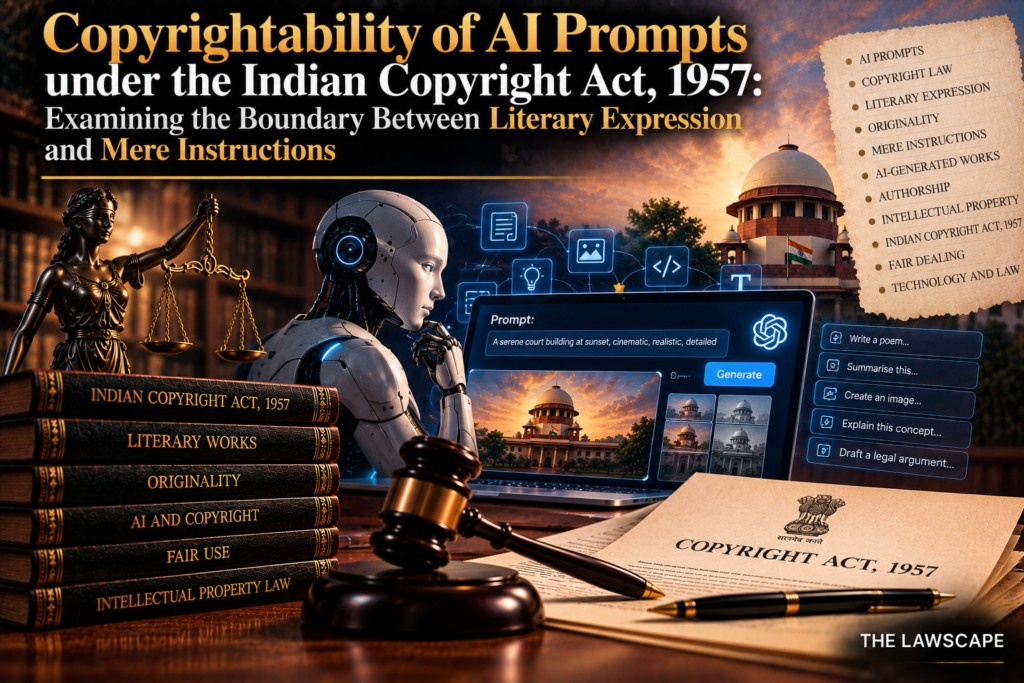
Copyrightability of AI Prompts under the Indian Copyright Act, 1957: Examining the Boundary Between Literary Expression and Mere Instructions
Author: Santhoshini R.
Student, SASTRA Deemed University, Thanjavur
“He who receives an idea from me, receives instruction himself without lessening mine.”
— Thomas Jefferson
The emergence of generative artificial intelligence has introduced an unexpected object of legal inquiry: the prompt. Once regarded as a simple typed command, the prompt has evolved, in the hands of skilled users, into an elaborate textual artefact that may specify persona, tone, structure, illustrative examples and layered constraints, thereby shaping the output generated by an AI system. Online marketplaces now trade in prompts as though they were creative property, and prompt engineering is increasingly recognised as a specialised skill. This commercial reality raises questions under a statute that was not designed with generative AI in mind. The Copyright Act, 1957 (“the Act”), does not expressly address whether the words a person types into a machine to elicit an AI-generated output can themselves qualify as an “original literary work.”
This article examines that question in two parts. First, can a prompt qualify as a “literary work” under Section 2(o) of the Act? Second, even where it can, should it be excluded from protection because it functions as an idea, method, procedure or bare instruction addressed to a machine, rather than as protectable expression?
The central argument is that no categorical answer is appropriate. A prompt’s copyrightability should depend not on its label but on whether its specific textual formulation satisfies the established Indian doctrines of originality and the idea-expression dichotomy. The decisive question is whether the wording embodies a sufficient degree of creative skill and judgment beyond the bare instruction it conveys.
I. Prompts as “Literary Works”: The Threshold Question
Section 2(o) of the Act defines “literary work” broadly to include computer programmes, tables and compilations, including computer databases.¹ A prompt is, at a minimum, a sequence of words fixed in a communicable form once entered into an interface. There is therefore a basis for examining whether it can qualify as a literary work.
A potentially relevant analogy is the statutory definition of a computer programme under Section 2(ffc), which describes it as a set of instructions expressed in words, codes, schemes or another form and capable of causing a computer to perform a particular task or achieve a particular result.² This definition raises the question of whether natural-language instructions addressed to a large language model could similarly qualify as literary works.
However, the fact that a prompt may fall within the structural scope of a literary work does not automatically entitle it to copyright protection. It must independently satisfy the requirement of originality, and copyright does not extend to the bare idea or method conveyed by the words.
II. The Originality Standard: Skill and Judgment, Not “Sweat of the Brow”
In Eastern Book Company v. D.B. Modak, the Supreme Court rejected the low “sweat of the brow” threshold and adopted a standard requiring a minimal degree of creativity reflecting the author’s own skill and judgment, without demanding the novelty required under patent law.³
Applied to prompts, a short command such as “write a poem about the monsoon” is unlikely, by itself, to demonstrate substantial creative skill or judgment. Its wording primarily identifies a topic and genre, while the resulting poem’s creative features may arise principally from the AI system’s processing.
An elaborate, structured prompt presents a different question. A multi-paragraph prompt may specify a distinctive narrative voice, impose layered constraints, provide illustrative examples and establish an original scenario. The selection and arrangement of those elements may embody creative skill and judgment comparable, in principle, to the compilation-level choices considered in D.B. Modak.⁴
The distinction is not simply one of length. A long prompt may still consist of routine instructions, while a shorter formulation may contain distinctive expression. The relevant question is whether the prompt’s particular wording and arrangement demonstrate the requisite degree of originality.
III. The Idea-Expression Dichotomy and the Problem of Mere Instructions
The Act does not expressly enumerate ideas, procedures, methods of operation and concepts as exclusions in Section 13. Nevertheless, Indian courts have recognised the idea-expression distinction as a fundamental principle of copyright law.
In R.G. Anand v. Delux Films, the Supreme Court held that copyright does not subsist in an idea itself. Protection extends to the particular form, manner and arrangement in which an idea is expressed.⁵
Consider a prompt instructing an AI system to “generate a 500-word essay comparing X and Y in an academic tone.” The prompt primarily specifies the task, length and style of the required output. It may communicate an objective or method without expressing an original literary creation.
The distinction becomes particularly important where an instruction can be expressed in only a limited number of functionally equivalent ways. In such circumstances, the idea-expression merger principle may apply: granting exclusive rights over the available wording could effectively confer a monopoly over the underlying method or function. This concern is reflected in the reasoning associated with Baker v. Selden, a United States decision distinguishing the expression of an idea from the system or method itself.⁶
The Delhi High Court’s decision in Anil Gupta v. Kunal Dasgupta also provides context for the protection of ideas developed through substantial labour and particularised formulation.⁷ However, the existence of labour alone does not establish copyright in a bare instruction. The prompt must still contain protectable expression and satisfy the applicable originality standard.
IV. Functional Commands Versus Literary Prompts: Where the Line Might Fall
A. Functional or Operational Prompts
Short, imperative and technical prompts, such as “translate this paragraph into Tamil,” “debug this code” or “summarise this article in three bullet points,” lie close to the category of functional instructions.
Their principal purpose is to direct a machine to perform a task. Where the wording contains no sufficiently original expression or arrangement beyond the instruction itself, it is unlikely to qualify for copyright protection.
The issue is not that imperative language can never be protected. Rather, the relevant question is whether the particular wording contains original expression that can be distinguished from the function it performs.
B. Elaborate, Narrative or Stylistically Distinctive Prompts
Extended prompts may create an original scenario, assign a distinctive persona, combine multiple sub-instructions in a particular structure or incorporate original illustrative material. These features may bring the prompt closer to a literary composition or compilation capable of receiving limited protection.
The relevant inquiry remains whether, after the underlying theme or method is separated from the text, an original form, manner or arrangement survives.⁸ If it does, the prompt may qualify for protection to that extent. Such protection would not automatically extend to the general idea, function or method that the prompt communicates.
The distinction between functional commands and literary compositions is therefore a matter of applying established copyright principles to the particular text, rather than creating an entirely separate category of copyright law for prompts.
V. The Authorship Complication: Section 2(d) and Human Authorship
Section 2(d)(vi) of the Act defines the author of a computer-generated literary, dramatic, musical or artistic work as the person who causes the work to be created.⁹ This provision raises questions when applied to generative AI systems, which may produce outputs through processes involving machine-generated choices.
The controversy surrounding Ankit Sahni’s artwork Suryast, generated using the RAGHAV application, illustrates the related question of authorship in AI-generated output. According to the source cited in the manuscript, the Copyright Office initially registered the work with the software listed as a co-author before issuing a notice questioning whether an AI tool could hold that status under the Act.¹⁰ The example highlights the uncertainty surrounding the treatment of AI-generated works under Indian copyright law.
The manuscript also refers to Ani Media (P) Ltd. v. OpenAI Inc., concerning allegations of unauthorised use of copyrighted material in AI training.¹¹ That dispute raises questions about the use of copyrighted works in developing AI systems, but it is analytically distinct from whether a human-authored prompt can itself attract copyright.
The copyrightability of a prompt and the copyrightability of the output generated in response to it must therefore be examined separately. A prompt composed entirely by a human may qualify for protection if it satisfies the requirements of originality and protectable expression. Section 17, concerning first ownership of copyright, may then become relevant.¹² However, the existence of copyright in a prompt would not, by itself, establish human authorship of the AI-generated output.
VI. A Comparative Note
The United States Copyright Office has addressed the role of prompts in determining whether AI-generated outputs qualify for copyright protection. Its 2025 report, Copyright and Artificial Intelligence, Part 2: Copyrightability, states that prompts, even when detailed, ordinarily function as instructions and do not provide a human user with sufficient creative control over the resulting output to establish human authorship of that output.¹³
This position must be distinguished from the separate question of whether the prompt’s text is copyrightable as an independent literary composition. The report’s analysis of human authorship in AI-generated output does not, by itself, resolve the copyrightability of the prompt considered separately.
Maintaining this distinction is important. Treating every prompt as copyrightable could extend protection to trivial instructions, while denying protection to all prompts could overlook original literary expression embodied in carefully constructed text.
VII. Suggestions
The following measures may help clarify the legal position:
- Case-by-case assessment: Courts and the Copyright Office should apply the originality standard in D.B. Modak to individual prompts rather than adopt a blanket rule permitting or denying protection to all prompts.
- Separate consideration of prompt copyrightability: The expert panel constituted by the Ministry of Commerce and Industry in 2025 to examine the adequacy of the Act in addressing generative AI should consider prompt copyrightability as a distinct issue, rather than treating it solely as a question of AI-output authorship.¹⁴
- Clarification of the idea-expression distinction: The legislature could consider expressly clarifying the treatment of ideas, procedures, methods of operation and bare instructions, providing a clearer statutory basis for assessing prompts.
- Functional and literary categories: Copyright Office guidance could distinguish between functional commands and literary compositions, while making clear that classification depends on the actual wording and arrangement of the prompt.
- Independent assessment of authorship: Guidance should state that establishing human authorship of a prompt does not automatically establish human authorship of the AI-generated output. Each claim should be assessed independently under the relevant provisions of Section 2(d).
These proposals seek to apply established copyright principles to the practical challenges presented by generative AI without extending protection beyond the expression that copyright law is intended to protect.
VIII. Conclusion
Prompts occupy an unsettled position between ideas and expression. A categorical answer would overlook the differences between a simple functional instruction and a carefully constructed literary composition.
The existing principles of Indian copyright law provide a framework for examining this question. The originality standard in Eastern Book Company v. D.B. Modak requires a minimal degree of creativity reflecting skill and judgment, while R.G. Anand v. Delux Films distinguishes protectable expression from the underlying idea.
Applied to prompts, these principles support a fact-specific inquiry into the wording, structure and originality of each text. Functional commands that merely communicate a task may fall outside copyright protection, while prompts containing sufficiently original expression may warrant protection limited to that expression.
Until the legislature or the relevant authorities provide more specific guidance for generative AI, the copyrightability of a prompt should depend on its particular characteristics and its compliance with the established requirements of the Copyright Act, 1957.
References and Footnotes
- The Copyright Act, 1957, § 2(o) (India).
- The Copyright Act, 1957, § 2(ffc) (India).
- Eastern Book Company v. D.B. Modak, (2008) 1 SCC 1, 15 (India).
- Eastern Book Company v. D.B. Modak, (2008) 1 SCC 1, 24–25 (India).
- R.G. Anand v. Delux Films, AIR 1978 SC 1613, 1621 (India).
- Baker v. Selden, 101 U.S. 99, 103 (1879).
- Anil Gupta v. Kunal Dasgupta, 2002 (25) PTC 1, 11 (Del) (India).
- R.G. Anand v. Delux Films, AIR 1978 SC 1613, 1623–24 (India).
- The Copyright Act, 1957, § 2(d)(vi) (India).
- Astha Ojha, AI & Copyright in India: Law, Policy, and the Future of Creative Rights, NeGD (2025), https://negd.gov.in/wp-content/uploads/2025/10/Astha-Ojha-AI-Copyright-in-India-Bridging-the-Digital-Divide.pdf.
- Ani Media (P) Ltd. v. OpenAI Inc., 2024 SCC OnLine Del 8120 (India).
- The Copyright Act, 1957, § 17 (India).
- U.S. Copyright Office, Copyright and Artificial Intelligence, Part 2: Copyrightability (2025).
- “Generative AI & Copyright Law in India: Who Owns Machine-Made Works?”, Lexology (July 16, 2025), https://www.lexology.com/library/detail.aspx?g=ec2ab57f-9934-45c6-9bce-fd7e6c04db71.
Disclaimer: The views expressed in this article are those of the author and do not necessarily reflect the views of The Lawscape.
The Lawscape — clear, practical legal insight for students and future lawyers.