
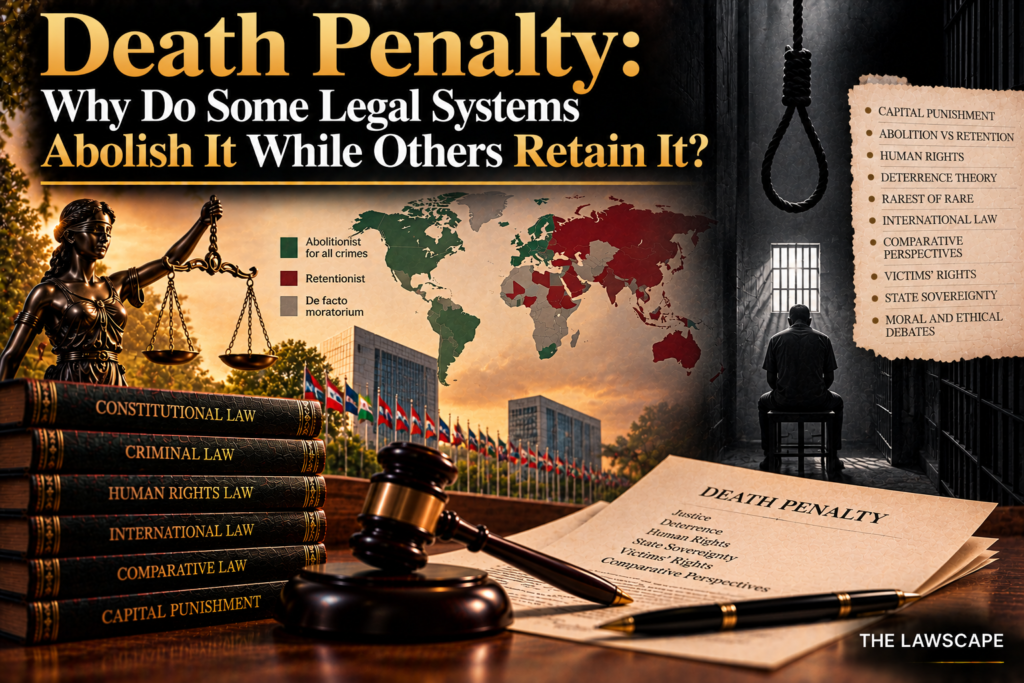
Death Penalty: Why Do Some Legal Systems Abolish It While Others Retain It?
Author: Dhaani Malhotra
Student, Symbiosis law school nagpur
——————————————————————–
💡 3 Quick Takeaways
- The global divide over capital punishment reflects differences in constitutional principles, human-rights commitments, historical experiences, public opinion and theories of punishment.
- India retains the death penalty under the “rarest of rare” doctrine established in Bachan Singh v. State of Punjab, while the European Union and South Africa follow abolitionist approaches.
- The irreversible nature of execution, the risk of wrongful convictions and the tension between individual rights and State power remain central to the debate over capital punishment.
I. Introduction
The death penalty, also known as capital punishment, is a severe punishment imposed by the State in which a person convicted of certain serious crimes is executed following legal proceedings. Some legal systems prescribe it for offences such as aggravated murder, terrorism-related killings, genocide and crimes against the State.
The continued existence of capital punishment raises a fundamental question: if a legal system abolishes the death penalty, what alternative punishments can achieve the purposes traditionally associated with it?
Imprisonment, life imprisonment, probation, community service, restitution and rehabilitation are among the alternatives available to criminal justice systems. Imprisonment and life imprisonment restrict an offender’s liberty while leaving open the possibility of rehabilitation. Probation, parole, house arrest and electronic monitoring allow varying degrees of supervision without completely removing an individual from society.
The death penalty differs fundamentally from these punishments because it is irreversible. Once an execution has taken place, it cannot be undone. This characteristic makes capital punishment distinct from every other criminal sanction and places particular importance on the reliability of criminal proceedings.
II. Historical Development of Capital Punishment
Capital punishment has existed in numerous societies throughout history. It was historically used for a wider range of offences, partly because developed prison systems and other forms of institutional punishment were less available.
Historical accounts describe the use of several forms of punishment, including compensation, corporal punishment, banishment and execution. Over time, the scope of capital punishment has changed alongside the development of legal institutions and ideas about justice.
In nineteenth-century Australia, for example, the death penalty was imposed for offences including sheep stealing, burglary, sexual assault, forgery and unlawfully being at large. Such examples illustrate how the range of offences attracting capital punishment has varied across historical periods.
Capital Punishment in Ancient and Medieval India
The manuscript identifies references to capital punishment in ancient Indian texts, particularly the Dharmashastras and Arthashastra. The Manusmriti associated punishment with maintaining social order and preventing serious offences.
The Arthashastra, attributed to Kautilya, also discusses the ruler’s authority to punish serious wrongdoing and protect the security of the State. According to the account presented in the source, capital punishment was associated with grave offences such as murder, espionage and high treason.
During the medieval period, Islamic legal traditions also influenced the administration of justice in parts of the Indian subcontinent. The source discusses the concepts of Hadd, referring to prescribed punishments for certain offences, and Qisas, referring to retribution in specified cases.
Capital Punishment under British Rule
British colonial rule brought significant changes to India’s criminal justice system, including the introduction of English common-law influences. The Indian Penal Code, enacted in 1860, provided capital punishment for certain offences, including murder and waging war against the Government.
The historical development of capital punishment in India therefore reflects the influence of multiple legal traditions, colonial legislation and changing understandings of punishment and State authority.
III. Capital Punishment under Indian Law
Capital punishment remains part of India’s criminal justice system under the Bharatiya Nyaya Sanhita, 2023, and certain special statutes. Hanging is the principal method of execution.
The source identifies several categories of offences for which the death penalty may be prescribed, including murder, certain terrorism-related offences, specified sexual offences resulting in death, kidnapping for ransom in qualifying circumstances, and certain repeat offences under the Narcotic Drugs and Psychotropic Substances Act.
The availability of the death penalty does not mean that it must be imposed in every case involving a serious offence. The Supreme Court’s decision in Bachan Singh v. State of Punjab established the “rarest of rare” doctrine, under which the death penalty is reserved for exceptional cases in which the alternative of life imprisonment is considered inadequate.
This doctrine seeks to reconcile the punishment of exceptionally serious crimes with constitutional protections for life and personal liberty. However, the application of the doctrine also raises questions about consistency in judicial decision-making. Different courts may assess the circumstances of a crime and the relevant mitigating factors differently, potentially producing different sentencing outcomes in cases with similar features.
IV. International Human Rights and the Death Penalty
International human-rights law provides an important framework for understanding the global debate over capital punishment.
Article 6 of the ICCPR
Article 6 of the International Covenant on Civil and Political Rights (ICCPR) recognises the inherent right to life and provides that no person shall be arbitrarily deprived of life.
For States that have not abolished capital punishment, Article 6 permits its imposition only within specified limits. In particular, a death sentence may be imposed only for the most serious crimes, in accordance with applicable law and subject to the Covenant’s requirements. It must follow a final judgment by a competent court.
Article 6 also makes clear that its provisions must not be invoked to delay or prevent the abolition of capital punishment by a State Party.
These provisions demonstrate that the ICCPR places restrictions on the use of the death penalty while recognising abolition as a permissible development.
International Safeguards and Abolition
The United Nations Economic and Social Council has adopted safeguards intended to protect the rights of people facing the death penalty.
The Second Optional Protocol to the ICCPR, adopted on 15 December 1989 and entering into force on 11 July 1991, specifically aims at abolishing capital punishment. Its adoption represents an international legal framework through which participating States commit to abolition, subject to the Protocol’s provisions.
The existence of both Article 6 and the Second Optional Protocol illustrates the distinction between international rules restricting capital punishment and international commitments directed towards its abolition.
V. Different Legal Approaches across Jurisdictions
There is no single global approach to capital punishment. Different legal systems reflect distinct constitutional traditions, judicial interpretations, international commitments and social attitudes.
India: Retention under Strict Judicial Limits
India retains capital punishment for specified offences, subject to constitutional and statutory requirements. The “rarest of rare” doctrine limits its imposition and requires consideration of whether life imprisonment would be inadequate in the circumstances of the case.
The doctrine represents an attempt to balance the gravity of certain crimes against the constitutional significance of life and personal liberty. Its application nevertheless raises questions about sentencing consistency and the extent of judicial discretion.
European Union: An Abolitionist Approach
The European Union represents an abolitionist approach to capital punishment. Its human-rights framework reflects commitments to human dignity, the right to life and protection against irreversible State action.
This approach treats abolition as part of a broader commitment to limiting the circumstances in which the State may take human life.
United States: Retention with Constitutional Restrictions
The United States retains capital punishment at the federal level and in some states, while other states have abolished it. Consequently, the legal position and practical use of the death penalty vary across the country.
The United States Supreme Court has imposed constitutional restrictions on capital punishment, particularly through its interpretation of the Eighth Amendment. The American approach therefore combines retention in some jurisdictions with constitutional limits on its application.
South Africa: Constitutional Abolition
South Africa abolished capital punishment following the Constitutional Court’s decision in S v. Makwanyane. The Court held that the death penalty was unconstitutional because it conflicted with constitutional protections, including the right to life and the prohibition of cruel, inhuman or degrading punishment.
The decision illustrates how constitutional interpretation can transform a country’s approach to criminal punishment.
VI. Why Do Some Legal Systems Abolish Capital Punishment While Others Retain It?
Several interconnected factors help explain the differences between abolitionist and retentionist legal systems.
1. Constitutional philosophy. Legal systems that place strong emphasis on the right to life and human dignity may view execution as incompatible with constitutional protections. Others permit capital punishment within defined legal and constitutional limits.
2. International human-rights commitments. States that undertake strong regional or international obligations directed towards abolition may be more likely to remove capital punishment from domestic law.
3. Political and social attitudes. Public opinion can influence criminal justice policy. Where severe punishment receives substantial public support, governments may face pressure to retain the death penalty. Concerns about wrongful convictions, discrimination and human rights may, conversely, contribute to support for abolition.
4. The purposes of punishment. Retentionist systems commonly defend capital punishment by reference to retribution, deterrence and incapacitation. Abolitionist approaches place greater emphasis on rehabilitation, proportionality and limiting State power.
5. Historical and cultural development. Different societies have experienced distinct political histories, patterns of crime and constitutional transformations. These experiences shape how they understand justice, punishment and the relationship between individuals and the State.
These factors help explain why countries can reach different legal conclusions about whether capital punishment is compatible with their criminal justice systems.
VII. The Irreversibility of Execution and the Risk of Error
One of the central concerns in the debate over capital punishment is the possibility of wrongful conviction. Courts may establish safeguards and appellate procedures, but no legal system can guarantee that every judgment will be correct.
The irreversible nature of execution makes this concern particularly significant. An erroneous imprisonment can, at least in principle, be followed by release and compensation where the law permits. An execution cannot be reversed.
India’s “rarest of rare” doctrine seeks to restrict the death penalty to exceptional cases. However, reliance on judicial discretion also creates challenges. Differences in how judges evaluate aggravating and mitigating circumstances may lead to inconsistent outcomes.
The practical application of capital punishment also varies among retentionist jurisdictions. A country may retain the death penalty in legislation while carrying out relatively few executions because of judicial restrictions, clemency procedures, lengthy legal proceedings or other practical obstacles.
The debate therefore concerns not only whether the death penalty is legally available, but also how reliably and consistently it is imposed.
VIII. Conclusion
The death penalty remains one of the most contested forms of State punishment because it brings together questions of justice, human rights, public safety and the limits of governmental authority.
Countries that have abolished capital punishment have often emphasised human dignity, the right to life, the possibility of wrongful convictions and the availability of alternative punishments. Countries that retain it commonly refer to retribution, deterrence, public protection and the gravity of certain crimes.
The approaches of India, the European Union, the United States and South Africa demonstrate that the legal status of capital punishment is shaped by constitutional rules, international commitments, political and social attitudes, historical experience and judicial interpretation.
Ultimately, the debate extends beyond the question of whether serious crimes deserve severe punishment. It concerns whether the State should retain the power to take a person’s life when other forms of punishment remain available. The irreversibility of execution makes this question especially consequential, while the continuing diversity of national approaches demonstrates that legal systems have not reached a universal conclusion.
Disclaimer: The views expressed in this article are those of the author and do not necessarily reflect the views of The Lawscape.
The Lawscape — clear, practical legal insight for students and future lawyers.