
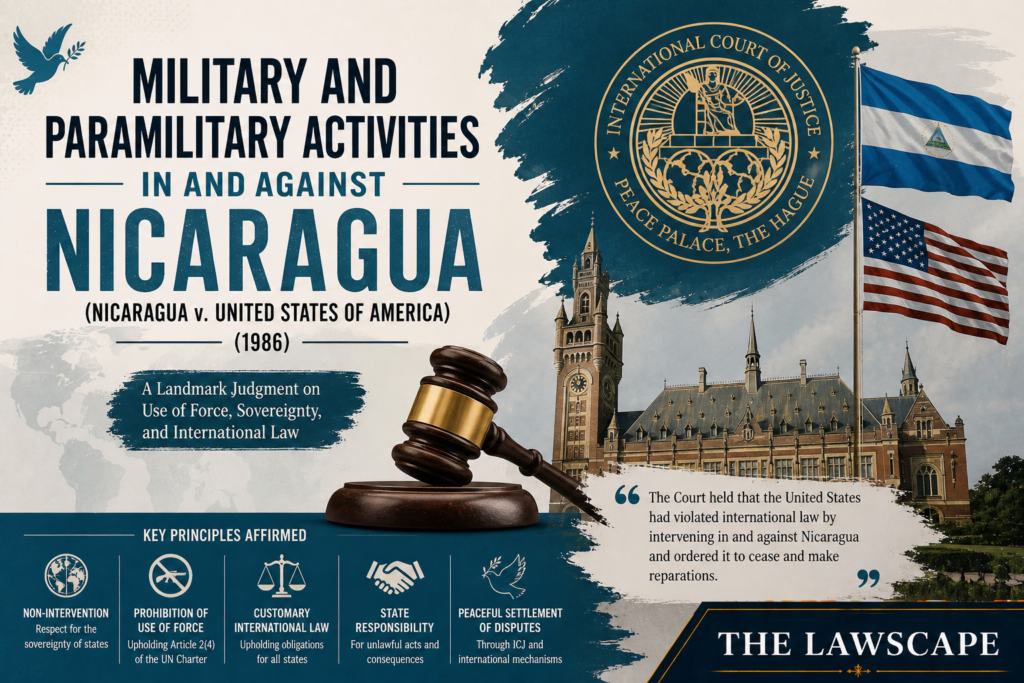
Military and Paramilitary Activities in and against Nicaragua (Nicaragua v. United States of America) (1986)
Author: Alina Ijaz
Student, National Defense University, Islamabad
——————————————————————————————
💡 3 Quick Takeaways
1. The ICJ held that the United States violated customary international law by mining Nicaragua’s ports, supporting the Contras, and interfering in Nicaragua’s internal affairs — finding that these actions constituted unlawful use of force and unlawful intervention regardless of whether treaty obligations could be directly applied.
2. The Court drew a critical distinction between different degrees of state involvement: providing weapons and military training to insurgents may constitute use of force, but financial or logistical support, while potentially unlawful as intervention, does not automatically amount to an “armed attack” triggering the right of self-defence.
3. The judgment affirmed that the prohibition on the use of force and the principle of non-intervention exist as rules of customary international law — binding on all states independently of treaty obligations — a finding that remains foundational to international law on the use of force.
Case Title: Military and Paramilitary Activities in and against Nicaragua (Nicaragua v. United States of America)
Citation: 1986 ICJ Rep. 14 (Judgment of 27 June 1986)
Court: International Court of Justice
Introduction
The case of Military and Paramilitary Activities in and against Nicaragua (Nicaragua v. United States of America) is one of the most significant decisions in the jurisprudence of the International Court of Justice. Delivered on 27 June 1986, the judgment clarified fundamental principles of international law relating to the prohibition on the use of force, the principle of non-intervention, and the doctrine of collective self-defence under the United Nations Charter. The case is widely regarded as a landmark decision because it elaborated on the relationship between treaty law and customary international law and provided authoritative interpretation of the key norms governing State conduct in international relations.
The dispute arose during the geopolitical tensions of the Cold War, particularly in Central America. Following the overthrow of the Somoza regime in 1979 by the Sandinista National Liberation Front, Nicaragua underwent major political changes that drew the attention of the United States. The US Government viewed the Sandinista government with suspicion, believing it to be aligned with socialist and Soviet interests. In response, the United States provided support to armed opposition groups known as the Contras, who sought to challenge and destabilise the Nicaraguan government.
Nicaragua alleged that the United States had engaged in a range of unlawful activities — including the training, arming, and financing of Contra forces, as well as direct military actions such as the mining of Nicaraguan ports and attacks on economic targets. In April 1984, Nicaragua brought a case before the ICJ, claiming that these actions violated fundamental principles of international law. The United States challenged the jurisdiction of the Court and eventually withdrew from the proceedings. Nevertheless, the ICJ continued to examine the case and delivered a judgment finding the United States responsible for violating international law. Despite the United States’ refusal to comply, the decision remains a cornerstone of modern international law and is frequently cited in legal scholarship and judicial decisions concerning the use of force and State responsibility.
Facts of the Case
The background of the dispute lies in the political developments in Nicaragua following the 1979 revolution. The Sandinista National Liberation Front overthrew the long-standing Somoza dictatorship and established a new government that implemented significant political and social reforms. These changes raised concerns in the United States, which feared the spread of leftist influence in the region during the Cold War.
One of the primary strategies employed by the United States involved supporting armed opposition groups collectively known as the Contras. These groups carried out military operations against the Nicaraguan government and its infrastructure. Nicaragua alleged that the United States played a central role in organising, training, and equipping these forces — providing financial assistance, weapons, logistical support, and intelligence, and helping coordinate their military operations.
In addition to supporting the Contras, the United States was accused of engaging in direct military activities against Nicaragua. One of the most controversial actions was the mining of Nicaraguan ports in early 1984. Explosive mines were placed in Nicaragua’s territorial waters, damaging several vessels and disrupting international shipping. Nicaragua argued that these actions constituted an unlawful use of force and violated its sovereignty under international law.
On 9 April 1984, Nicaragua filed an application before the ICJ, requesting the Court to declare that the United States had violated international law and to order cessation of those activities and reparations for the damage caused. The United States challenged the Court’s jurisdiction, relying on a reservation attached to its acceptance of compulsory jurisdiction which excluded disputes arising under multilateral treaties unless all parties to the treaty were before the Court. After the Court rejected many of the jurisdictional objections, the United States announced in January 1985 that it would no longer participate in the proceedings. The ICJ continued to examine the evidence and legal arguments presented by Nicaragua, and on 27 June 1986 delivered its judgment on the merits.
Issues Raised
The Nicaragua case presented several important legal questions concerning the interpretation and application of international law.
The first concerned the jurisdiction of the ICJ — whether the Court had authority to hear the case despite the US reservation regarding multilateral treaties, and whether the relevant principles could be applied as rules of customary international law independently of treaty obligations.
The second concerned whether the actions of the United States — including the mining of ports, attacks on economic targets, and the training and arming of the Contras — constituted a violation of the prohibition on the use of force under international law.
The third concerned the principle of non-intervention — whether US support for armed groups attempting to destabilise the Nicaraguan government constituted unlawful interference in Nicaragua’s internal affairs.
The fourth concerned the doctrine of collective self-defence. The United States argued that its actions were justified because Nicaragua had allegedly supported insurgent movements in neighbouring states, particularly El Salvador, constituting an armed attack under Article 51 of the UN Charter. The Court was required to determine whether the conditions for invoking collective self-defence had been met.
Analysis
The judgment of the ICJ in the Nicaragua case is widely regarded as a foundational decision in the development of international law on the use of force. One of its most significant aspects was the Court’s reliance on customary international law. Because the United States had invoked a reservation limiting the Court’s jurisdiction over treaty disputes, the Court examined whether the relevant principles also existed independently as customary rules. It concluded that the prohibition on the use of force and the principle of non-intervention were firmly established norms of customary international law — binding on all states regardless of whether the dispute could be adjudicated solely under treaty provisions. This reasoning allowed the Court to proceed with the case despite the jurisdictional objections.
On the use of force, the Court found that the United States had clearly violated the applicable prohibition. The mining of Nicaragua’s ports and attacks on oil installations and other economic targets were considered direct uses of force against another state — actions inconsistent with obligations under international law. The Court also addressed indirect uses of force, holding that the training, arming, and equipping of the Contras constituted unlawful intervention in the internal affairs of Nicaragua. International law prohibits states from organising or assisting armed groups whose purpose is to overthrow the government of another state. This interpretation reinforced the principle that states must respect the political independence and sovereignty of other nations.
However, the Court drew an important distinction between different forms of assistance. While the provision of weapons and military training could amount to a use of force, other forms of assistance — such as financial support — might not reach the same legal threshold. Nonetheless, even non-military assistance could constitute unlawful intervention if it was intended to coerce another state in matters within its domestic jurisdiction.
On collective self-defence, the Court held that the concept of an armed attack refers to the most serious forms of the use of force. The provision of weapons or logistical support to insurgents in another state, while it may constitute a breach of the principle of non-intervention, does not necessarily amount to an armed attack justifying the use of force in self-defence. The Court also held that collective self-defence requires a formal request from the state claiming to be the victim of an armed attack — a condition which the evidence showed had not been satisfied. The US justification for its actions accordingly failed.
Based on these findings, the Court concluded that the United States had violated its obligations under customary international law not to use force against another state, not to intervene in its internal affairs, and not to infringe upon its sovereignty. The Court ordered the United States to cease its unlawful activities and to provide reparations to Nicaragua for the damage caused.
The judgment also had broader implications for international law. By affirming that fundamental norms such as the prohibition on the use of force exist independently as customary international law, the Court strengthened the legal framework governing international relations. It clarified the legal limits of indirect intervention and provided authoritative guidance on the interpretation of collective self-defence. Despite the United States’ refusal to comply with the judgment, the decision remains a highly influential precedent and continues to shape the interpretation of international law in subsequent proceedings and scholarly discourse.
Conclusion
The judgment in Military and Paramilitary Activities in and against Nicaragua (Nicaragua v. United States of America) represents one of the most important contributions of the ICJ to the development of international law. The case reaffirmed fundamental legal principles governing the conduct of states — particularly the prohibition on the use of force, the principle of non-intervention, and respect for state sovereignty.
By emphasising the role of customary international law, the Court demonstrated that certain legal norms remain binding even when treaty provisions cannot be directly invoked. The decision clarified the legal requirements for invoking collective self-defence and established important distinctions between different forms of state involvement in conflicts involving non-state actors.
Although the United States did not comply with the judgment, the Nicaragua case continues to serve as a foundational precedent in international law. It is frequently cited in discussions concerning the legality of military intervention, the responsibility of states for supporting armed groups, and the interpretation of the UN Charter. Ultimately, the case underscores the importance of international judicial institutions in clarifying legal principles and promoting the rule of law in international relations.
United Nations Charter, arts. 2(4), 51.
Disclaimer: The views expressed in this article are those of the author and do not necessarily reflect the views of The Lawscape.
The Lawscape — clear, practical legal insight for students and future lawyers.